Papers
Topics
Authors
Recent
Search
2000 character limit reached

Can LLMs Replace Human Evaluators? An Empirical Study of LLM-as-a-Judge in Software Engineering

Published 10 Feb 2025 in cs.SE and cs.AI | (2502.06193v3)

Abstract: Recently, LLMs have been deployed to tackle various software engineering (SE) tasks like code generation, significantly advancing the automation of SE tasks. However, assessing the quality of these LLM-generated code and text remains challenging. The commonly used Pass@k metric necessitates extensive unit tests and configured environments, demands a high labor cost, and is not suitable for evaluating LLM-generated text. Conventional metrics like BLEU, which measure only lexical rather than semantic similarity, have also come under scrutiny. In response, a new trend has emerged to employ LLMs for automated evaluation, known as LLM-as-a-judge. These LLM-as-a-judge methods are claimed to better mimic human assessment than conventional metrics without relying on high-quality reference answers. Nevertheless, their exact human alignment in SE tasks remains unexplored. In this paper, we empirically explore LLM-as-a-judge methods for evaluating SE tasks, focusing on their alignment with human judgments. We select seven LLM-as-a-judge methods that utilize general-purpose LLMs, alongside two LLMs specifically fine-tuned for evaluation. After generating and manually scoring LLM responses on three recent SE datasets of code translation, code generation, and code summarization, we then prompt these methods to evaluate each response. Finally, we compare the scores generated by these methods with human evaluation. The results indicate that output-based methods reach the highest Pearson correlation of 81.32 and 68.51 with human scores in code translation and generation, achieving near-human evaluation, noticeably outperforming ChrF++, one of the best conventional metrics, at 34.23 and 64.92. Such output-based methods prompt LLMs to output judgments directly, and exhibit more balanced score distributions that resemble human score patterns. Finally, we provide...
Summary

  • The paper demonstrates that LLM-as-a-Judge can achieve up to 79.11% Pearson correlation with human evaluators in code translation tasks.
  • It compares various LLM methods across code translation, generation, and summarization, highlighting performance differences using empirical evaluation metrics.
  • The study indicates that while LLMs show promise in specific SE tasks, they face challenges in nuanced evaluations like pairwise comparisons and summarization.

Can LLMs Replace Human Evaluators? An Empirical Study of LLM-as-a-Judge in Software Engineering

Introduction

This paper explores the viability of using LLMs as automated evaluators for Software Engineering (SE) tasks, coining the term "LLM-as-a-Judge". Traditional metrics like Pass@kk and BLEU have limitations either due to their high resource requirements or their lexical focus rather than semantic understanding. The research investigates LLMs' alignment with human judgment through an empirical study, particularly focusing on code translation, generation, and summarization tasks.

Methodology

Task and Model Selection

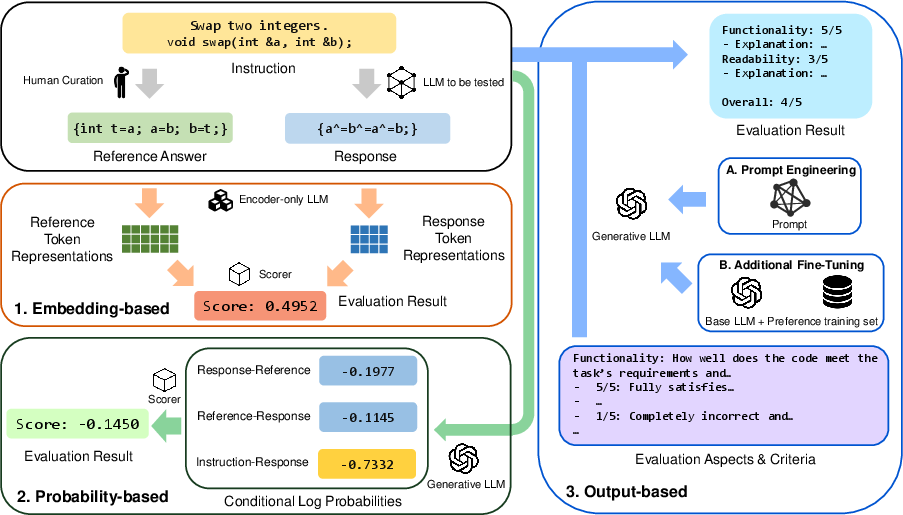
The study selects seven LLM-as-a-Judge methods, utilizing both general-purpose and SE-specific fine-tuned models. The tasks examined include code translation from the CodeTransOcean, code generation from ComplexCodeEval, and code summarization from CodeXGLUE. Each task involves generating responses which are scored both manually and via automated methods. Figure 1

Figure 1: Overview of different LLM-as-a-judge methods.

Evaluation Metrics

For evaluation alignment, metrics such as Pearson correlation coefficients are used to compare LLM-generated scores with human evaluators. The study designs research questions focusing on alignment performance, score distribution characteristics, and the efficacy of pairwise comparison versus individual scoring.

Results

Alignment with Human Evaluators

The study finds that output-based LLM-as-a-Judge models using LLMs like GPT-4o outperform conventional methods, providing high Pearson correlations of up to 79.11% in code translation and somewhat less in code generation with 68.51%. Notably, no substantial superiority is observed in code summarization tasks where conventional methods slightly outperform LLM-based evaluations.

Score Distribution Characteristics

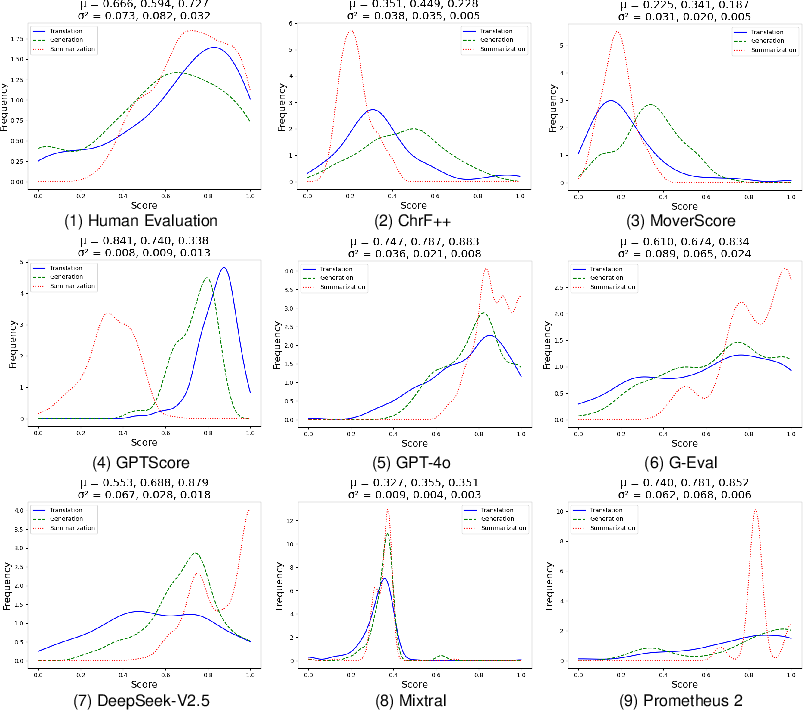
LLM-as-a-Judge methods using large models exhibit score distributions closely resembling human scoring patterns. They manage to cover a more balanced range of scores, unlike embedding-based methods which closely mirror lexical-based similarity metrics like BLEU. Figure 2

Figure 2: Score distributions of selected metrics. μ,σ2\mu,\sigma^2 refer to the means and variances of scores for code translation, code generation, and code summarization. All scores are rescaled into range [0,1][0, 1].

Pairwise Comparison

Methods struggled with pairwise comparisons, often yielding inconsistent results. Despite achieving certain accuracy improvements in translation tasks, these methods displayed low agreement levels when the order of response pairs changed, highlighting current challenges in using LLMs for this specific evaluation strategy.

Discussion

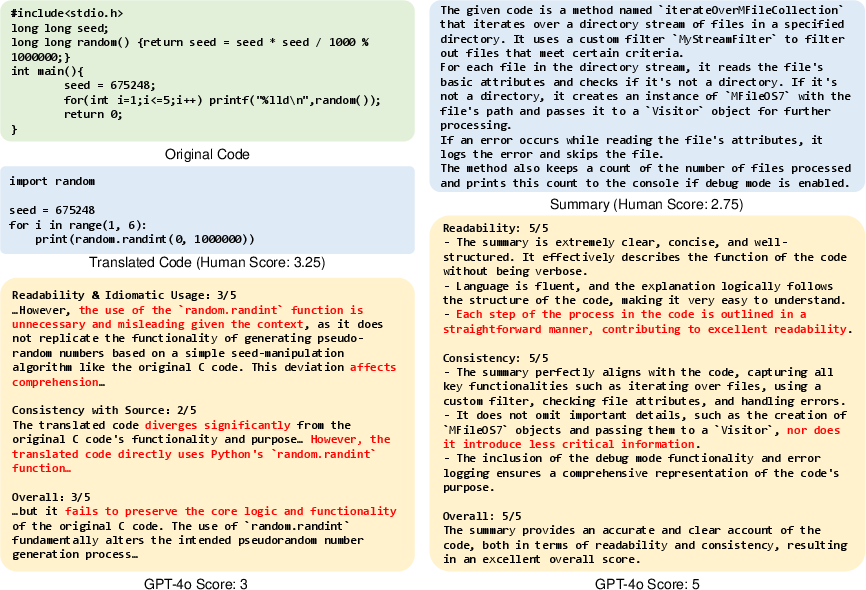
The research indicates that current LLM-as-a-Judge methods can potentially replace human evaluators for certain SE tasks, such as code translation, where high alignment is observed. However, for code summarization, these methods are less effective. This highlights the need for task-specific calibration of LLM evaluators. Additionally, the exploration into different inference strategies such as Chain-of-Thought (CoT) prompting and batch evaluations show minimal gains, suggesting that simple text-output-based methods with advanced LLMs are currently optimal. Figure 3

Figure 3: Case study. The successful case from code translation is on the left while the failing case from code summarization is on the right.

Conclusion

The study concludes that while LLM-as-a-Judge methods offer promising alternatives for evaluating SE tasks like code translation and generation, significant challenges remain, particularly in tasks that require more nuanced evaluation such as summarization. Future research should focus on developing LLMs fine-tuned for SE tasks, bridging gaps in NLP and SE evaluations, and improving evaluation-based inference strategies.

Paper to Video (Beta)

Whiteboard

No one has generated a whiteboard explanation for this paper yet.

Open Problems

We haven't generated a list of open problems mentioned in this paper yet.

Collections

Sign up for free to add this paper to one or more collections.