- The paper introduces CorrTPS, a method that initializes registration using anatomical landmarks to reduce alignment errors.
- It combines deep learning-based correspondence prediction with thin plate spline deformation for faster and more accurate non-rigid registration.
- Results demonstrate improved performance with lower mean distance-to-agreement metrics and significant speed gains over traditional methods.
Introduction
The paper discusses a methodology focused on optimizing non-rigid registration (NRR) procedures crucial for radiotherapy applications. It explores an anatomically-informed correspondence initialization approach to enhance the efficacy of learning-based registration techniques. Registration is aimed at spatially aligning imaging data, which is vital for tasks like treatment planning and evaluation. Traditionally, implementing hybrid registration approaches—which integrate intensity and feature-based metrics—remains labor-intensive. However, the proposed method leverages deep learning (DL) capabilities to address these challenges, offering a substantial computational advantage by facilitating initialization through anatomically-informed landmarks.
Methodology
The authors introduce a two-step NRR process, combining a learning-based approach to predict structures' correspondences with a thin plate spline (TPS) for deformation initialization. This initialization step sets up conditions for enhanced alignment before deploying advanced NRR methods. The registration pipeline employs two distinct architectures: NiftyReg, an iterative B-spline approach, and Voxelmorph, a deep learning unsupervised model. The proposed strategy, termed CorrTPS, demonstrates the alignment process accentuated by anatomical insights.
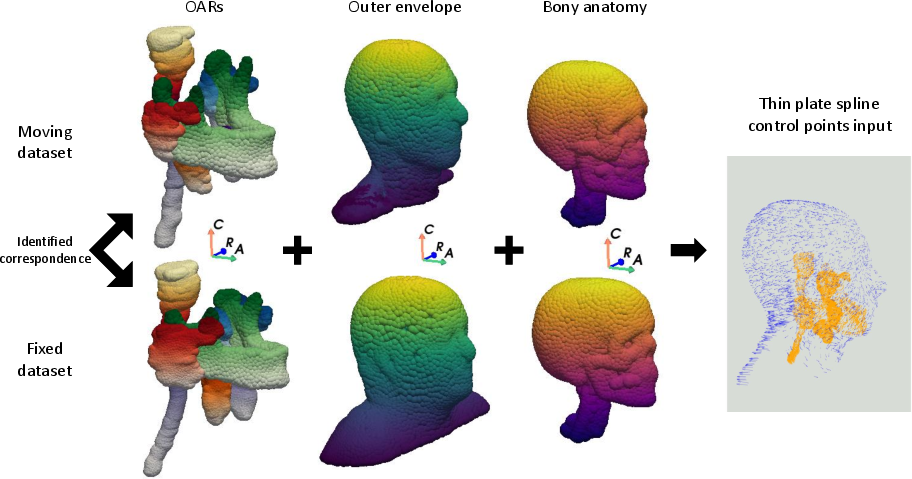
Figure 1: Correspondence of each structure between the fixed and moving datasets, represented by matching colours, serves as the input for the TPS to set up the non-rigid initialization.
For implementation, the study utilized 31 head and neck CT scans, implementing a correspondence model capable of interpreting anatomical structures into deformation models through TPS setup.
Results
Applying the CorrTPS significantly optimized the performance of learning-based registration, notably Voxelmorph, by reducing the mean distance-to-agreement (mDTA) metrics for those structures included within the TPS framework by 1.8 mm and 0.6 mm for those excluded. Execution was notably fast, with Voxelmorph taking 5 seconds compared to NiftyReg’s 72 seconds, signifying a substantial computational efficiency.
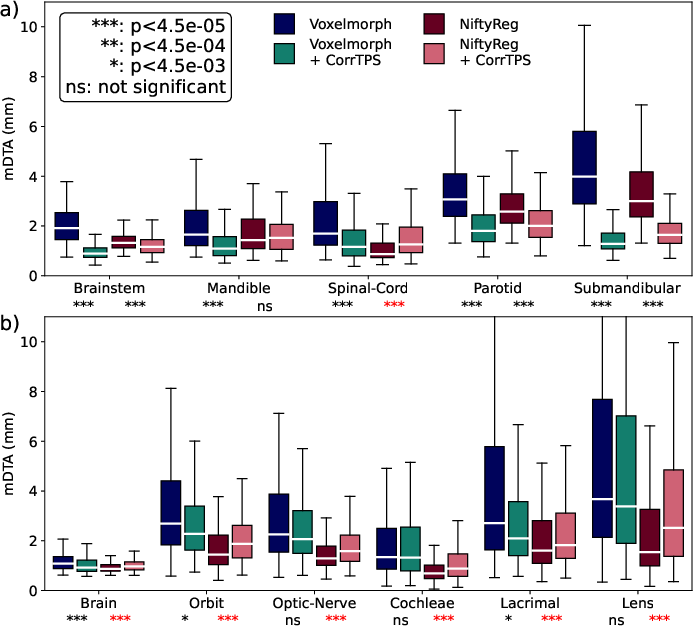
Figure 2: Mean distance-to-agreement results indicating enhanced registration performance when including CorrTPS, with significant deviations showcased via Wilcoxon signed-rank tests.
In comparing methods, CorrTPS paired effectively with Voxelmorph, showing registration improvement without significantly compromising computational speed. Conversely, when integrated with NiftyReg, some structures saw performance improvements, whereas others, excluded from CorrTPS, experienced registration degradation.
Discussion
The deployment of this anatomically-informed initialization suggests a promising trajectory in DL registration tasks, ensuring faster processing with streamlined alignment for intricate anatomical regions. It showcases particular effectiveness in scenarios requiring extensive deformation handling, such as inter-subject CT registration, establishing a precedent to balance between algorithmic speed and precision. The findings emphasize the importance of anatomical structure selection in governing TPS impact, where evenly distributed control points could enhance reliability.
This research indicates potential for broader applicability, including intra-patient registration challenges in complex surgical contexts. It paves the way for integrating auto-segmentation techniques to minimize observer variability, enabling fully automated registration frameworks. Future comparisons with traditional hybrid models could extend the efficacy and robustness of the proposed pipeline.
Conclusion
The anatomically-informed CorrTPS method presents valuable enhancements in DL-based NRR, effectively calibrating performance toward that achieved by traditional methods but with a significant reduction in computation time. This approach is positioned to refine registration techniques further, potentially redefining practices within radiotherapy imaging and beyond.