- The paper introduces ACAI, an innovative AI tool that guides small business owners in creating personalized ad briefs through structured inputs and multimodal interfaces.
- The study demonstrates that using structured inputs reduces cognitive load and enhances brand alignment, significantly improving ad creation for small business owners.
- Design recommendations focus on adaptive interfaces, contextual memory, and bi-directional feedback to refine GenAI outputs and support novice designers.
ACAI for SBOs: AI Co-creation for Advertising and Inspiration for Small Business Owners
The paper introduces ACAI, an AI-powered tool aimed at aiding small business owners (SBOs) in creating advertisements. The system addresses specific challenges SBOs face, such as the lack of design expertise and resources. Through ACAI’s structured inputs, multimodal interaction, and user-centric design, the paper aims to bridge the gap between AI capabilities and user needs.
Introduction and Problem Framing
Small business owners represent a significant segment of the global economy, yet they often lack the expertise and resources to produce impactful advertisements. Current GenAI tools do not adequately cater to the unique branding needs of SBOs because they produce generic output not aligned with individual brand identities. ACAI was developed to address these issues by providing structured inputs that guide novice users through the ad creation process.
ACAI System Design
The ACAI system is designed with a user-friendly interface that organizes branding elements into three panels: branding, audience and goals, and inspiration. This structure aids SBOs in organizing their branding assets systematically, which are then concatenated into a "super prompt" used by the AI to generate an ad brief.
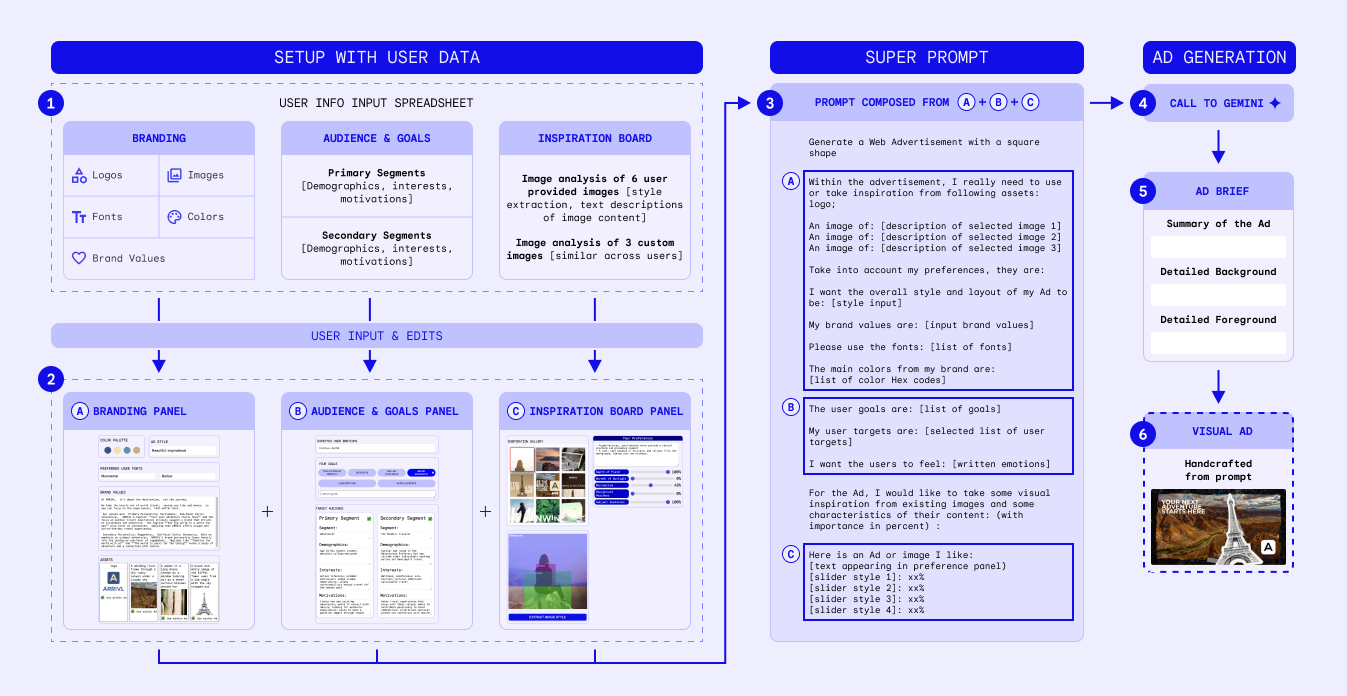
Figure 1: ACAI Prototype Design 1) User input submitted prior to the study 2) Interface design of ACAI incorporating user input and AI content into 3 panels 3) Backend "super prompt" concatenating user input 4) Call to Gemini to generate Ad Brief 5) Ad brief template 6) Visual ad designed by human designer according to Ad brief.
User Study and Evidence
A user study was conducted with 16 small business owners in London. Participants across various business domains interacted with ACAI, revealing preferences for features like inspiration panel functionality and structured input, which enhanced their control and creativity in the ad creation process.
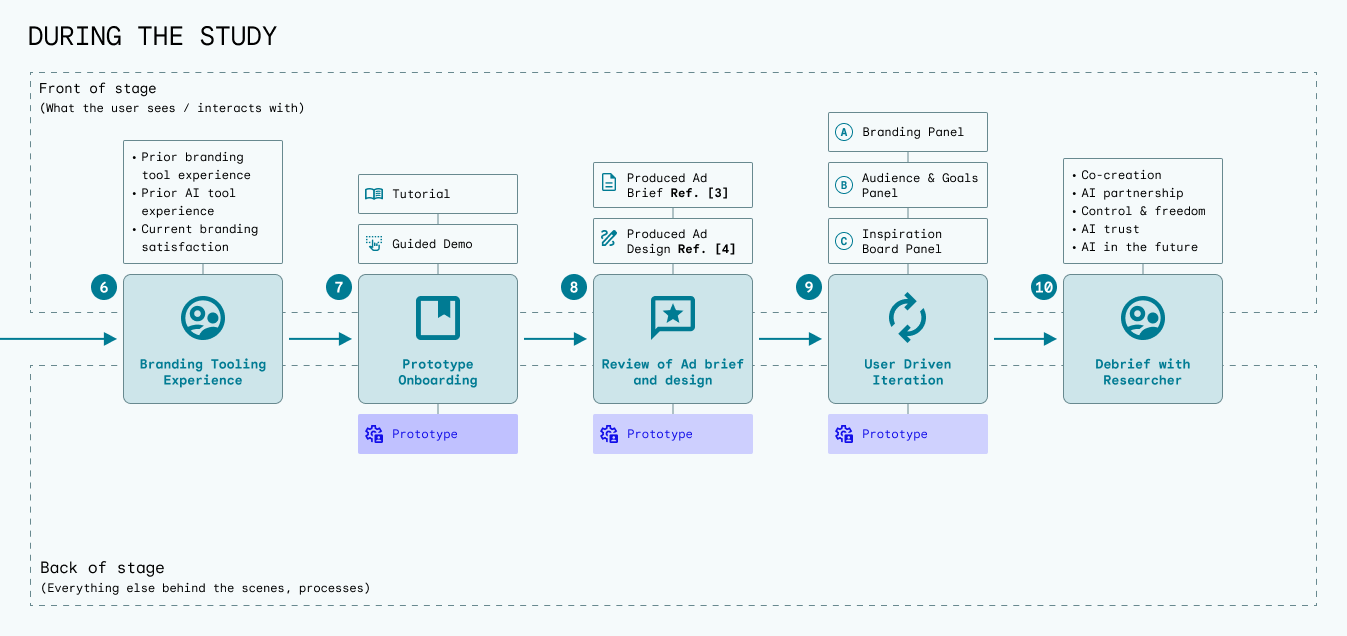
Figure 2: Study Flow Diagram: 6) Interview about using AI for business branding 7) Prototype onboarding 8) Review of Ad brief and Ad design 9) User driven iteration 10) Interview about overall experience and AI co-creation.
Results
The study shows that structured inputs facilitate better AI outputs by reducing cognitive load and improving brand alignment. Participants found ACAI to be an effective tool for producing authentic brand expressions through its guided input system and inspiration board, which leverages visual elements to enhance prompt specificity.
Design Recommendations
Building on the study findings, the paper proposes enhancements to GenAI tools, focusing on contextual intelligence, adaptive interactions, and data management. It suggests mechanisms like contextual memory to retain user preferences over time and adaptive interfaces to support novice designers dynamically.
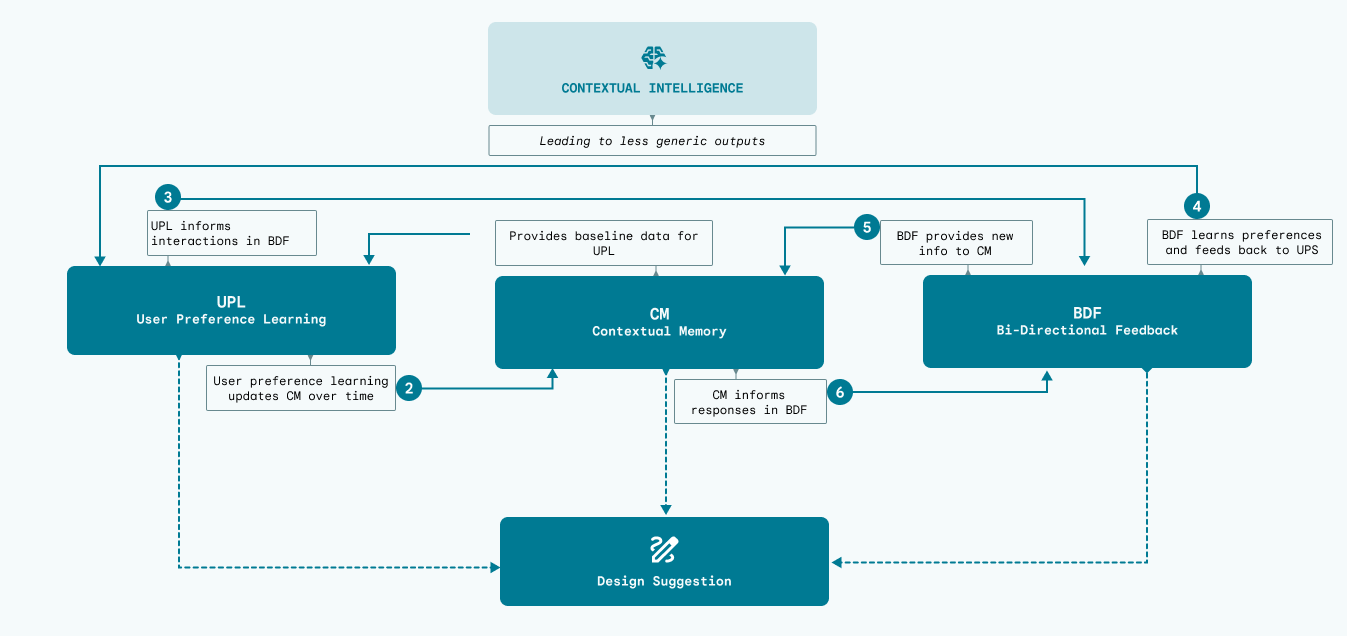
Figure 3: Contextual Intelligence - Design recommendations for less generic output 1) Provide baseline data for user preference learning (UPL) 2) User Preference Learning updates Contextual Memory (CM) over time 3) UPL inform interactions in Bi-Directional Feedback (BDF) 4) BDF learns preferences and feeds back to UPL 5) BDF provides new information to CM 6) CM informs responses in BDF. This operates as a dynamic, cyclical process where each component informs and is informed by the others, creating an adaptive and responsive AI-mediated design process within the framework of Contextual Intelligence.
Conclusion
The research successfully demonstrates the effectiveness of ACAI in assisting SBOs in the advertisement creation process. The structured input and multimodal prompting help bridge the design gap for novice users, making GenAI tools more accessible and aligned with their specific needs. The proposed functionalities aim to foster a more personalized and collaborative experience between AI tools and small business owners.
In summary, ACAI presents a significant step toward effectively integrating AI into the advertising workflows of small business owners, helping them overcome constraints and capitalize on AI's potential for precise and brand-aligned advertisements. Future work might involve further development of AI's contextual memory and its ability to deliver feedback on design outputs in real-time.