- The paper reveals that AI agents with high Openness exhibit significantly higher acceptance of new information compared to their cautious counterparts.
- The paper employs a multi-agent simulation using AgentVerse and GPT-3.5-turbo to analyze discrepancies between agents' public expressions and internal thoughts.
- The paper demonstrates that traits like Extraversion and Conscientiousness influence decision-making, emphasizing the role of social context in shaping behavior.
The Impact of Big Five Personality Traits on AI Agent Decision-Making in Public Spaces: A Social Simulation Study
Introduction
The paper "The Impact of Big Five Personality Traits on AI Agent Decision-Making in Public Spaces: A Social Simulation Study" examines the implications of integrating Big Five personality traits into AI agents' decision-making processes within public spaces. Utilizing the AgentVerse framework and GPT-3.5-turbo, this research simulates interactions among AI agents in a classroom environment to explore how these personality traits affect agents' acceptance of information. The study focuses on revealing the correlations between personality dimensions and decision-making patterns.
Methodology
Experimental Setup and Agent Design
The experimental framework leverages the AgentVerse platform, deploying a multi-agent simulation in a classroom setting to observe interactions and the resultant behaviors (Figure 1). The agents were designed to embody distinct dimensions of the Big Five personality model: Openness, Conscientiousness, Extraversion, Agreeableness, and Neuroticism. For consistency, opposing traits were paired for comparative analysis across the ten-agent collective.

Figure 1: Visualization Interface of AgentVerse Framework: A Classroom-based Multi-agent Simulation Environment.
The study employed a Gradio-based interface for real-time visualization to facilitate observation of agent interactions.
Simulation and Evaluation
Each AI agent was tasked with presenting a piece of misinformation, after which their peers assessed it based on their personality traits. Responses were categorized into publicly expressed opinions ([Speak]) and internal thoughts ([Think]), highlighting any discrepancies between what agents expressed and their internal beliefs.
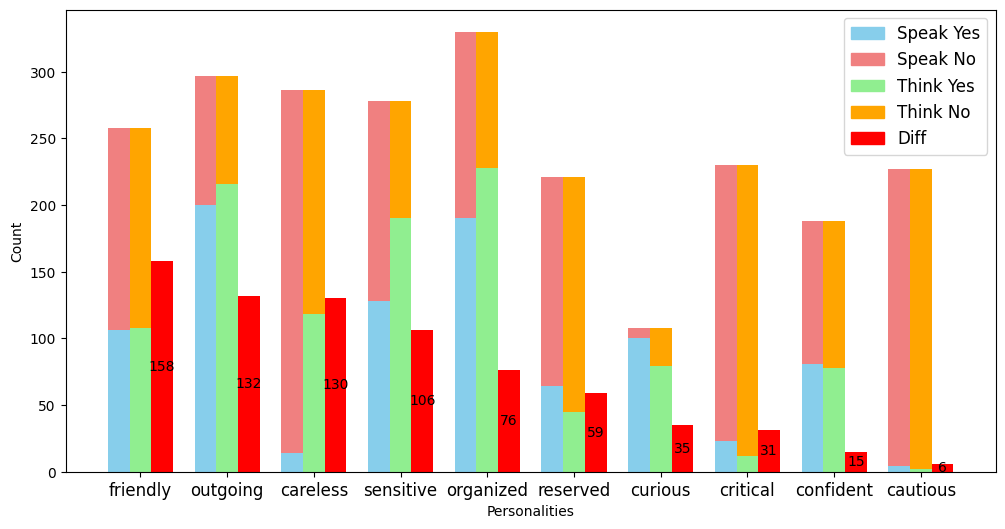
Figure 2: Comparison of Expressed Opinions ([Speak]) and Internal Thoughts ([Think]) Across Ten Personality Types.
Measurement and Analysis
Personality consistency was validated through pre- and post-experiment assessments, employing a five-point Likert scale to measure response stability. Personality influence on decision-making was quantified by analyzing the discrepancy between external expressions and internal cognitions, particularly observing how Openness influenced receptivity to novel information.
Results
Impact of Personality Traits
The results indicate that Openness to Experience significantly impacts information acceptance, with curious agents showing receptivity and cautious agents displaying skepticism. Extraversion and Conscientiousness also influenced decision-making but to a lesser extent. Notably, agents with friendly and extroverted traits exhibited frequent discrepancies between public and private responses, indicating social context's influence on behavior.
Numerical analysis of agent responses revealed that Openness to Experience was the most decisive trait in altering information acceptance patterns, followed by Conscientiousness and Extraversion. Specific characteristics, such as skepticism in cautious agents (97.8% negative responses), contrasted with high acceptance in curious agents (92.6% affirmative responses).
Discussion
The study's empirical findings suggest underlying cognitive and environmental influences on AI agents' decision-making. Agents with high openness were more receptive to new information, reflecting less discrimination in information sources. In contrast, agents characterized by cautiousness and criticality rigorously evaluated information before accepting it.
Additionally, discrepancies between expressed and internal beliefs were prevalent among agents with extroverted and friendly traits, suggesting a heightened sensitivity to social environments and peer influence. These discrepancies imply that while inherent personality traits guide decision-making, the external context plays a significant shaping role.
Conclusion
The integration of Big Five personality traits into AI agents enhances the understanding of decision-making processes within social frameworks. This research delineates how personality influences behavior, offering insights into developing AI systems that are more adaptive to social dynamics. Future work might explore extending these simulations to broader social environments and incorporating more complex behavioral models to refine AI agents' social cognitive capabilities. The findings contribute to ongoing efforts to build nuanced, context-aware AI systems, reinforcing the importance of personality considerations in agent design.