Metric spaces with small rough angles and the rectifiability of rough self-contracting curves
Published 4 Apr 2025 in math.MG | (2504.03362v2)
Abstract: The small rough angle ($\mbox{SRA}$) condition, introduced by Zolotov in arXiv:1804.00234, captures the idea that all angles formed by triples of points in a metric space are small. In the first part of the paper, we develop the theory of metric spaces $(X,d)$ satisfying the $\mbox{SRA}(α)$ condition for some $α<1$. Given a metric space $(X,d)$ and $0<α<1$, the space $(X,dα)$ satisfies the $\mbox{SRA}(2α-1)$ condition. We prove a quantitative converse up to bi-Lipschitz change of the metric. We also consider metric spaces which are $\mbox{SRA}(α)$ free (there exists a uniform upper bound on the cardinality of any $\mbox{SRA}(α)$ subset) or $\mbox{SRA}(α)$ full (there exists an infinite $\mbox{SRA}(α)$ subset). Examples of SRA free spaces include Euclidean spaces, finite-dimensional Alexandrov spaces of non-negative curvature, and Cayley graphs of virtually abelian groups; examples of $\mbox{SRA}$ full spaces include the sub-Riemannian Heisenberg group, Laakso graphs, and Hilbert space. We study the existence or nonexistence of $\mbox{SRA}(ε)$ subsets for $0<ε<2α-1$ in metric spaces $(X,dα)$ for $0<α<1$. In the second part of the paper, we apply the theory of metric spaces with small rough angles to study the rectifiability of roughly self-contracting curves. In the Euclidean setting, this question was studied by Daniilidis, Deville, and the first author using direct geometric methods. We show that in any $\mbox{SRA}(α)$ free metric space $(X,d)$, there exists $λ_0 = λ_0(α)>0$ so that any bounded roughly $λ$-self-contracting curve in $X$, $λ\le λ_0$, is rectifiable. The proof is a generalization and extension of an argument due to Zolotov, who treated the case $λ=0$, i.e., the rectifiability of self-contracting curves in $\mbox{SRA}$ free spaces.
The paper establishes that metric spaces satisfying the SRA(α) condition are bi-Lipschitz equivalent to snowflake spaces, setting sharp geometric thresholds.
A key methodology is demonstrating the interplay between snowflaking and rough angle measurements to derive rectifiability results for roughly self-contracting curves.
The results have significant implications in nonsmooth analysis, offering new insights into embedding theorems and the geometric structure of gradient flow curves.
Metric Spaces with Small Rough Angles and the Rectifiability of Rough Self-Contracting Curves
Introduction and Core Concepts
The paper "Metric spaces with small rough angles and the rectifiability of rough self-contracting curves" (2504.03362) develops a comprehensive framework for understanding metric spaces that exhibit uniformly small "1" among their point triples, formalized through the SRA(α) condition. The paper focuses on two main axes: the structural analysis of the SRA(α) property within general metric spaces, and the application of this structure to questions about the rectifiability of a generalization of self-contracted curves, termed roughly self-contracting curves.
The SRA(α) condition is a parametric strengthening of the triangle inequality: for fixed 0≤α<1, a metric space (X,d) satisfies SRA(α) if for any x,y,z∈X,
d(x,y)≤max{d(x,z)+αd(z,y),αd(x,z)+d(z,y)}.
This provides a geometric interpretation: all comparison angles between triples of points are quantitatively bounded away from π, with α governing the extremality. The case α=0 recovers ultrametricity, while α=1 recovers generic metric spaces.
Snowflaking, Embeddability, and the SRA(α) Condition
One of the central results is the interplay between snowflaking—raising metrics to a power α<1—and the SRA(α) condition. Given any metric space (X,d) and 0<α<1, the snowflaked space (X,dα) satisfies SRA(2α−1), with 2α−1<α. Theorem (Lemma 2.4) demonstrates this is a sharp threshold. Furthermore, the authors establish a quantitative converse up to bi-Lipschitz equivalence: metric spaces satisfying SRA(α) are bi-Lipschitz equivalent to q-snowflake spaces for q depending quantitatively on α.
A significant consequence is a new equivalence (Theorem 2.5): a metric space is bi-Lipschitz to a p-snowflake, p>1, if and only if it is bi-Lipschitz to a metric satisfying SRA(α) for some α<1.
This positioning of SRA(α) spaces within the broader landscape of metric geometry enables the transfer of classic embeddability results. In particular, any doubling SRA(α) metric space (i.e., finite Assouad dimension) admits a bi-Lipschitz embedding into some Euclidean space, generalizing the Assouad embedding theorem.
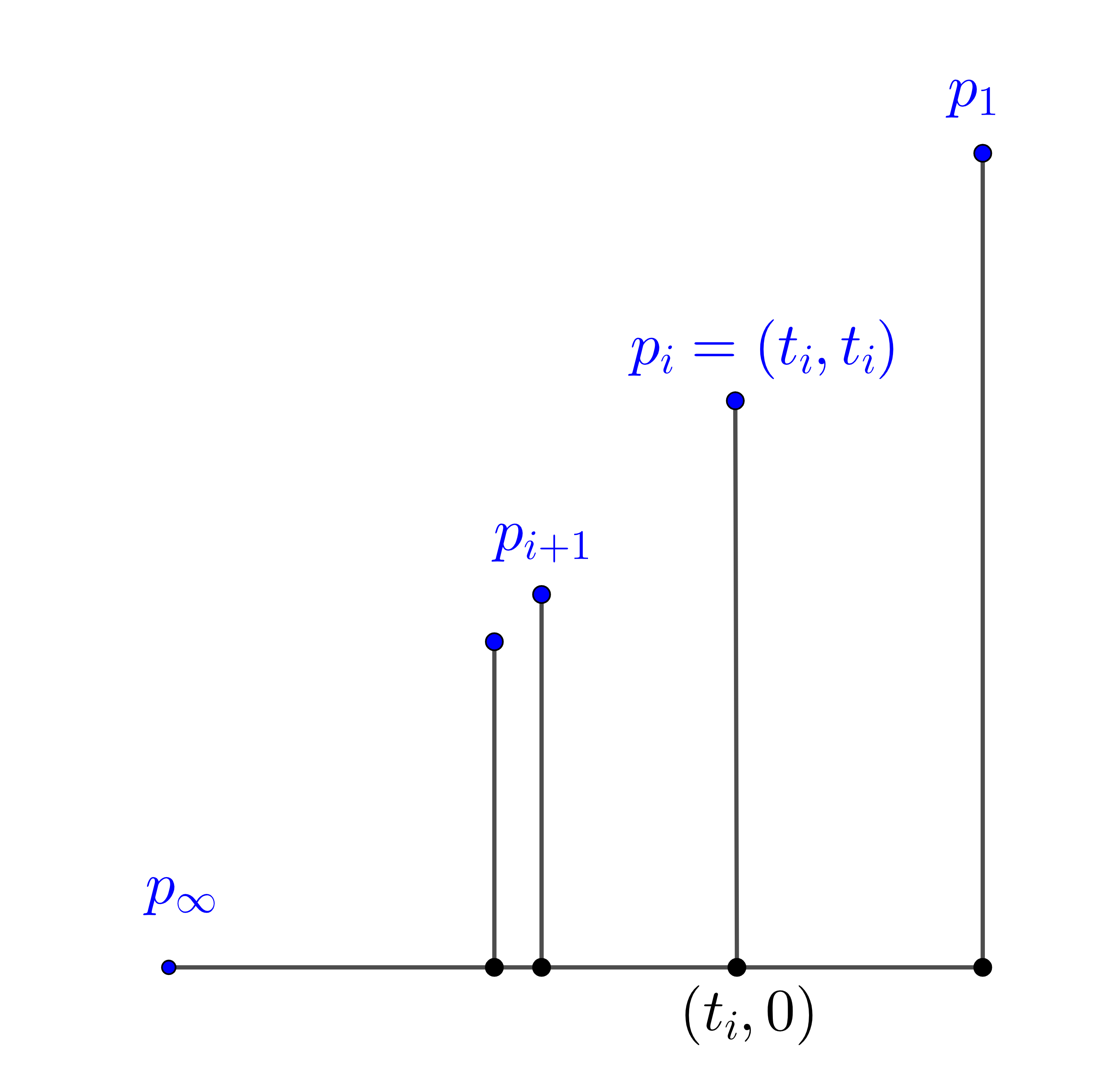
Figure 1: Metric tree Tt, a prototypical example of a space with large ultrametric (SRA(0)) subsets, depending on branching sequence.
Structure Theory: SRA(α)-Free and Full Spaces
The notions of SRA(α)-free and SRA(α)-full spaces partition metric spaces by the maximality (respectively, infinitude) of their SRA(α)-subsets. Euclidean spaces, finite-dimensional Alexandrov spaces of non-negative curvature, and Cayley graphs of virtually abelian groups are SRA(α)-free for any α<1. This is grounded in combinatorial results of Erdős and Füredi, which control the cardinality of equiangular sets in Rn as a function of the minimal upper angle (and thus as a function of α).
On the other hand, spaces with large snowflaked (i.e., "flattened" metric) subsets, such as certain subspaces of the Heisenberg group, Hilbert space, and Laakso graphs, are SRA(α)-full for appropriate α. Infinite regular trees provide canonical examples of ultrametric (and thus SRA(0)-full) spaces.
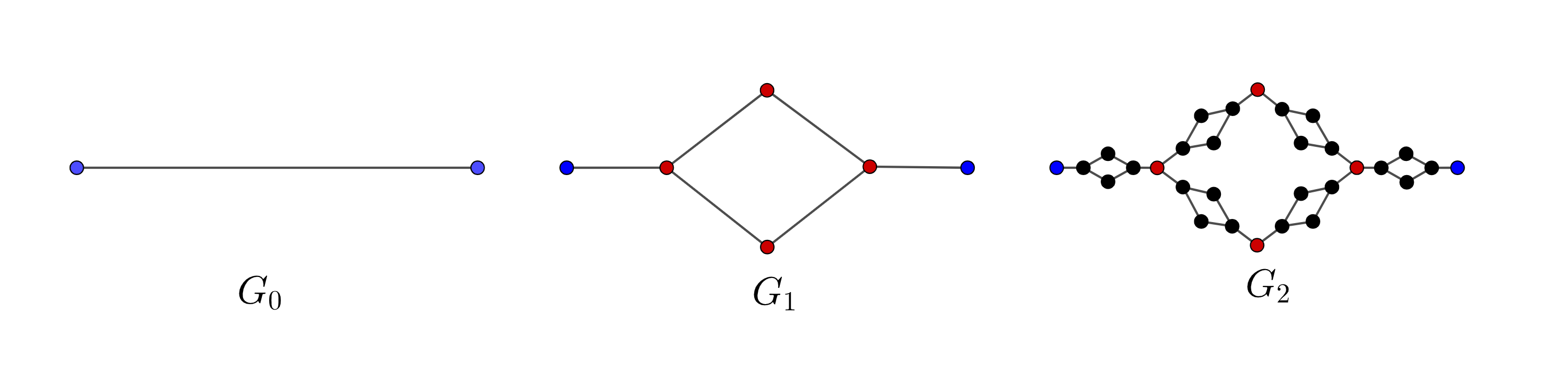
Figure 2: Metric graphs G0,G1,G2 in Laakso graph construction, exemplifying the existence of large ultrametric subsets in complex, non-Euclidean spaces.
A key structural result is that all SRA(α)-free metric spaces are necessarily doubling. However, the converse fails in general since several doubling spaces (e.g., the Heisenberg group) are SRA(α)-full for some α>0.
Sharpness and Subset Structure in Snowflaked Spaces
A novel contribution is the precise analysis of large SRA(β)-subsets present in snowflaked spaces (X,dα) for arbitrary β<2α−1. By explicit construction (Theorem 4.1), the authors show that if (X,d) contains a nontrivial geodesic, then (X,dα) is SRA(β)-full for any 0<β<2α−1, including subsets of positive Hausdorff dimension (e.g., Cantor-type constructions). By contrast, subsets of positive Lebesgue density cannot form large SRA(β)-sets for β<2α−1.
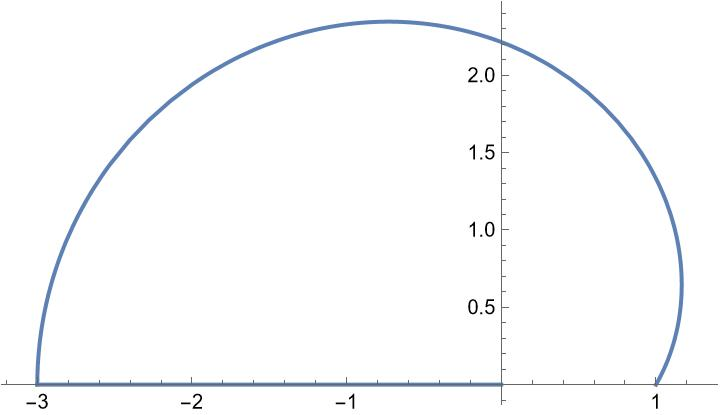
Figure 3: The curve {(x,y):x2+y2=1+λ(x−1)2+y2}∪(a,0]×{0}, illustrating extremal behavior of rough self-contracting curves.
Rectifiability of Roughly Self-Contracting Curves
The second half addresses rectifiability of roughly self-contracting curves, an important question in metric analysis and the study of gradient flows in nonsmooth settings. A curve γ:I→X is rough λ-self-contracting if for t1≤t2≤t3,
For λ=0, this yields the classical self-contracting property, intrinsic to the analysis of convex gradient flows. Larger values interpolate between geodesics (λ=−1) and arbitrary curves (λ=1).
A principal theorem (Theorem 5.2) asserts that in any SRA(α)-free (X,d) with α>1/2, there exists λ0=λ0(α,X)>0 such that every bounded, rough λ-self-contracting curve (λ≤λ0) is rectifiable. The proof generalizes earlier work restricted to the λ=0 case, and proceeds via an intricate induction on the structure of ordered sets combined with Ramsey-theoretic colorings to extract large "bad" configurations unless rectifiability holds.
This result extends the rectifiability criterion from the Euclidean context (previously, for λ<1/n in Rn) to all SRA(α)-free spaces, encompassing a broad class of spaces of interest across geometric analysis and the theory of metric gradient flows.
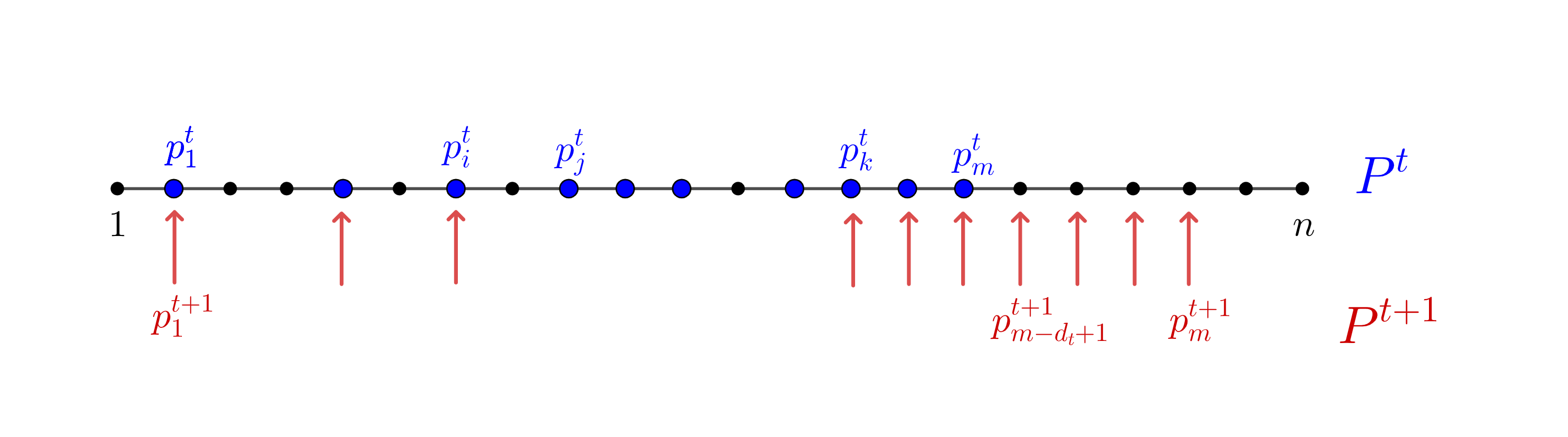
Figure 4: Distribution of elements in Pt and Pt+1, illustrating the combinatorial structure deployed in the induction step of rectifiability proofs.
Implications, Open Questions, and Future Directions
The synthesis of small rough angle conditions, snowflaking, and rectifiability theory provides a robust toolkit with both geometric and analytic implications. Practically, the work implies that the geometric regularity encoded in the SRA(α)-free property suffices to guarantee the regularity of certain evolution curves arising in nonsmooth optimization and geometric flows, even in severely non-Euclidean spaces. Conversely, the presence of unrectifiable self-contracted curves in SRA(α)-full spaces signals essential geometric obstructions.
The authors pose a suite of open questions, targeting:
Sharp thresholds for λ0 in the rectifiability of rough self-contracting curves in general (and in specific) spaces,
The existence (or nonexistence) of self-contracted unrectifiable curves in certain singular metric spaces (e.g., the Laakso graph),
The intricate relationship between snowflaking, doubling, ultrametric structure, and SRA(α)-freeness.
Further lines of inquiry include exploring connections with embeddability theory in Banach spaces, quantitative bounds on bi-Lipschitz distortion vs. α, and expansions to curvature-dimension synthetic frameworks.
Conclusion
This paper offers a unified treatment of the geometric theory of metric spaces with small rough angles, deeply connects this theory to snowflaked metric structures, and yields decisive rectifiability results for broad classes of self-contracted and roughly self-contracted curves. The structural dichotomy between SRA(α)-free and SRA(α)-full spaces not only advances fundamental geometric understanding but also informs applications in convex and metric analysis, the geometry of metric measure spaces, and the study of gradient-like flows in highly non-Euclidean contexts. The technical, combinatorial, and analytic methods developed will likely facilitate further advances in the analytical theory of nonsmooth spaces.