- The paper presents Conditional Pareto Fronts and Sets to incorporate uncertainties into multiobjective optimization using Gaussian Process Regression.
- It employs active learning with acquisition functions such as PEHVI and IEHVI to efficiently approximate Pareto fronts while mitigating computational costs.
- Numerical experiments and a cabin design case study demonstrate the approach's robustness and practical potential in real-world applications.
Multiobjective Optimization Under Uncertainties Using Conditional Pareto Fronts
This paper introduces novel methodologies for tackling multiobjective optimization problems under parametric uncertainties by utilizing Conditional Pareto Sets and Conditional Pareto Fronts. The paper's foundational theme involves enhancing optimization procedures where uncertainties impact the performance of multiobjective decisions.
Introduction and Background
In multiobjective optimization (MOO), objectives are simultaneously optimized, resulting in a Pareto front that represents the best compromises among competing objectives. Traditional methods such as scalarization translate multiobjective problems into mono-objective ones, facilitating optimization but potentially oversimplifying challenges related to stochastic environmental variables. For instance, popular approaches like NSGA-II or CMA-ES often require multiple objective function evaluations, which might be expensive if simulations are costly.
To mitigate computational burdens, this paper leverages Bayesian Optimization, utilizing Gaussian Process Regression to refine function evaluations and approximate optimal decisions iteratively.
Conditional Pareto Fronts and Sets
By considering both control and uncertain environmental variables, each sample state of the environmental variables $u \in U$ results in a deterministic MOO problem. This leads to Conditional Pareto Fronts (CPF) and Conditional Pareto Sets (CPS), which can be used to establish the probability of Pareto set coverage. Calculating this probability requires potentially intensive evaluations, motivating the use of surrogate models.
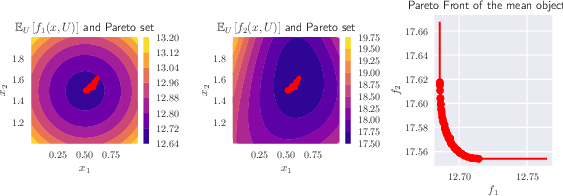
Figure 1: Mean objective multiobjective optimization: the mean of the first and second objective are shown on the leftmost and middle figures. The Pareto front is shown on the rightmost figure.
Active Learning and PEHVI
Active learning using Bayesian Optimization is crucial for efficiently navigating the input space under uncertainties. The paper proposes various acquisition functions such as Profile Expected Hypervolume Improvement (PEHVI), which conditions on the uncertain variable $u$, optimizing the CPF estimation via Gaussian Processes. The Integrated EHVI (IEHVI) averages over environmental variables for better hypervolume improvement assessment.
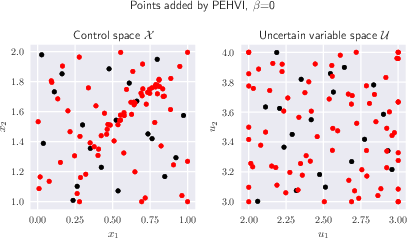
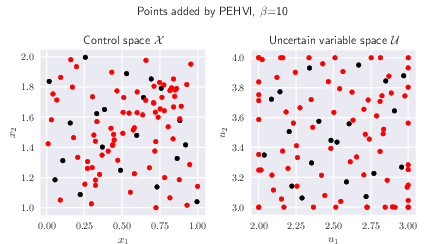
Figure 2: Design of experiment obtained using the PEHVI with beta=0.
Numerical Experiments
The paper presents several numerical experiments demonstrating the efficiency of the proposed methodology. These include analytical toy problems focusing on diverse dimensionalities where performance metrics such as the averaged Hausdorff distance reveal insights into quality approximation of Pareto fronts.
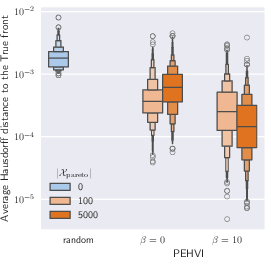
Figure 3: Averaged Hausdorff distance comparing the estimated Pareto front using the GP mean, depending on the hyperparameter beta and the number of points of $\mathcal{X$.
In these experiments, it emerges that variation in hyperparameters like $\beta$ and the chosen candidate input space size can drastically influence efficiency and exploration capabilities. IEHVI shows superiority in approximating CPS, but computational complexity poses challenges.
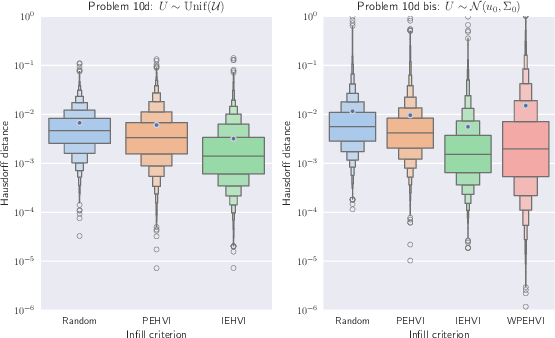
Figure 4: Average Hausdorff distance for the 10d problem, at the end of the computational budget.
Application to Real-World Problems: Cabin Design
The paper extends its methodology to practical applications by optimizing the design of an energy-efficient cabin using EnergyPlus simulations. Here, control variables represent physical attributes, while uncertain environmental conditions affect design preferences. It integrates energy consumption, comfort index, and material cost into three objectives, explaining the choice among designs objectively and under uncertainties.
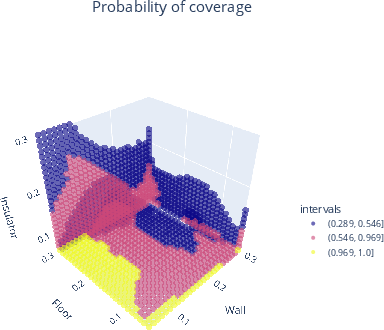
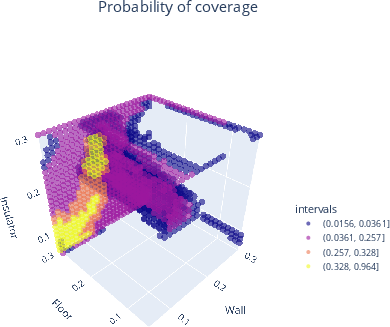
Figure 5: All objectives are considered.
Conclusion
This research establishes Conditional Pareto Fronts as beneficial for understanding multiobjective optimization in uncertain environments. Introducing estimation techniques like PEHVI and IEHVI enhances the robustness and efficiency of optimal decision-making across varied complexities, exhibiting potential applications in industrial settings requiring precise optimization solutions.
Future work may extend to scenarios lacking direct knowledge of uncertainty distributions, employing distributionally robust optimization or ambiguity sets. While IEHVI outperforms alternatives, computational constraints remain a focal area for research and optimization.
This work reflects substantial contributions to both theoretical understanding and practical advancements in multiobjective optimization methodologies.