- The paper presents a novel task and framework, PartStickers, that generates isolated object parts using diffusion models and a fine-tuning strategy on PartImageNet.
- It leverages Low-Rank Adaptation of Stable Diffusion 1.5 to ensure precise, centered placement of parts that accurately match descriptive text prompts.
- Experimental results demonstrate superior performance over state-of-the-art models, achieving improved FID and SSIM metrics for rapid prototyping applications.
PartStickers: Generating Parts of Objects for Rapid Prototyping
Introduction
The paper "PartStickers: Generating Parts of Objects for Rapid Prototyping" focuses on advancing AI-driven design prototyping techniques. The research addresses significant limitations in current generative AI models that hinder the generation of isolated parts of objects from textual prompts. Existing models often produce entire objects or scenes, failing to fulfill the nuanced requirements of rapid prototyping tasks that need specific object parts. This paper introduces a novel task, "part sticker generation," designed to create accurately isolated parts against a neutral background, and proposes the PartStickers framework to effectively tackle this task.
Methodology
The PartStickers framework builds on diffusion models, particularly leveraging advancements in noise-based image synthesis. In this approach, image generation is formulated as an iterative denoising process, starting from noise and gradually refining the image. The core innovation lies in the training pipeline and fine-tuning strategy using PartImageNet, a part segmentation dataset.
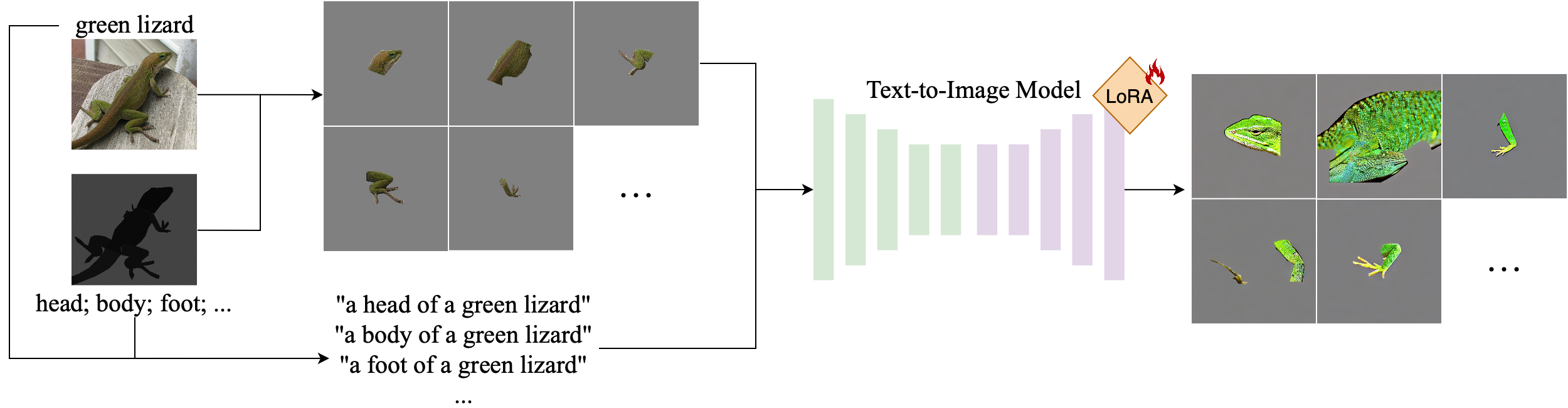
Figure 1: Overview of our proposed PartStickers framework.
PartStickers employs Low-Rank Adaptation (LoRA) to fine-tune a pre-existing model, Stable Diffusion 1.5, focusing on generating parts with text prompts. The key operations involve extracting parts from images, placing them on neutral backgrounds, and associating them with descriptive prompts. Notably, the framework emphasizes a consistent placement (centered parts) to aid in training and inference precision.
Experimental Evaluation
The paper evaluates PartStickers against state-of-the-art models like Stable Diffusion XL, InstanceDiffusion, and GLIGEN. PartStickers showed superior performance in generating high-fidelity, isolated parts, as evidenced by both Fréchet Inception Distance (FID) and Structural Similarity Index Measure (SSIM).
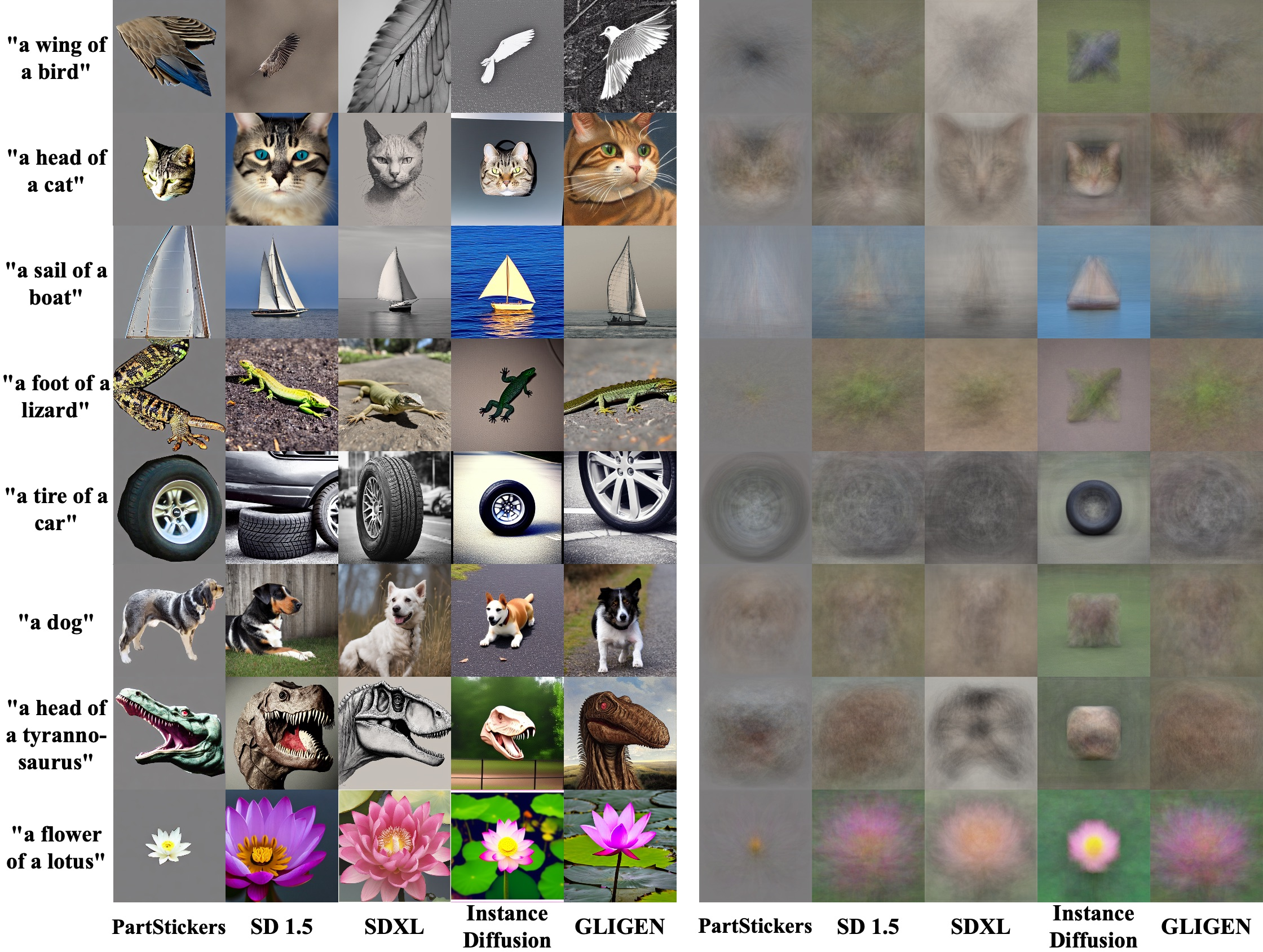
Figure 2: Qualitative results showing examples of generated images given text prompts and the average image of generated samples from a given method.
The PartStickers framework excelled in maintaining fidelity to the text prompts while consistently generating only the intended parts on neutral backgrounds. In contrast, baseline models struggled to isolate parts without generating additional unwanted regions or complex backgrounds.
Discussion
PartStickers presents an effective solution for scenarios requiring specific object parts rather than full scenes. Its capacity to maintain realistic outputs while reducing manual intervention allows for faster design iterations in fields like video game development and product design. The framework's robustness to unseen categories and its ability to generate parts on demand demonstrates potential applicability in diverse domains.
Future work could focus on refining the segmentation quality to enhance edge smoothness further and investigating the integration of compositional strategies for assembling new objects from generated parts.
Conclusion
"PartStickers: Generating Parts of Objects for Rapid Prototyping" delivers a compelling approach to part-level image generation, addressing the nuanced needs of rapid design prototyping workflows. By ensuring the generation of isolated parts with minimal user intervention, PartStickers significantly contributes to the toolkit available for designers and engineers. The framework's ability to produce realistic, domain-specific outputs underscores its potential for adoption across various creative and industrial applications.