Towards Adaptive Self-Normalized Importance Samplers
Published 1 May 2025 in stat.CO | (2505.00372v2)
Abstract: The self-normalized importance sampling (SNIS) estimator is a Monte Carlo estimator widely used to approximate expectations in statistical signal processing and machine learning. The efficiency of SNIS depends on the choice of proposal, but selecting a good proposal is typically unfeasible. In particular, most of the existing adaptive IS (AIS) literature overlooks the optimal SNIS proposal. In this paper, we introduce an AIS framework that uses MCMC to approximate the optimal SNIS proposal within an iterative scheme. This is, to the best of our knowledge, the first AIS framework targeting specifically the SNIS optimal proposal. We find a close connection with adaptive schemes used in ratio importance sampling (RIS), which also brings a new perspective and paves the way for combining techniques from AIS and adaptive RIS. We outline possible extensions, connections with existing MCMC-driven AIS algorithms, theoretical directions, and demonstrate performance in numerical examples.
The paper introduces AN-SNIS, an MCMC-driven scheme that approximates the optimal self-normalized importance sampler to reduce variance in Monte Carlo estimates.
It employs a flexible proposal adaptation that bridges techniques from RIS and AIS, enhancing estimation accuracy without being confined to a restrictive parametric family.
Experimental results in Bayesian regression tasks show significant relative error reductions, demonstrating the method's theoretical and practical advantages.
Authoritative Summary of "Towards Adaptive Self-Normalized Importance Samplers"
Introduction to Self-Normalized Importance Sampling
The paper "Towards Adaptive Self-Normalized Importance Samplers" by Nicola Branchini and Víctor Elvira introduces an innovative approach within the field of Monte Carlo methods to address challenges associated with self-normalized importance sampling (SNIS). SNIS is a well-established technique in statistical signal processing and machine learning for approximating expectations of functions with respect to a target distribution, especially when the normalizing constant of the distribution is unknown. Selecting an optimal proposal distribution is crucial for the efficiency of SNIS; however, this selection is typically infeasible with most existing methods. The paper proposes a novel framework aimed at approximating the optimal SNIS proposal through Markov chain Monte Carlo (MCMC) techniques, a significant departure from conventional adaptive importance sampling (AIS) methods that often overlook SNIS-specific optimizations.
Proposal and Methodology
The paper introduces the adaptive nested self-normalized importance sampler (AN-SNIS). Unlike most adaptive schemes that adhere to a restrictive parametric family for proposals, AN-SNIS allows for flexibility in proposal distribution selection, targeting the elusive optimal SNIS proposal through iterative refinement using MCMC chains. This approach effectively bridges techniques from ratio IS (RIS) while also paving the way for integration with existing MCMC-driven AIS algorithms. The convergence properties and potential extensions of this framework mark a significant theoretical contribution, as it promises to alleviate some of the complexities and computation burdens traditionally associated with SNIS schemes.
*Figure 1: In this example, $q_{\text{SNIS}^{\bigstar}$ is clearly different from both the optimal UIS proposal ∝π(x)∣φ(x)∣ and π(x). *
Theoretical Insights and Connections
The work demonstrates a profound understanding of the theoretical underpinnings of importance sampling methodologies. It reveals the inherent connection between AN-SNIS and RIS, specifically targeting the variance reduction capabilities of RIS through formulation adjustments. Moreover, it acknowledges the potential implementation advancements relating to bridge sampling and other MCMC-driven adaptivity paradigms such as LAIS. These connections allow AN-SNIS to capitalize on established knowledge about asymptotic variance minimization in SNIS estimators and integrate diverse algorithmic structures inherently linked with the improvements attempted within the importance sampling literature.
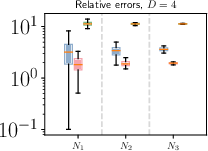
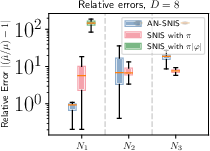
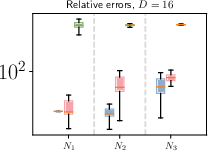
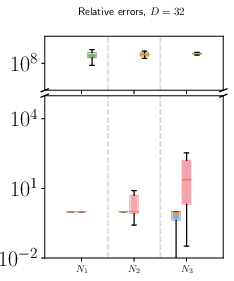
*Figure 2: Relative error of AN-SNIS compared to SNIS with proposals proportional to π∣φ∣ and π. As $q_{\text{SNIS}^{\bigstar}$, differs from both π∣φ∣ and π, we achieve significantly lower relative error, ∣μ/μ−1∣. *
Experimental Validation
The efficacy of AN-SNIS was verified through numerical experiments, particularly focusing on Bayesian linear regression tasks. These experiments underscore the practical advantage of AN-SNIS in stark contrast to traditional SNIS methods, even when the optimal SNIS proposal diverges significantly from distributions like π or π∣φ∣. The results demonstrated substantial improvements in terms of relative error reduction, validating the premise that AN-SNIS's flexible targeting can yield superior estimation accuracy through better-tailored proposal distributions.
Figure 3: Relative error comparison across different dimensions (D=4,8,16,32), results over 50 replications.
Conclusion
Towards Adaptive Self-Normalized Importance Samplers significantly enriches the discourse on AIS with its focus on SNIS-specific optimizations using MCMC. The framework not only brings theoretical novelty by converging ideas from RIS but also offers practical insights that promise advancements in both Bayesian computation and broader Monte Carlo methodologies. Future research suggested by the paper includes exploring resampling, tempering, and more complex AIS architectures to further exploit the advantageous properties of an optimal SNIS proposal and its impact on computational efficiency.
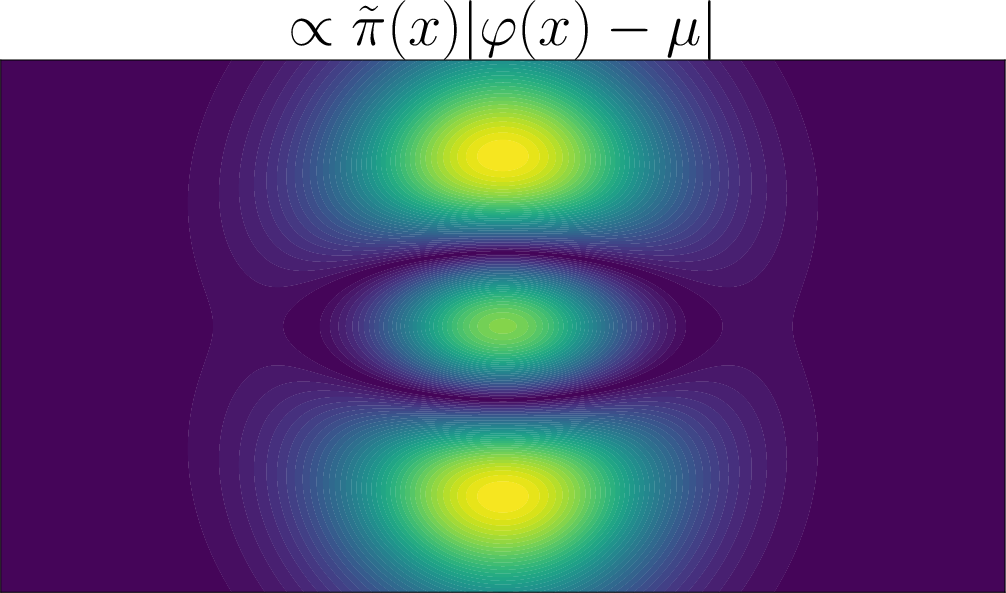
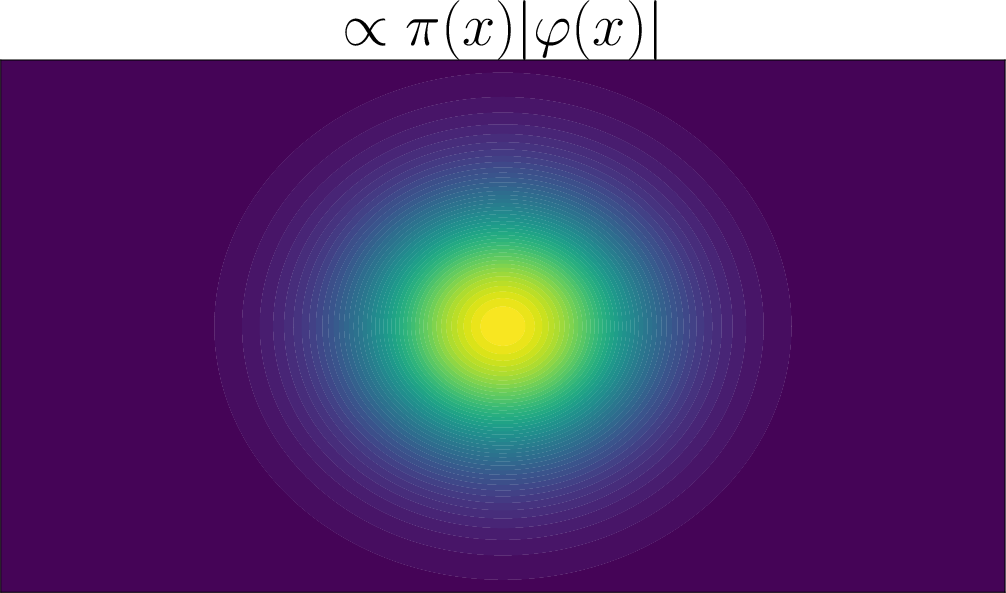
 *Figure 1: In this example, $q_{\text{SNIS}^{\bigstar}$ is clearly different from both the optimal UIS proposal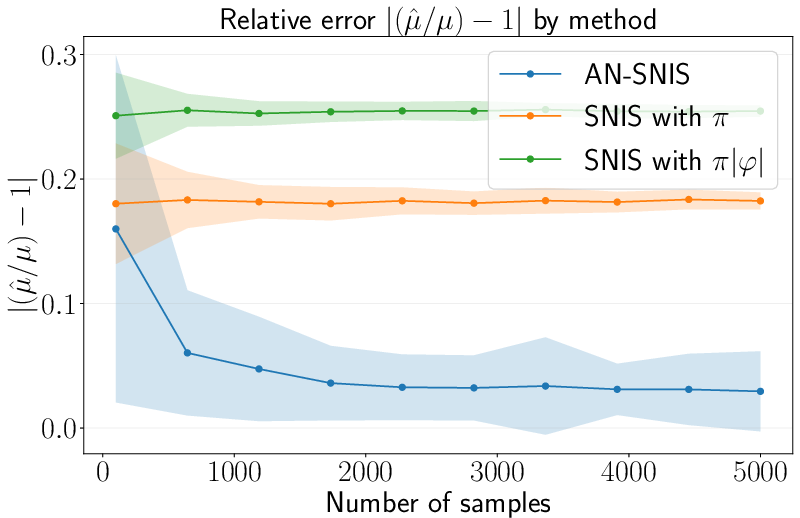
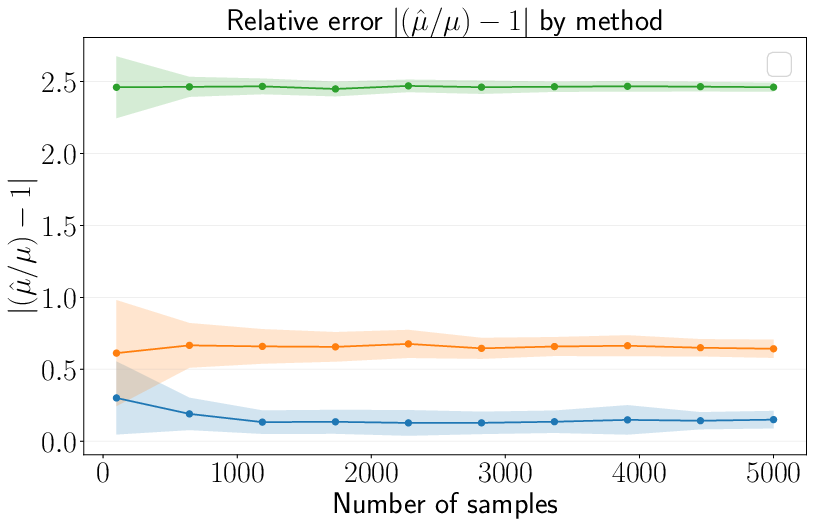 *Figure 2: Relative error of AN-SNIS compared to SNIS with proposals proportional to