- The paper introduces a novel trainable quantum feature mapping that optimizes QSVM performance in noisy intermediate-scale quantum environments.
- It leverages parameterized quantum circuits to encode classical data into high-dimensional Hilbert spaces, enhancing multi-class discrimination.
- Numerical simulations, including tests on the IRIS dataset, demonstrate improved clustering, accuracy, and robustness over classical methods.
Quantum Classifiers with Trainable Kernel
Introduction
The paper "Quantum Classifiers with Trainable Kernel" proposes a novel approach to improve quantum classifiers by introducing a trainable quantum feature mapping (TQFM) to enhance classification performance. The research focuses on developing a more efficient and accurate quantum support vector machine (QSVM) framework that utilizes quantum feature maps to better encode classical data into a higher-dimensional Hilbert space. The paper introduces the TQFM architecture, analyzes error sources, and proposes a quantum iterative multi-classifier framework that enhances support vector classification performance in noisy intermediate-scale quantum (NISQ) computers.
Trainable Quantum Feature Mapping (TQFM)
The TQFM is a mechanism for encoding classical data into quantum states that allows for fine-tuning based on a set of parameters θ. This is achieved through a parameterized quantum circuit (PQC) U(x,θ), which performs a series of Pauli rotations and entanglement gates on the input data.
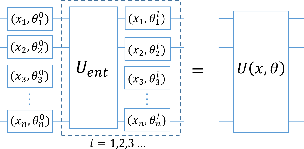
Figure 1: (a) Circuits representation of U(x,θ). The single qubit gates (x,θ) are Pauli rotations. Uent are entangled quantum gates.
The objective is to optimize a loss function to improve the clustering of data, aligning samples of the same class and distinguishing different classes more precisely. The training process leverages a novel protocol to optimize the loss function with reduced qubits and a tractable number of measurements. The layouts and loss functions are formulated to exploit both explicit (direct measurement) and implicit (kernel-based) approaches.
Quantum Support Vector Machine (SV-QSVM)
Classical SVMs are unsuitable for large-scale quantum data due to inherent computational limits. This paper addresses these challenges by developing a support vector-based quantum support vector machine (SV-QSVM). It combines the benefits of quantum superposition and classical optimization techniques to achieve efficient data classification.
The SV-QSVM introduces modifications in the dual optimization process to frame the optimization as a variational problem. It utilizes random sampling for efficient Hamiltonian decomposition, which allows approximate solutions to be derived within practical limits, leveraging NISQ capabilities.
Quantum Iterative Multi-Classifier
The paper also proposes methods for multi-classification using quantum iterative methods. Often, binary classifiers such as QSVMs are generalized to multi-class problems using one-versus-one or one-versus-rest strategies. The researchers employ quantum search algorithms for amplifying the target classification results, facilitating a more efficient retrieval of the maximum classification likelihood among potential labels.
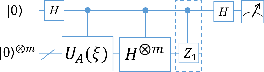
Figure 2: Hadamard test for calculating ∥∣α⟩∥1(without C-Z gate) and l(α)(with C-Z gate).
The quantum iterative approach applies Grover’s search algorithm to iteratively increase the probability of reading out the largest classification amplitude, effectively distinguishing between multiple classes with a minimal number of operations. This is shown to significantly improve classification robustness and reduce error rates, particularly in the presence of overlapping quantum states from different classes.
Numerical Validation and Results
Simulation experiments were performed using the qiskit package to validate the theoretical developments. Evaluations on datasets, such as the IRIS dataset, exhibited superior performance in clustering and classification accuracy when leveraging the TQFM approach over classical and other quantum classifiers. Particularly, the explicit and ensemble models demonstrated improved accuracy and robustness in classifying non-linearly separable data.
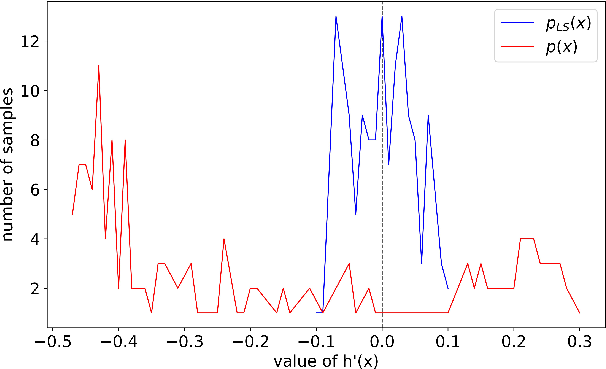
Figure 3: Sample density distribution where the function value is rounded to two decimal places. Values greater than 0 are positive, while values less than 0 are negative.
Conclusion
The study introduces a quantum classification framework with distinct advantages in performance, potentially paving the way for effective quantum solutions for large-scale data problems. Trainable quantum kernel strategies offer adaptable and efficient classification models that can accommodate the complexities of current machine learning challenges. Future research could explore further optimization techniques for parameterized circuits, potentially overcoming the constraints imposed by existing quantum hardware limitations.