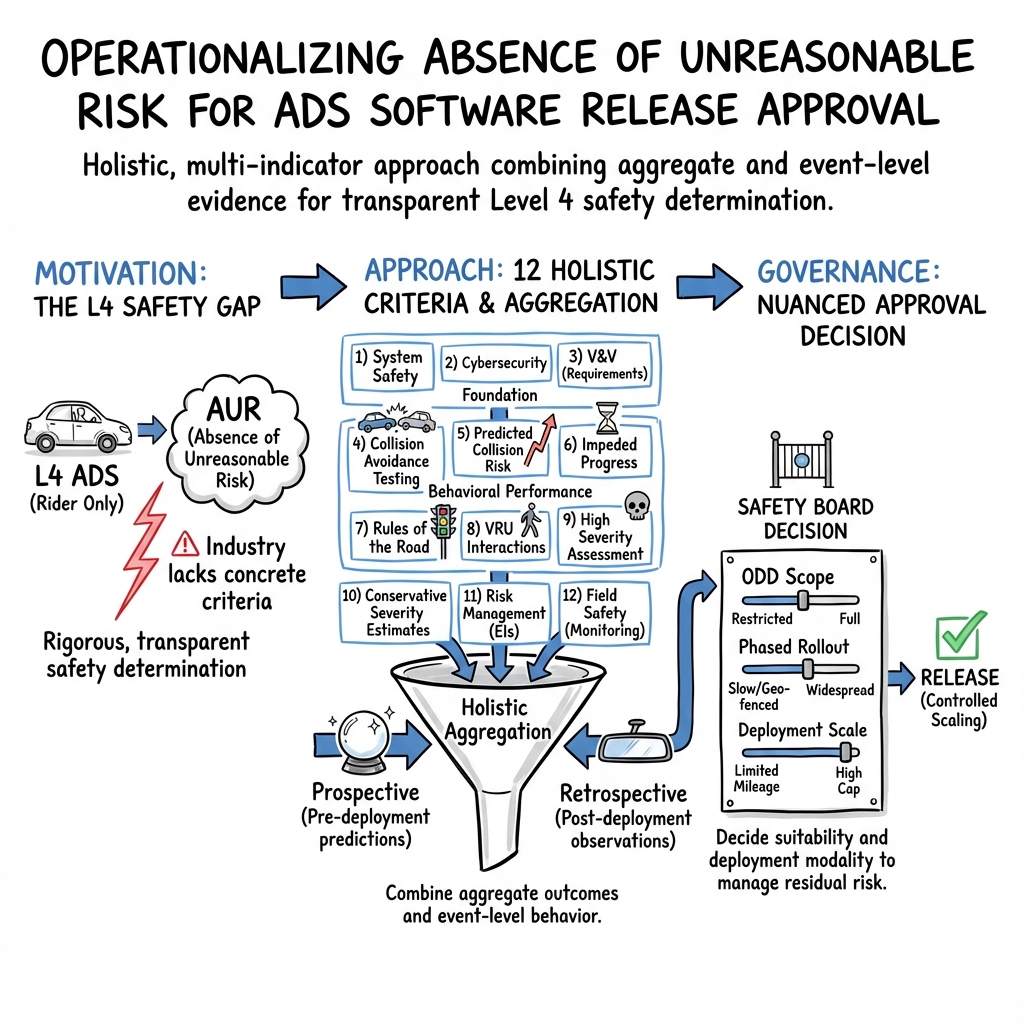
- The paper presents 12 rigorous criteria for determining absence of unreasonable risk in automated driving system deployments.
- It integrates multidisciplinary assessments including system safety, cybersecurity, verification and collision avoidance testing.
- The proposed framework lays the groundwork for standardized regulatory practices and continuous on-road performance monitoring.
Determining Absence of Unreasonable Risk: Approval Guidelines for an Automated Driving System Deployment
Introduction and Purpose of the Study
The determination of absence of unreasonable risk (AUR) is integral to the deployment and readiness assessment of Automated Driving Systems (ADS). This paper outlines a methodological framework for assessing the readiness of ADS, focusing on safety assurance, process rigor, and performance evaluation. The criteria proposed are designed to support systematic approval processes, particularly in the context of "Rider Only" operations, where no user is in charge, emphasizing the need for comprehensive safety measures.
Methodology and Criteria for Readiness Determination
This publication introduces twelve detailed methodological criteria that form the backbone of Waymo's readiness review for ADS software release candidates. These criteria range across diverse domains such as system safety, cybersecurity, verification and validation, collision avoidance testing, predicted collision risk, and field safety. Each criterion is intended to contribute to a holistic assessment of AUR, ensuring that both aggregate safety outcomes and individual event performances meet rigorous standards. Crucially, these criteria are formulated to be technology-agnostic, allowing broad implementation across different architectural designs within the industry.
Governance and Decision-Making
A structured governance framework supports the readiness determination, emphasizing systematic safety management practices. The decision-making process is nuanced, involving a multistep evaluation that considers the deployment scale, geographic distribution, and rollout phasing. The Safety Board, supported by a cross-functional steering committee, oversees the approval processes, ensuring that residual risk remains within acceptable limits while aligning with pre-specified targets. This framework prioritizes the integration of diverse insights from methodology owners and field safety teams, supplemented by continuous on-road performance monitoring.
Implications and Future Directions
The implications of this work are twofold: it provides a robust methodology for current ADS deployment decisions and sets the groundwork for future standardization in the absence of unreasonable risk determination. By offering technology-independent criteria, this paper paves the way for industry-wide adoption and informs future regulatory frameworks that will govern ADS technologies. Ongoing refinement of evaluation methodologies and acceptance criteria is essential, given the dynamic evolution of ADS capabilities and their operational contexts.
Limitations and Conclusions
While presenting comprehensive criteria for readiness evaluation, this study acknowledges the necessity for robust processes, resources, and tools that complement the operationalization of AUR. These criteria are not intended as exhaustive or static; they require continuous adaptation based on empirical insights and technological advancements.
This paper adds a vital piece to the broader discourse on ADS safety standards, contributing practical guidelines to ensure safe, reliable deployment on public roads. As the industry evolves, collaboration between developers, regulators, and other stakeholders will be crucial in achieving the transformative potential of automated driving technology while safeguarding public welfare.