- The paper presents a comprehensive review of AI-driven generative models (VAE, GAN, diffusion) for novel material design.
- It details diverse representations for crystal structures, including geometric graphs, textual formats, and diffraction patterns.
- The study highlights challenges such as synthesis constraints and cross-scale modeling, urging integration of physics and deep learning.
Materials Generation in the Era of Artificial Intelligence: A Comprehensive Survey
This paper provides an extensive survey on AI-driven materials generation, exploring recent advancements, methodologies, and potential future directions in the field. The primary focus is on how AI, particularly generative models, is revolutionizing the discovery and design of materials with tailored properties to address various technological challenges.
Types and Representations of Materials
Materials are typically categorized based on their bonding types, such as ionic, metallic, covalent, and molecular bonds, and can include both ordered crystalline solids and non-periodic systems like amorphous materials and quasicrystals. AI research primarily targets crystalline solids, employing various representations to facilitate machine learning models.
One key aspect discussed is the representation of crystal structures in machine learning models. Geometric graphs, textual data formats like Crystallographic Information File (CIF), SLICES strings, and diffraction patterns serve as different modalities to capture crystal information.
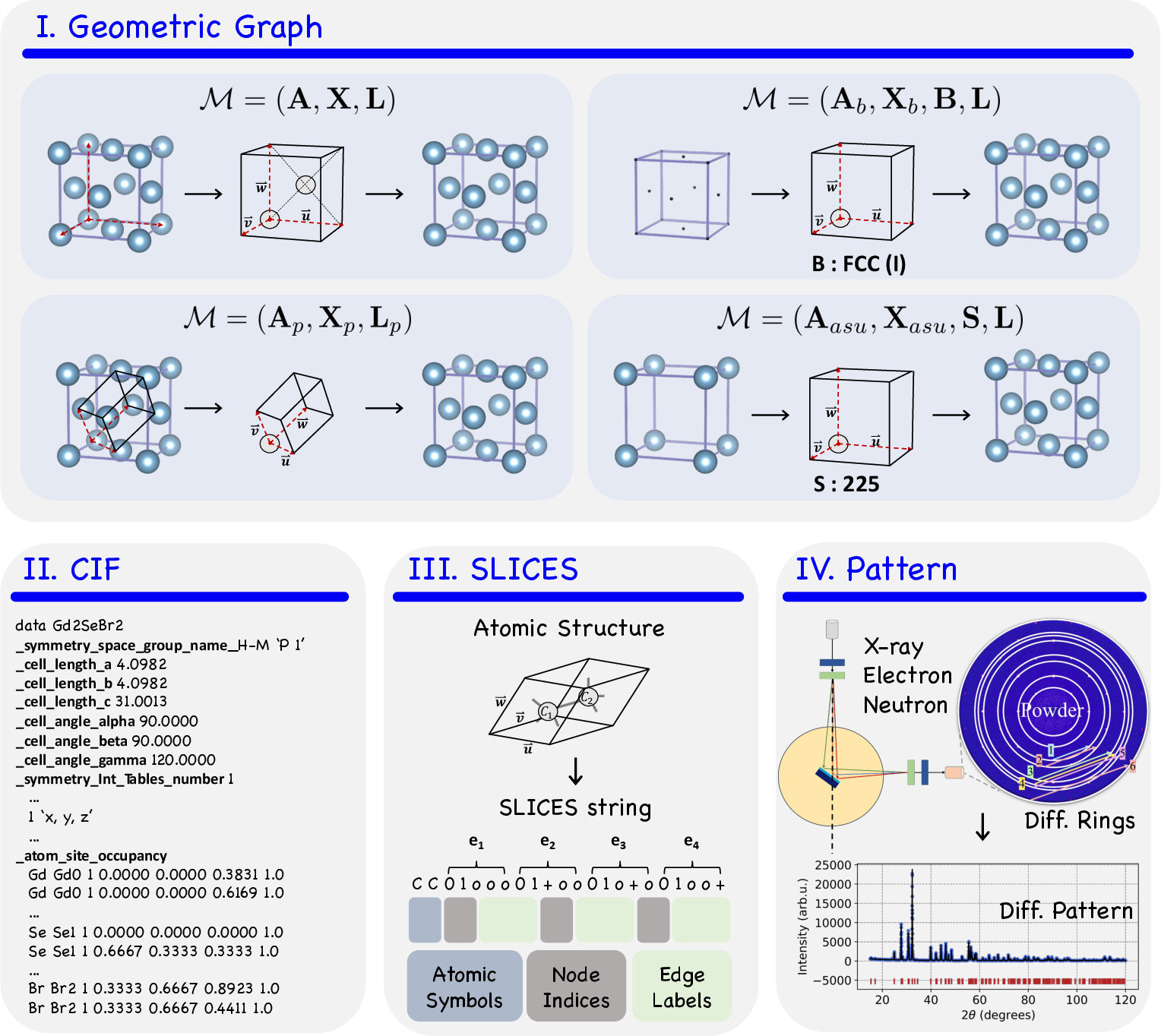
Figure 1: Universal crystal structure representation using geometric graphs, textual data, SLICES string, and diffraction patterns.
Generative Models for Materials
The paper categorizes materials generation models into various types, including VAE-based, GAN-based, and diffusion-based models, each contributing uniquely to the domain:
- VAE-based Models: Variational Autoencoders (VAEs) are leveraged for their ability to explore the latent space of materials, facilitating inverse design. Models like iMatGen and Cond-DFC-VAE use VAEs to construct structural representations and predict properties of inorganic crystals.
- GAN-based Models: Generative Adversarial Networks (GANs) are employed to synthesize diverse crystal structures, from simple cubic forms to complex zeolites. Approaches like GANCSP and CubicGAN incorporate physics-based principles to guide the generation process.
- Diffusion-based Models: Diffusion models, including Crystal Diffusion Variational Autoencoder (CDVAE) and its variants, utilize score matching and Langevin dynamics to generate periodic materials by learning from the noise processes inherent in crystal structures.
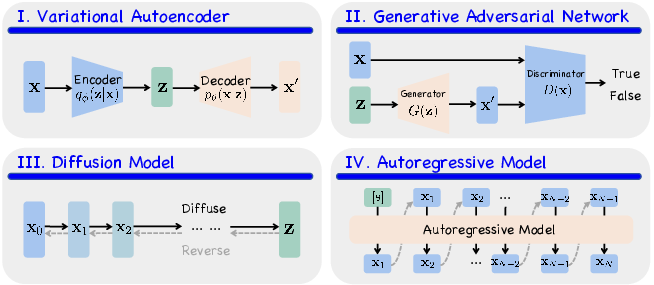
Figure 2: A schematic diagram of mainstream generative model frameworks in material generation.
Backbone Architectures
The architecture of models plays a vital role in efficiently handling the representative data forms. The paper describes three main types of neural network architectures used as backbones for generative models in materials science:
- Convolutional Neural Networks (CNNs): Suitable for grid-based tensor representations, although they lack flexibility in capturing detailed geometric information.
- Graph Neural Networks (GNNs): Ideal for structures represented as graphs, naturally preserving permutation invariance and local atomic environments. They have become the primary tool for modeling crystalline materials.
- Transformers: Recently adapted for materials generation, renowned for their capability to model sequential data, enabling the application to serialized crystallographic data.
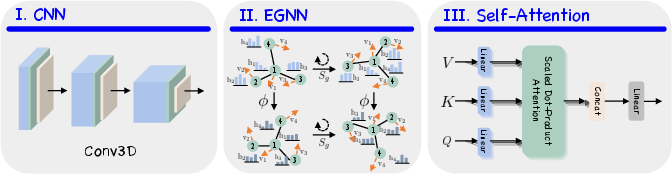
Figure 3: A general illustration of model backbones: CNN, GNN, and Transformers.
Challenges and Future Directions
Despite remarkable progress, AI-driven materials design still faces key challenges:
- Doping and Defect Structures: Effectively capturing these complexities within AI models remains a challenge due to disrupted material periodicity and the introduction of local structural variations.
- Synthesizability and Validation: Most generative frameworks do not directly account for the practical constraints of material synthesis, requiring enhanced integration with domain-specific knowledge.
- Cross-Scale Modeling: Bridging scales from quantum mechanics to macroscale properties is critical for comprehensive materials modeling.
- Integration with Domain Knowledge: Combining deep learning with traditional physics and chemistry principles is necessary to improve model interpretability and generative accuracy.
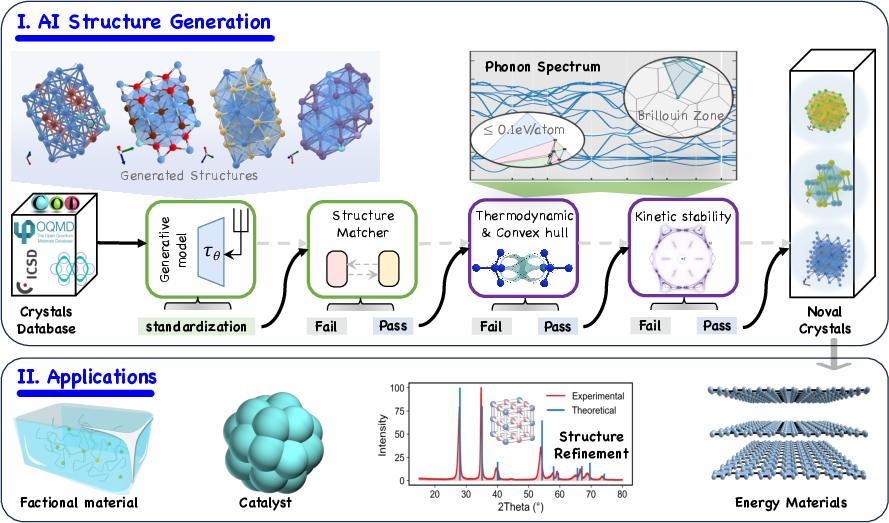
Figure 4: A theoretically novel crystal structure should be standardized, unique, and pass both thermodynamic and kinetic stability tests.
Conclusion
The survey concludes by emphasizing the transformative potential of AI in materials generation, while also pointing out that fully realizing this potential requires overcoming existing challenges by further integrating interdisciplinary insights and advancing computational techniques. The future of AI-driven material discovery will likely focus on refining models to handle the complexity and scale of real-world applications, driving innovations in experimental validation and practical deployment strategies.