- The paper presents the RAZOR model, a novel machine learning framework that integrates electric field responses to predict potential energy changes and atomic forces at electrified interfaces.
- It employs local descriptors and Born effective charges to extend MLIP architectures, successfully capturing bias-induced transformations in OH adsorption on Cu(100) surfaces.
- The findings, which quantitatively align with ab initio thermodynamics, underline the model’s potential to advance simulation techniques in electrochemistry and catalysis.
Machine Learning the Energetics of Electrified Solid/Liquid Interfaces
This paper presents a novel machine learning framework aimed at improving the modeling of energetics in electrified solid/liquid interfaces. This work introduces the "Response Analysis in z-ORientation" (RAZOR) model, which focuses on capturing the electronic response to bias charges in interfacial environments.
RAZOR Model Framework
The RAZOR model extends conventional machine learning interatomic potentials (MLIPs) by incorporating the response to electric fields. The model treats the influence of electric fields at electrified interfaces as perturbations, allowing for the efficient evaluation of potential energy changes and atomic forces.
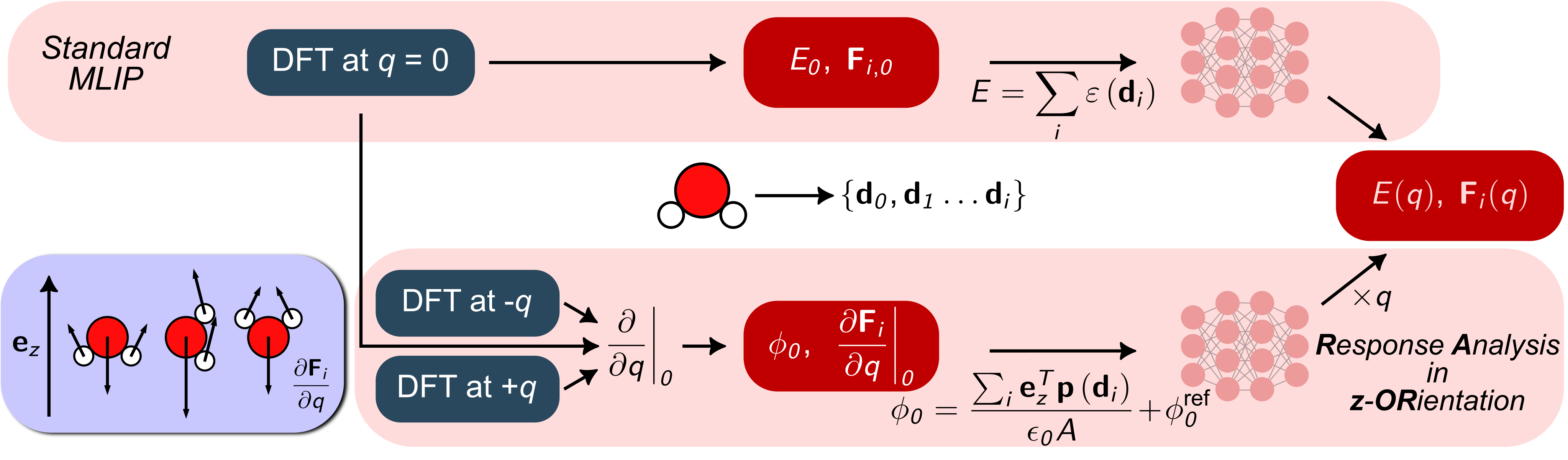
Figure 1: Schematic workflow showing how combining the "Response Analysis in z-ORientation" (RAZOR) approach with a standard MLIP provides the energy Eα and atomic forces Fi of an interfacial configuration α at excess bias charge q.
Within the RAZOR framework, local descriptors are employed to learn the first-order energy change due to bias charges, while Born effective charges stabilize the prediction of these properties. This approach allows MLIP architectures to naturally extend to finite bias conditions up to second-order, providing a robust surrogate for first-principal computations.
Application to Cu(100) Surface
The application of RAZOR to OH adsorption on Cu(100) surfaces demonstrates its effectiveness. The method successfully captures non-Nernstian behavior and potential-dependent site switching at the atomic level.
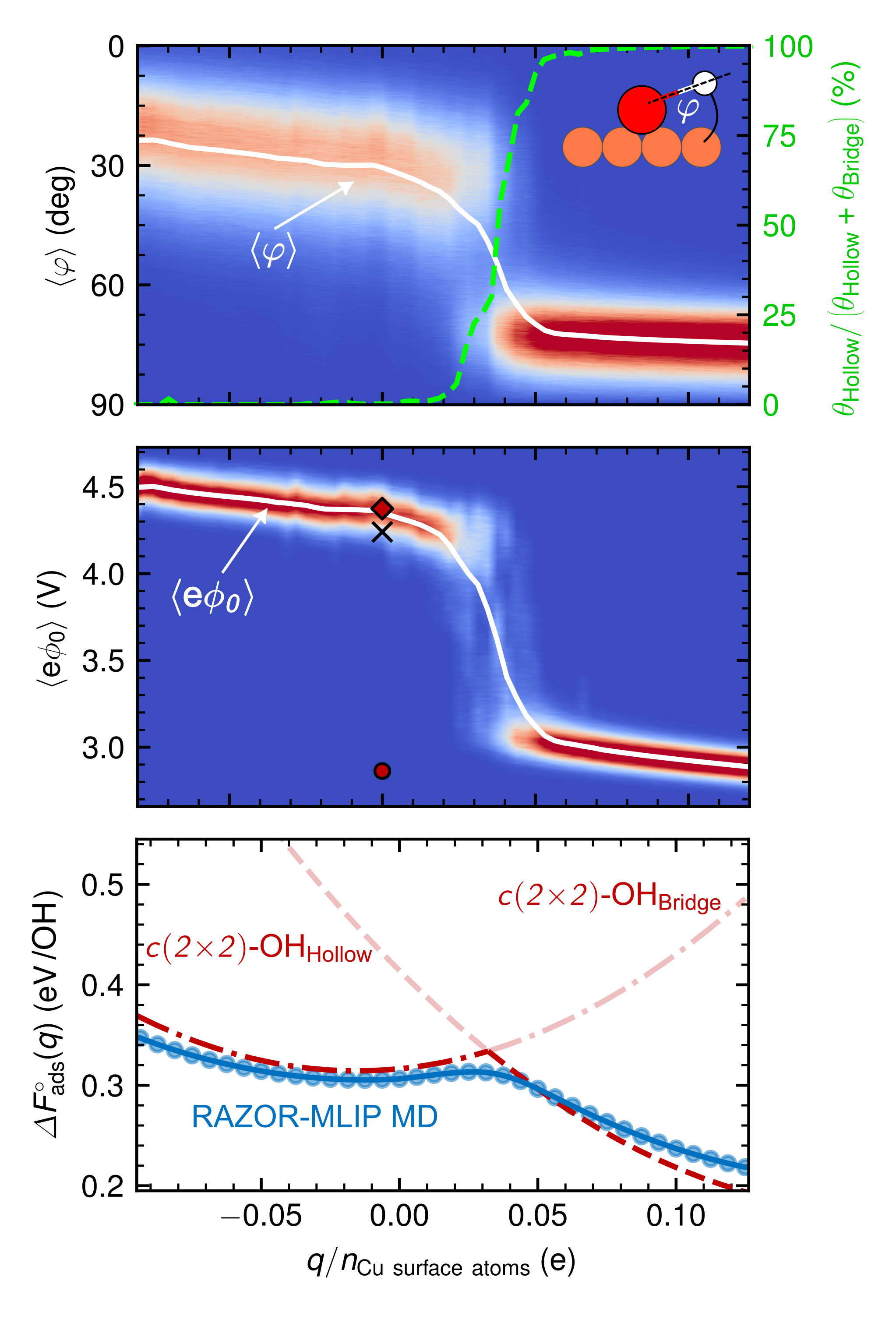
Figure 2: RAZOR-MLIP based MD simulations for a 0.5\,monolayer OH-covered Cu(100) surface at different q (per Cu surface atom).
Molecular dynamics simulations based on RAZOR-MLIP at applied charges reveal a transition of the adsorption site from bridge to hollow, emphasized by a significant variation in the work function eϕ0. These simulations underscore the model's capability to describe dynamical processes influenced by the local electrostatic environment.
Additionally, the RAZOR model provides a quantitative agreement with ab initio thermodynamics, reinforcing its validity across a range of applied biases.
Implication and Future Work
The findings have significant implications for the modeling of electrochemical interfaces, particularly in catalysis and materials science. The RAZOR framework enables accurate simulations by efficiently factoring in bias-induced modifications and allows for the evaluation of systems with flexible compositions and states.
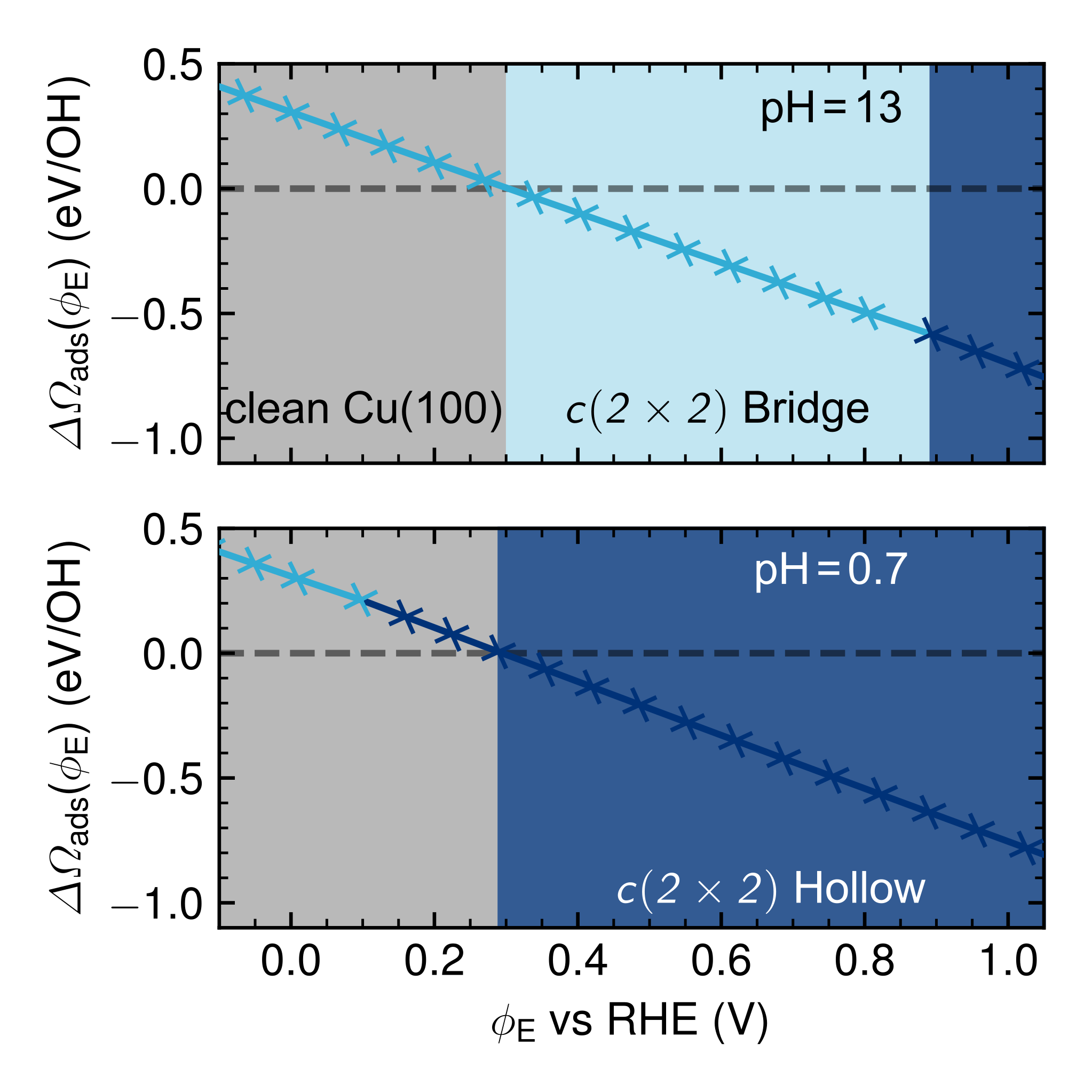
Figure 3: Adsorption free energy ΔΩads of 0.5\,monolayer OH at Cu(100) as a function of the applied potential $$ on the reversible hydrogen electrode (RHE) scale.
The ability to simulate charge-induced transformations at electrochemical interfaces supports the development of atomistic models for complex systems beyond conventional computational scales. Future studies could focus on expanding this framework to include explicit solvent models and more diverse interfacial compositions to capture the full range of electrochemical phenomena.
Conclusion
The RAZOR model represents a sophisticated advancement in machine learning applications for electrochemistry, providing a valuable tool for probing interface behavior at the atomic scale. This computational framework holds the potential to transform understanding and optimization of catalytic processes and materials at electrified interfaces.