- The paper introduces a novel simulation platform that integrates graph-based AI agents with human-like cognitive architectures to assess recommender systems.
- It implements a multi-layer social graph and the ICR² motivational engine to simulate dynamic user interactions and evolving preferences.
- Evaluations show that agent behavior metrics, measured by KL divergence and Earth Mover’s Distance, align closely with human data.
GGBond: Growing Graph-Based AI-Agent Society for Socially-Aware Recommender Simulation
The paper "GGBond: Growing Graph-Based AI-Agent Society for Socially-Aware Recommender Simulation" presents a novel simulation platform designed to address the limitations of conventional recommender systems which rely predominantly on static offline data. By integrating human-like cognitive agents and dynamic social interactions, this research provides a controlled environment for realistically simulating user behavior evolution under recommendation interventions. Here's an exploration of the key components and innovations proposed in the study.
System Architecture and Agent Design
The proposed system, GGBond, introduces a high-fidelity simulation platform with two main components: a population of AI agents with a five-layer cognitive architecture, and a dynamically evolving multi-layer social graph referred to as the GGBond Graph. The cognitive architecture of each agent includes modules for memory, emotion, preferences, trust assessment, and natural language generation. The Intimacy–Curiosity–Reciprocity–Risk (ICR²) motivational engine is implemented to facilitate realistic decision-making processes among agents.
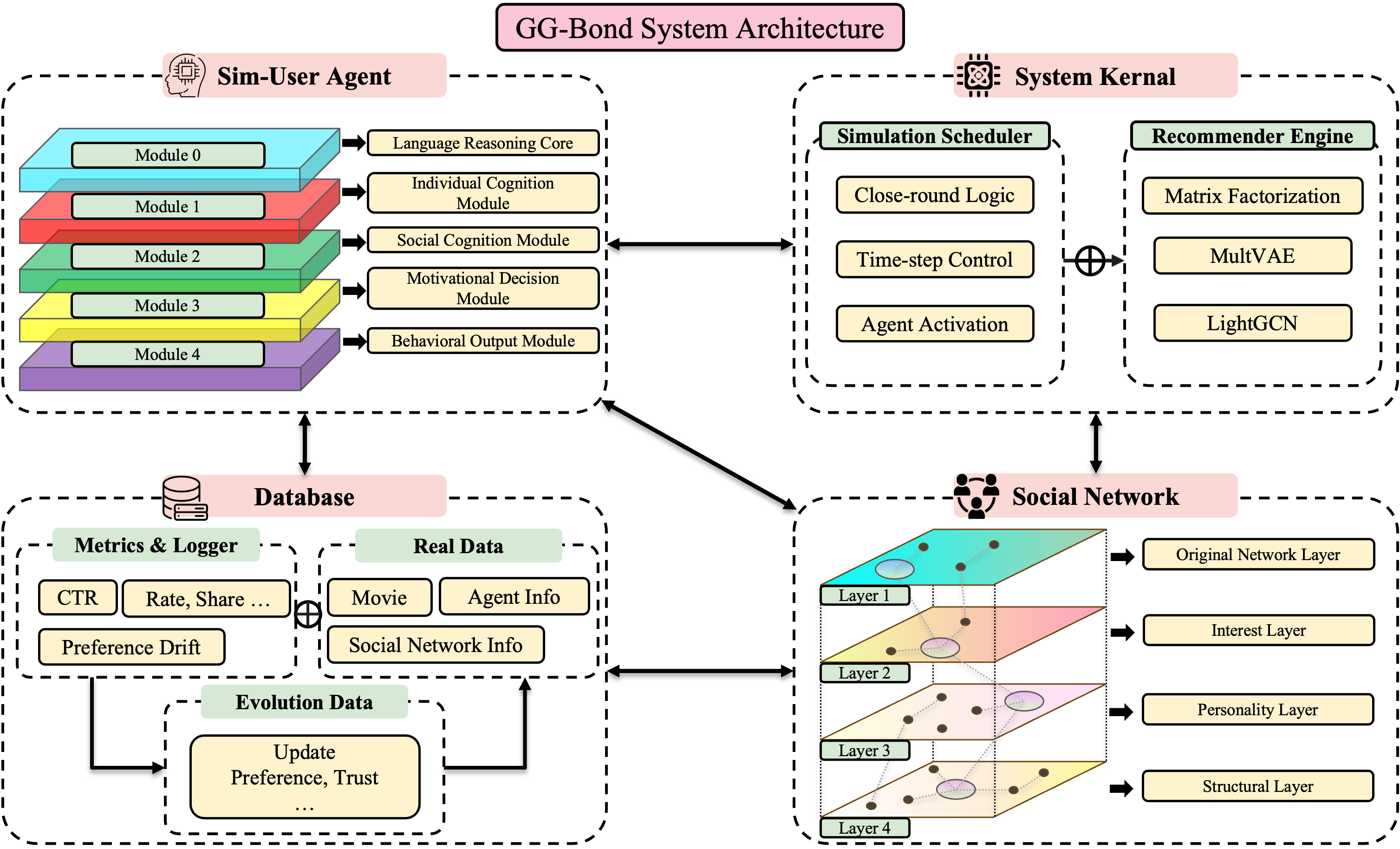
Figure 1: GGBond System Architecture: Recommender Engine, Database, Social Network, Agent
The GGBond Graph supports dynamic relational evolution, modeling users’ evolving social ties based on interest similarity, personality alignment, and structural homophily. This multi-layer social network captures the complexity of human interactions more accurately than static models. The architecture allows agents to autonomously respond to recommendations, consume, rate, and share content, while updating their internal states and social connections.
High-Fidelity Simulation Paradigm
The GGBond system transcends static data constraints by allowing long-term evaluation of recommendation systems in a setting that reflects real-world dynamics. Agents interact with various recommendation algorithms (such as Matrix Factorization, MultVAE, and LightGCN) in a stable feedback loop, autonomously deciding on actions based on their internal states and external stimuli.
The multi-layer social graph in GGBond encompasses distinct types of social connections, permitting nuanced representation and interaction modeling:
(Figure 4)
Figure 2: GGBond Multi-layer Social Network Framework.
- Interest Graph Layer: Captures shared preferences using Jaccard similarity.
- Personality Graph Layer: Connects agents with similar psychological traits via cosine similarity.
- Structural Graph Layer: Models social homophily based on shared demographics.
- Unified Layer: Integrates all previous edges, supporting comprehensive social reasoning.
Agent Architecture
Agents in GGBond use a structured architecture divided into multiple modules that drive the perception-action loop:
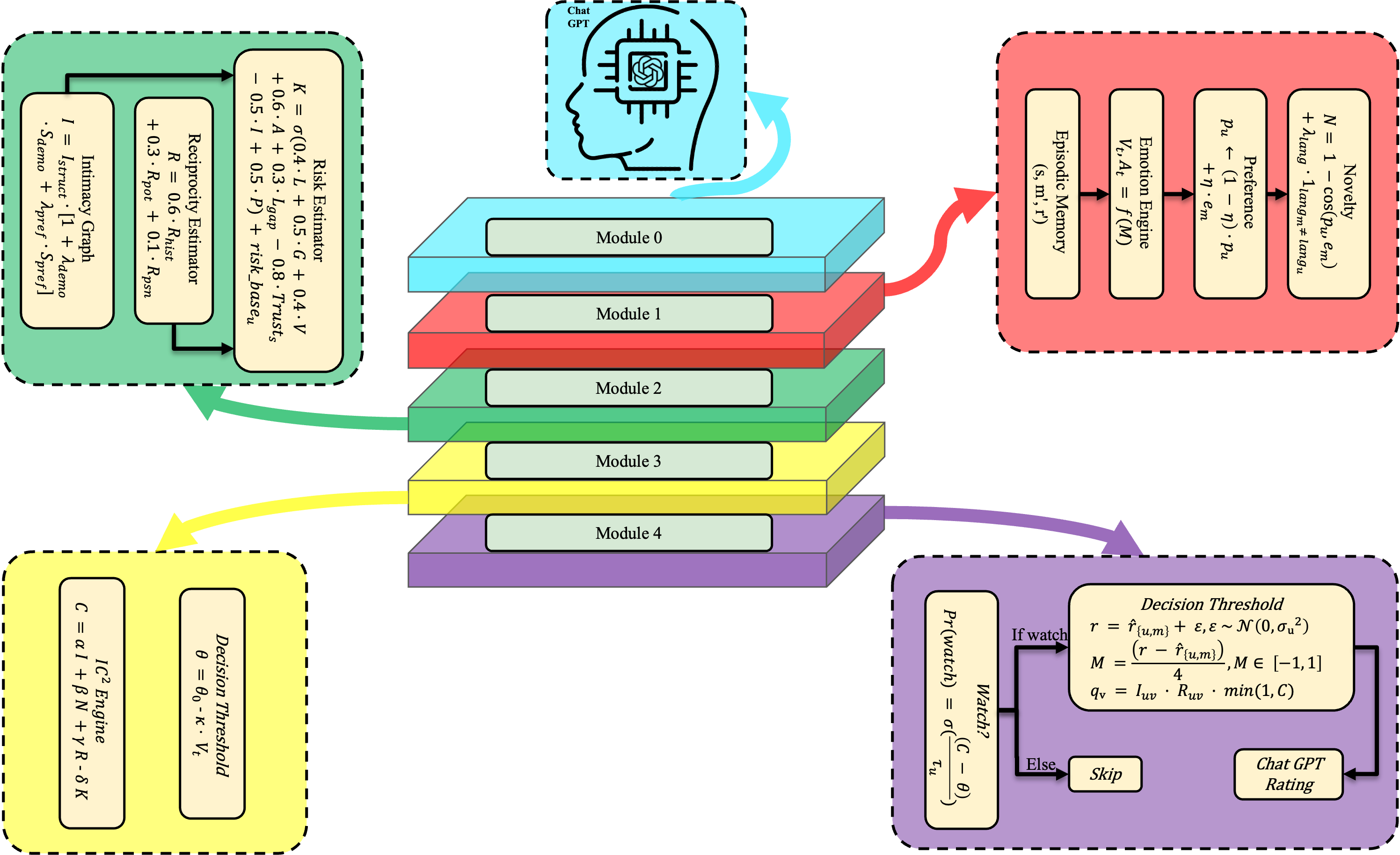
Figure 3: Agent Architecture: Module 0 (GPT4 API), Module 1 (Individual cognition Module), Module 2 (Social cognition Module), Module 3 (Decision Module), Module 4 (Behavior Module).
- Module 1: Processes individual cognition, including memory, emotions, and preferences.
- Module 2: Handles social cognition, evaluating trust and risk in recommendations.
- Module 3: Combines cognitive inputs to generate motivation for actions.
- Module 4: Executes the determined behaviors and logs interactions for subsequent processing.
Evaluation and Experiments
Evaluations conducted on the GGBond platform demonstrate its effectiveness in enabling the long-term assessment of recommender systems under dynamic social interaction. By engaging simulations across diverse algorithms, GGBond allows for benchmarking improvements in metrics like personalization accuracy and diversity over extended periods.
Agent Consistency
Experiments with agent-generated rating distributions compared to human data suggest that GGBond agents exhibit alignment with human evaluative behavior. Using metrics such as KL divergence and Earth Mover’s Distance, the research presents quantitative evidence of GGBond’s ability to emulate realistic user behavior.
Conclusion
The GGBond framework offers a profound leap forward in simulating the complexity of human interactions in recommender systems. By instituting agents with advanced cognitive architectures in a nuanced social network, GGBond sets a foundation for evaluating and improving recommendation algorithms beyond static datasets. Future developments can potentially enhance agent cognition models, address ethical considerations, and integrate the environment into real-world applications.