Can AI Master Econometrics? Evidence from Econometrics AI Agent on Expert-Level Tasks
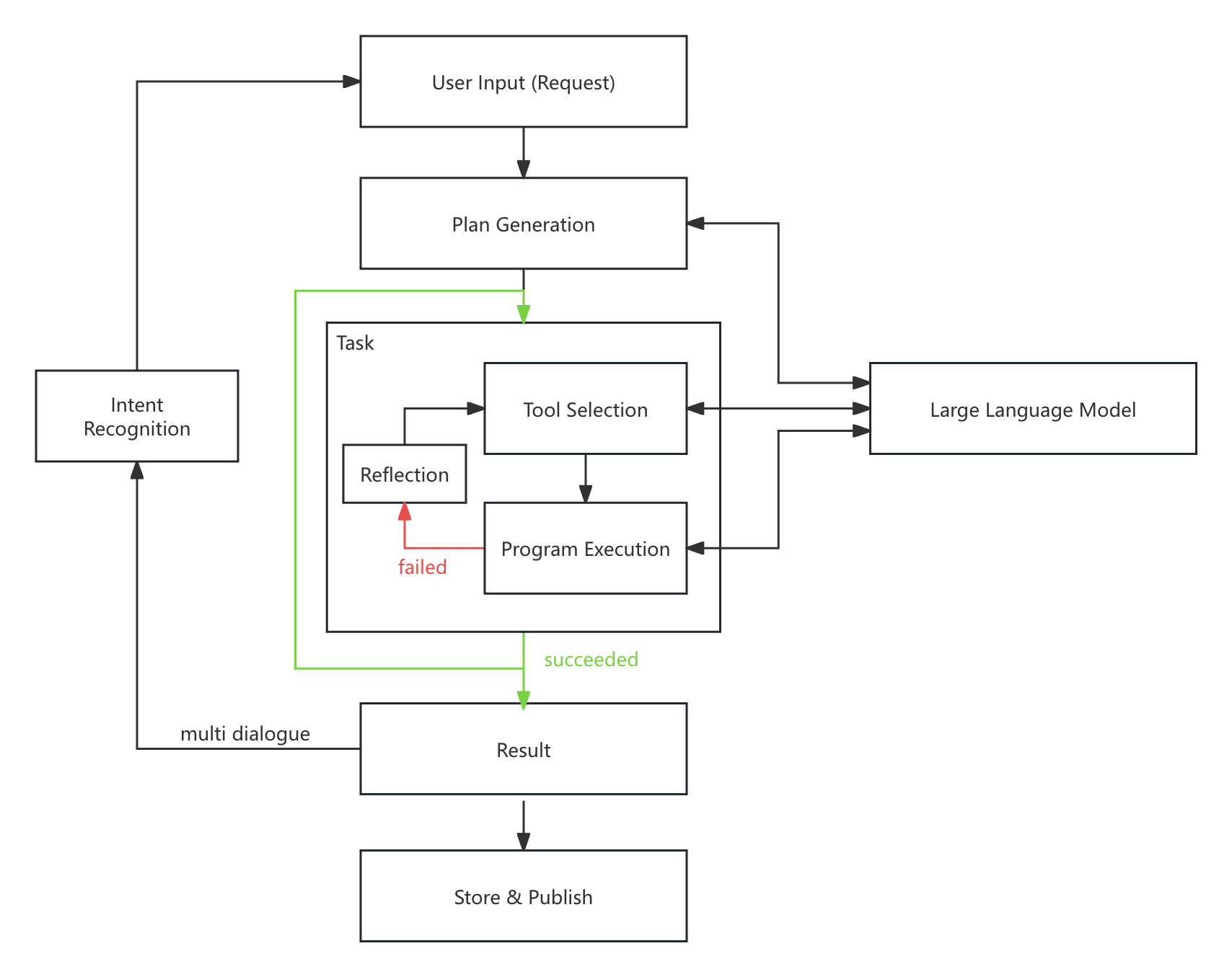
Abstract: Can AI effectively perform complex econometric analysis traditionally requiring human expertise? This paper evaluates AI agents' capability to master econometrics, focusing on empirical analysis performance. We develop an ``Econometrics AI Agent'' built on the open-source MetaGPT framework. This agent exhibits outstanding performance in: (1) planning econometric tasks strategically, (2) generating and executing code, (3) employing error-based reflection for improved robustness, and (4) allowing iterative refinement through multi-round conversations. We construct two datasets from academic coursework materials and published research papers to evaluate performance against real-world challenges. Comparative testing shows our domain-specialized AI agent significantly outperforms both benchmark LLMs and general-purpose AI agents. This work establishes a testbed for exploring AI's impact on social science research and enables cost-effective integration of domain expertise, making advanced econometric methods accessible to users with minimal coding skills. Furthermore, our AI agent enhances research reproducibility and offers promising pedagogical applications for econometrics teaching.
Paper Prompts
Sign up for free to create and run prompts on this paper using GPT-5.
Top Community Prompts
Explain it Like I'm 14
Overview
This paper asks a simple question: Can AI do the kind of careful, data-based analysis that economists do, known as econometrics? The authors build a special AI assistant—called the Econometrics AI Agent—that plans the work, writes and runs code, checks for mistakes, and improves its answers. They test how well it performs on real, expert-level tasks from university courses and published research papers.
Key Objectives
The paper aims to find out:
- Whether an AI agent can handle complex econometric analyses from start to finish.
- If a domain-specialized agent (one built with econometrics in mind) beats general AI tools and basic LLMs like ChatGPT.
- How to design an AI system that makes advanced methods easier to use, more accurate, and more reproducible.
Methods and Approach
Think of the Econometrics AI Agent like a smart, organized teammate:
- It plans the steps of the analysis (like a checklist).
- It chooses the right tool for each step.
- It writes and runs code to analyze data.
- If it hits an error, it learns from it and fixes the problem.
- It can talk with the user over multiple rounds to refine the results.
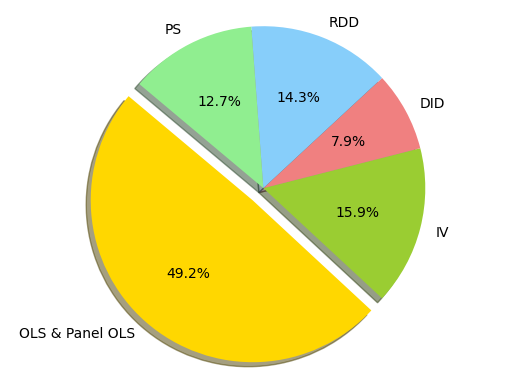
To make this work, the authors give the agent a toolbox of econometric methods, including:
- OLS and Panel OLS: Basic ways to find relationships between variables (like “study hours” and “test score”).
- IV-2SLS (Instrumental Variables): An approach to deal with hidden causes. Imagine using a fair coin toss that influences whether someone gets a training program but doesn’t directly affect their final performance—this helps isolate true cause and effect.
- DID (Difference-in-Differences): Like comparing two groups over time—one affected by a new rule and one not—to see the rule’s impact beyond normal changes.
- RDD (Regression Discontinuity): Compare people just above and just below a cutoff (like a scholarship score threshold) to estimate the effect of crossing that line.
- Propensity Score Methods: Balance two groups (like smokers and non-smokers) based on how similar they are, so comparisons are fair.
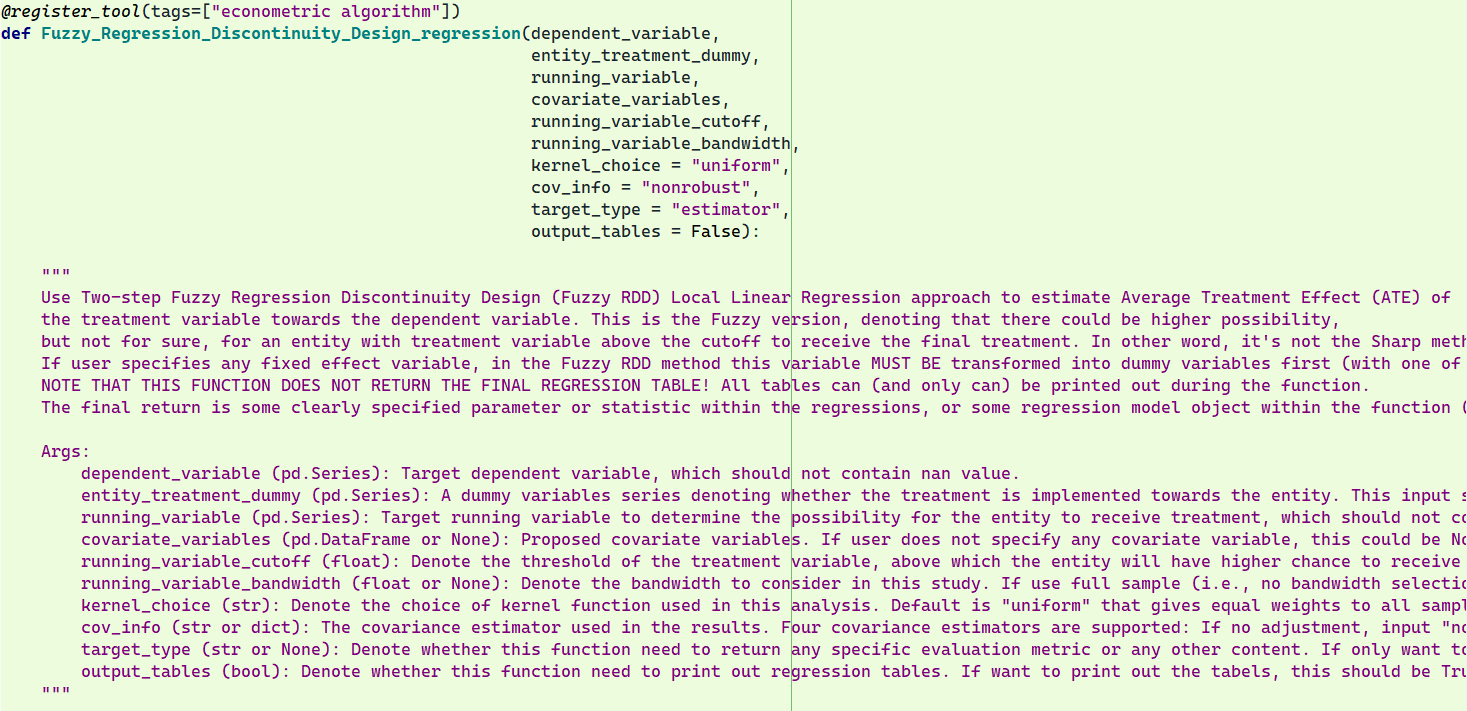
The agent’s toolbox comes with “instructions written for AI,” so it knows when and how to use each method. This design reduces “hallucinations” (made-up or incorrect steps) because the AI calls pre-checked functions rather than inventing complex code from scratch.
How they tested it:
- Two datasets were used: tasks from a PhD-level applied econometrics course, and replication tasks from published academic papers.
- They wrote clear, structured prompts telling the AI exactly what data to use, what methods to apply, and what outputs to produce.
- They compared the specialized agent to:
- A plain LLM generating Python code.
- A plain LLM generating Stata code (a common economics software).
- A general-purpose data AI agent without the special econometrics toolbox.
- They checked accuracy by seeing how closely the AI’s results matched known correct answers, including whether signs were right (positive vs. negative), and how small the differences were for key numbers (coefficients, standard errors, and p-values).
Main Findings
The Econometrics AI Agent clearly outperformed the other approaches.
- It completed almost all tasks correctly, while plain LLMs often failed or produced code that didn’t run.
- It reproduced results much more accurately, especially on course assignments, and did well even on harder published-paper replications.
- It was better at picking the right econometric method and applying it properly.
- Its design—planning steps, using a specialized toolbox, and fixing errors—made it more reliable than general tools.
Why this matters:
- In econometrics, small mistakes can lead to wrong conclusions about cause and effect. The agent’s structure reduces those mistakes and produces trustworthy results.
- It makes complex methods more accessible to people who don’t have advanced coding skills.
What didn’t go perfectly:
- The agent was slightly less accurate on the most complex methods (like certain DID and RDD setups) and on the hardest paper replications. However, these gaps can be narrowed by adding more tools and clearer instructions to the toolbox.
Implications and Impact
This research shows that an AI agent, equipped with the right tools and workflow, can help economists and social scientists do advanced analyses faster and more reliably.
- It lowers barriers for students and practitioners by making expert-level methods easier to use.
- It improves reproducibility—others can rerun the agent’s standardized process and get similar results.
- It’s cost-effective: instead of retraining big AI models, you can update the agent’s toolbox with new methods as they appear.
- The same idea can be adapted to other fields: build specialized tool libraries and let an AI agent plan, execute, and self-correct.
In short, this paper provides strong evidence that AI, when designed as a focused agent with domain-specific tools, can “master” much of the practical work in econometrics and could change how social science research is done.
Collections
Sign up for free to add this paper to one or more collections.