- The paper introduces a neurocomputational framework demonstrating how sparse engram neurons and synaptic plasticity support stable memory encoding.
- The paper employs techniques like optogenetics and sparse distributed memory models to elucidate mechanisms of memory consolidation and retrieval.
- The paper discusses the implications of modulating engram stability for developing targeted interventions in memory-related disorders.
Engram Memory Encoding and Retrieval: A Neurocomputational Perspective
Introduction
The paper "Engram Memory Encoding and Retrieval: A Neurocomputational Perspective" (2506.01659) explores the intricate neurocomputational mechanisms underpinning memory encoding and retrieval through the lens of engram theory. This theory posits that sparse populations of neurons, termed engrams, undergo persistent alterations to facilitate long-term memory storage. This paper integrates cellular neuroscience findings with computational models, delineating how synaptic plasticity and sparsity constraints culminate in efficient, interference-resistant memory systems. The research sets forth a comprehensive theoretical framework for engram investigation, positing potential applications in diagnosing and treating memory-related disorders.
Biological Underpinnings and Computational Approaches
The engram concept, originally coined by Richard Semon, refers to specific neurons active during learning, which undergo biochemical and physical modifications for stable information storage. This theory has gained traction, with modern neuroscience corroborating that these "engram cells" serve as the substrate where the learned experience imprints persistently. The process of memory formation encompasses encoding, consolidation, and storage stages, integrating into what is known as the "engram complex", spanning multiple brain regions.
Technological advancements have bolstered engram research, laying the groundwork for precise identification and manipulation of engram neurons via methods such as optogenetics, chemogenetics, and electrophysiology. For example, optogenetics can selectively activate or deactivate engram neurons, substantiating their role in memory functions, as demonstrated by synthetic memory creation.
Synaptic Plasticity and Engram Consolidation
Memory trace encoding in engram cells involves plastic alterations driven by biochemical processes such as synaptic plasticity. Synaptic modifications underpinning learning and memory are cemented by Hebbian plasticity, encapsulated in the axiom "neurons that fire together wire together". Synaptic potentiation, particularly through long-term potentiation (LTP), proves crucial in cementing engram formation, characterized by increased synaptic strength and density.
The dynamism of engram populations manifests in memory refinement and adaptability. Substantial synaptic modifications during memory consolidation exhibit a duality of excitatory and inhibitory synaptic input regulation, maintaining neuronal circuit stability (Figure 1).
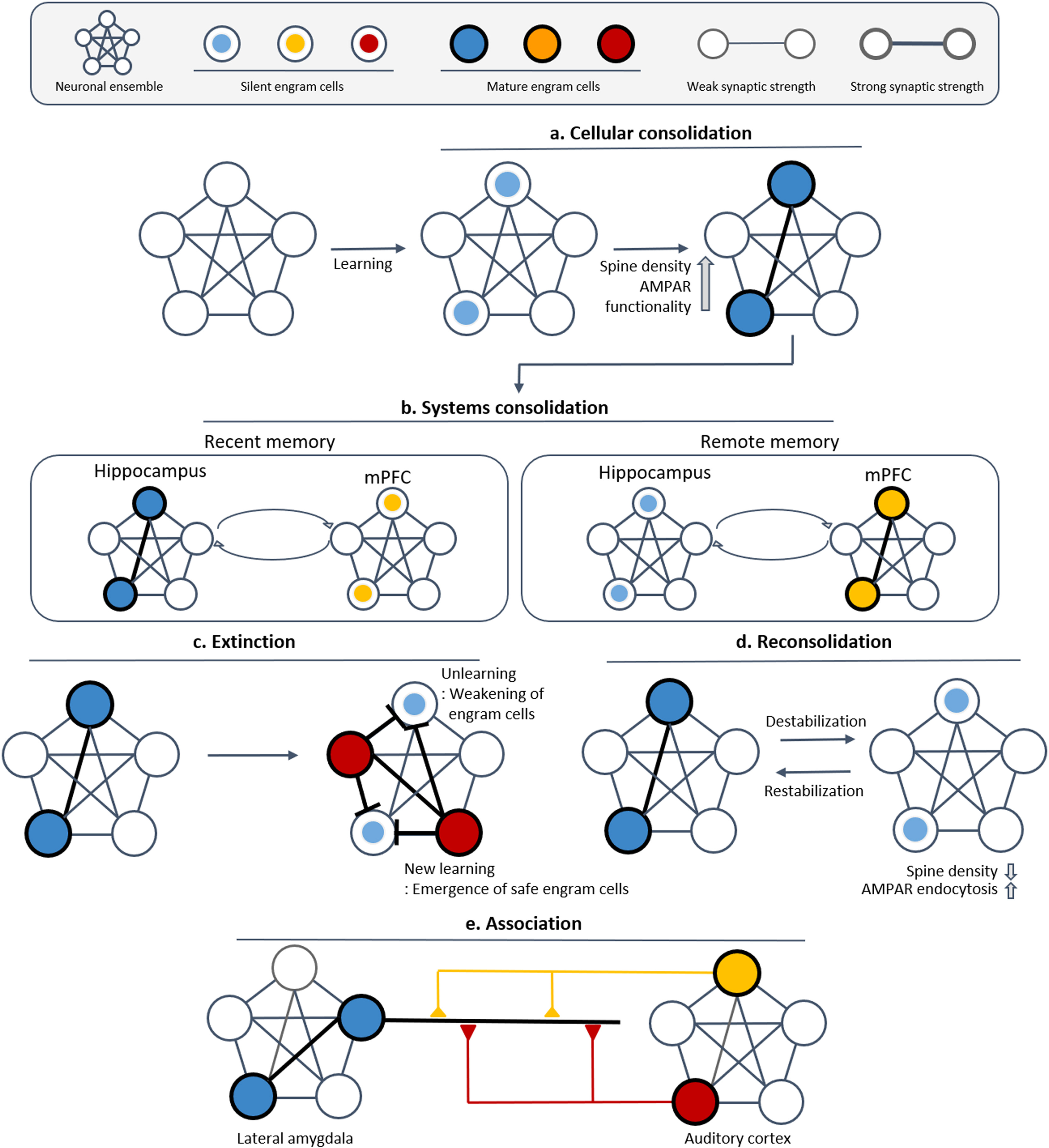
Figure 1: Phases of engram formation, transformation, and modulation (memory retrieval; adapted from \citep{cite38}).
Computational Neuroscience and Sparse Memory Models
The paper highlights computational models like sparse distributed memory (SDM) that serve as pivotal frameworks for understanding memory systems, offering insights into associative recall and pattern separation. SDM simulates vast, content-addressable memory spaces, incorporating principles of sparsity akin to biological neural networks. Computational simulations leverage concepts such as sparse regularization and engram gating in artificial neural networks, underscoring their utility in preventing catastrophic forgetting and enhancing life-long learning capabilities.
Challenges and Implications
Current challenges impeding engram research include methodological barriers in clear engram identification and theoretical gaps in explicating engram roles within broader computational processes. These constraints necessitate an interdisciplinary approach combining empirical validation with robust computational models. The implications of engram study are profound, with potential therapeutic applications targeting disorders such as Alzheimer's and PTSD. By altering engram stability or accessibility, interventions could be devised to ameliorate memory dysfunctions.
Conclusion
The exploration of engram theory from a neurocomputational perspective serves as a nexus between biological discovery and computational advancements. The paper advocates for an integrated model of memory systems, wherein engrams emerge from interactive plasticity mechanisms modulated by sparsity constraints. Such convergence bolsters our understanding of cognitive processes and sets a foundation for innovative solutions in memory disorder interventions. The pursuit of a deepened, unified theoretical framework for engram study remains pivotal in advancing memory research and its real-world applications.