- The paper introduces a qubit-efficient solver that leverages the PCE framework to reduce qubit requirements for the LABS problem.
- It employs a 10-layer brickwork quantum circuit, achieving exponential runtime improvements over classical Tabu Search.
- Numerical results indicate scalable performance on NISQ architectures, paving the way for future quantum advantage.
A Competitive NISQ and Qubit-Efficient Solver for the LABS Problem
Introduction
The paper introduces a qubit-efficient solver for the Low Autocorrelation Binary Sequences (LABS) problem using the Pauli Correlation Encoding (PCE) framework. This approach significantly reduces the number of qubits required to solve the LABS problem, achieving a polynomial reduction in qubit count and offering a runtime improvement over traditional classical methods, including Tabu Search. The solver operates within the Noisy Intermediate-Scale Quantum (NISQ) era's constraints, showcasing the potential of quantum-inspired heuristics in solving NP-hard problems.
LABS Problem Overview
The LABS problem involves finding a binary sequence that minimizes the sidelobe energy characterized by E(x)=∑ℓ=1N−1Cℓ2(x), where Cℓ(x) represents the autocorrelation of sequence x. This problem is NP-hard due to the optimization landscape’s complexity, which includes a high degree of local minima. Traditional methods like Memetic Tabu Search offer solutions up to size N≤66 but degrade significantly for larger instances.
PCE-Based Solver
The novel solver encodes binary variables using n qubits, allowing for N=poly(n) binary variables, thereby achieving a significant reduction in qubit requirements. The PCE framework employs a brickwork parameterized quantum circuit with a depth of 10 layers and 30 two-qubit gates, staying well within NISQ capabilities.
The numerical simulations demonstrate the solver's exponential scaling advantage over both QAOA and classical Tabu Search approaches. The time-to-solution (TTS) benchmarks reveal favorable outcomes for the PCE method, showing competitive results with leading classical heuristics, especially in larger problem sizes.
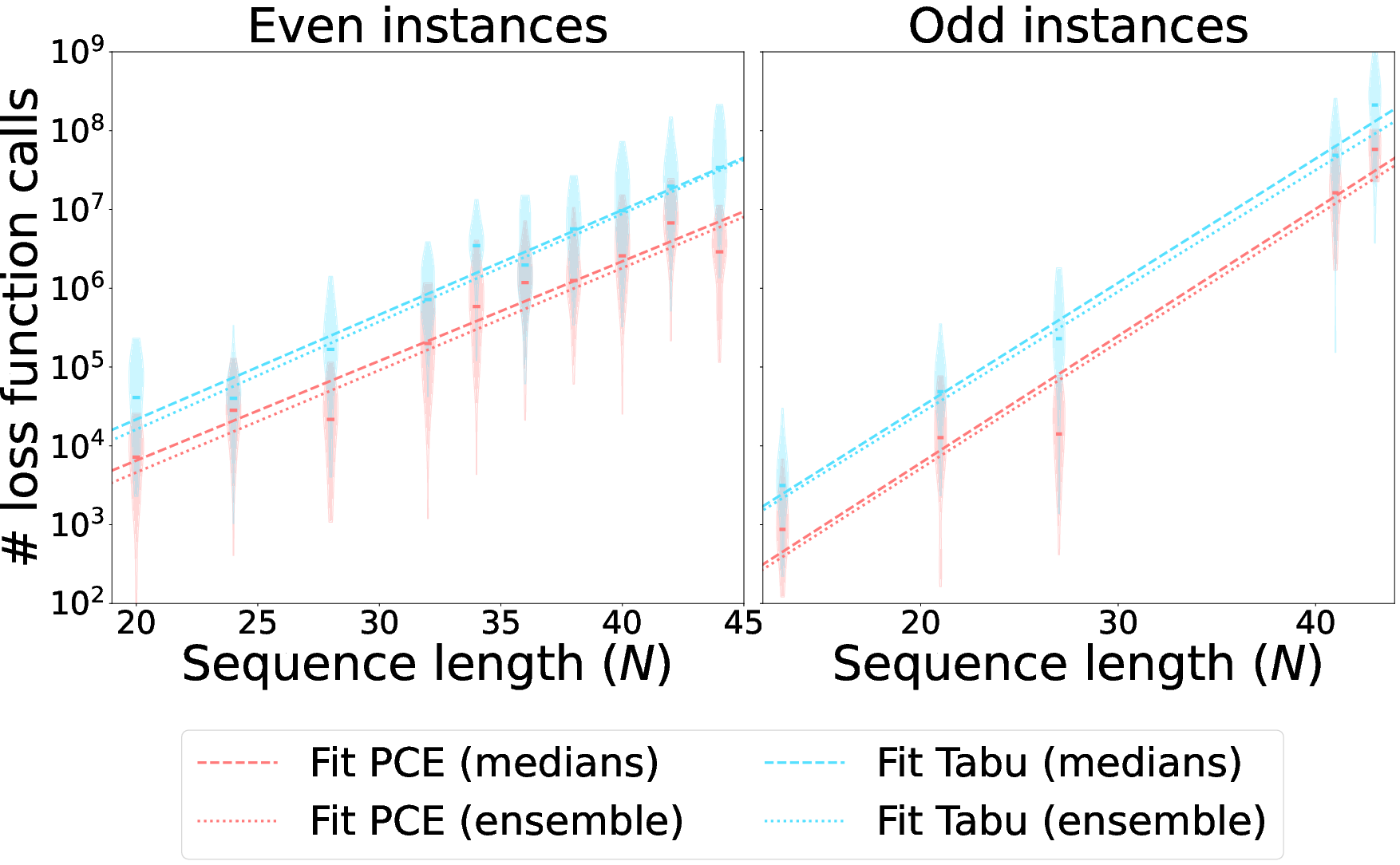
Figure 1: Time-to-solution benchmark comparing PCE (red) with Tabu Search (blue) for both even and odd values of N.
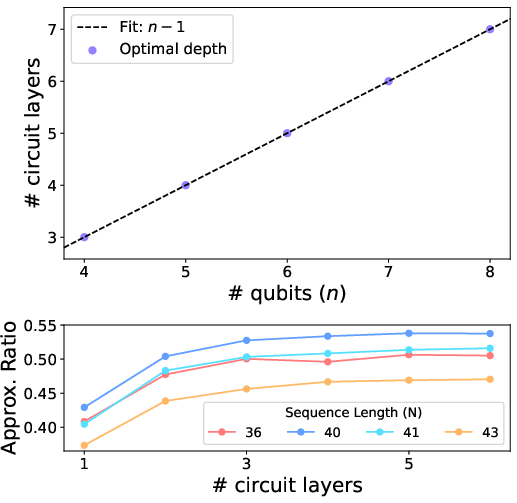
Figure 2: Circuit depth scaling, illustrating linear scaling with the number of qubits n in the qubit-efficient solver with quadratic compression (k=2).
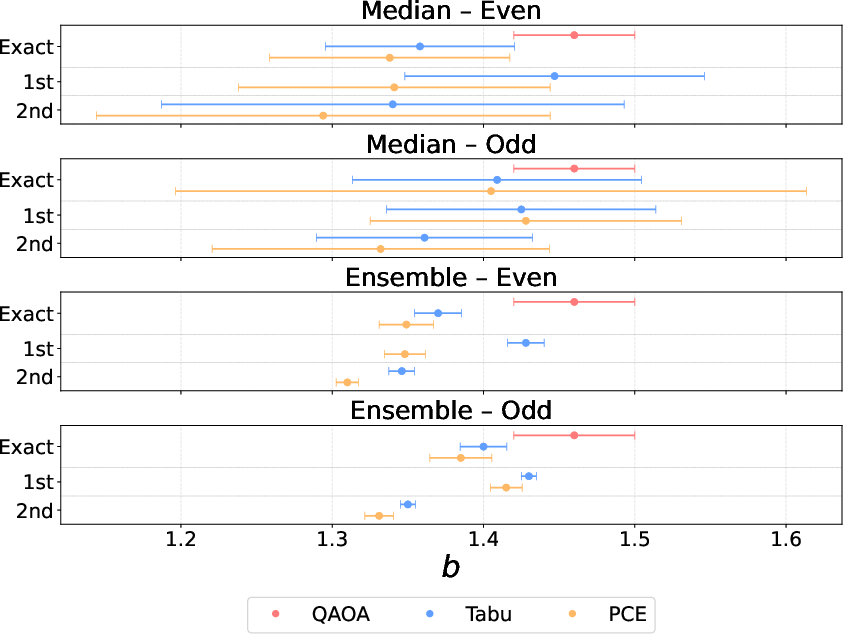
Figure 3: TTS scaling for different solvers, with fitted exponential scaling parameters.
The solver's architecture, employing a polynomially scaled circuit depth and a sophisticated regularization term, facilitates efficient exploration of large instances. Even accounting for the overhead of sampling and gate operations required for executing the quantum circuit on actual quantum hardware, PCE displays potential scalability for larger instances, suggesting future quantum advantage.
Conclusion
The qubit-efficient PCE solver for LABS provides a compelling demonstration of quantum-inspired computation's potential, offering a pathway for efficient resource usage in quantum algorithms. It presents substantial implications for the development of quantum heuristics and their application on NISQ devices. Future work may focus on exploring solving capabilities beyond LABS and on further reducing classical simulations' overhead, enhancing quantum efficiency and exploring practical crossover points where quantum methods can feasibly surpass classical solvers. The demonstrated scaling advantage frames PCE as a fertile ground for continued exploration into quantum algorithms' applicability to combinatorially hard problems.