- The paper introduces Warm-PCE, a novel method incorporating classical bias from the GW algorithm into PCE for improved TSP optimization.
- It utilizes a modulated bias parameter (ε) to steer the variational quantum algorithm towards optimal solutions, yielding success rates up to 64% on 5-city TSP instances.
- Results demonstrate that Warm-PCE outperforms standard PCE with consistently higher approximation ratios and reduced qubit requirements.
"Warm-Starting PCE for Traveling Salesman Problem" Analysis
Introduction
The paper addresses the scalability limitations of variational quantum algorithms (VQAs) in combinatorial optimization, particularly focusing on the Traveling Salesman Problem (TSP). A novel approach, termed Warm-Starting Pauli Correlation Encoding (Warm-PCE), is introduced. This method incorporates classical bias from the Goemans-Williamson (GW) algorithm into Pauli Correlation Encoding (PCE) to optimize performance. The results demonstrate that Warm-PCE surpasses standard PCE in achieving a higher probability of solving TSP instances optimally.
Background and Motivation
Combinatorial optimization problems, such as the TSP, present formidable challenges due primarily to their NP-Hard classification, which implies exponential resource scaling with problem size. Traditional one-hot encoding, which assigns each variable to an individual qubit, results in impractically high qubit requirements. PCE addresses this by using multi-body Pauli-matrix correlations to achieve polynomial qubit reductions. Despite PCE's effectiveness, further improvements were sought by integrating warm-start techniques to steer solutions towards feasibility more efficiently.
Methodology and Warm-PCE
Warm-PCE extends the PCE framework by integrating a bias term from the GW algorithm into the loss function, helping to focus the optimization search space. The paper proposes using a parameter ε to modulate this bias, making it strong enough to guide the optimization yet flexible to allow deviations if better solutions are available. Figure 1 illustrates the dependency of Warm-PCE performance on ε, highlighting that an optimal range exists for better performance in solving the TSP.
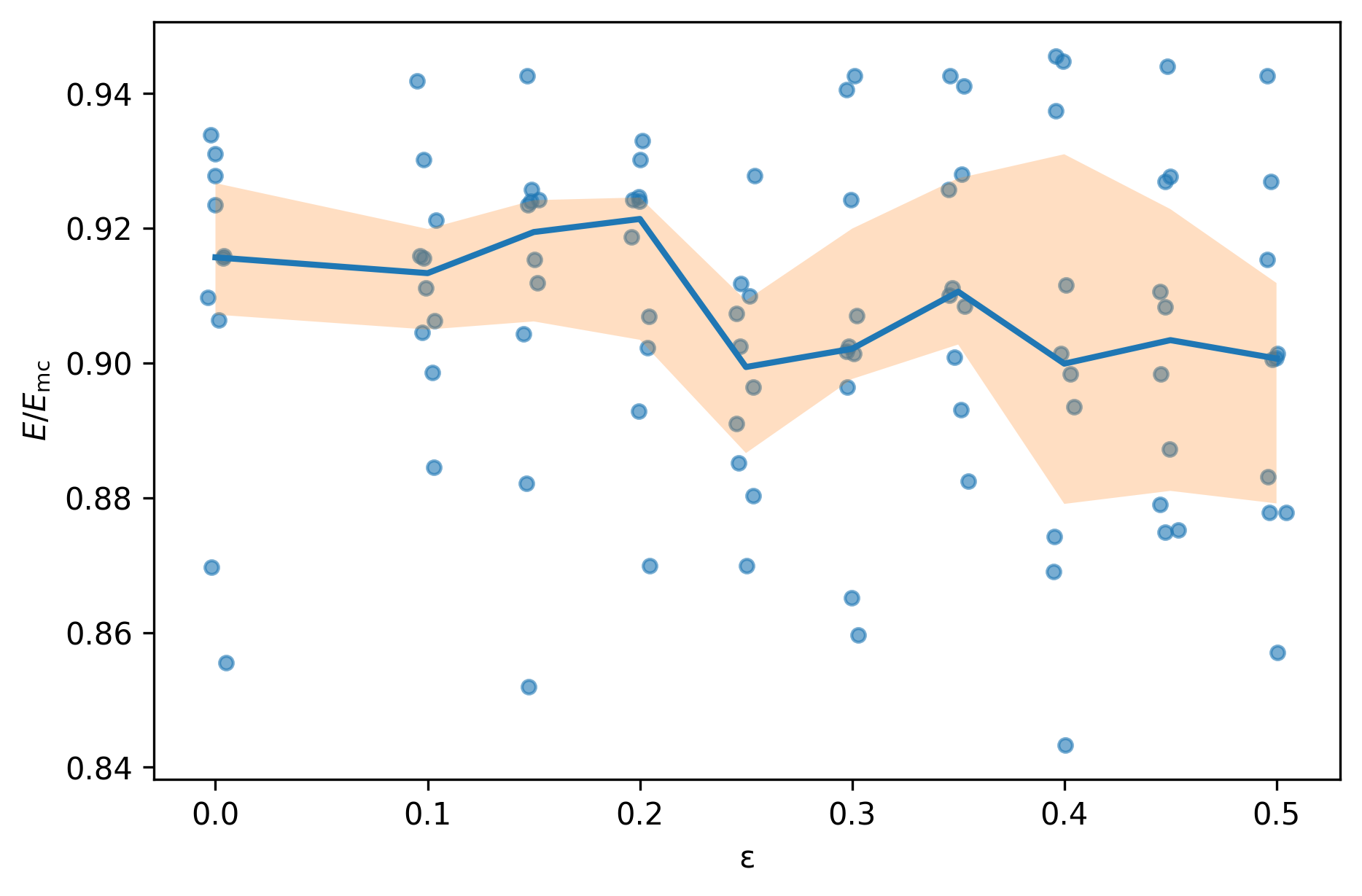
Figure 1: Sweep over the regularization parameter ϵ. The y-axis shows the energy normalized by the maximum-cut energy ($E/E_{\mathrm{mc}$).
Applications to Traveling Salesman Problem
The research reformulates the TSP into a QUBO framework suitable for PCE application. Using a QUBO-to-MaxCut transformation, the Warm-PCE approach demonstrates its potential on 5-city TSP instances. The QUBO formulation is adjusted with constraints ensuring each city is visited exactly once, with penalties to maintain valid Hamiltonian cycles.
Results and Implications
Results show that Warm-PCE is consistently superior to standard PCE across various depth configurations (Figure 2). Specifically, Warm-PCE increases the average approximation ratio with depth, while PCE stagnates. Key numerical results include a success rate of Warm-PCE for optimal solutions ranging from 28% to 64%, against PCE's 4% to 26%. Importantly, Warm-PCE's robustness is illustrated by consistent per-instance wins across tested configurations.
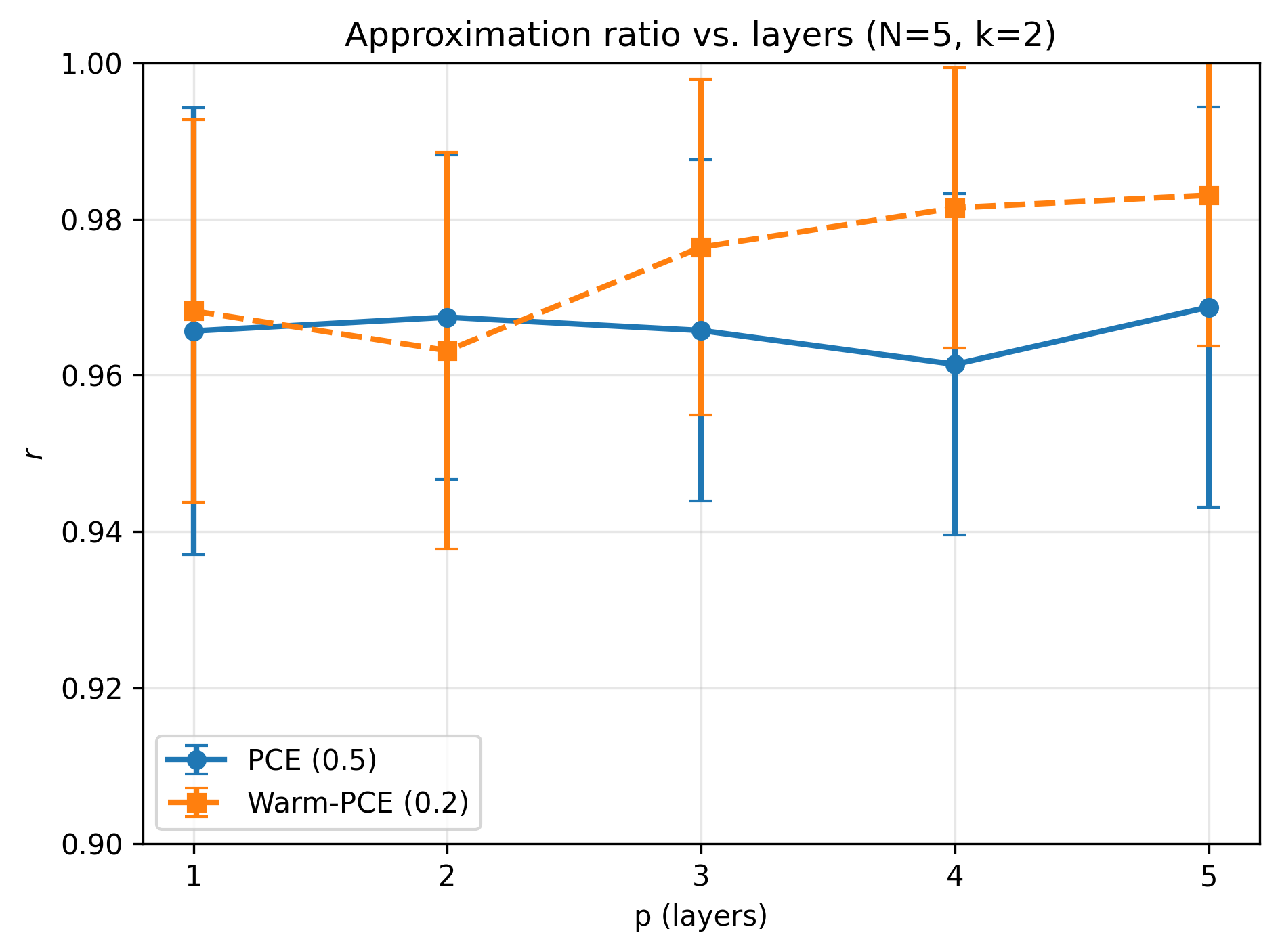
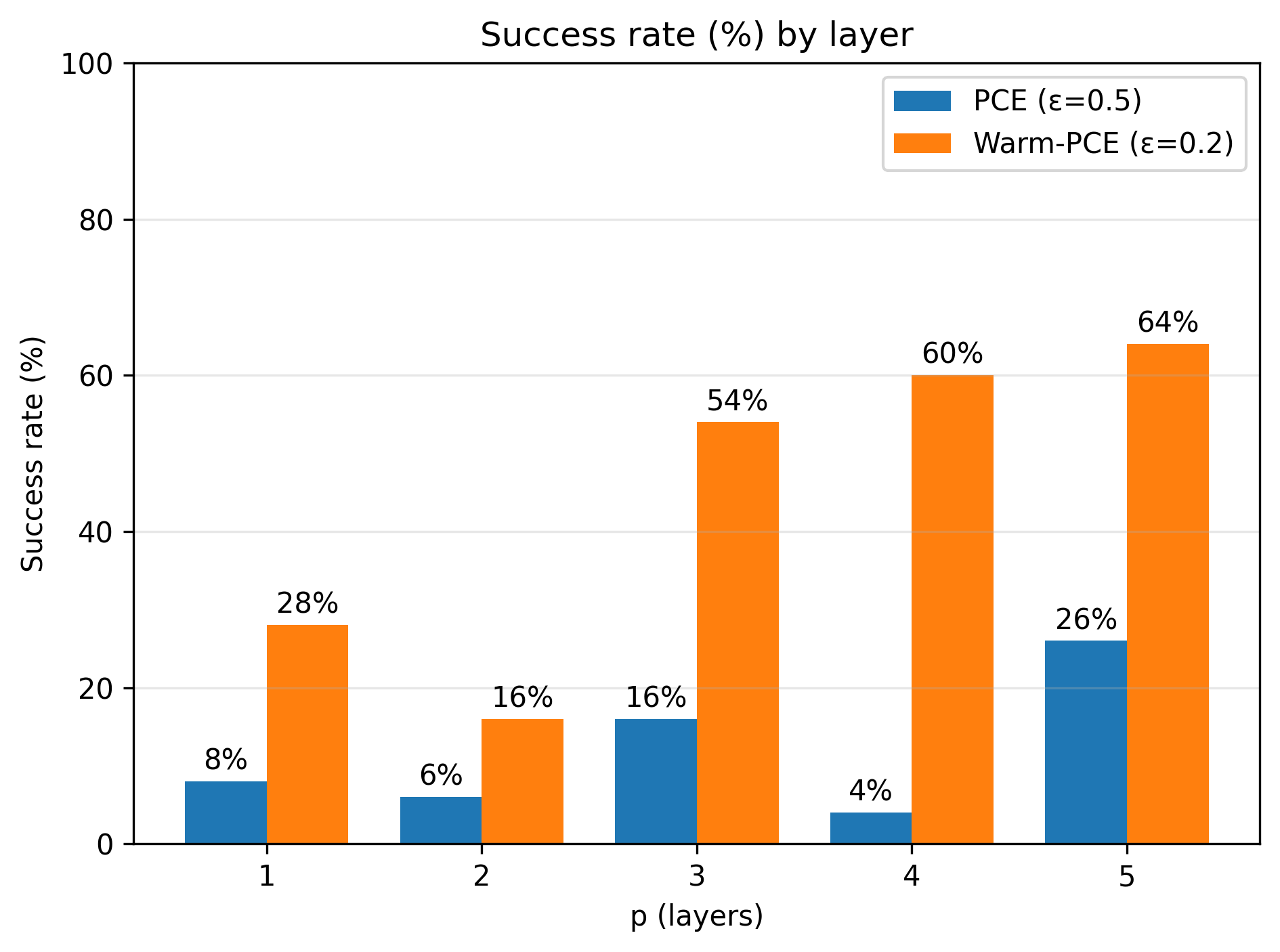
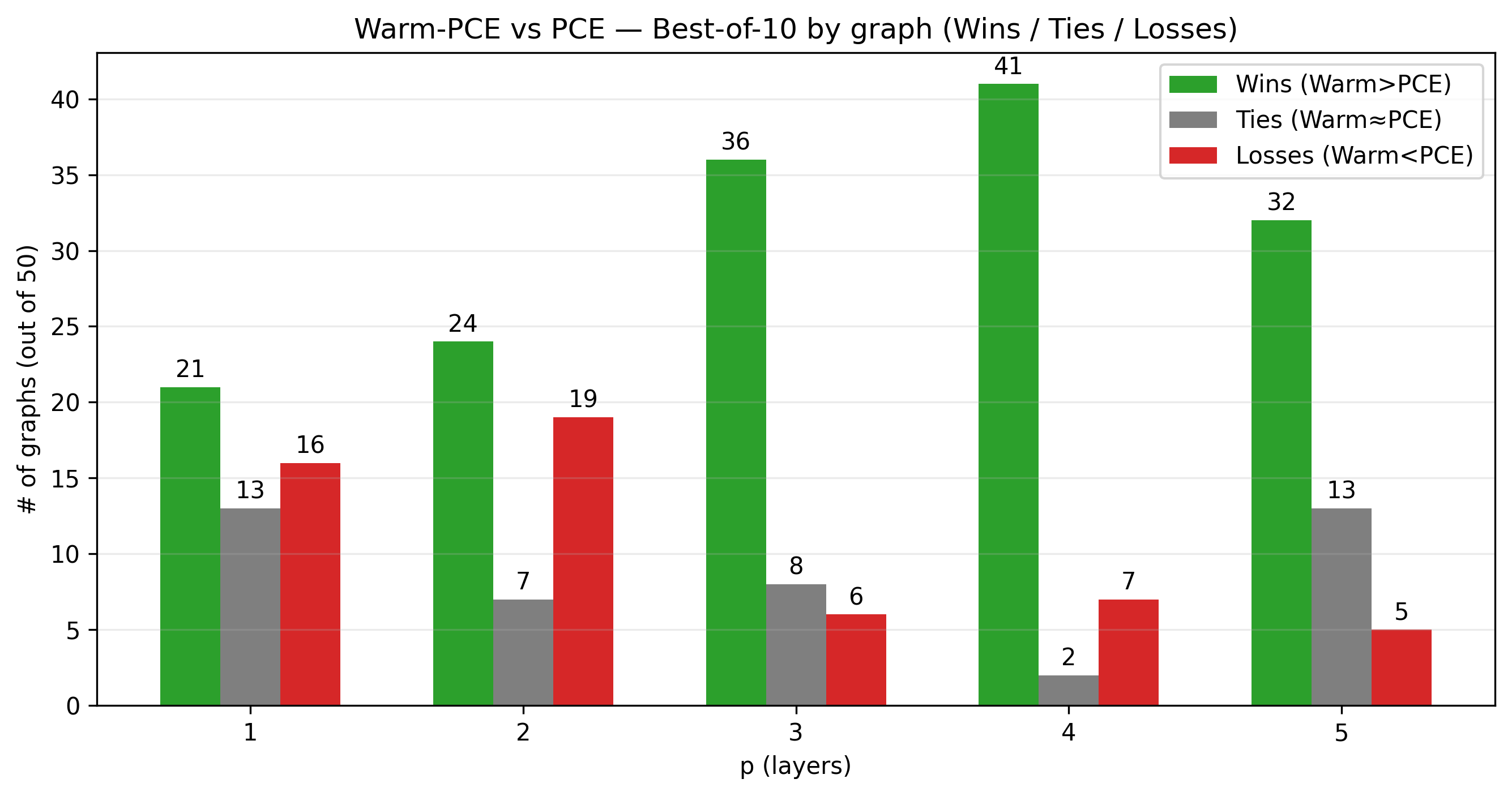
Figure 2: Warm-PCE vs.\ PCE (5-city TSP). Mean approximation ratio r vs.\ depth p (Warm-PCE improves monotonically with depth; PCE is nearly flat).
Conclusion
Warm-PCE presents a significant advancement in solving combinatorial optimization problems using VQAs by leveraging classical heuristics to warm-start the optimization process. This integration not only enhances the probability of achieving optimal solutions but does so with efficient qubit usage. Future work could extend these findings to larger instances and explore the robustness under real-world noise conditions, paving the way for more practical applications of quantum algorithms in combinatorial problems.