- The paper introduces STELLA, a self-evolving LLM agent that autonomously enhances biomedical research through continuous learning and dynamic tool integration.
- The methodology leverages a Template Library and an expanding Tool Ocean to optimize reasoning strategies and integrate new bioinformatics tools.
- Benchmarking results demonstrate that STELLA achieves state-of-the-art accuracy and progressive improvements through iterative test-time evolution.
STELLA: Self-Evolving LLM Agent for Biomedical Research
Introduction to STELLA's Architecture
STELLA represents an advanced approach to AI-driven biomedical research through a unique self-evolving architecture. This system is designed to autonomously adapt and enhance its capabilities, addressing the rapid diversification and complexity inherent in biomedical data and methodologies. The framework comprises several specialized agents that collaboratively facilitate continuous learning and tool integration, effectively adapting to novel challenges without manual intervention.
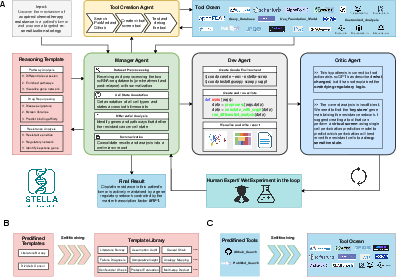
Figure 1: Overall Framework of STELLA, a self-evolving LLM Agent for Biomedical Research. (A) Overview of STELLA's multi-agent architecture, leveraging key agents such as Manager Agent, Dev Agent, Critic Agent, and Tool Creation Agent. (B and C) Illustration of STELLA's self-evolving mechanisms, highlighting the adaptability of the Template Library and Tool Ocean.
Self-Evolving Mechanisms
The core of STELLA's capability lies in its dynamic system of evolution, which incorporates two primary mechanisms: the Template Library and the Tool Ocean.
- Template Library: This component accumulates and optimizes successful reasoning strategies, allowing STELLA to generalize experiences into reusable templates. This mechanism enables the system to apply learned solutions to similar future tasks more efficiently.
- Tool Ocean: Acted upon by the Tool Creation Agent, this continually expanding repository of bioinformatics tools ensures that STELLA is not limited to a static set of functionalities. By integrating new tools as they emerge, STELLA maintains its relevance and capability in rapidly evolving scientific landscapes.
STELLA's performance evaluation against established benchmarks, including "Humanity's Last Exam: Biomedicine" and "LAB-Bench: DBQA and LitQA", demonstrates the system's advanced reasoning capabilities and adaptive efficiency. The results indicate a notable achievement of state-of-the-art accuracy, surpassing established models by a measurable margin across various challenging biomedical tasks.
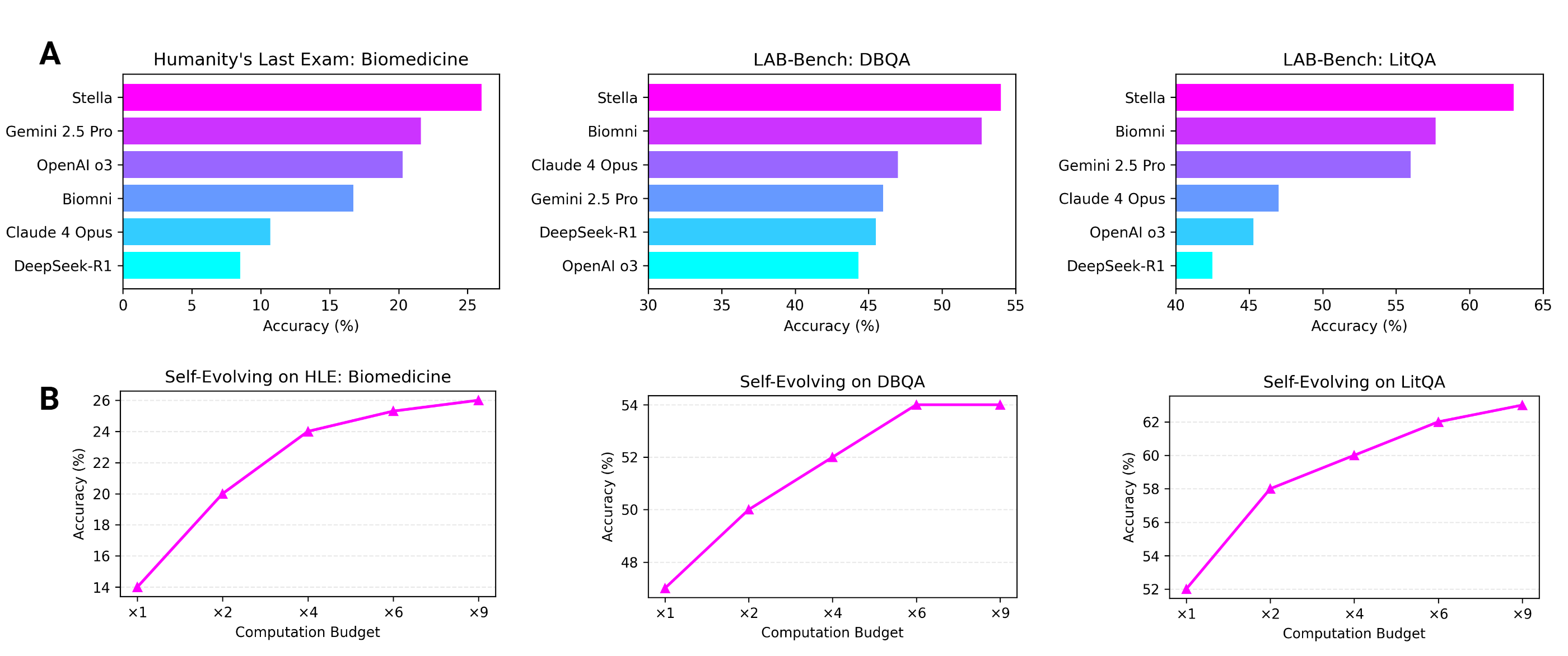
Figure 2: (A) STELLA's benchmark results compared with state-of-the-art LLMs and agents. (B) Demonstration of test-time self-evolving effects showing accuracy improvements with an increasing number of trials.
Test-Time Evolution and Continuous Improvement
A distinctive feature of STELLA is its ability to improve its performance through iterative computational processes. The analysis of test-time evolution highlights a systematic enhancement in accuracy correlating with extended computational trials, showcasing STELLA's capacity to refine its approach and solution strategies over time through experiential learning.
Conclusion
STELLA exemplifies progress in the design of AI systems that are capable of autonomous learning and tool integration, significantly enhancing the efficiency and scope of biomedical research applications. By shifting from static operations to a dynamic, evolving approach, STELLA presents a novel paradigm in AI-based scientific inquiry, promising to accelerate discovery processes and improve the adaptability of research agents in complex and rapidly changing environments. Future endeavors will focus on real-world deployment and further enhancement of collaborative interfaces with human researchers, paving the way for more autonomous and insightful scientific tools.