Text to model via SysML: Automated generation of dynamical system computational models from unstructured natural language text via enhanced System Modeling Language diagrams
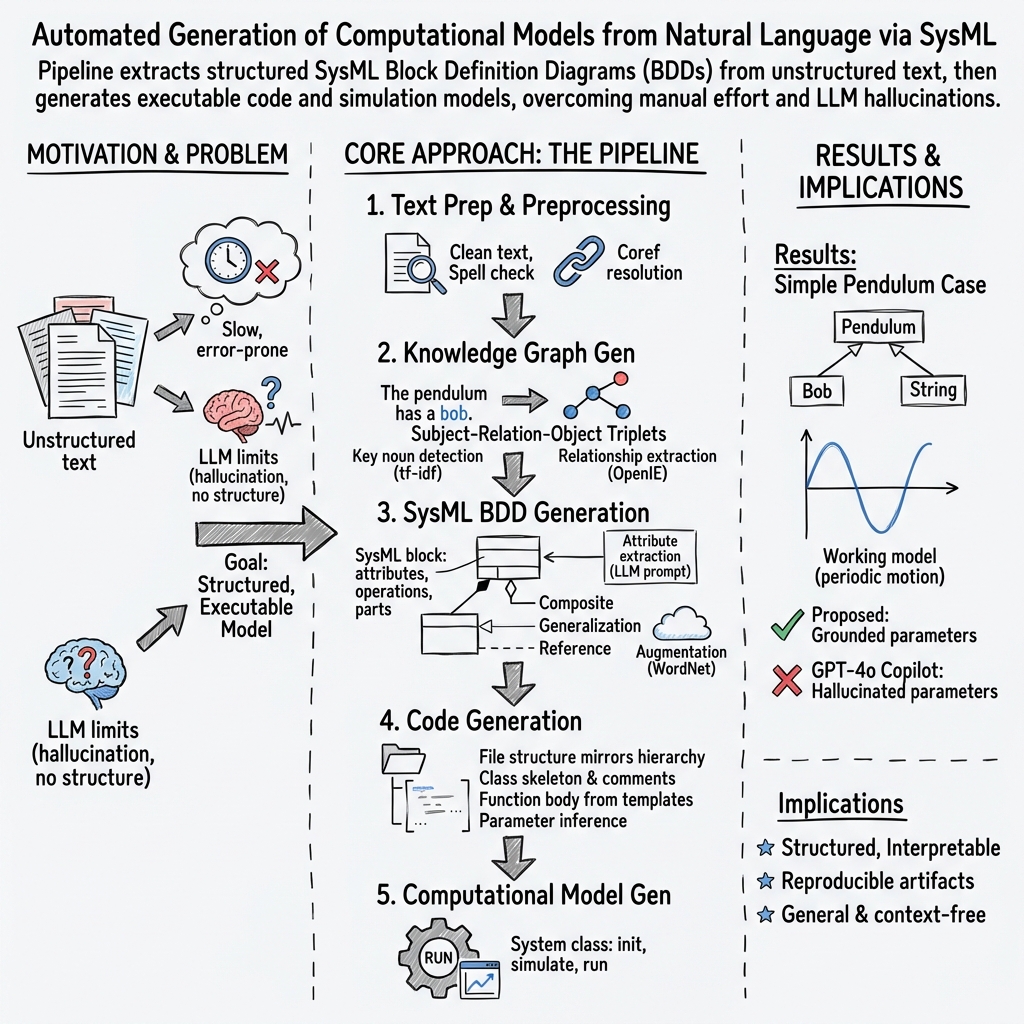
Abstract: This paper contributes to speeding up the design and deployment of engineering dynamical systems by proposing a strategy for exploiting domain and expert knowledge for the automated generation of dynamical system computational model starting from a corpus of document relevant to the dynamical system of interest and an input document describing the specific system. This strategy is implemented in five steps and, crucially, it uses system modeling language diagrams (SysML) to extract accurate information about the dependencies, attributes, and operations of components. NLP strategies and LLMs are employed in specific tasks to improve intermediate outputs of the SySML diagrams automated generation, such as: list of key nouns; list of extracted relationships; list of key phrases and key relationships; block attribute values; block relationships; and BDD diagram generation. The applicability of automated SysML diagram generation is illustrated with different case studies. The computational models of complex dynamical systems from SysML diagrams are then obtained via code generation and computational model generation steps. In the code generation step, NLP strategies are used for summarization, while LLMs are used for validation only. The proposed approach is not limited to a specific system, domain, or computational software. The applicability of the proposed approach is shown via an end-to-end example from text to model of a simple pendulum, showing improved performance compared to results yielded by LLMs only.
Paper Prompts
Sign up for free to create and run prompts on this paper using GPT-5.
Top Community Prompts
Collections
Sign up for free to add this paper to one or more collections.