- The paper introduces a thermodynamics-inspired method using oscillatory neural networks to solve inverse matrix problems via energy function and dynamics approaches.
- The methodology employs a linearized Kuramoto model alongside Langevin dynamics to map oscillator phase interactions to matrix inversion with controlled error margins.
- Simulation results validate the approach, emphasizing the role of coupling strength and noise parameters in achieving precise inverse matrix computations.
Thermodynamics-Inspired Computing with Oscillatory Neural Networks for Inverse Matrix Computation
Introduction
The paper explores the utilization of oscillatory neural networks (ONNs) to solve linear algebraic problems such as matrix inversion. It shifts the paradigm from conventional deterministic computing to a thermodynamics-inspired method based on stochastic processes in ONNs. This novel approach taps into the dynamics of coupled oscillators, traditionally used in combinatorial optimization, to address computational tasks in linear algebra.
Theoretical Foundation
The theoretical basis of this research is grounded in the Kuramoto model, which describes the dynamics of coupled oscillators. The paper employs a linear approximation of the Kuramoto equations to derive the inverse matrix from ONNs. In this framework, the characteristic matrix is represented through the oscillator's phase interactions, where the coupling strengths map to non-diagonal elements, and harmonic injections adjust the diagonal elements.
To achieve this, the energy landscape of an ONN system is analyzed alongside a stochastic model, specifically the Langevin equation, which incorporates both deterministic drift and stochastic diffusion components. This approach necessitates a stochastic interpretation to correctly handle the noise inherent in thermodynamic systems, leading to a formulation where the matrix inversion relies on the analysis of phase covariances.
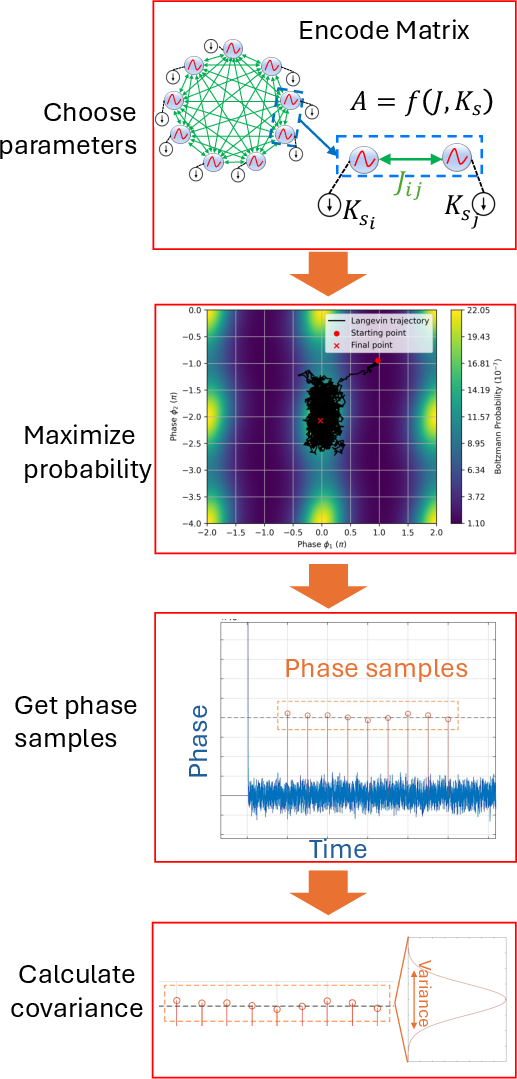
Figure 1: Illustration of the analytical approach for computing the inverse matrix with ONNs.
Methods
The paper outlines two primary methods for matrix inversion via ONNs: the ONN energy function approach and the ONN dynamics approach:
- ONN Energy Function Approach: This technique leverages the Boltzmann distribution of the ONN's energy landscape to estimate phase covariances. The relative precision of the computed inverse matrix improves with increases in coupling strength (K) and noise terms (Kn).
- ONN Dynamics Approach: This method focuses on direct numerical simulations of ONNs governed by a modified stochastic Kuramoto model. It shows that accurate results require reasonable values for K and Kn, which significantly impact relative error distributions.
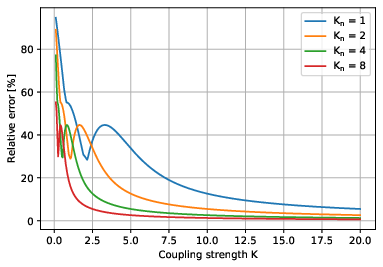
Figure 2: Relative error between computed and actual inverse matrix with respect to overall coupling strength K for various noise terms Kn.
Results and Discussion
Simulation results corroborate the theoretical predictions, confirming the potential of ONNs to compute inverse matrices with considerable accuracy. The ONN's performance is heavily influenced by critical parameters, especially the overall connection strength K, and for practical use, precision concerns predominate. The analysis suggests scale-dependent tuning of K to match typical magnitudes of matrix elements.
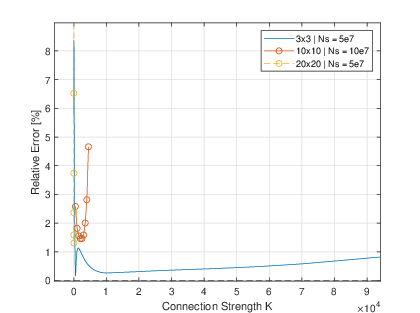
Figure 3: Average relative error as a function of the overall connection strength K for 3x3 and 20x20 matrices with a number of steps Ns=5⋅107 as well as 10x10 matrices with Ns=107.
Interestingly, while noise is a crucial factor in thermodynamic systems, its optimal levels helped balance precision and robustness, as evidenced by testing on diverse random matrices. Time-to-solution emerges as a critical performance metric, primarily reliant on the network's synchronization time and hardware sampling capabilities.
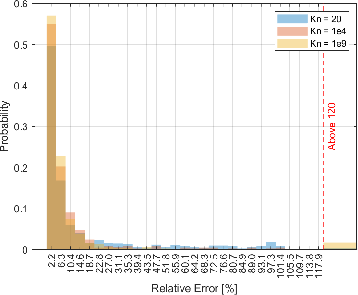
Figure 4: Average relative error distribution of 1000 random 3x3 matrices for various noise terms Kn with number of steps $N_s=5\cdot105. Values exceeding 120\% are grouped into the final bin.
Conclusion
The research presents a promising alternative to classical methods for solving inverse matrix problems by exploiting the dynamics of ONNs. The transitioning from theory to practice involves addressing challenges in phase measurement and integration of physical hardware. Future exploration could advance physical implementations, optimizing the coupling and noise parameters to enhance performance and scalability in practical applications.