- The paper introduces a novel mapping of Brazilian legal norms to Schema.org using the FRBR model to enhance machine readability and data interoperability.
- It utilizes JSON-LD with legal legislation vocabularies to differentiate abstract legal works from their digital manifestations for robust data representation.
- The proposed approach improves AI legal applications by establishing a deterministic ground truth, despite challenges in metadata standardization.
A Foundational Schema.org Mapping for a Legal Knowledge Graph
Introduction
The development of Legal Knowledge Graphs (LKGs) revolutionizes the way legal norms are structured and accessed, enabling advanced AI and information retrieval systems to understand and process legal data effectively. The paper "A Foundational Schema.org Mapping for a Legal Knowledge Graph: Representing Brazilian Legal Norms as FRBR Works" proposes a schema for mapping Brazilian legal norms using the Schema.org vocabulary. This approach leverages the Functional Requirements for Bibliographic Records (FRBR) model, focusing on enhancing the machine readability and interoperability of legal information.
Mapping Methodology
The paper introduces a conceptual framework for representing legal norms as FRBR Works, materialized as Norm nodes within a legal Graph RAG framework. By employing the Schema.org Legislation vocabulary, the mapping offers a structured methodology to handle various aspects of legal norms, such as lifecycle properties, URN identifiers, and inter-norm relationships. JSON-LD is used as the primary data serialization format, given its capability to integrate Linked Data principles effectively.
A central aspect of this mapping is the distinction between the abstract intellectual content of a legal norm (Work) and its specific textual or digital manifestations (Expressions and Manifestations). This conceptual separation ensures a robust representation of legal norms that maintains their semantic integrity across different contexts and timeframes.
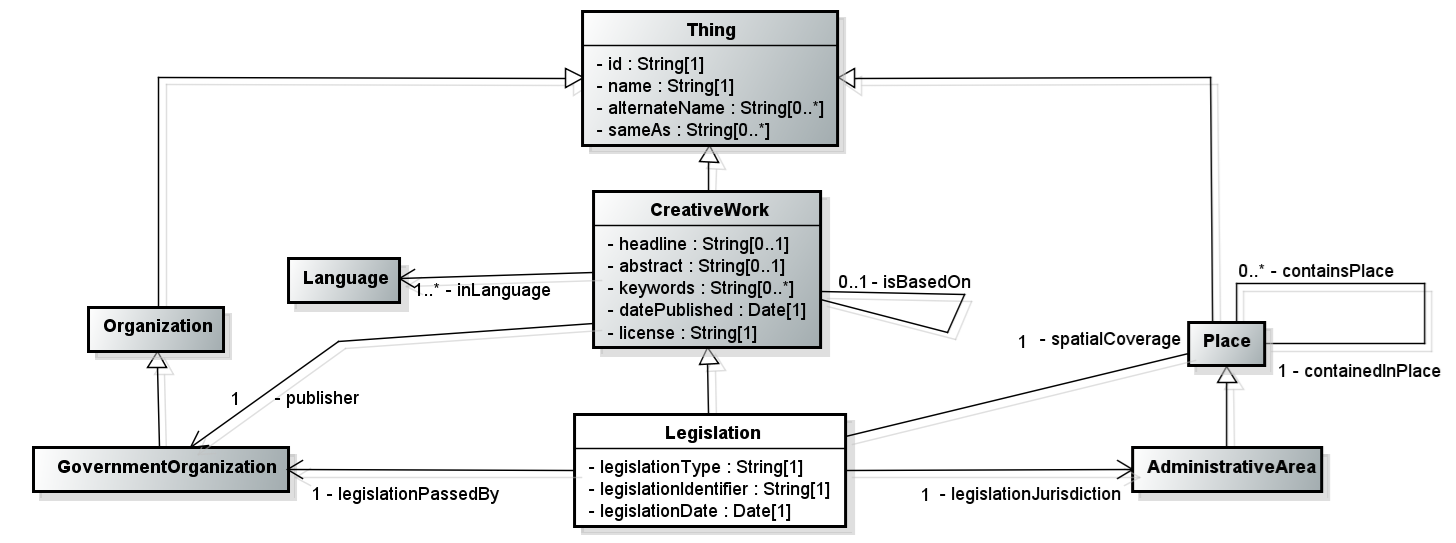
Figure 1: Simplified diagram of the Schema.org vocabulary, according to the proposed mapping in this work.
Implementation Example
Through a detailed case study using the Normas.leg.br portal, the paper exemplifies the mapping process for a specific legal work, the "Lei Complementar n° 123 de 14/12/2006." By employing a set of properties from the sdo:Legislation class, the paper illustrates how these Brazilian legal norms can be encoded in a machine-readable format, facilitating seamless integration into a global LKG ecosystem. Key properties include legislationType, legislationIdentifier, and spatialCoverage, among others, to encapsulate the unique attributes of a legal Work.
1
2
3
4
5
6
7
8
9
10
11
12
13
14
15
16
17
18
|
{
  "@context": "http://schema.org/",
  "@type": "Legislation",
  "@id": "https://normas.leg.br/?urn=urn:lex:br:federal:lei.complementar:2006-12-14;123",
  "legislationType": {
    "@type": "CategoryCode",
    "@id": "https://normas.leg.br/?urn=urn:lex:br:federal:tipo-norma:lei.complementar"
  },
  "legislationIdentifier": "urn:lex:br:federal:lei.complementar:2006-12-14;123",
  "sameAs": [
    "http://www.lexml.gov.br/urn/urn:lex:br:federal:lei.complementar:2006-12-14;123",
    "http://legis.senado.leg.br/legislacao/DetalhaSigen.action?id=572878"
  ],
  "inLanguage": "pt",
  "name": "Lei Complementar n° 123 de 14/12/2006",
  "abstract": "Institui o Estatuto Nacional da Microempresa e da Empresa de Pequeno Porte...",
  "legislationDate": "2006-12-14"
} |
Advantages and Challenges
This mapping strategy provides several benefits, including enhanced interoperability of legal data, improved accuracy of legal AI applications, and greater accessibility of legal information. By establishing a deterministic "ground truth," this approach counters the probabilistic uncertainties inherent in many AI models, such as those used in natural language processing. However, challenges remain in standardizing metadata across jurisdictions and ensuring the completeness of data descriptions to capture all relevant legal nuances.
Conclusion
The paper establishes a foundational layer for structuring Brazilian legal norms as a Legal Knowledge Graph using Schema.org. This groundwork paves the way for advanced applications in Legal Tech, enabling more efficient legal information retrieval and decision support systems. Future work will likely expand this schema to handle the full breadth of legal document versioning, as well as explore cross-jurisdictional and multilingual legal data integration. By better understanding the complexities of legal norms through structured data, the legal domain can continuously innovate and adapt to the evolving digital landscape.