- The paper finds that the entropy-driven phase transition between triple-Q and RW-AFM states is induced by higher-order exchange interactions.
- The authors employ Monte Carlo simulations backed by DFT-based parameters to model and analyze the free energy landscape.
- The study demonstrates that entropic effects favor the RW-AFM state above 32.7 K, emphasizing the role of thermal excitations in ultra-thin antiferromagnets.
Entropy-Driven Phase Transition in Non-Collinear Antiferromagnets
Introduction
This paper explores the emergence of a phase transition in non-collinear antiferromagnets driven by entropy, focusing on the triple-Q (3Q) state in a Mn monolayer on a Re(0001) surface. Utilizing Monte Carlo (MC) simulations based on an atomistic spin model parameterized by density functional theory (DFT), the study identifies a low-temperature phase transition between the 3Q state and the row-wise antiferromagnetic (RW-AFM) state. The authors model the free energy landscape using thermal excitations to derive an analytical expression for the partition function, proving that the phase transition is prominently driven by entropy.
Atomistic Spin Model
Addressing the 3Q state emergence requires incorporating higher-order exchange interactions (HOI) beyond the standard Heisenberg model. These HOIs, although typically smaller than pair-wise exchanges, significantly alter the magnetic ground state by breaking degeneracies between single-Q and multi-Q states. A classical extended Heisenberg Hamiltonian models the system:
H=−i,j∑Jij(mi⋅mj)−i∑Ki(n⋅mi)2−...i,j,k,l∑Fijkl(mi⋅mj)(mk⋅ml)...
The parameters are derived from previous DFT calculations for a Mn monolayer on a Re(0001) surface, neglecting minor contributions from dipole-dipole interactions and the Dzyaloshinskii-Moriya interaction.
Monte Carlo Simulations and Observations
Monte Carlo simulations reveal both the triple-Q state and RW-AFM state as significant configurations.
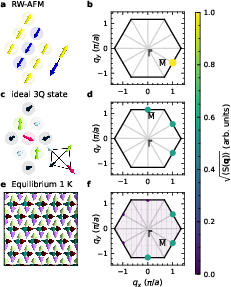
Figure 1: Representations of RW-AFM and 3Q state in real and reciprocal space, demonstrating distinct components in their spin-structure factor.
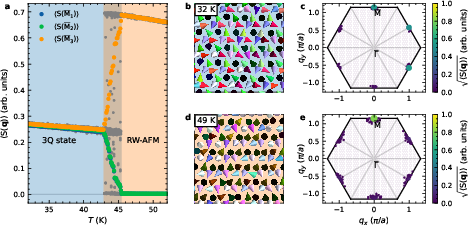
Figure 2: Phase transition from the 3Q to the RW-AFM state, indicating shifts in temperature dependence and SSF prominence.
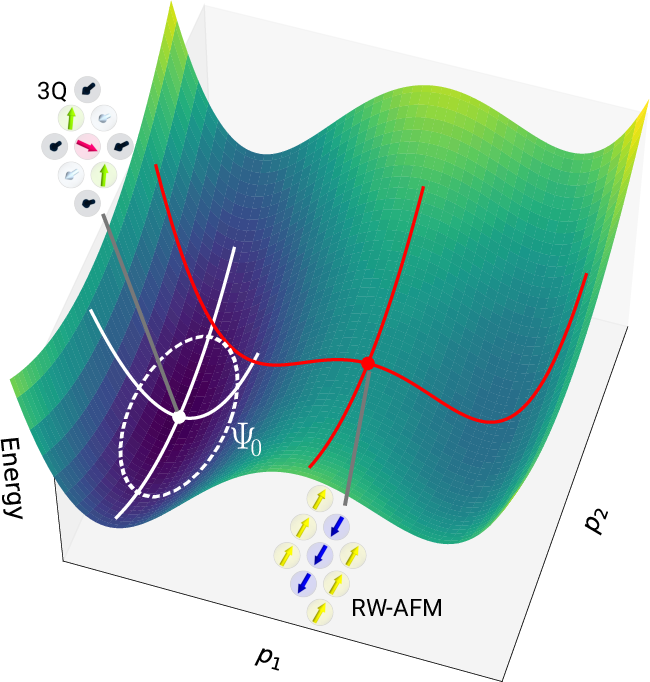
Figure 3: Energy landscape around the 3Q and the RW-AFM state, highlighting Hessian eigenmodes around local minima and stationary points.
With DFT parameters, simulations showcase the 3Q state at low temperatures transitioning to an RW-AFM state at higher temperatures, underscoring HOI's influence on free energy configurations.
Analytical Approaches: Partition Function and Free Energy
The framework extends traditional harmonic approximations to include unstable Hessian eigenmodes, enabling calculation of partition functions and state functions like free energy, entropy, and internal energy.
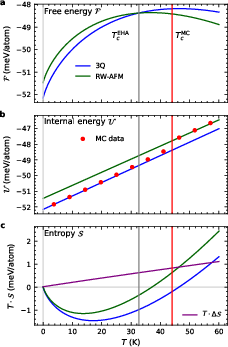
Figure 4: Thermodynamic state functions across the phase transition, with entropy differences calculated between states.
For low temperatures, the free energy of the 3Q state is lower, but at Tc=32.7 K, the RW-AFM gains favor due to entropic advantages, manifesting as a temperature-driven transition.
Phase Diagrams and Variability
Phase stability checks across various magnetic interaction parameters corroborate the transition's robustness.
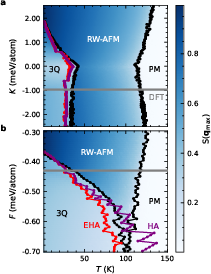
Figure 5: Phase diagrams show SSF variations with magnetic interaction strengths, confirming robust phase boundaries.
MAE and four-spin interactions notably shift transition temperatures, demonstrating the delicate balance of entropic and energetic factors.
Conclusion
The paper confirms the role of entropy in governing phase transitions between 3Q and RW-AFM states via HOI, with far-reaching implications for understanding the thermodynamics of ultra-thin antiferromagnetic films. The extended harmonic approach proves valuable, potentially aiding the design of new materials with targeted magnetic properties. Future exploration could address structural factors affecting state energy discrepancies, enhancing predictive accuracy in experimental contexts.