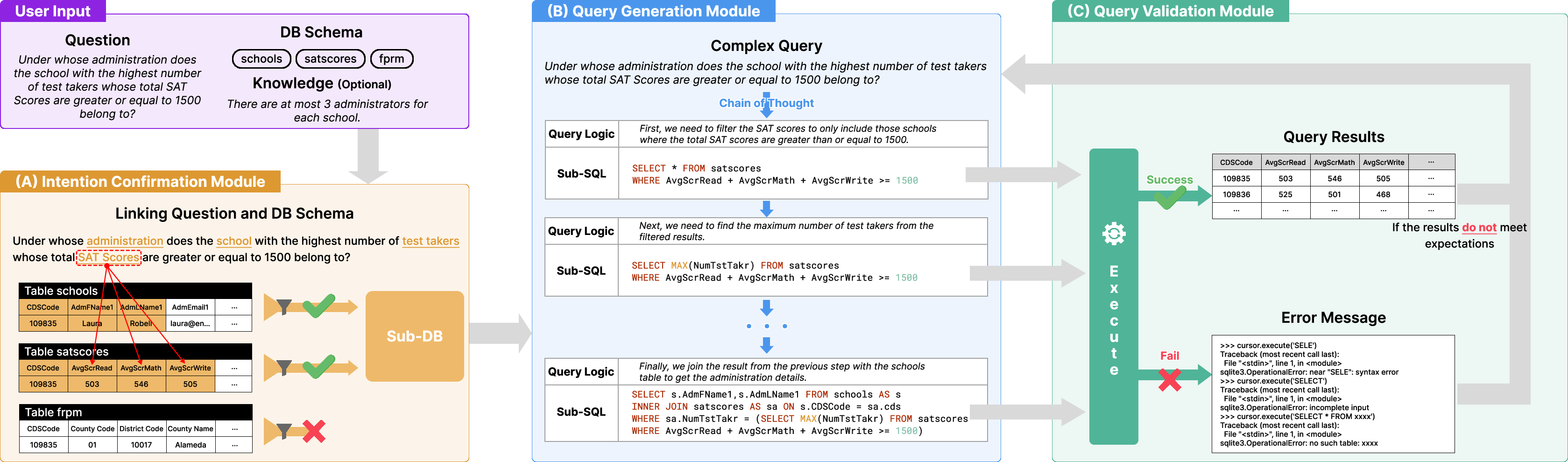
- The paper presents QueryGenie’s three-stage framework—Intention Confirmation, Query Generation, and Query Validation—to ensure accurate mapping of natural language to SQL.
- The system employs a chain-of-thought approach to decompose complex queries into interpretable sub-queries, enhancing user understanding and intervention.
- Preliminary evaluations demonstrate a 90.3% query accuracy, outperforming existing tools and significantly strengthening user trust.
QueryGenie: Making LLM-Based Database Querying Transparent and Controllable
The paper "QueryGenie: Making LLM-Based Database Querying Transparent and Controllable" introduces a novel framework aimed at addressing the challenges of opacity and lack of control in LLM-powered database querying systems. QueryGenie enhances the interaction between users and LLMs by implementing a structured, three-module system designed to improve accuracy and user trust in the query generation process.
Introduction
LLM-powered conversational interfaces have democratized access to database querying by enabling users to interact with databases using natural language. However, issues such as intent misinterpretation, hallucinated content generation, and inefficacy in handling user feedback remain significant obstacles to their reliable application. This paper presents QueryGenie, an interactive system that aims to mitigate these challenges by fostering transparent and controllable LLM query generation. The system allows users to monitor and intervene in the query generation process, enhancing both reliability and user trust through a three-stage framework: Intention Confirmation, Query Generation, and Query Validation.
System Framework and Components
QueryGenie's architecture consists of three primary modules, each focusing on a distinct aspect of the querying process:
Enhanced User Interface
The user interface of QueryGenie is designed to maximize transparency and user control. It features a database panel where users can connect to their databases and explore their structures visually. This interface supports keyword-based filtering and UML diagram integration for an intuitive understanding of database schemas.

Figure 2: The user interface of QueryGenie.
The conversational interface supports user-LLM interaction by visualizing the schema mappings and reasoning paths. Users have the option to provide corrective feedback to the LLM or manually adjust schema mappings. The interface emphasizes transparency by allowing users to expand intermediate steps of the CoT breakdown and view detailed explanations for each query component.
Preliminary evaluations indicate that QueryGenie significantly enhances query accuracy compared to existing tools like Vanna. Participants' use of QueryGenie resulted in a performance accuracy of 90.3%, compared to Vanna's 66.7%. While QueryGenie requires more time per task, the trade-off yields higher reliability and insight into LLM reasoning, contributing positively to user confidence and system usability.
Conclusion
QueryGenie represents a step forward in the field of LLM-driven database querying by facilitating a human-AI collaboration paradigm that emphasizes transparency and user control. It addresses fundamental challenges in current LLM applications by integrating visualization and real-time feedback mechanisms. Future work can explore the integration of more sophisticated user guidance systems and the expansion of the framework to accommodate more diverse querying contexts. The implications of this study suggest significant potential for enhancing user trust and effectiveness in LLM-based systems for database interaction.