- The paper presents quaternion-native iterative methods adapted for computing the Moore-Penrose pseudoinverse in noncommutative quaternion spaces.
- It introduces damped Newton-Schulz and higher-order hyperpower schemes that ensure faster convergence and higher computational accuracy.
- The study demonstrates significant improvements in image/video completion, Lorenz system filtering, and nonblind image deblurring.
Iterative Methods for Computing the Moore-Penrose Pseudoinverse of Quaternion Matrices, with Applications
Introduction
This paper proposes quaternion-native iterative methods to compute the Moore-Penrose (MP) pseudoinverse of quaternion matrices, which are essential for applications such as image/video processing and solving large-scale quaternion inverse problems. Traditional techniques for calculating the MP pseudoinverse in real or complex domains are extended to accommodate the non-commutativity of quaternion multiplication, highlighting the challenges and innovations involved.
Quaternion Matrix Properties
The foundation of quaternion matrices relies on the quaternion algebra H, where basic arithmetic operations extend the rules of complex numbers to include three imaginary units. This non-commutative nature necessitates a careful formulation of iterative methods to ensure computational stability and convergence in quaternion space, without reverting to real or complex embeddings. The Moore-Penrose pseudoinverse in H is defined through four Penrose equations analogous to those in the real/complex domains, preserving mathematical integrity while leveraging quaternionic properties.
Quaternion-native Newton-Schulz Methods
The proposed iterative methods start with a damped Newton-Schulz (NS) iteration, specifically tailored for quaternion matrices. The iteration is initialized with a scaled quaternionic adjoint of the matrix, and convergence is ensured through spectral scaling. This method is augmented by higher-order hyperpower NS schemes that drive faster convergence by reconstructing quaternion residuals using exact recurrence relations.
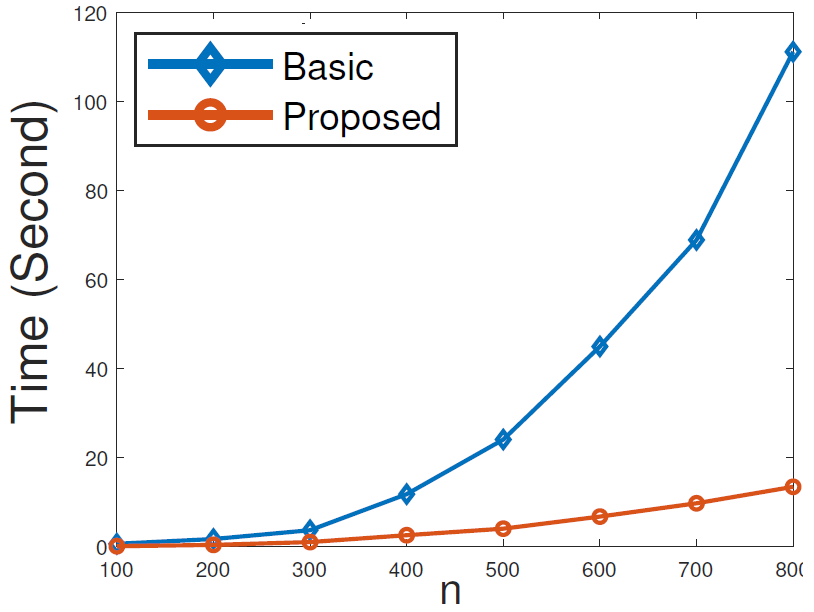
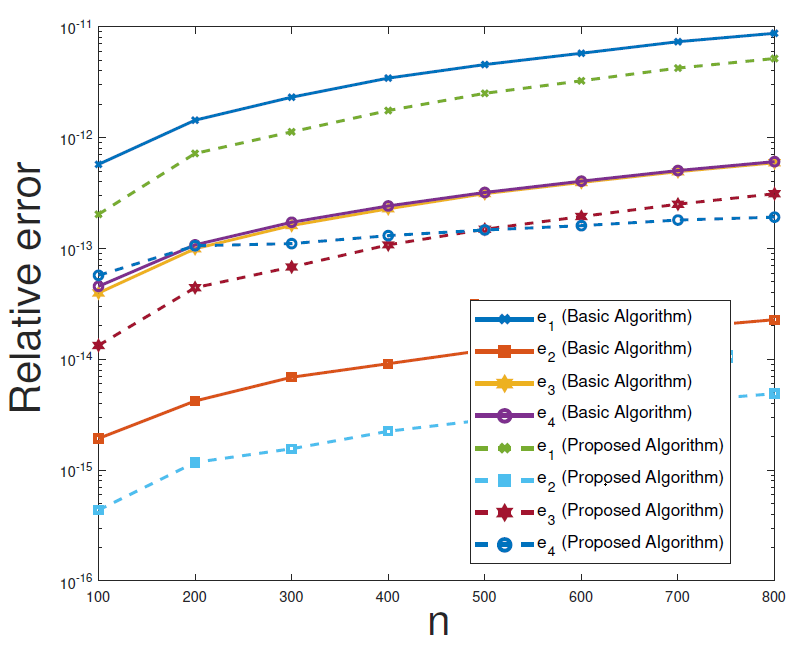
Figure 1: Comparison of QSVD-based MP inverse (baseline) and the proposed iterative method on random n×(n+50) quaternion matrices, demonstrating faster computation and higher accuracy.
Randomized Sketch-and-Project Methods
A hybrid randomized sketch-and-project approach is introduced, interleaving randomized projections with quaternion local updates. This method effectively combines global exploration with rapid local convergence, taking advantage of both randomized and deterministic paradigms to arrive at the pseudoinverse more efficiently.
Application Case Studies
The application of these quaternion-native iterative methods extends across several domains:
- CUR Decomposition for Image/Video Completion: Utilizing the NS family to compute pseudoinverses within CUR decompositions significantly reduces computation time while enhancing completion quality for missing data imputation in images and videos.
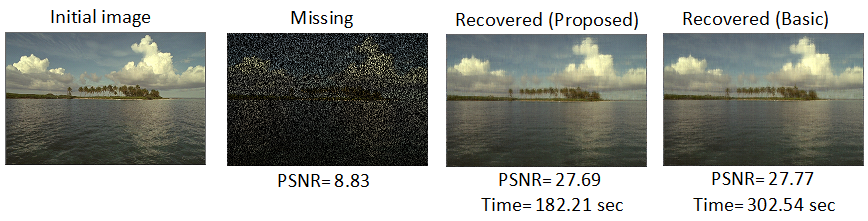
Figure 2: Kodim16: original (left), 70\% missing, and reconstructions by QSVD-MP (``basic algorithm") vs. iterative MP.
- Lorenz System Filtering: Employing NS iterations provides a quaternion-based filtering mechanism that efficiently reconstructs trajectories from noisy inputs, outperforming comparators like QGMRES in both accuracy and computational cost.
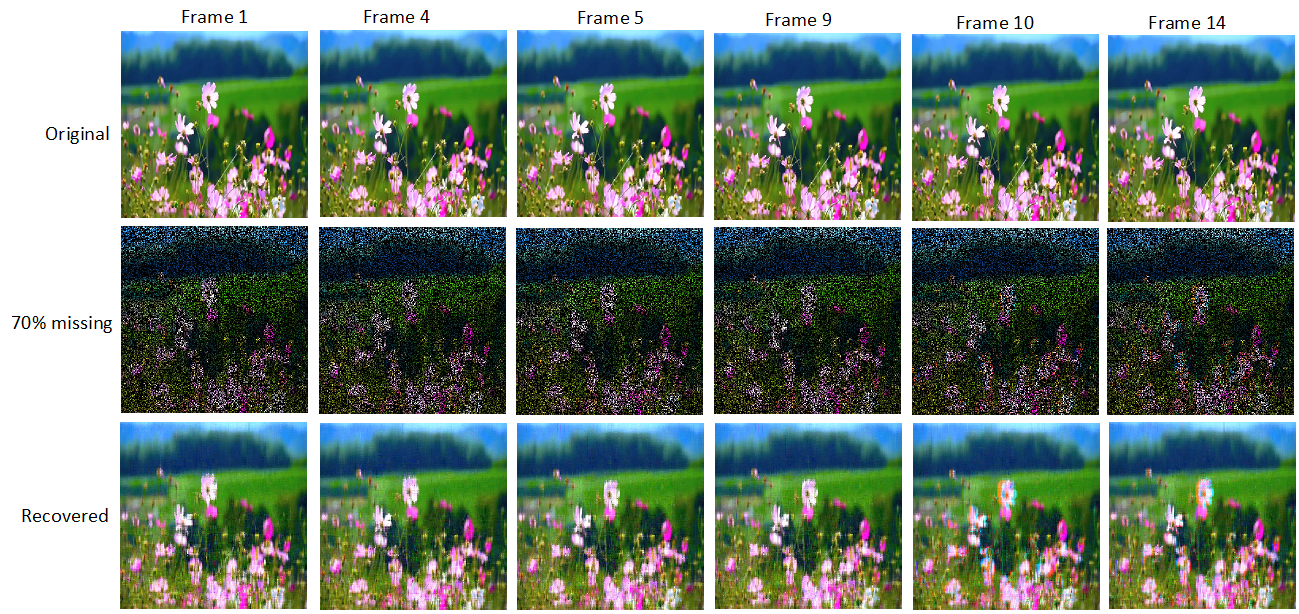
Figure 3: True vs. reconstructed 1D signal components for the Lorenz system over T=10 s. Solid light green: observed signal (noisy), Solid black: ground truth; dashed blue: NS--Q; dotted red: QGMRES.
- Nonblind Image Deblurring: FFT-accelerated NS--Q algorithms offer a powerful alternative to traditional FFT-based deblurring methods, especially when preserving quaternionic information is crucial for color image accuracy.
Figure 4: Nonblind deblurring comparison at N=512: each grid shows, from left to right, the original image, the blurred/noisy observation, the QSLST--FFT reconstruction, and the FFT--NS--Q reconstruction. Both methods produce visually indistinguishable results.
Conclusion
The effective computation of MP pseudoinverses of quaternion matrices through NS and related iterative methods bridges a significant gap in quaternion matrix applications, providing a robust computational framework. Future work could explore regularization extensions, tensor generalizations, and adaptations suitable for GPU acceleration, ensuring these methods meet emerging demands in AI and graphics.
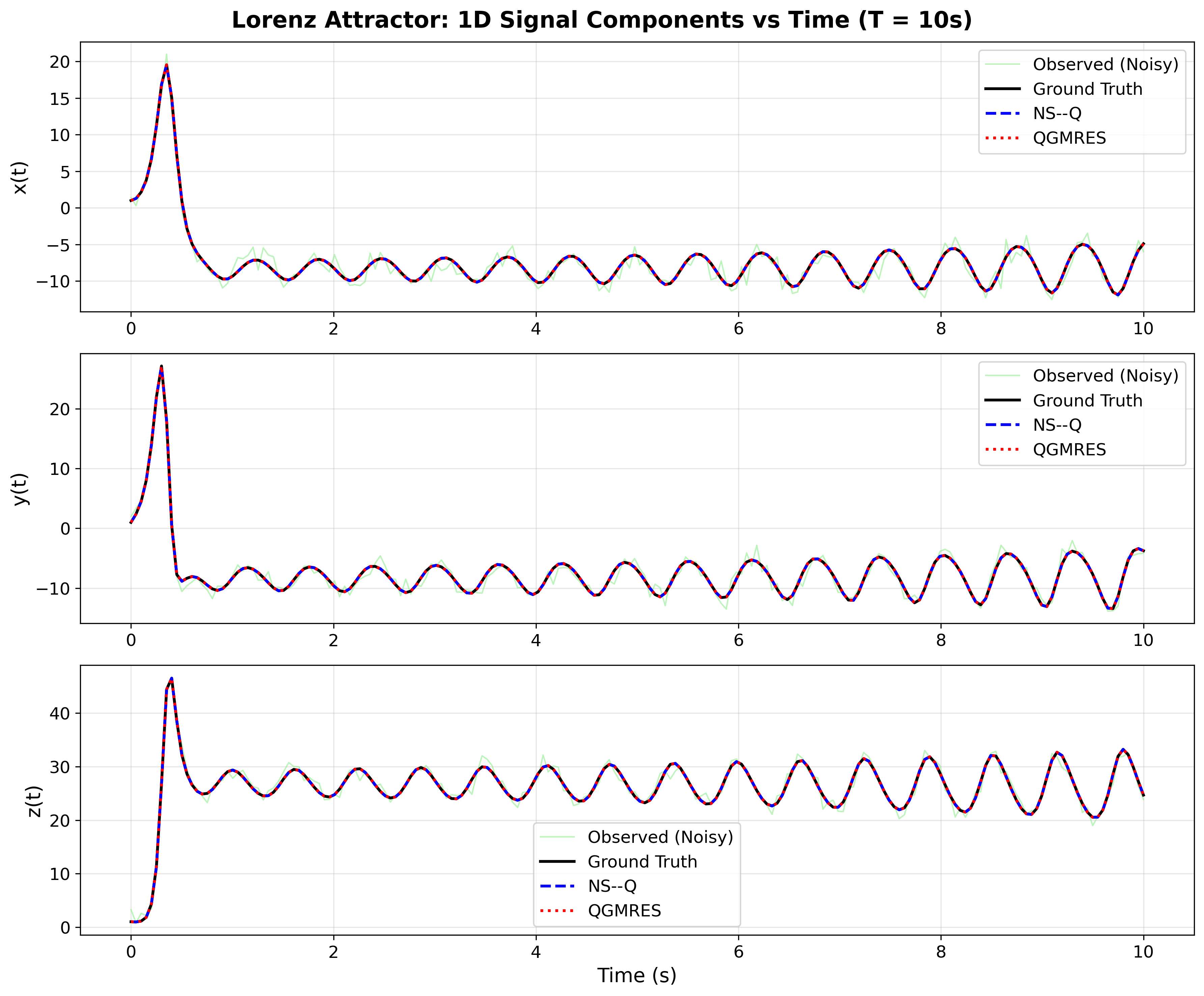
Figure 5: Benchmark for proposed iterative methods for computing pseudo-inverses, highlighting their scalability and efficiency in quaternion computations.