- The paper presents the first infrared spectroscopic detection of a CO2-dominated gas coma with a CO2/H2O mixing ratio of 8.0±1.0.
- JWST NIRSpec IFU observations and spectral modeling provided precise production rates and spatially resolved images of the coma.
- Results suggest either intrinsic CO2 enrichment or suppressed H2O sublimation, challenging conventional cometary volatile trends.
JWST NIRSpec Detection of a CO2-Dominated Gas Coma Surrounding Interstellar Object 3I/ATLAS
Introduction
The paper presents JWST NIRSpec IFU observations of 3I/ATLAS, the third confirmed interstellar object (ISO) and only the second ISO to display a clear coma. The study provides the first infrared spectroscopic characterization of its volatile inventory, focusing on the detection and quantification of CO2, H2O, CO, and OCS in the coma at rH=3.32~au. The results reveal a CO2-dominated gas coma with a CO2/H2O mixing ratio of 8.0±1.0, which is 4.4σ above the trend observed in Solar System comets at similar heliocentric distances. This finding has significant implications for understanding the chemical diversity of ISOs and the physicochemical processes in their parent protoplanetary disks.
Observational Strategy and Data Reduction
JWST NIRSpec IFU observations were conducted with a 3′′×3′′ field of view, providing spatially resolved spectra from $0.6$--$5.3$~μm at variable resolving power (Rλ∼30--$300$). Four dithered exposures were combined in the comet rest frame, with sky background subtraction to isolate faint gas emission bands. The data reduction pipeline included uncertainty and data quality mapping, yielding an absolute calibration accuracy of 3%.
The integrated spectrum over the IFU field of view displays prominent features: a broad dust-scattered sunlight peak at ∼1.2 μm, a strong CO2 emission at 4.3 μm, and weaker bands from H2O, CO, and 13CO2. Water ice absorption features are evident at 3.0~μm and 4.5~μm, consistent with micrometer-sized icy grains.
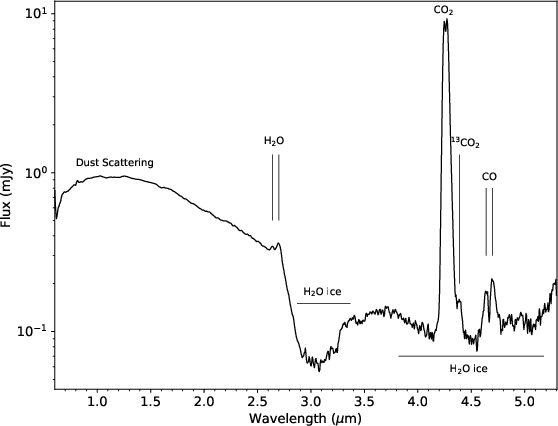
Figure 1: JWST NIRSpec prism spectrum of 3I/ATLAS, showing strong CO2 emission and labeled spectral features.
Spatial Distribution of Dust and Gas
Spectrally integrated flux maps for dust and gas species reveal a heterogeneous coma morphology. The dust-scattered light at 1.2 μm is enhanced in the sunward direction, while CO2, H2O, and CO emission maps show more symmetric distributions, with subtle azimuthal variations. The 1/ρ-enhanced maps (where ρ is the sky-projected nucleocentric distance) highlight a plume-like dust feature in the sunward direction and minor asymmetries in the gas distributions, attributed to differences in molecular sublimation temperatures and outgassing mechanisms.
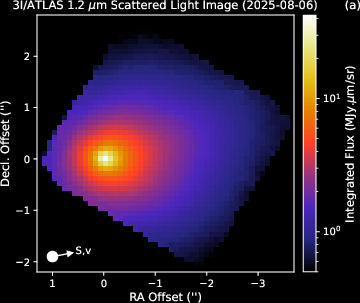
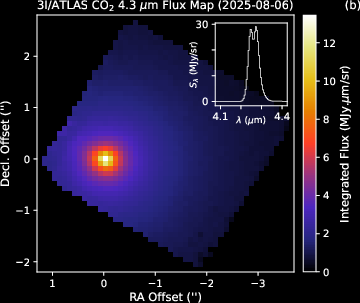
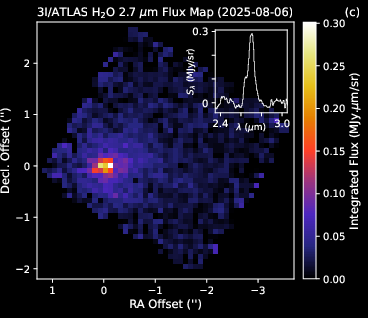
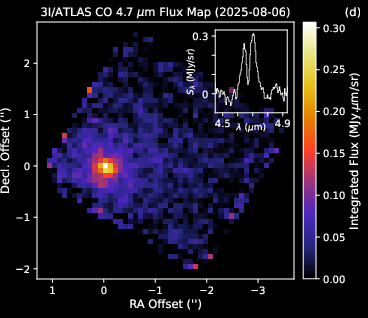
Figure 2: JWST NIRSpec flux maps for dust at 1.2 μm, CO2 at 4.3 μm, H2O at 2.7 μm, and CO at 4.7 μm, showing spatially resolved coma structure.
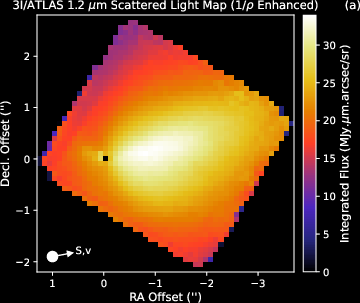
Figure 3: 1/ρ-enhanced 1.2 μm dust map, revealing a sunward plume-like feature.
Spectral Modeling and Gas Production Rates
Spectral modeling was performed using the Planetary Spectrum Generator (PSG), with optimal estimation routines and synthetic fluorescence models. Continuum subtraction employed polynomial and physically motivated analytic functions, particularly for the H2O region, to account for the wing of the 3~μm ice band.
Production rates (Q) and rotational temperatures (Trot) were retrieved as a function of nucleocentric distance using a Q-curve analysis. For the nucleus-centered aperture ($0.625''$ radius), the best-fit production rates are:
- Q(CO2)=(9.81±0.08)×1026~s−1
- Q(CO)=(1.94±0.04)×1026~s−1
- Q(H2O)=(1.04±0.07)×1026~s−1
- Q(OCS)=(1.3±0.2)×1024~s−1
Terminal production rates from the outer annuli are:
- Q(CO2)=(1.76±0.02)×1027~s−1
- Q(CO)=(3.0±0.2)×1026~s−1
- Q(H2O)=(2.19±0.08)×1026~s−1
- Q(OCS)=(4.3±0.9)×1024~s−1
The CO2/H2O mixing ratio is 8.0±1.0, and the CO/H2O ratio is 1.4±0.2. The Q curves for CO2 and CO plateau at larger distances, indicating nucleus-confined production, while H2O may have an extended source from sublimating icy grains.
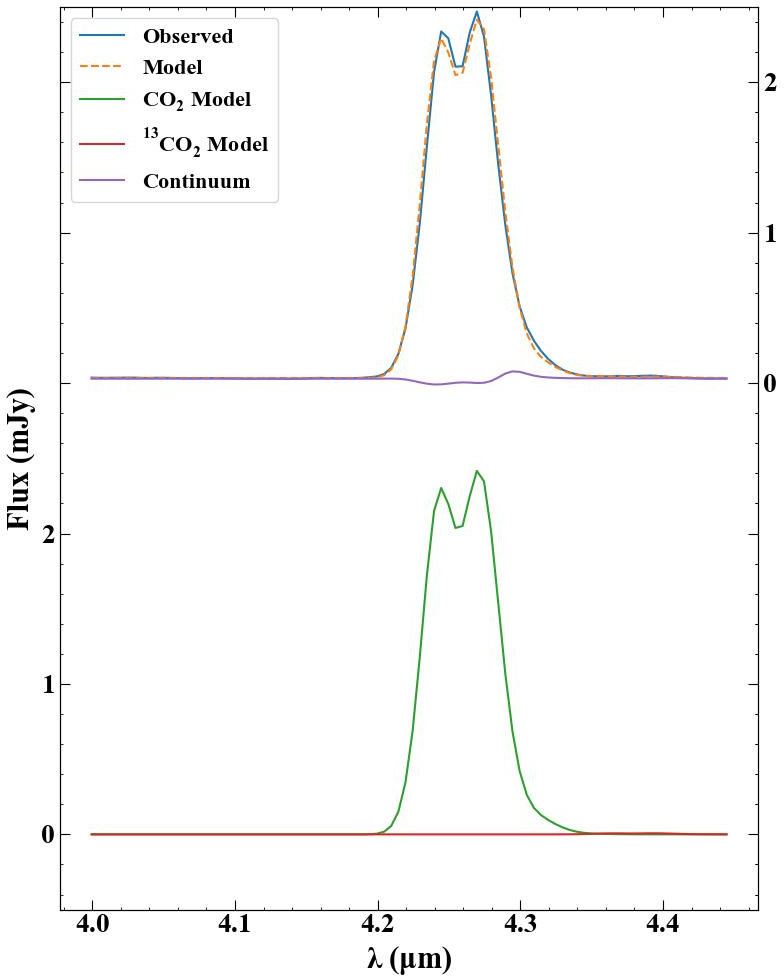
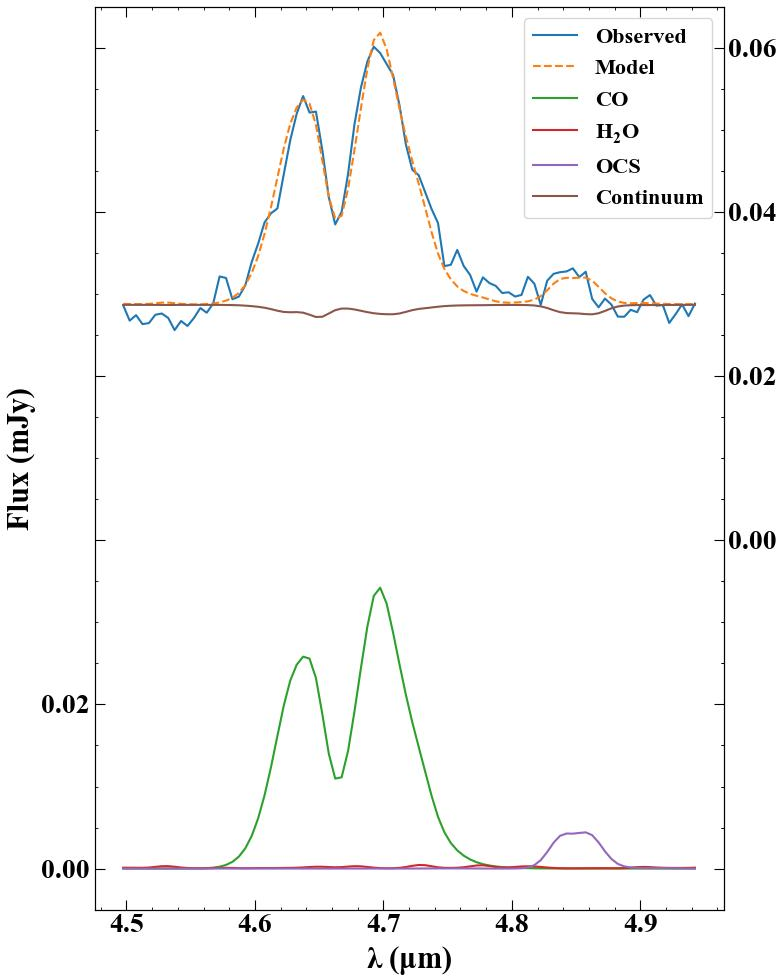
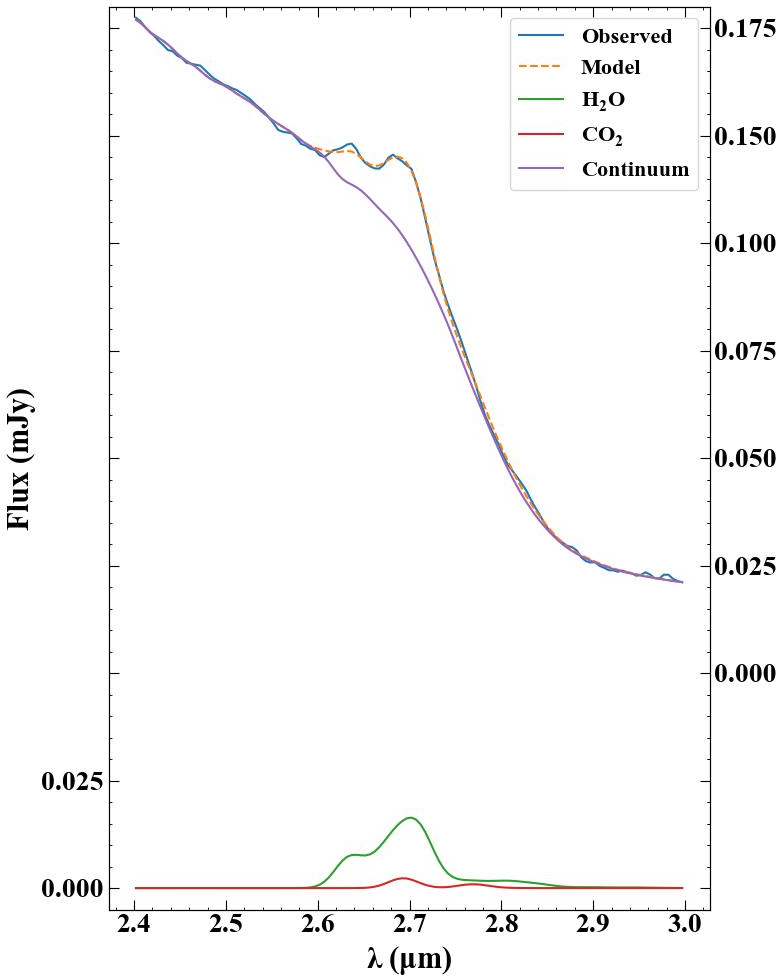
Figure 4: NIRSpec IFU spectra and best-fitting PSG models for CO2, CO, and H2O in a nucleus-centered aperture.
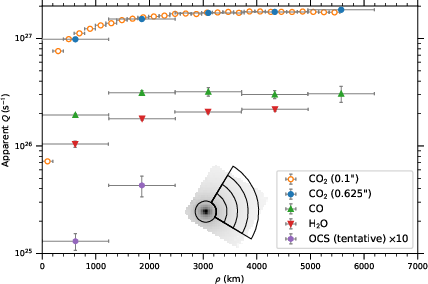
Figure 5: Production rates (Q curves) for CO2, CO, H2O, and OCS as a function of distance from the nucleus.
Isotopic Constraints
13CO2 is detected in the nucleus-centered aperture, but optical depth effects preclude a reliable 12CO2/13CO2 ratio. In the first annular sector, a 3σ lower limit of 12C/13C > 77 is obtained, consistent with the terrestrial value.
Comparison with Solar System Comets
The CO2/H2O ratio in 3I/ATLAS is anomalously high compared to Solar System comets at similar rH. Figure 6 shows the distribution of CO2/H2O ratios as a function of heliocentric distance for various comet populations. 3I/ATLAS lies 4.4σ above the log-linear trend for long-period and Jupiter-family comets, with only the hypervolatile-rich C/2016 R2 (PanSTARRS) displaying a comparably high ratio.
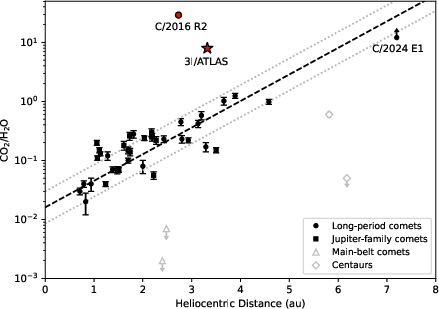
Figure 6: CO2/H2O mixing ratios vs. heliocentric distance for comets; 3I/ATLAS (red star) is a strong outlier.
Physical and Chemical Implications
The high CO2/H2O ratio suggests either an intrinsically CO2-rich nucleus or suppressed H2O sublimation due to inhibited heat penetration, possibly from a volatile-depleted crust or high-albedo surface. Theoretical models of protoplanetary disk chemistry indicate that CO2 enrichment can occur in UV-irradiated or cosmic-ray-processed regions, or near the CO2 ice line due to diffusive redistribution and pebble drift. The observed ratios in 3I/ATLAS may reflect formation in such environments, potentially in a low-metallicity, thick-disk stellar system.
Active surface fraction calculations yield lower limits of >2.6% for CO2, >0.14% for CO, and >0.62% for H2O, consistent with CO2-driven dust ejection. The presence of micrometer-sized water ice grains and amorphous ice signatures further supports a unique thermal and irradiation history.
Rotational Temperatures
Rotational temperatures for CO2, CO, and H2O were retrieved as a function of nucleocentric distance, providing constraints on coma excitation conditions and outflow dynamics.
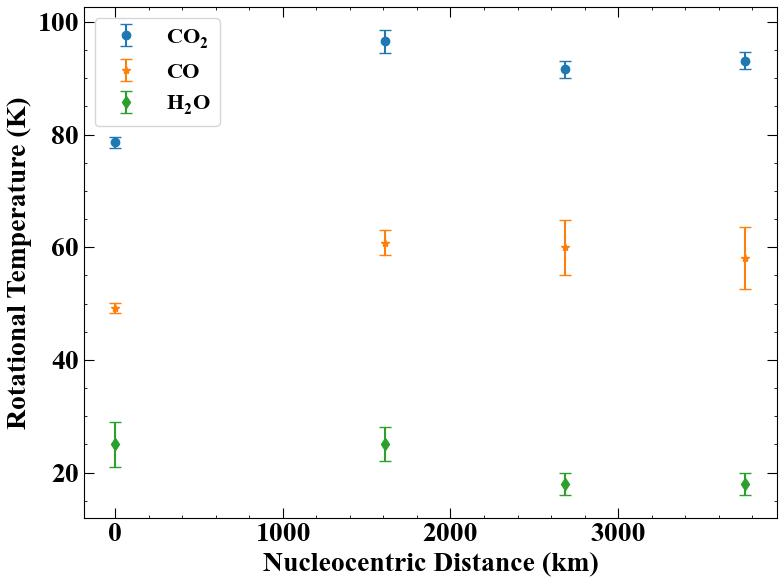
Figure 7: Rotational temperatures for CO2, CO, and H2O as a function of distance from the nucleus.
Broader Context and Future Directions
The detection of a CO2-dominated coma in 3I/ATLAS expands the compositional diversity observed in ISOs and challenges existing paradigms of cometary volatile inventories. The result underscores the need for further JWST and ground-based observations of ISOs and distant comets, particularly at rH<3~au, to probe the activation of less volatile ices and refine models of nucleus composition and thermal evolution.
The findings have implications for the interpretation of protoplanetary disk chemistry, the role of irradiation and disk dynamics in setting ice abundances, and the potential for ISOs to sample regions of disks inaccessible to direct observation. The combined capabilities of JWST and the Vera C. Rubin Observatory will be instrumental in building a statistically robust sample of ISOs and constraining the range of volatile compositions.
Conclusion
JWST NIRSpec IFU spectroscopy of 3I/ATLAS reveals a gas- and ice-rich coma with an unprecedented CO2/H2O mixing ratio of 8.0±1.0 at rH=3.32~au, far exceeding the trend observed in Solar System comets. The data support a scenario of either intrinsic CO2 enrichment or suppressed H2O sublimation, with implications for the object's formation environment and thermal history. These results highlight the compositional diversity of ISOs and motivate continued spectroscopic monitoring to elucidate the origins and evolution of interstellar small bodies.