- The paper demonstrates that nickel emission increases steeply with decreasing heliocentric distance, suggesting low-activation-energy release mechanisms in 3I/ATLAS.
- It employs medium- and high-resolution VLT spectroscopy to quantify Ni and CN production rates, tracking their temporal evolution from 4.4 to 2.85 au.
- Results highlight potential organometallic carriers and distinct activation thresholds compared to classical cometary volatiles, offering insights into extrasolar cometary chemistry.
Spectroscopic Evolution of Interstellar Comet 3I/ATLAS: Nickel and CN Emission at Large Heliocentric Distances
Introduction
This study presents a comprehensive spectroscopic analysis of the interstellar comet 3I/ATLAS (C/2025 N1) using ESO VLT/X-shooter and UVES instruments, focusing on the evolution of atomic nickel (Ni I) and cyanogen (CN) emissions as the comet approaches perihelion. The work situates 3I/ATLAS within the context of previous interstellar objects (ISOs), notably 1I/‘Oumuamua and 2I/Borisov, and Solar System comets, emphasizing the unique opportunity provided by early discovery and extended monitoring at large heliocentric distances (rh=4.4–$2.85$ au).
Observational Campaign and Data Reduction
The campaign utilized medium-resolution (X-shooter, R∼3200) and high-resolution (UVES, R∼35,000–$80,000$) spectroscopy, spanning the UV/blue region (300–550 nm). Observations were scheduled at a cadence of 3–5 days, enabling temporal tracking of volatile and refractory species. Data reduction involved custom PSF tracing and extraction routines to mitigate contamination from crowded stellar fields, with continuum subtraction performed using solar analog spectra to isolate emission features.
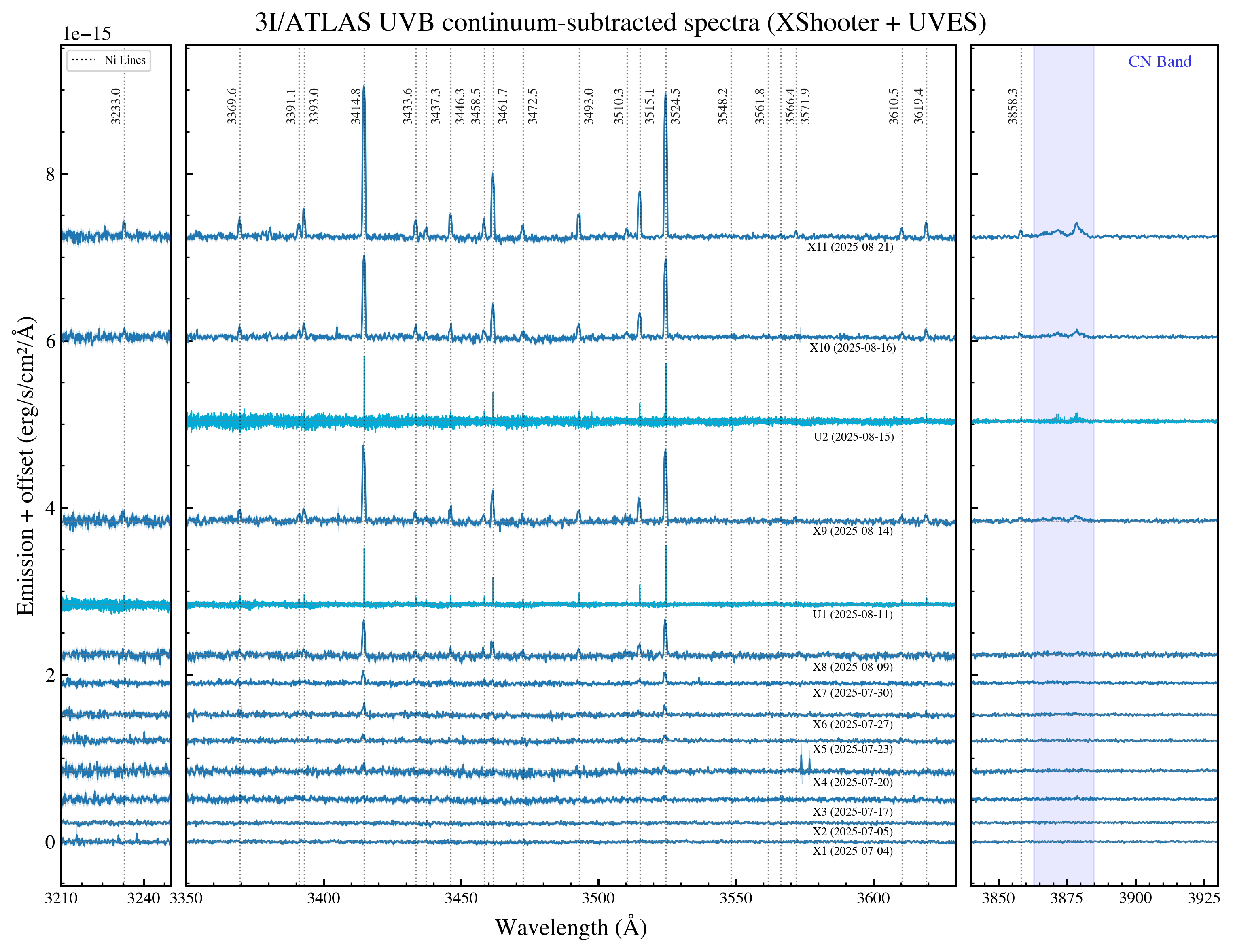
Figure 1: Continuum-subtracted UV/blue spectra of 3I/ATLAS over eleven VLT/X-shooter and two VLT/UVES visits, showing the emergence of Ni I and CN emission lines as the comet approaches perihelion.
Spectral Analysis and Emission Line Identification
Continuum-subtracted spectra revealed the onset and strengthening of Ni I emission lines (3400–3600 Å) and the CN (B-X) band (3880 Å) at progressively smaller rh. The dust continuum exhibited a constant red slope (∼22%/1000 Å), with no significant evolution in color, indicating stable dust properties during the period of volatile activation.
Production Rate Determination
Emission line fluxes were converted to production rates using established Haser models and multilevel fluorescence modeling. For Ni I, Gaussian fitting of individual lines and integration over the slit area yielded robust column densities. CN production rates were derived from the asymmetric band profile, adopting fluorescence efficiencies and scale lengths consistent with prior cometary studies.
Temporal Evolution of Nickel and CN Emission
Nickel emission was first detected at rh=3.88 au, with production rates increasing steeply as the comet approached the Sun, following Q(Ni)∝rh−8.43±0.79. CN emission appeared later, at rh=3.07 au, with a similarly steep dependence, Q(CN)∝rh−9.38±1.2. These indices are significantly steeper than those observed for classical volatiles in Solar System comets, suggesting activation mechanisms beyond simple radiative or insolation scaling.
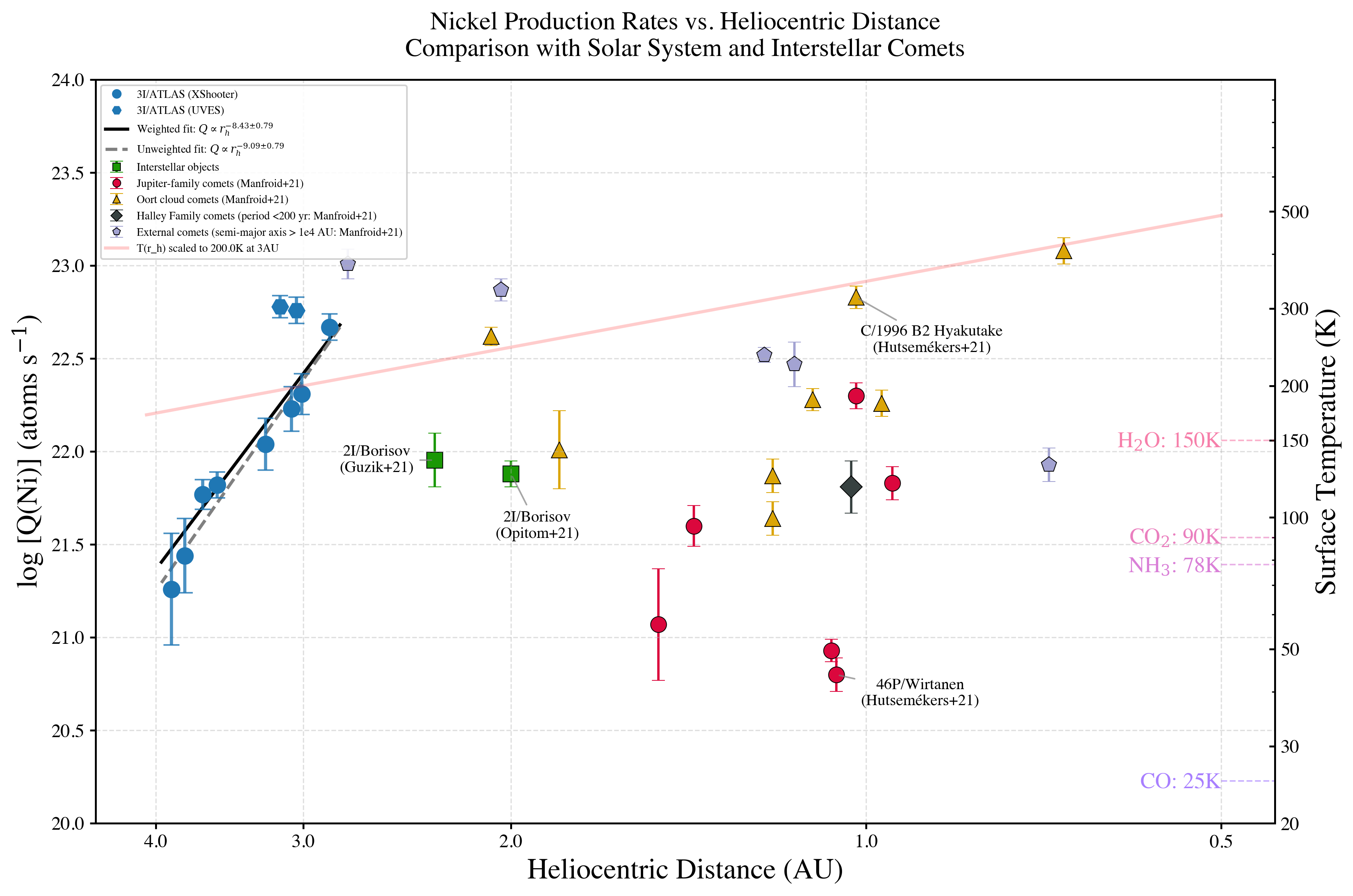
Figure 2: Nickel production versus heliocentric distance, showing a steep power-law dependence and comparison with Solar System comets and 2I/Borisov.
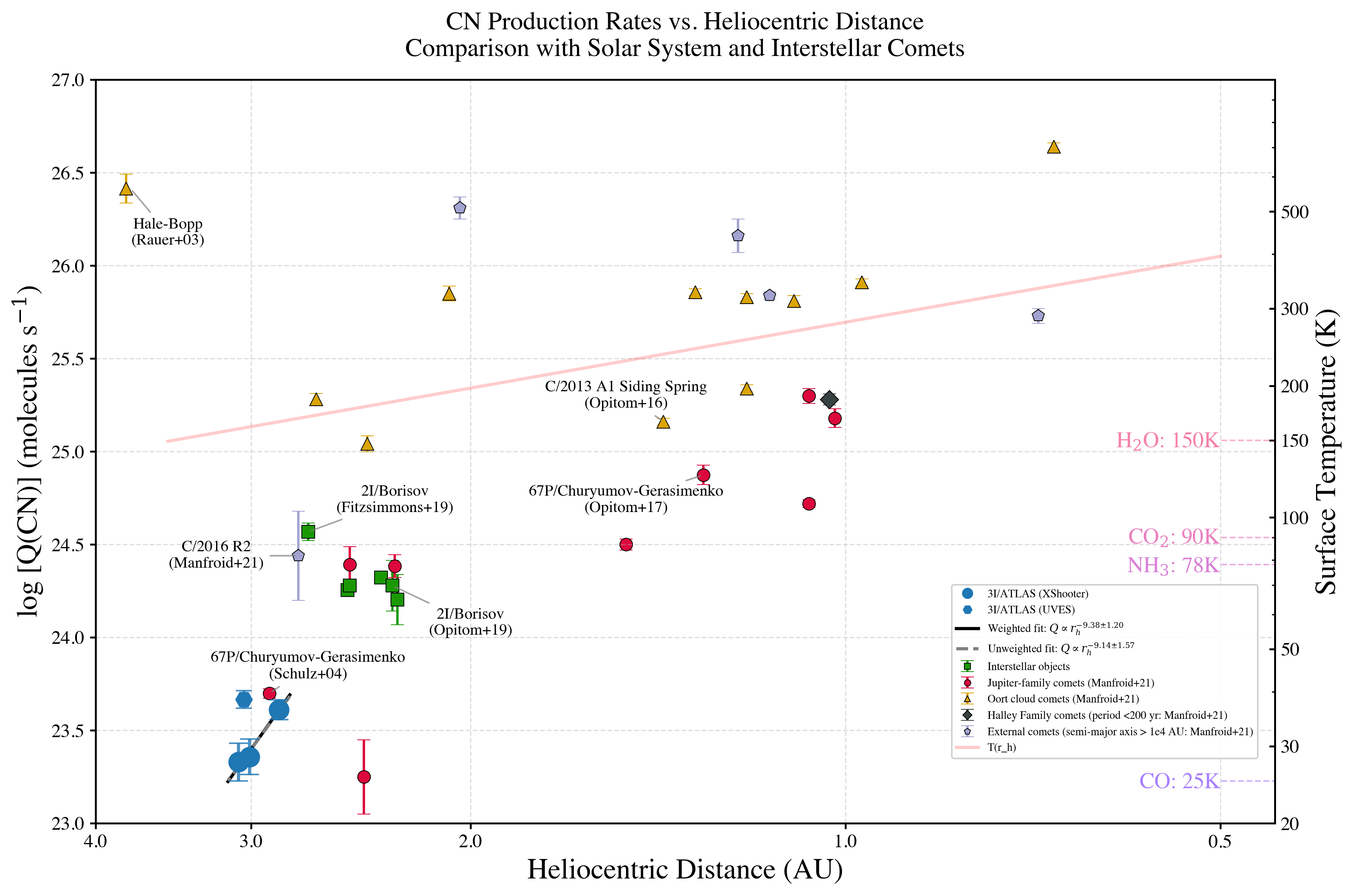
Figure 3: CN production versus heliocentric distance, illustrating the onset and rapid increase of CN outgassing in 3I/ATLAS compared to other comet populations.
Mechanistic Interpretation: Nickel Release Pathways
The observed steep scaling and absence of Fe I emission imply that Ni is released from low-activation-energy carriers, inconsistent with direct sublimation of canonical metal/sulfide phases. Theoretical modeling supports the hypothesis of Ni-bearing organometallics (e.g., Ni(CO)4), metal-PAH complexes, or nanophase carriers as parent species. The Arrhenius analysis yields activation energies (Ea∼0.22–$0.29$ eV) typical of desorption or diffusion barriers for weakly bound species, not metal vaporization.
The preferential release of Ni over Fe is chemically plausible given the higher volatility and photolability of Ni(CO)4 compared to Fe(CO)5, and the susceptibility of Fe carbonyls to hydrolysis in water-rich environments. The correlation of Ni production with CO2-dominated activity, as indicated by SPHEREx measurements, further supports the carbonyl formation channel.
Comparative Context: Solar System Comets and ISOs
Nickel and CN production rates in 3I/ATLAS are consistent with or exceed those observed in 2I/Borisov and Oort cloud comets, but differ from Jupiter-family comets in both magnitude and variability. The sequential detection of Ni and CN at large rh suggests distinct thermal thresholds for parent molecule release, with Ni activation preceding CN. The absence of classical daughter species ([O I], C2, C3, NH2) at these distances highlights the unique volatile inventory of 3I/ATLAS.
The efficient release of Ni at low temperatures, decoupled from Fe, points to organometallic or nanophase pathways that may be universal in extrasolar comets. These findings have implications for the interpretation of cometary metal emissions as tracers of disk chemistry, irradiation history, and metallicity in planetary systems. The age and likely lower metallicity of 3I/ATLAS’s progenitor system provide a window into early Galactic chemical evolution.
Conclusion
The spectroscopic monitoring of 3I/ATLAS reveals a dramatic rise in Ni I emission and incipient CN outgassing at large heliocentric distances, with production rates scaling steeply with decreasing rh. The data favor low-activation-energy release mechanisms, such as photodissociation of Ni-carbonyls or metal-organic complexes, over direct sublimation of refractory phases. The absence of Fe I emission and the timing of CN activation further constrain the parent chemistry. Continued monitoring through perihelion and coordinated ground- and space-based observations will be essential to disentangle the relative contributions of dust, volatiles, and organometallic carriers, and to establish nickel as a calibrated tracer of extrasolar cometary material and Galactic provenance.