- The paper presents a methodology combining THz–IR spectroscopy with effective medium and Rayleigh scattering theories to determine the scattering and porosity of CO and CO2 ices.
- Key results reveal porosity values of 15% for CO ices and 22% for CO2 ices, with effective pore radii approximated at 0.9 µm and 0.5 µm respectively.
- The findings emphasize integrating porosity effects into astrophysical models to enhance the accuracy of radiative transfer and observation interpretations.
Broadband Spectroscopy of Astrophysical Ice Analogues
Introduction
The paper "Broadband spectroscopy of astrophysical ice analogues: III. Scattering properties and porosity of CO and CO2 ices" (2508.20827) explores the scattering properties and porosity of CO and CO2 ice analogues. Understanding these properties is essential for interpreting observational data from interstellar and circumstellar regions where such ices are prevalent. The study emphasizes the need for accurate models that relate the terahertz (THz) and infrared (IR) optical properties of these ices to their physical structure, particularly focusing on porosity, which significantly affects scattering behavior.
Methodology
Data Acquisition and Modelling
The research employs THz–IR spectroscopy to characterize the scattering properties and porosity of CO and CO2 ices. Extending previous spectral range analysis to 32 THz, the study includes scattering effects. The methodology integrates the Bruggeman effective medium theory (EMT) with scattering theories, such as Rayleigh and Lorentz-Mie, to evaluate the optical constants and scattering coefficients.
The model acknowledges two core scattering effects for porous materials: a reduction in effective optical properties across the spectrum and frequency-dependent scattering that leads to opacity at higher frequencies.
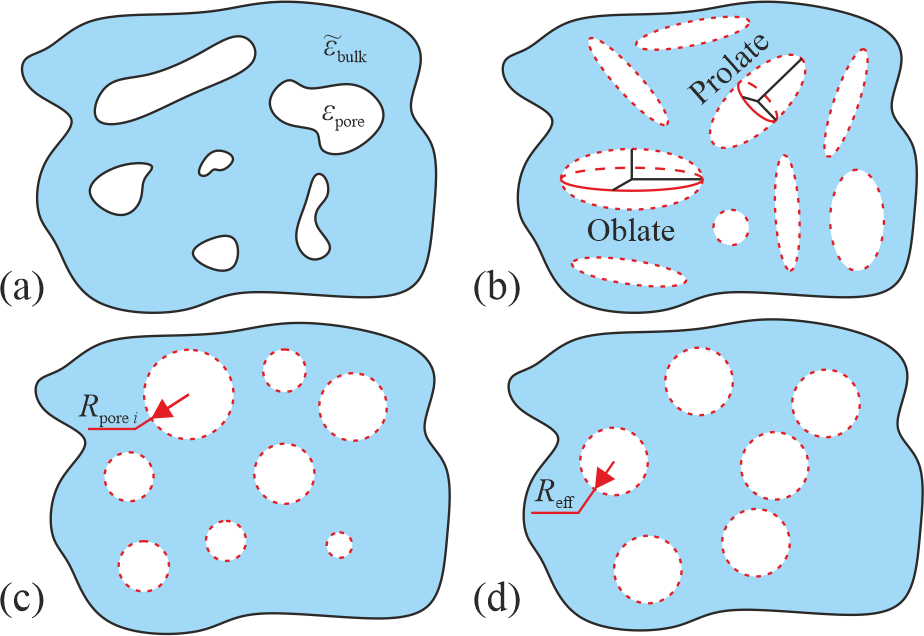
Figure 1: Pores of arbitrary shapes (a) can be approximated by spheroids (b) or spheres (c) of different sizes, or spheres of the same effective radius, Reff.
EMT and Rayleigh Scattering
Using the Bruggeman EMT, the paper calculates effective dielectric permittivity for porous media. This is crucial in predicting how porosity affects the THz–IR response. The Rayleigh approximation, applicable due to the small pore sizes relative to the wavelength, was utilized to model scattering behaviors.
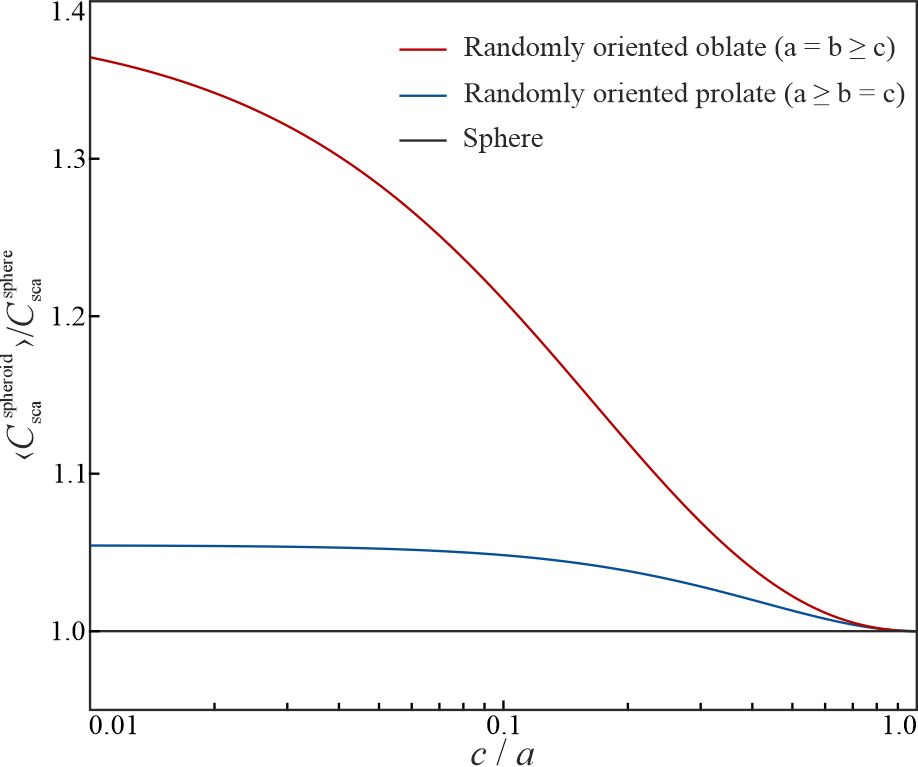
Figure 2: Ratio of the Rayleigh scattering cross section of a randomly oriented oblate or prolate spheroid, ⟨Cscaspheroid⟩, to that of a sphere of the same volume, Cscasphere.
Validating the Rayleigh Regime
The Lorentz-Mie theory was employed to confirm the appropriateness of the Rayleigh approximation. Comparisons between Rayleigh and Mie scattering regimes, based on discrepancies observed in spherical pore models, validated the dominance of Rayleigh scattering in the given frequency domain up to 15 THz.
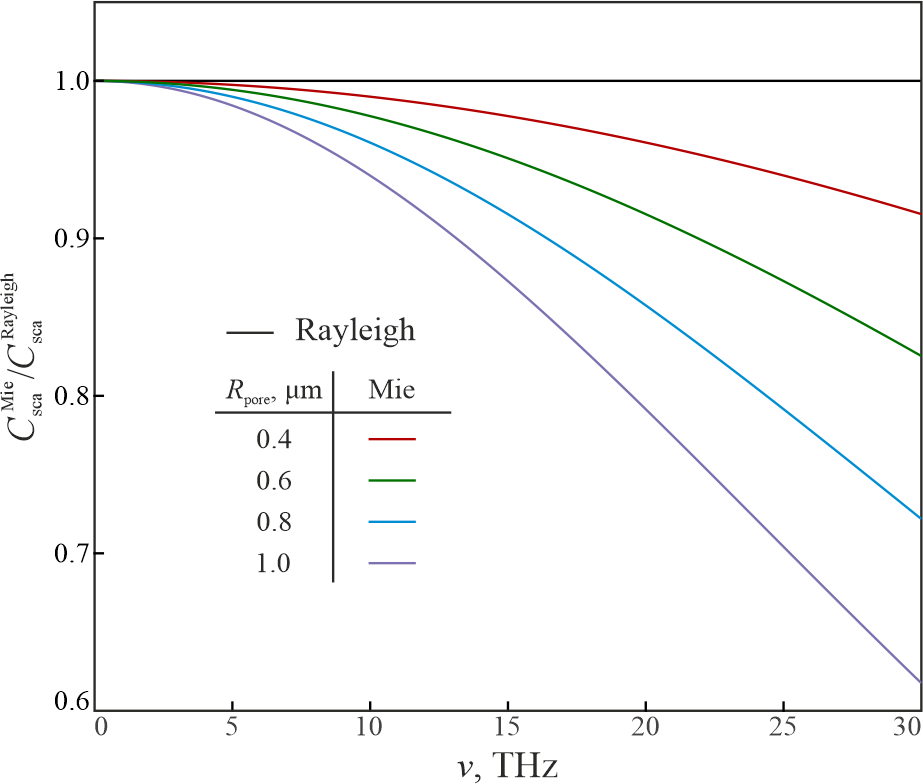
Figure 3: Frequency-dependent ratio of the Lorentz-Mie (CscaMie) and Rayleigh (CscaRayleigh) scattering cross sections for spherical pores with εpore=1, embedded in a host medium with εbulk=2.
Results
The research derived critical numerical identities such as porosity values of 15% for CO ices and 22% for CO2 ices. Effective pore radii of approximately 0.9 µm and 0.5 µm, respectively, were determined. Scattering behavior aligned primarily with the Rayleigh regime, as indicated by the monotonic frequency response observed in absorption coefficients.
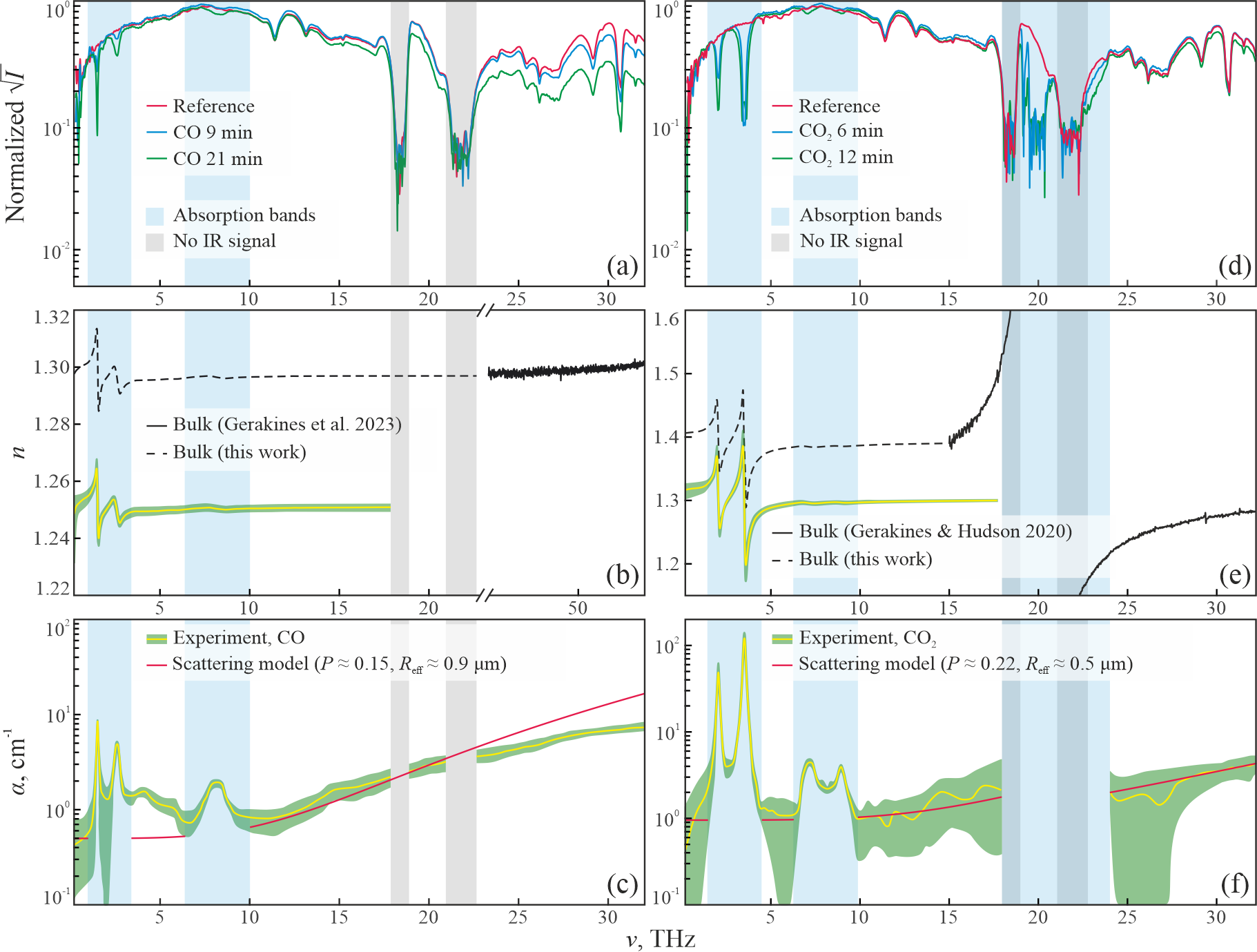
Figure 4: THz--IR optical properties of the studied \ce{CO} and \ce{CO2} ices along with the estimates of scattering parameters.
Implications for Astrophysics
Structural Insights
This study underlines how porosity influences ice optical properties, severely impacting interpretations of astrophysical observations. Such insights facilitate accurate modeling of ice mantles within dense interstellar environments, affecting theories on molecule formation and dust grain behavior.
Future Developments
The findings advocate for enhanced ice growth and processing methodologies in laboratory settings. Exploring dielectric responses and implementing advanced models can significantly improve understanding of radiative transfer in the interstellar medium.
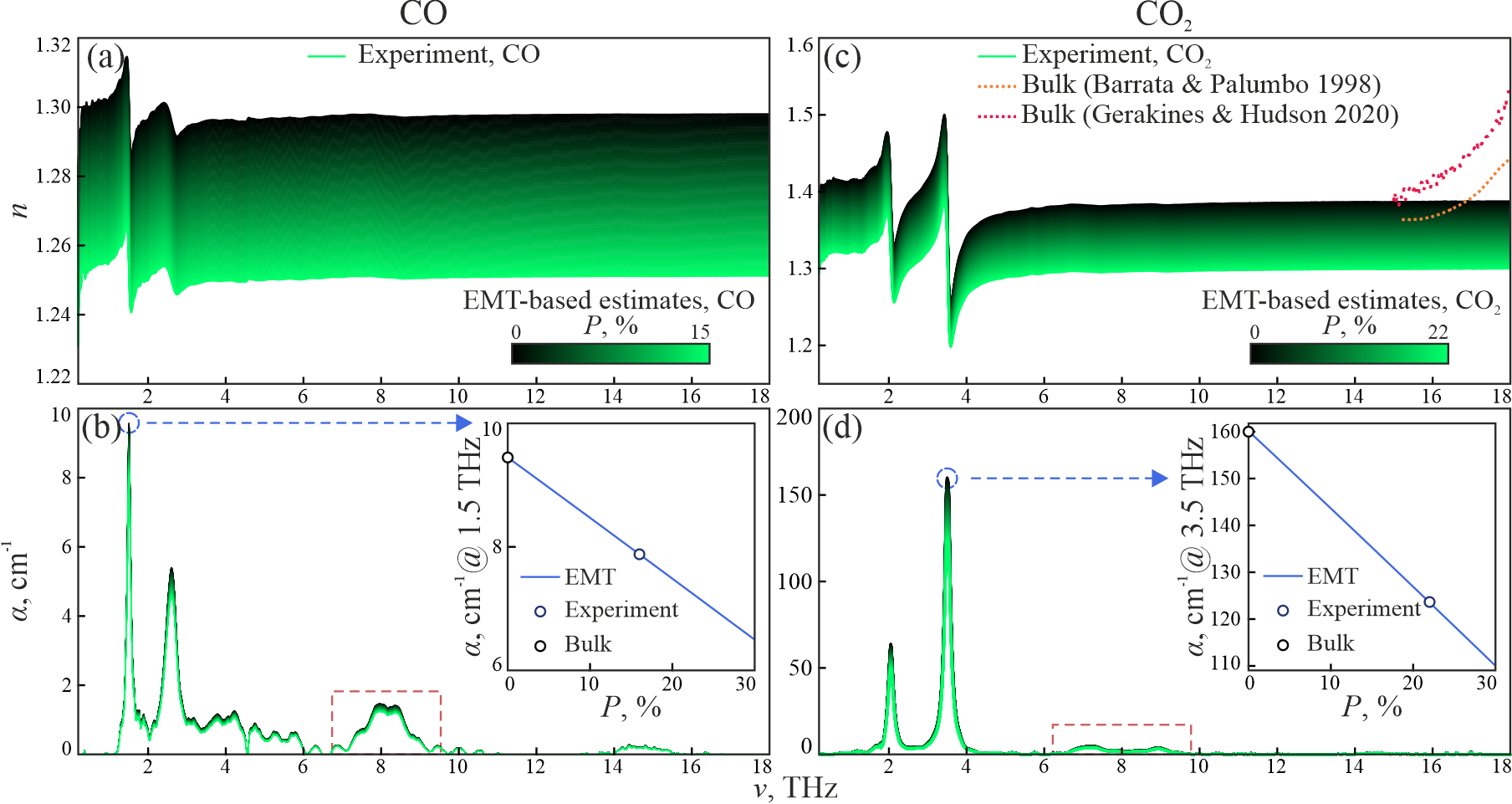
Figure 5: Bruggeman model-based predictions of the THz--IR optical properties of \ce{CO} and \ce{CO2} ices for different values of porosity (P).
Conclusion
The presented model establishes a vital link between THz–IR optical properties and ice structure, crucial for accurate interpretation of astrophysical data. The study's methodology and findings argue for integrating porosity assessments in ice analyses, essential for refining our understanding of cosmic environments. By effectively quantifying porosity and refining scattering estimates, this research significantly contributes to both theoretical and practical realms in laboratory astrophysics.