- The paper presents a unified theoretical framework employing scattering matrix poles to extract complex band structures and identify accidental BICs in PhC slabs.
- It demonstrates that analyzing both real and imaginary components yields insights into resonant mode dispersion, spectral width, and quality factors.
- The framework reveals the role of polarization interactions and exceptional points in coupling mechanisms, guiding the design of advanced photonic devices.
Complex Band Structures and Bound States in the Continuum: A Unified Theoretical Framework
Introduction
The paper presents a systematic theoretical framework for analyzing complex band structures in periodic systems that are finite in one dimension, such as photonic crystal (PhC) slabs. The approach focuses on using the poles of the scattering matrix to obtain a comprehensive understanding of complex band structures and bound states in the continuum (BICs). The framework is designed to evaluate both the real and imaginary components of the band structures, which are crucial for understanding the resonant modes in these systems.
Scattering Matrix and Bloch Wave Basis
The scattering matrix, a fundamental tool in quantum mechanics, is utilized to relate incoming and outgoing wave amplitudes within the periodic framework. An analysis of the poles of the scattering matrix allows the determination of the complex band structure of resonant modes. By employing Bloch wave expansion, the scattering matrix effectively describes electromagnetic fields inside the periodic structure, whether one-dimensional or two-dimensional.
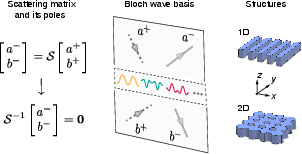
Figure 1: Scattering matrix and its poles in the complex-omega plane. The scattering matrix relates the incoming (a+,b+) and outgoing (a−,b−) waves. Inside the periodic structure, a Bloch wave basis is adopted to describe the electromagnetic fields.
Complex Band Structures and Accidental BICs
The complex band structure is primarily influenced by the interaction of Bloch waves, affecting both the dispersion and spectral width of modes inside the PhC slab. The two-band model provides the leading-order expression for the imaginary part of the frequency, indicating the quality factor of the system. By evaluating the real and imaginary parts of the complex band structure, accidental BICs can be identified as the zero points of the proportionality coefficient C(k∣∣).
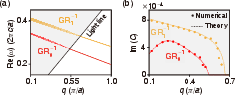
Figure 2: Complex band structure of a 1D PhC slab. (a) Dispersion relation and imaginary part ω′′ (spectral width) of guided-mode resonances.
Friedrich–Wintgen BICs and Symmetry-Protected Modes
The theoretical framework further reveals insights into Friedrich–Wintgen BICs and symmetry-protected modes, which arise from their coupling mechanisms within the PhC slab. These BICs result from interactions involving multiple Bloch waves and typically demonstrate robustness due to the protection afforded by their constructive interference patterns.
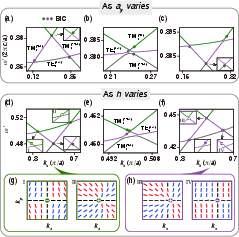
Figure 3: Friedrich–Wintgen BICs and their duals. (a) Dispersion of GR01 band shows a Friedrich–Wintgen BIC arising from its coupling with GR2−1.
Polarization Interactions and Exceptional Points
The research also addresses interactions between different polarization states and identifies exceptional points (EPs) resulting from these interactions. Polarization state interactions, specifically away from high-symmetry lines, give rise to complex band structures and far-field radiation singularities. EPs are presented as critical points connecting bands with different polarizations.
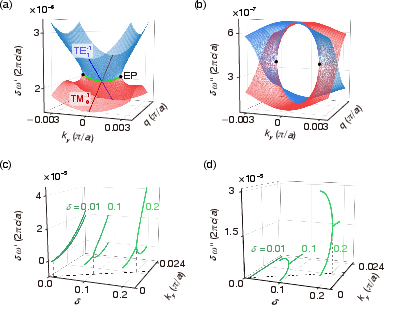
Figure 4: Exceptional points (EPs) from the interaction of bands with different polarizations. (a) Real and (b) imaginary parts of band structure; EPs connected by a Fermi arc.
Application to Two-Dimensional PhC Slabs
The theoretical framework is extended to two-dimensional PhC slabs, demonstrating how complex bands and accidental BICs manifest in square and triangular lattice configurations. The approach continues to leverage the minimal Hilbert space requirement, focusing on interactions among complex bands when folded through reciprocal lattice translations.
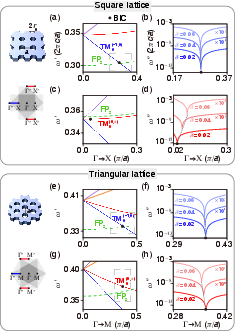
Figure 5: Complex bands and accidental BICs in 2D PhC slabs with square and triangular lattices.
Conclusion
This framework offers a unified methodology for exploring complex band structures and BICs in periodic media, providing significant insights into light confinement behavior. The first-principles-based approach proposes innovative pathways to understanding resonant mode evolution, with implications for managing light-matter interactions in optical systems. Future developments, such as optimizing parameter tuning and perturbation, hold the potential for significantly advancing the design of metasurfaces and photonic devices.