- The paper presents an exact Bethe-ansatz solution for the wave functions and eigenvalues of two-particle bound states in non-Hermitian systems.
- It demonstrates how nonreciprocal hopping delocalizes bound states, reducing the region of bound states in the continuum (BIC).
- Analytical phase diagrams and critical breakdown conditions are established, highlighting the interplay of nonreciprocity, interaction strength, and impurity effects.
Fate of Two-Particle Bound States in the Continuum in Non-Hermitian Systems
Introduction
The paper investigates the existence and characteristics of two-particle bound states in the continuum (BIC) within non-Hermitian systems, specifically in a one-dimensional nonreciprocal lattice with generalized boundary conditions (GBCs). Using the Bethe-ansatz method, the authors derive exact solutions for the wave functions and eigenvalues of these bound states, which facilitates a precise determination of their phase diagrams. A notable discovery is that nonreciprocal hopping can delocalize bound states, thereby reducing the BIC region. The authors classify two distinct types of BICs based on their spatial distributions and analytically determine the critical points for their breakdown.
Theoretical Model and Spectrum Analysis
The research employs a model of two interacting bosons in a nonreciprocal Hatano-Nelson lattice with GBCs or with an impurity potential. The Hamiltonian governing these systems is expressed as:
H^=x=−L∑M[−t(ega^x†a^x+1+e−ga^x+1†a^x)+2Ua^x†a^x†a^xa^x]−γ(ega^0†a^1+e−ga^1†a^0)
The study reveals four complex continuum bands and bound states characterized by real eigenvalues. These are calculated for the Hatano-Nelson model considering imbalanced hopping amplitudes and interactions. The spectra analysis, shown in Figure 1, includes the real and imaginary components of the system's spectrum with particular parameters. The distribution of states within these bands is measured by the Fractal Dimension (FD), calculated using the inverse participation ratio (IPR).
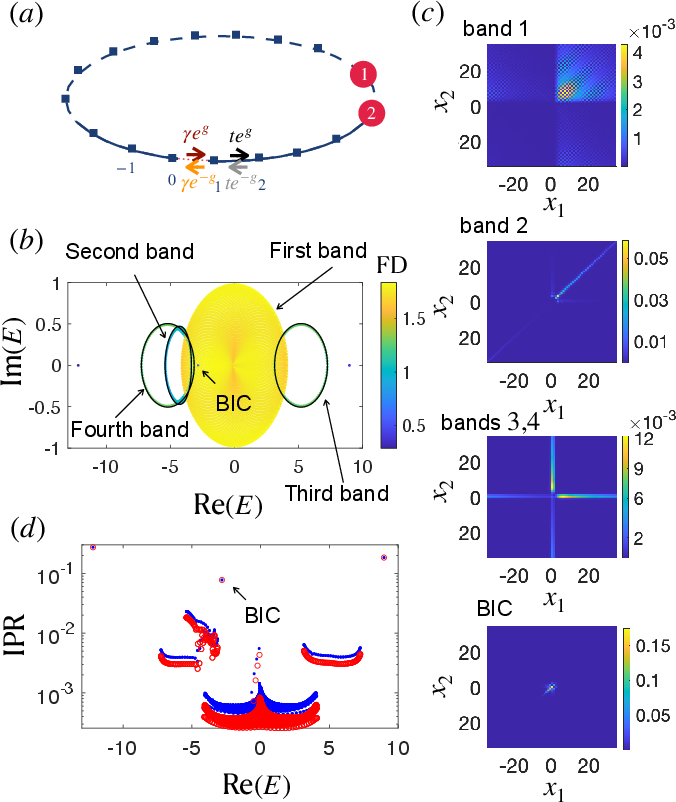
Figure 1: Schematics of the two-particle Hatano-Nelson model showing the real and imaginary parts of the spectra, with FDs of eigenstates.
Bethe-Ansatz Solution and Bound State Analysis
By applying a Bethe-ansatz type wave function, the paper rigorously derives the wave function for the BIC, expressed as:
ub(x1,x2)=e−g(x1+x2)ub,0(x1,x2)
where ub,0 follows a piecewise definition across coordinates (x1,x2). This wave function accurately describes localized and delocalized states under nonreciprocal hopping, demonstrating two types of BICs. The parameter space for existence and behavior of these states is extensively explored, with Figure 2 illustrating the phase diagrams for various values of nonreciprocal hopping g and interaction strengths.
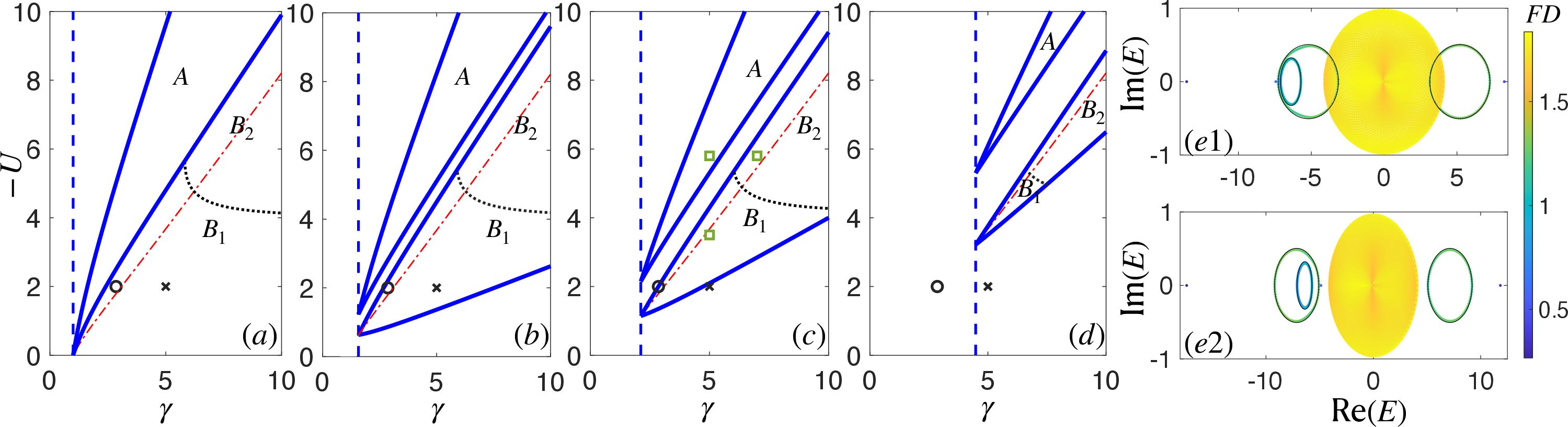
Figure 2: Phase diagrams illustrating regions A and B with different conditions on Eb1 and Eb2.
Phase Diagram and Breakdown of BICs
The derived phase diagrams highlight regions where BICs persist under specific conditions of boundary strength γ, interaction strength U, and the nonreciprocal hopping parameter g. The boundaries of these regions are analytically determined, providing insight into the interplay between non-Hermitian and interaction-induced properties. The paper explicates threshold values of g necessary for the breakdown of BICs.
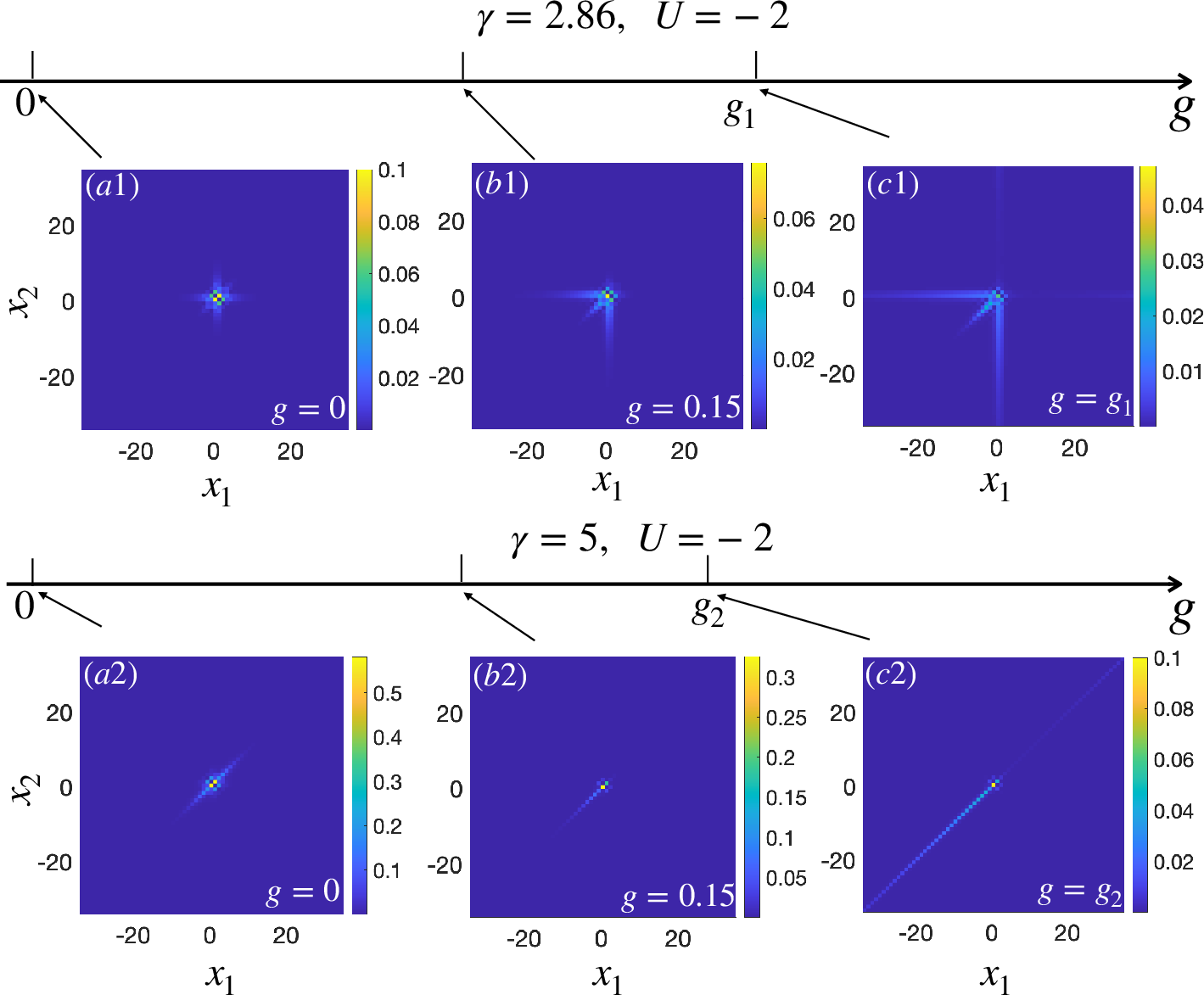
Figure 3: Density distribution of BICs for various g values and parameters indicating delocalization trends.
Impurity Model and Generalized Findings
The phenomenon of BIC is further corroborated in a two-particle system with an impurity potential under periodic boundary conditions. The same analytical methods reveal similar BIC characteristics and elucidate competition mechanisms between interactions, impurity strength, and nonreciprocal hopping. The results show how BICs are affected by these factors through changes in wave function localization.
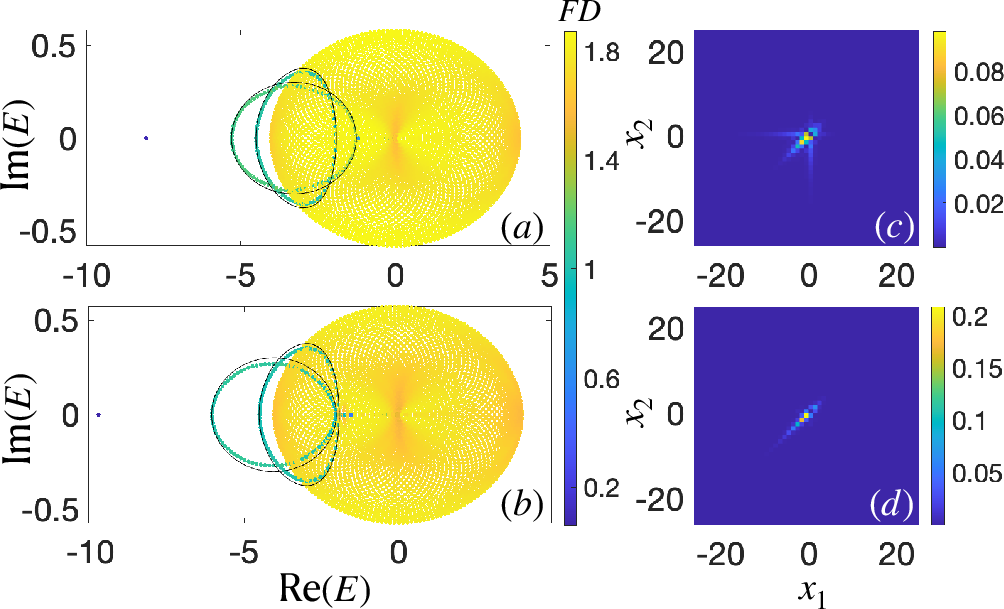
Figure 4: Spectra and density distribution of BICs in a model with impurity potential.
Conclusion
This study provides a comprehensive analytical exploration of BICs in the context of non-Hermitian systems, highlighting the influence of nonreciprocal hopping and interaction potentials. By deriving exact wave functions and phase diagrams, the paper significantly enhances the understanding of BIC phenomena, delineating conditions under which these states persist or vanish. These findings have broader ramifications for the study of non-Hermitian quantum systems and may inspire future research into multi-particle interactions and localized state engineering.