Real-Time Detection of Hallucinated Entities in Long-Form Generation
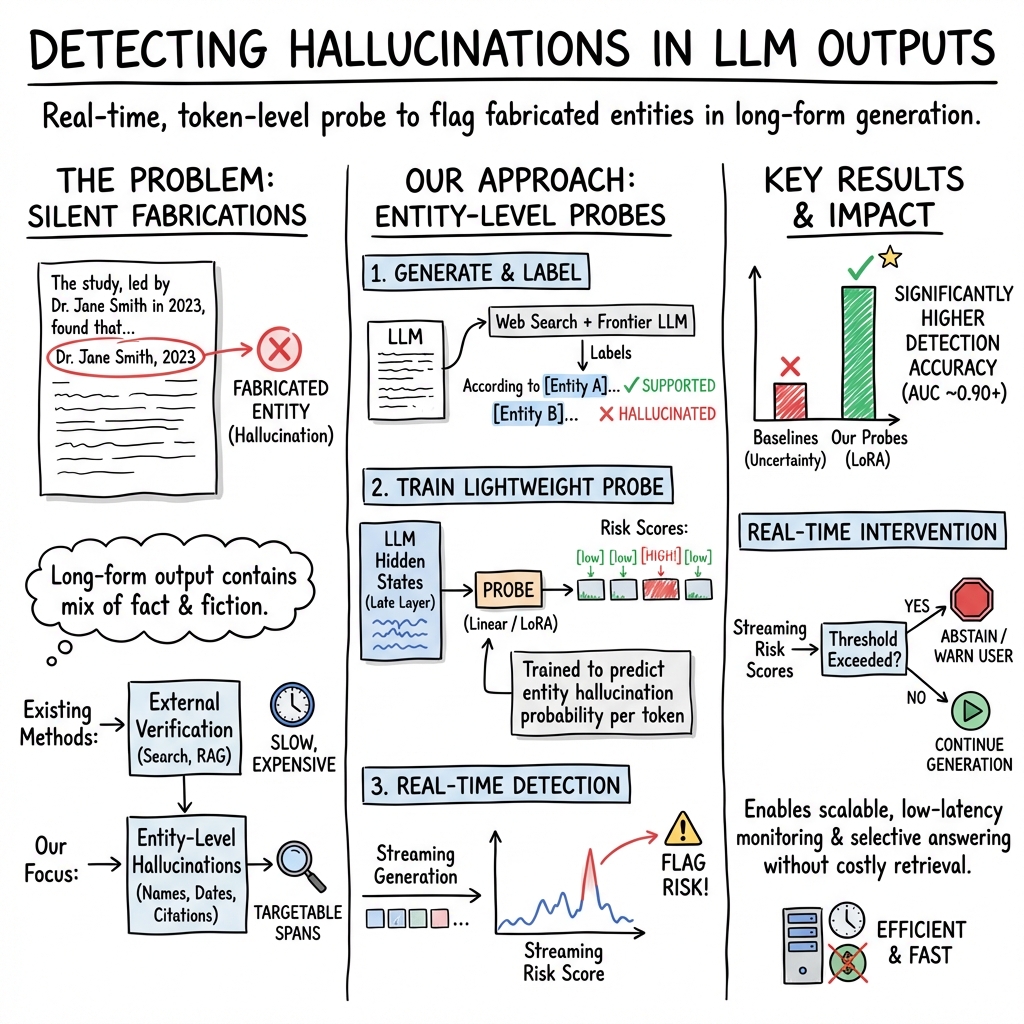
Abstract: LLMs are now routinely used in high-stakes applications where hallucinations can cause serious harm, such as medical consultations or legal advice. Existing hallucination detection methods, however, are impractical for real-world use, as they are either limited to short factual queries or require costly external verification. We present a cheap, scalable method for real-time identification of hallucinated tokens in long-form generations, and scale it effectively to 70B parameter models. Our approach targets \emph{entity-level hallucinations} -- e.g., fabricated names, dates, citations -- rather than claim-level, thereby naturally mapping to token-level labels and enabling streaming detection. We develop an annotation methodology that leverages web search to annotate model responses with grounded labels indicating which tokens correspond to fabricated entities. This dataset enables us to train effective hallucination classifiers with simple and efficient methods such as linear probes. Evaluating across four model families, our classifiers consistently outperform baselines on long-form responses, including more expensive methods such as semantic entropy (e.g., AUC 0.90 vs 0.71 for Llama-3.3-70B), and are also an improvement in short-form question-answering settings. Moreover, despite being trained only with entity-level labels, our probes effectively detect incorrect answers in mathematical reasoning tasks, indicating generalization beyond entities. While our annotation methodology is expensive, we find that annotated responses from one model can be used to train effective classifiers on other models; accordingly, we publicly release our datasets to facilitate reuse. Overall, our work suggests a promising new approach for scalable, real-world hallucination detection.
Paper Prompts
Sign up for free to create and run prompts on this paper using GPT-5.
Top Community Prompts
Collections
Sign up for free to add this paper to one or more collections.