- The paper quantifies encounter rates for large ISOs using a power-law framework, revealing a steep flux enhancement for kilometer-scale objects.
- It employs Eddington inversion and Liouville mapping to show that steep density profiles and low-angular momentum orbits boost phase-space density near the Sun.
- The findings challenge standard ejection models and suggest either unknown natural processes or potential artificial influences, underscoring the need for future surveys.
Dynamical Constraints on a Population of Massive Interstellar Objects
Introduction
The detection of kilometer-scale interstellar objects (ISOs) such as 1I/'Oumuamua, 2I/Borisov, and most recently 3I/ATLAS, has provided direct empirical access to the population of small bodies formed outside the Solar System. The properties of 3I/ATLAS—its large inferred size, high excess velocity, and specific trajectory—pose significant dynamical challenges to standard models of ISO ejection and delivery. This paper develops a quantitative framework to assess whether the observed encounter rates of large ISOs are compatible with natural dynamical mechanisms or require anomalous velocity-space anisotropies, potentially pointing to artificial origins.
Encounter Rate Scaling and Flux Enhancement
The encounter rate for ISOs is formulated as Γ1(R)=n(R)⟨v⟩σ(R), where n(R) is the number density for radius R, ⟨v⟩ is the average encounter speed, and σ(R) is the brightness-limited detection cross section. The analysis demonstrates that, under a power-law size distribution dN/dR∝R−q and a detection cross section scaling as σ(R)∝R, the cumulative encounter rate for ISOs with radius ≥R scales as Γ1(R)∝R−(q−2).
To reconcile the observed detection rate of 3I/ATLAS with natural expectations, the required flux enhancement factor is derived as (R/0.6)q−2, which increases steeply for larger R and steeper q. For q≳4, the encounter rate for multi-kilometer ISOs exceeds natural expectations by several orders of magnitude.
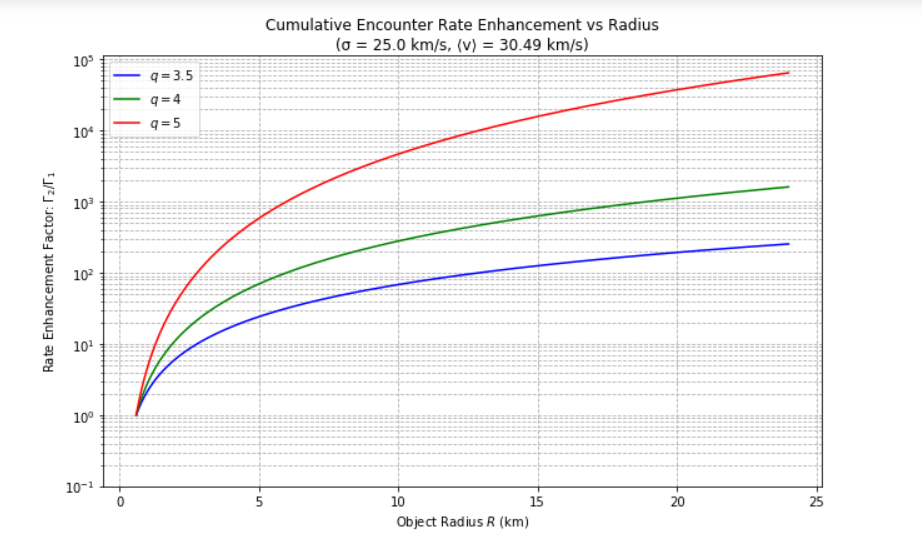
Figure 1: Cumulative encounter rate enhancement factor as a function of minimum ISO radius R for different power-law slopes q, showing the steep increase in required enhancement for larger objects.
This result implies that the detection of large ISOs like 3I/ATLAS cannot be explained by a simple Maxwellian velocity distribution and isotropic spatial distribution, but instead requires a strong inward velocity bias or an additional population component.
Eddington Inversion and Phase-Space Density
The Eddington inversion method is employed to link power-law spatial density profiles ρ(r)∝r−k to their corresponding phase-space distribution functions f(E). The analysis yields f(E)∝Ek−3/2, indicating that steep density profiles (k≳3) correspond to strong velocity-space focusing toward the Sun.
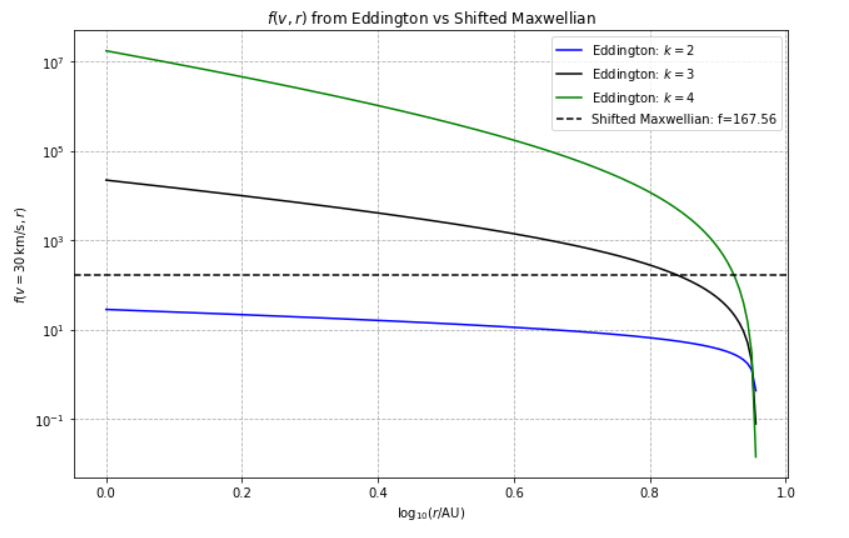
Figure 2: Comparison of Eddington-inverted phase-space densities for k=3,3.5,4 with a shifted Maxwellian background.
The figure demonstrates that for k=3,3.5,4, the phase-space density near the Sun is strongly enhanced relative to the Maxwellian background, consistent with a population of ISOs concentrated on low-angular-momentum, radial orbits. Shallower profiles (k≲2) fail to produce the necessary enhancement, underestimating the encounter rate at small heliocentric distances. This analytic connection between spatial overdensity and velocity-space bias provides a clear dynamical mechanism for the observed detection rates, but also highlights the need for a physical process capable of generating such steep anisotropies.
Liouville Mapping and Angular Momentum Anisotropy
To address the limitations of the Eddington inversion for boundary-driven problems, the paper develops a Liouville mapping formalism that propagates the interstellar Maxwellian distribution inward under conservation of energy and angular momentum. The phase-space distribution is explicitly constructed in (E,J) coordinates, allowing for the direct modeling of anisotropy via a weighting function gR(J) that favors low-angular-momentum trajectories.
The effective slope k(R), quantifying the enhancement of encounter rates with object size, is extracted by fitting the local density profile near the detection radius. The analysis shows that k(R) rises monotonically with R, reaching k≈4 for R∼10 km, consistent with the requirements from encounter rate analysis.
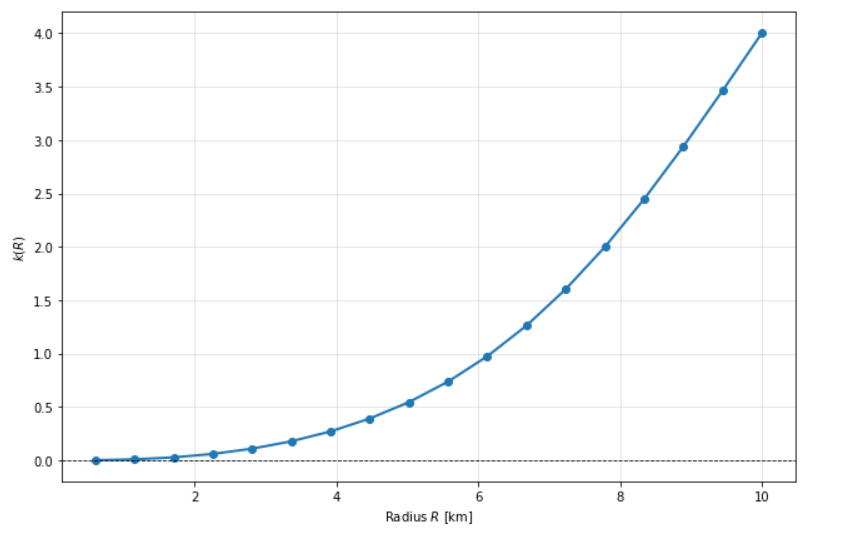
Figure 3: k(R) as a function of ISO radius R, taking into account Liouville mapping formalism.
This result demonstrates that the necessary size-dependent enhancement in encounter rates can be reproduced by tuning the anisotropy in angular momentum, without invoking non-physical mechanisms. However, the absence of a known astrophysical process capable of generating such a distribution of low-angular-momentum ISOs leaves open the possibility of artificial or directed delivery scenarios.
Implications and Future Directions
The analysis establishes that the detection of large ISOs is dynamically consistent with strong gravitational focusing, but only under specific velocity-space biases whose natural origin remains unaccounted for. The tension between the required anisotropy and known ejection mechanisms suggests two possible avenues: (1) the existence of new physical processes, such as stellar perturbations or local Galactic structure, that produce the necessary velocity anisotropies; or (2) the possibility of artificial fine-tuning, such as directed release of objects with engineered orbits.
Future surveys, particularly with the Vera C. Rubin Observatory, will provide the statistical sample necessary to test these dynamical predictions and distinguish between natural and artificial population hypotheses.
Conclusion
This work provides a rigorous dynamical framework for constraining the population of massive ISOs, demonstrating that the observed encounter rates for large objects require strong velocity-space anisotropies. While gravitational dynamics can in principle account for the observed scaling, the lack of a known mechanism for producing the required anisotropy leaves open the possibility of artificial origins. The results sharpen the distinction between natural and non-natural delivery mechanisms and highlight the importance of future ISO discoveries for resolving this question.