- The paper introduces a multi-agent system that automates transforming academic papers into pedagogically optimized slides.
- It employs specialized agents for content extraction, PMRC-based reorganization, and interactive natural language editing to ensure content accuracy.
- User studies demonstrate that Auto-Slides significantly enhances comprehension and engagement compared to traditional LLM chat interfaces.
Auto-Slides: An Interactive Multi-Agent System for Creating Research Presentations
Introduction
The paper "Auto-Slides: An Interactive Multi-Agent System for Creating and Customizing Research Presentations" (2509.11062) introduces an innovative system designed to automate the conversion of academic papers into coherent, structured presentation slides. With the increasing reliance on LLMs in educational contexts, the authors address the gap between the unstructured dialogue-based interactions commonly available and the need for well-organized, multimodal instructional materials.
The system leverages advanced techniques in cognitive science to create slides that not only present information clearly but also align with pedagogical principles that enhance learning and retention. Auto-Slides employs a multi-agent framework integrating content extraction, semantic analysis, and interactive editing to produce slides tailored to learners' needs.
Methodology
Multi-Agent Architecture
Auto-Slides utilizes a sophisticated multi-agent architecture, dividing the task of slide creation into specialized agents.
- Content Parsing and Structuring: The Parser Agent processes and extracts high-fidelity content from PDF documents, capturing text, figures, tables, and equations. Meanwhile, the Planner Agent reorganizes the information following a Problem-Motivation-Results-Conclusion (PMRC) narrative, which has been shown to improve readability and comprehension.
(Figure 1)
Figure 1: Overview of Auto-Slides' capabilities, illustrating the generation and iterative revision of presentation slides.
- Quality Assurance: Verification and Adjustment Agents ensure all extracted information maintains accuracy and logical consistency when shifted into a slide format. This step prevents the propagation of errors that might misrepresent the original material.
- Generation and Interactive Optimization: The Generator Agent compiles the content into \LaTeX{} slides, ensuring multimodal consistency. Users can then interact with the Editor Agent to refine these slides through natural language commands, allowing dynamic customization to meet diverse learner preferences.
Cognitive Principles
The transformation into pedagogically optimized slides employs several cognitive science principles:
- Cognitive Load Theory suggests optimizing content subdivision to minimize extraneous cognitive load, allowing learners to concentrate on essential information.
- Multimedia Learning Theory advocates for integrating verbal and visual content, enhancing understanding through multimodal learning experiences.
These principles guide the presentation planning stage, effectively restructuring academic content to enhance educational efficacy.
Results and Evaluation
Extensive user studies have demonstrated Auto-Slides' ability to enhance comprehension and engagement over conventional LLM-based reading methods.
User Experiments
- Learning Enhancement: Participants reported significantly improved understanding due to the structured format and visual elements offered by Auto-Slides. The interactive editing features empowered learners to customize slides based on their background knowledge and learning goals.
- Comparative Study: Auto-Slides was favored over LLM chat interfaces for visual clarity, organizational structure, and support for detailed understanding.
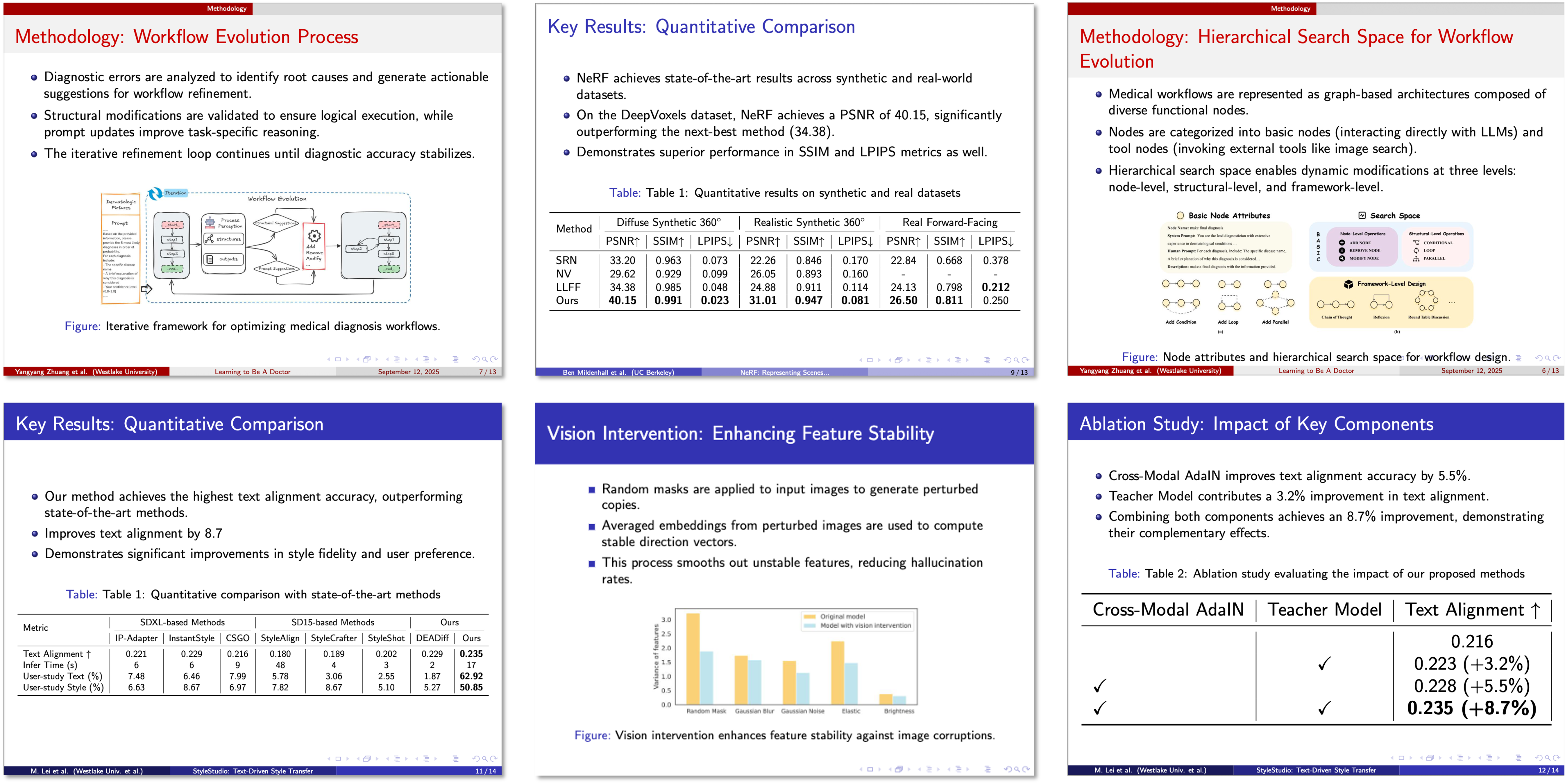
Figure 2: Example slides generated by Auto-Slides, demonstrating structured and learner-friendly presentation conversion.
Automated Evaluations
Cross-model LLM comparisons established the superior fidelity of Auto-Slides in maintaining the structural integrity of complex information elements like tables and equations. Verification loops further contribute to reliable factual representation.
Future Directions
While Auto-Slides effectively bridges the gap between dense academic writing and engaging presentations, future work could extend its capabilities to incorporate dynamic content forms like interactive media and code scripts. Enhancing user interfaces for direct visual slide editing could further simplify post-generation adjustments for users lacking technical expertise in \LaTeX{} editing.
Integration with supplementary materials and further refinement of interactive functions could also enrich the system's versatility, adapting to the growing complexity in modern academic publications.
Conclusion
Auto-Slides presents a substantial advancement in AI-assisted educational tools, demonstrating how complex academic research can be transformed into accessible educational presentations. By utilizing a multi-agent system and drawing upon cognitive science insights, it offers a sophisticated solution that both enhances learning experiences and promises future developments in automated content delivery. The comprehensive approach ensures that critical academic insights are communicated clearly and effectively, paving the way for richer interactions and educational practices.