- The paper presents a modular workflow of seven distinct stages that reveal key trade-offs in designing decentralized prediction markets.
- It analyzes mechanisms such as automated market making, on-chain trading, and oracle-based resolution to ensure market integrity.
- The study highlights how blockchain-enabled transparency and permissionless operations drive innovation while posing regulatory challenges.
SoK: Market Microstructure for Decentralized Prediction Markets
Introduction
The paper "SoK: Market Microstructure for Decentralized Prediction Markets (DePMs)" explores the evolution and functionality of decentralized prediction markets, offering a comprehensive systematization of knowledge (SoK) on the topic. DePMs, which have been evolving since 2011, differ from traditional prediction markets by minimizing reliance on centralized intermediaries. Despite Polymarket's current prominence, this paper highlights that DePMs have diversified through various innovative designs beyond conventional platforms like Truthcoin and Augur v1.
The authors present a modular workflow for understanding DePMs, composed of seven stages: underlying infrastructure, market topic, share structure and pricing, trading, market resolution, settlement, and archiving. This framework not only elucidates the intricate design choices involved in creating DePMs but also addresses the trade-offs related to decentralization, expressiveness, and resistance to manipulation.
Historical Context and Core Concepts
Decentralized prediction markets are recognized as a distinct class of event wagering systems, fundamentally characterized by their openness and lack of centralized control. The initial systems, such as Truthcoin and the Princeton DePM, laid foundational concepts by introducing mechanisms like automated market making and share splitting, which have informed subsequent developments like Augur and Gnosis.
A key aspect of these markets is the ability to trade fungible outcome shares, radically altering the traditional betting framework by allowing participants to enter and exit positions fluidly, thus reflecting real-time market sentiment and information. Modern platforms like Polymarket exemplify the iterative refinement of these ideas, merging the initial philosophies of both Truthcoin and the Princeton DePM.
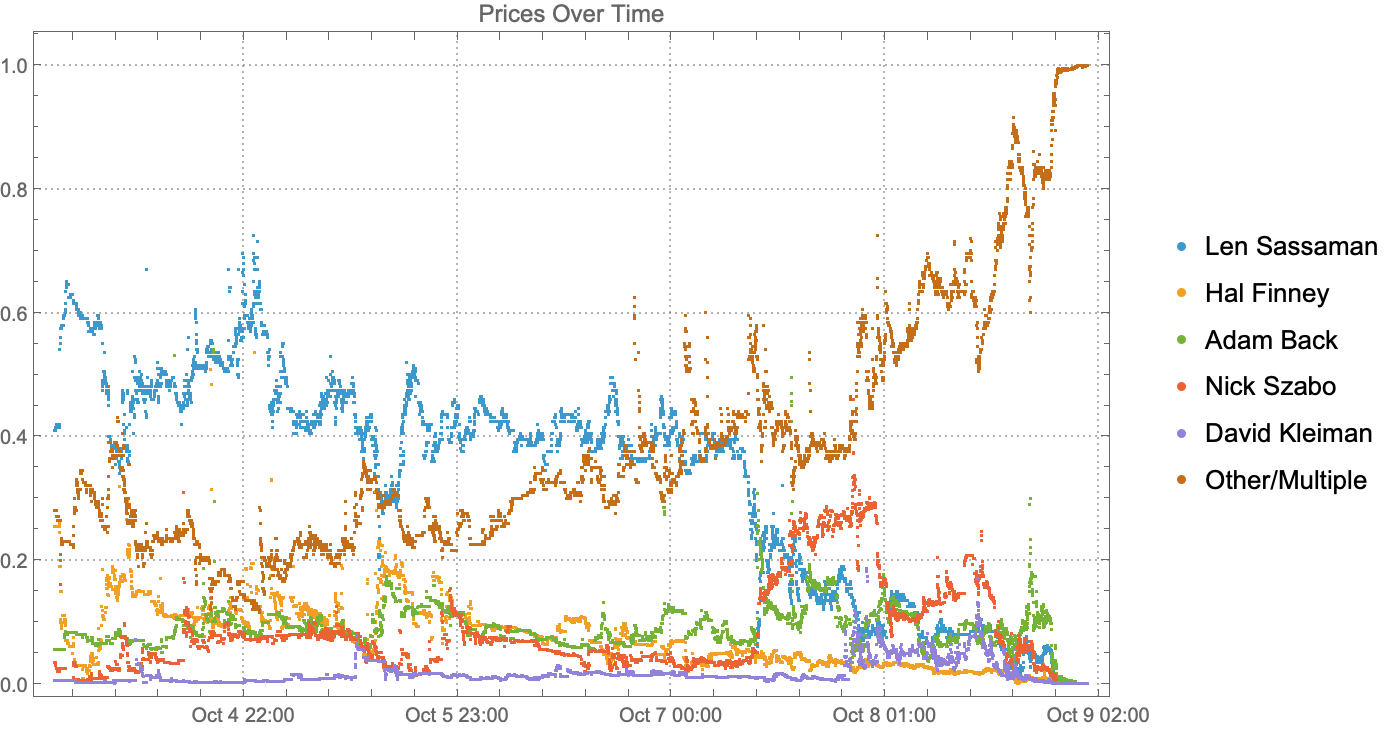
Figure 1: The price movements for 6 leading candidates in the Polymarket market for who would be named as Satoshi Nakamoto in the HBO documentary "Money Electric" aired in October 2024.
Modular Workflow
1. Underlying Infrastructure: DePMs predominantly utilize blockchain technology, with Ethereum and its competitors providing the requisite environment for smart contract execution. These platforms afford the transparency and immutability necessary for maintaining decentralized systems.
2. Market Topic: The market topic selection in DePMs is often permissionless. This freedom allows for a broad spectrum of speculative topics but also introduces challenges in moderating unlawful or ambiguous market propositions, a balance that centralized systems inherently maintain.
3. Share Structure and Pricing: The design space includes winner-take-all (WTA) and yes-no bundle (YNB) outcomes. The market's design determines its ability to accommodate arbitrary predictions while ensuring integrity through complete and exclusive share structures.
4. Trading: Initial trading involves creating shares through mechanisms like automated bookmaking or splitting, evolving from needing external liquidity to internal liquidity through AMMs. This flexibility facilitates diverse entry and exit strategies, maintaining liquidity and market efficiency.
5. Market Resolution: Resolution mechanisms form a crucial component, where markets rely on oracles or community consensus to resolve outcomes. The accuracy and reliability of these systems are pivotal, as they directly impact market credibility and trust.
6. Settlement: Settlements in DePMs are executed on-chain, ensuring transparency. The elimination of manual intervention reduces risk, ensuring that payouts are deterministic based on predefined contract logic.
7. Archiving: Maintaining an accessible archive of market data enhances research, analytics, and market calibration capabilities. It supports transparency and facilitates academic and practical exploration of prediction market dynamics.
Discussion and Implications
The DePMs encompass vast potential and pose challenges, notably regarding regulatory acceptance and market topic definition. The frictionless, permissionless nature complicates legal frameworks traditionally applied to financial and gambling markets. Future research should focus on optimizing AMM structures for prediction contexts, improving oracle accuracy, and formalizing verification of market definitions.
The paper emphasizes the need for future work on improving the trust, efficiency, and accessibility of DePMs. As blockchain and smart contract technologies advance, DePMs could converge to offer highly reliable and widely accepted forecasting tools beyond the limits of current financial markets.
Conclusion
This comprehensive overview of DePMs provides a foundational understanding of their architecture and design considerations. As this domain evolves, it presents opportunities and challenges that demand further research and development, especially in enhancing interoperability, market efficiency, and trust mechanisms. The modular framework proposed serves as an invaluable tool for understanding the complexities and potential of DePMs in modern decentralized finance landscapes.