- The paper presents SN 2025wny, a galaxy-scale, strongly lensed superluminous supernova at z=2, enabling precise time-delay cosmography for H0 measurement.
- It employs multi-wavelength photometry and spectroscopy to reveal high temperatures, weak carbon features, and a unique spectral signature in the UV.
- The study demonstrates the efficacy of combining transient surveys with lens catalogs to uncover rare, high-redshift events with significant implications for cosmology.
SN 2025wny at z=2: The First Strongly Lensed Superluminous Supernova
Introduction and Context
The discovery and characterization of SN 2025wny, presented as part of the HOLISMOKES program, marks the first confirmed case of a galaxy-scale, strongly lensed superluminous supernova (SLSN) at z=2. This system, with four resolved images produced by a two-galaxy deflector, provides a new avenue for high-precision cosmography via time-delay measurements, independent of the local distance ladder and early-Universe probes. The rarity of both SLSNe and strongly lensed SNe, combined with the system's favorable configuration for time-delay cosmography, positions SN 2025wny as a critical benchmark for future studies of the Hubble constant (H0) and the physics of SLSNe at high redshift.
Discovery and Imaging
SN 2025wny was initially detected by ZTF and subsequently identified as a lensed transient through cross-matching with a catalog of strong lens candidates. The system is associated with the lens candidate PS1 J0716+3821, which comprises two foreground galaxies (G1 and G2) acting as deflectors. Imaging from the Lulin and Maidanak observatories, as well as archival CFHT data, revealed four point-like images of the SN in a cusp configuration, with separations of ∼2 arcsec.
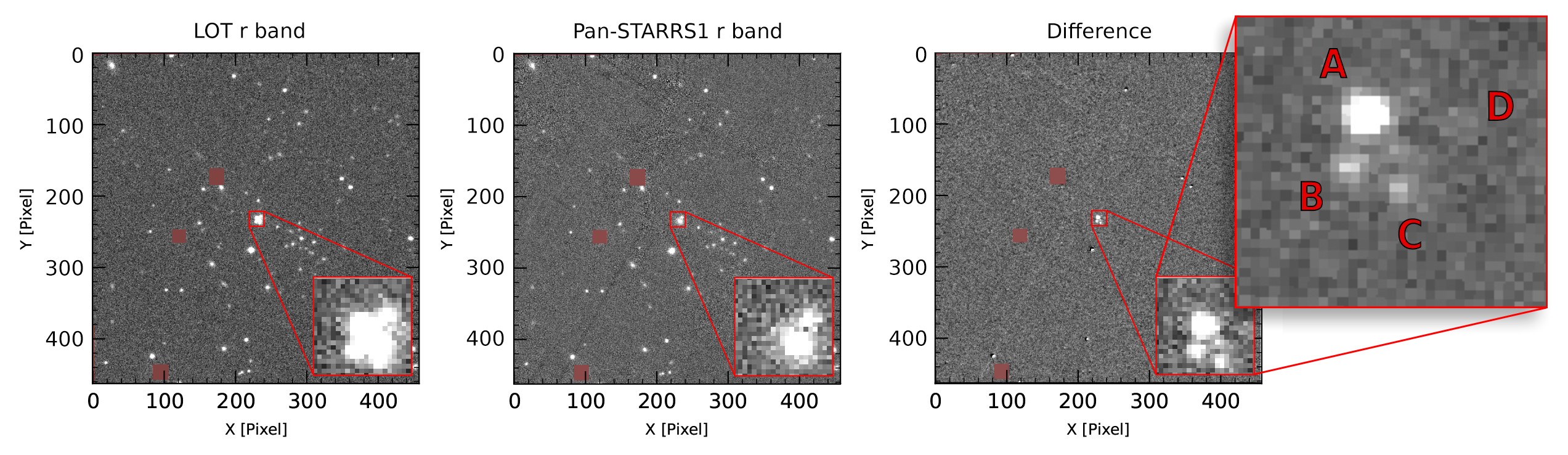
Figure 1: r-band imaging and difference image confirming four lensed images of SN~2025wny.
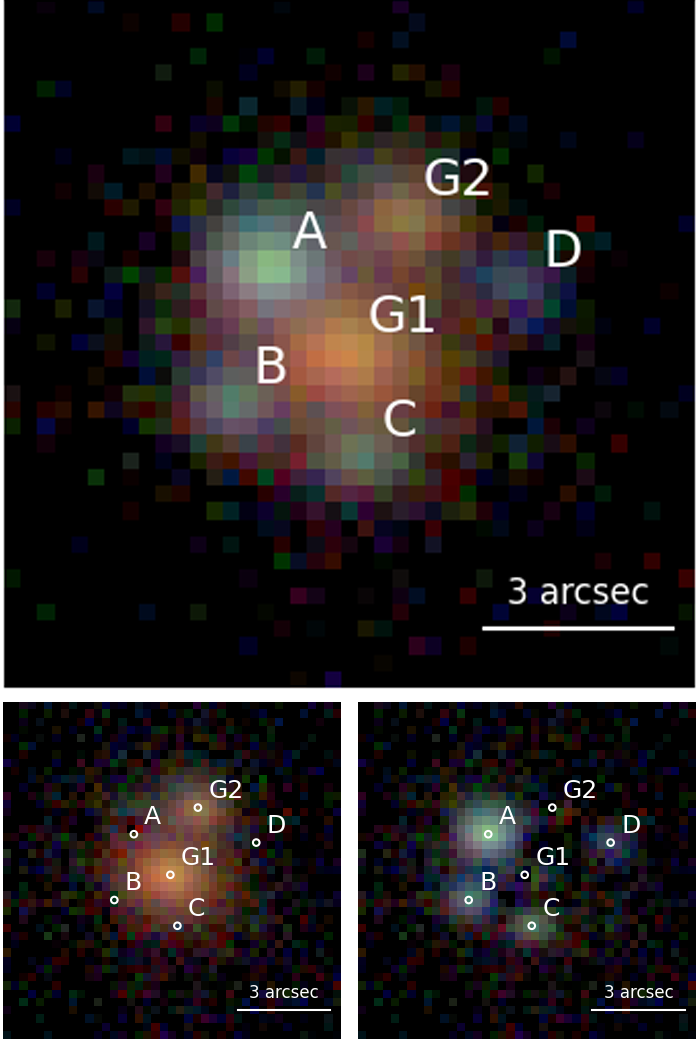
Figure 2: VRI-band composite showing the four SN images and the two deflector galaxies, with subtraction techniques isolating SN and host light.
The photometric monitoring campaign, utilizing multiple telescopes and bands, established the brightness hierarchy of the images (A, B, C, D) and confirmed the system's strong lensing nature. The main lens (G1) and the perturber (G2) are both at z≈0.375, forming a physical pair in a rich galaxy environment.
Spectroscopic Characterization
Spectroscopy of the brightest image (A) was obtained with NOT+ALFOSC and UH88+SNIFS, covering $3300$–$9700$ Å. The redshift determination relied on narrow ISM absorption features, as the broad SN features in the rest-frame UV were ambiguous. The key absorption lines (C IV λλ1548,1551, C II λλ1335,1336, and Mg II λλ2796,2803) established the SN redshift as zSN=2.008±0.001.
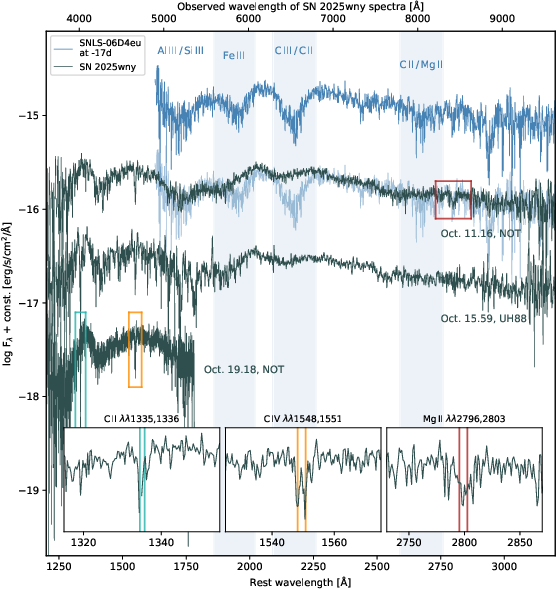
Figure 3: Spectra of SN~2025wny compared to the SLSN-I SNLS-06D4eu, with ISM absorption features used for redshift determination.
The spectrum of G2, extracted from the same slit, yielded zp=0.375±0.001, consistent with G1 and confirming the lensing geometry.
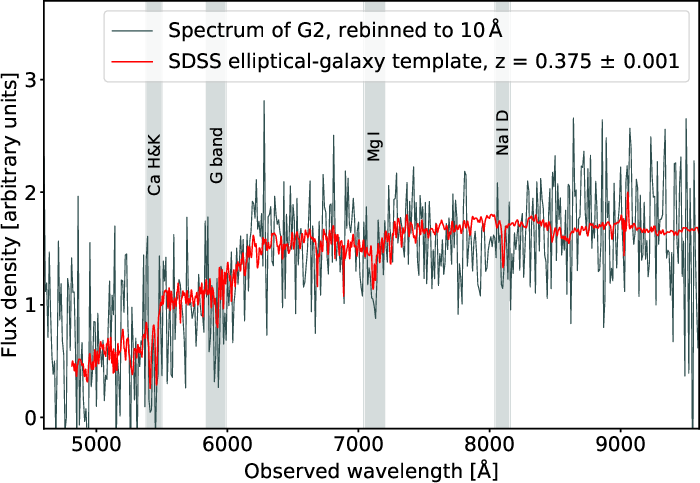
Figure 4: Spectrum of the perturber galaxy G2, with key absorption features matched to an early-type galaxy template at z=0.375.
Superluminous SN Properties
At z=2.008, the observed optical spectrum probes the rest-frame UV, revealing a high blackbody temperature (≳17,000 K) and a smooth, featureless continuum between $1300$ and $2300$ Å. The spectral energy distribution and persistent high temperature over several weeks post-discovery are consistent with SLSN-I phenomenology, but SN 2025wny exhibits unusually weak and blueshifted carbon features compared to archetypal SLSNe-I such as SNLS-06D4eu.
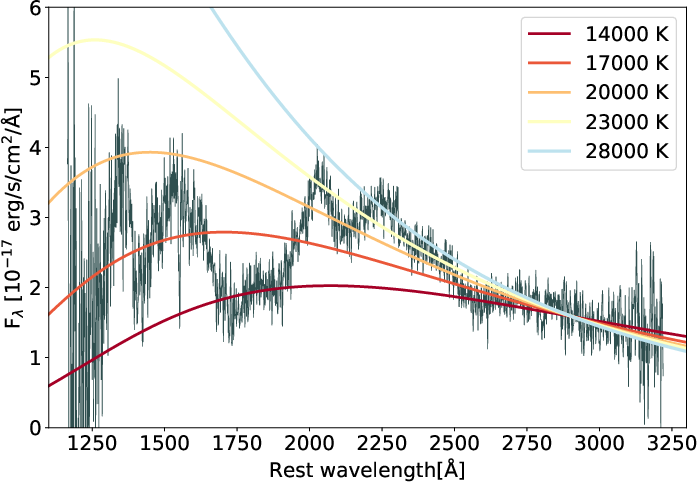
Figure 5: Spectrum of SN~2025wny with blackbody fits, indicating a temperature ≳17,000 K.
The spectral comparison suggests either a higher helium fraction in the ejecta or higher expansion velocities, but the lack of strong carbon features is atypical for SLSNe-I. The absolute magnitude and UV luminosity place SN 2025wny among the most distant spectroscopically confirmed SLSNe, demonstrating the power of lensing to probe the high-redshift transient universe.
Implications for Cosmography and SLSN Demographics
The system's configuration, with image separations and expected time delays of days to weeks, is optimal for time-delay cosmography. Unlike previous galaxy-scale lensed SNe (e.g., iPTF16geu, SN Zwicky) with sub-day delays, SN 2025wny enables robust measurement of H0 via the time-delay distance, provided that lens mass modeling and environmental effects are accurately constrained.
The detection of a lensed SLSN, despite their intrinsic rarity (volumetric rate %%%%20λλ2796,280321%%%% of core-collapse SNe at z∼1), is attributed to strong selection effects: SLSNe are ∼2 mag more luminous than SNe Ia and are extremely UV-bright, making them preferentially detectable in optical surveys at z>1.5. The slow-evolving light curves and high magnification further enhance their detectability in wide-field transient surveys.
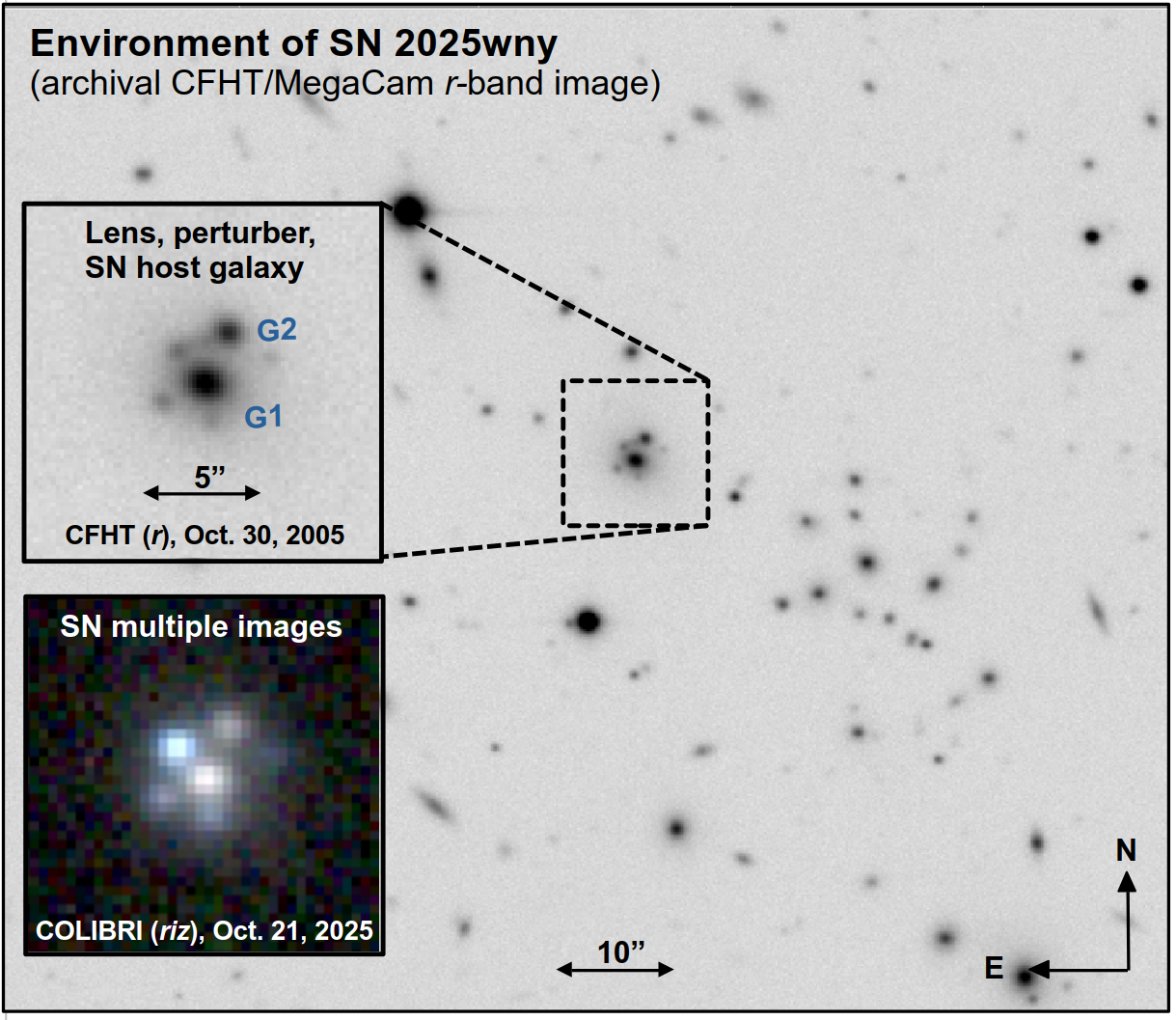
Figure 6: Archival CFHT imaging showing the lens environment and the four lensed host galaxy images.
Future Prospects and Theoretical Implications
The ongoing photometric and spectroscopic monitoring of SN 2025wny will enable precise time-delay measurements and detailed lens modeling, with HST and JWST follow-up providing high-resolution imaging and IFU spectroscopy. The system is expected to yield an independent H0 measurement, contributing to the resolution of the Hubble tension. The methodology—cross-matching static strong-lens catalogs with transient alerts—demonstrates high efficiency and will be further exploited with LSST and Euclid, potentially yielding ∼10 lensed SNe Ia per year suitable for cosmography.
Theoretical implications include the need to revisit SLSN rate calculations in lensing simulations and to refine models of SLSN progenitors and explosion mechanisms, particularly in the context of high-redshift, low-metallicity environments. The observed spectral diversity, especially the weak carbon features in SN 2025wny, motivates further radiative transfer modeling and population studies.
Conclusion
SN 2025wny represents a milestone in both time-delay cosmography and the study of SLSNe at high redshift. The system's unique configuration, robust spectroscopic characterization, and favorable properties for H0 measurement underscore the synergy between wide-field time-domain surveys, machine learning-based lens identification, and multi-wavelength follow-up. The detection of a lensed SLSN at z=2 is a direct consequence of selection effects in current surveys, and future facilities will expand the sample of such systems, enabling precision cosmology and advancing our understanding of the most luminous stellar explosions in the universe.