- The paper presents the discovery of SN 2025wny, the first confirmed strongly lensed SLSN-I at z=2.01 with four distinct images.
- Multi-wavelength imaging and spectroscopy determined the redshift, classified the SN, and revealed an unusually blue continuum with high blackbody temperatures.
- Light curve analysis and magnification estimates (μ ~20–50) highlight the potential for ground-based cosmology via time-delay measurements and studies of high-redshift galaxy evolution.
Discovery and Characterization of SN 2025wny: A Strongly Gravitationally Lensed Superluminous Supernova at z=2.01
Introduction
The paper presents the discovery and multi-wavelength characterization of SN 2025wny, the first confirmed strongly gravitationally lensed Type I superluminous supernova (SLSN-I) at z=2.011. The event is multiply imaged by a foreground galaxy at z=0.357, with four distinct SN images resolved in ground-based, seeing-limited data. This detection extends the redshift horizon for ground-based lensing studies of supernovae and demonstrates the feasibility of identifying and classifying lensed SNe at z>2 with current facilities.
Discovery and Imaging
SN 2025wny was initially identified by the Zwicky Transient Facility (ZTF) and subsequently flagged as a candidate lensed transient due to its proximity to a massive luminous red galaxy (LRG) with a DESI archival spectrum and a known lens candidate in the Strong Lensing Database. Archival CFHT imaging revealed four images of a blue background object in a cross pattern around the LRGs, consistent with a galaxy-scale lens system.
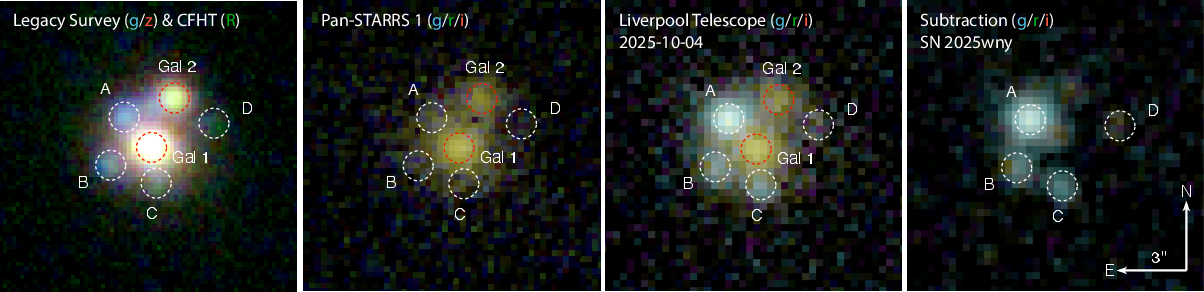
Figure 1: RGB composite images of the lens system from Legacy Survey (g and z-bands) and CFHT R-band imaging (left panel) prior to the SN explosion. The following panels show the Pan-STARRS images used for image subtraction, LT gri images from 2025 October 4, and the right panel the four transient images of SN\,2025wny.
Follow-up imaging with the Liverpool Telescope and other facilities confirmed the presence of four SN images in an Einstein Cross configuration, spatially coincident with the lensed images of the background host galaxy. The brightest image (A) reached g=20.42±0.04, r=19.60±0.03, i=19.54±0.03.
Spectroscopic Classification and Redshift Determination
Three spectra of SN 2025wny were obtained with NOT/ALFOSC and Keck/LRIS. The LRIS spectrum revealed a series of narrow absorption lines at a common redshift of z=2.011±0.001, including C IV λλ1550, Si IV λλ1394,1403, and Lyα, establishing the SN and host galaxy redshift. Broad features in the rest-frame far-UV matched those of SLSN-I templates, confirming the classification.
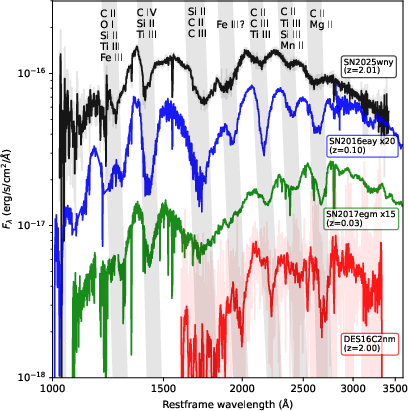
Figure 2: Keck/LRIS spectrum of SN\,2025wny (black line) compared to HST spectra of the low-z SLSN-I 2016eay (blue), SN\,2017egm (green), and Magellan/LDSS3 spectrum of high-z DES16C2nm (red), scaled by luminosity distance.
The continuum of SN 2025wny is notably bluer than comparison SLSNe-I, with fitted blackbody temperatures ranging from 29,000±1,000 K to 19,000±1,000 K, exceeding typical values for SLSNe-I at similar phases. The absorption features are generally weaker and broader, possibly indicating differences in ejecta ionization or composition.
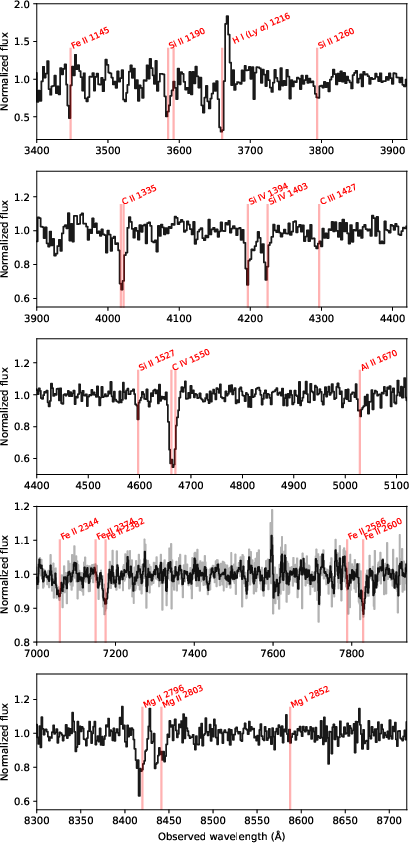
Figure 3: Selection of absorption lines identified for SN\,2025wny, used to determine the SN host redshift z=2.011±0.001.
The host galaxy absorption lines are weak, with a mean line-strength parameter (LSP) of −0.64, placing the system at the 20th percentile of the GRB distribution. The Lyα line is unresolved, implying a low neutral hydrogen column (log10(NH/cm−2)<19.3), indicative of a low-density, low-metallicity, star-forming dwarf galaxy.
Light Curve Analysis and Lensing Magnification
The rest-frame UV light curve of SN 2025wny, derived from ZTF r-band photometry, is compared to a sample of SLSNe in similar rest-frame bands. The observed peak absolute magnitude (uncorrected for lensing) is −25.8 at λrest=2120 Å. To reconcile this with the intrinsic luminosity of typical SLSNe-I, a lensing magnification of μ∼20–$50$ is required for the brightest image.
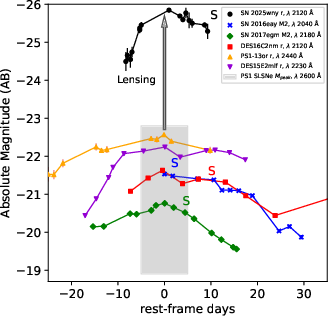
Figure 4: Rest-frame UV light curve of Image A of SN\,2025wny (from the ZTF r-band) compared to a set of comparison SLSN curves in similar rest-frame bands.
The rise of 1.5 mag over the first 10 rest-frame days is steep for a SLSN-I, though not unprecedented. The combination of high observed luminosity, blue color, and rapid rise suggests either an exceptionally high magnification, an intrinsically overluminous event, or early-phase UV emission not previously accessible for SLSNe-I.
Implications for Cosmology and Galaxy Evolution
The detection of SN 2025wny demonstrates that ground-based facilities can resolve multiply imaged SNe at z>2, previously thought to be accessible only to space-based NIR telescopes. This expands the parameter space for time-delay cosmography, enabling independent measurements of H0 and constraints on lens mass distributions at high redshift.
The event also provides a unique probe of the ISM in distant dwarf galaxies, with absorption line analysis indicating low metallicity and gas density. The magnification enables detailed spectroscopic studies of both the SN and its host, facilitating investigations of star formation, chemical enrichment, and feedback in the early universe.
Future Prospects
The paper anticipates rapid growth in the discovery of lensed SNe with the advent of LSST, JWST, and Euclid, which will provide large samples across a range of redshifts and environments. Routine detection and characterization of lensed SNe will enable precision cosmology and detailed studies of galaxy evolution. The synergy between ground-based surveys and space-based follow-up will be critical for time-delay measurements, lens modeling, and host galaxy characterization.
Conclusion
SN 2025wny is the first confirmed strongly lensed SLSN-I, multiply imaged and resolved from the ground at z=2.011. The event demonstrates the feasibility of ground-based lensing studies at high redshift, provides a new window into the study of distant supernovae and their host galaxies, and sets the stage for future cosmological and astrophysical applications of lensed transients. The combination of high magnification, early-phase UV coverage, and resolved imaging establishes a new benchmark for the field and motivates further systematic searches and follow-up of lensed SNe in the time-domain era.