A spectroscopically confirmed, strongly lensed, metal-poor Type II supernova at z = 5.13
Abstract: Observing supernovae (SNe) in the early Universe (z > 3) provides a window into how both galaxies and individual stars have evolved over cosmic time, yet a detailed study of high-redshift stars and SNe has remained difficult due to their extreme distances and cosmological redshifting. To overcome the former, searches for gravitationally lensed sources allow for the discovery of magnified SNe that appear as multiple images - further providing the opportunity for efficient follow-up. Here we present the discovery of "SN Eos": a strongly lensed, multiply-imaged, SN II at a spectroscopic redshift of z = 5.133 +/- 0.001. SN Eos exploded in a Lyman-α emitting galaxy when the Universe was only ~1 billion years old, shortly after it reionized and became transparent to ultraviolet radiation. A year prior to our discovery in JWST data, archival HST imaging of SN Eos reveals rest-frame far ultraviolet (~1,300Å) emission, indicative of shock breakout or interaction with circumstellar material in the first few (rest-frame) days after explosion. The JWST spectroscopy of SN Eos, now the farthest spectroscopically confirmed SN ever discovered, shows that SN Eos's progenitor star likely formed in a metal-poor environment (<= 0.1 Z_{\odot}), providing the first direct evidence of massive star formation in the metal-poor, early Universe. SN Eos would not have been detectable without the extreme lensing magnification of the system, highlighting the potential of such discoveries to eventually place constraints on the faint end of the cosmic star-formation rate density in the very early Universe.
Paper Prompts
Sign up for free to create and run prompts on this paper using GPT-5.
Top Community Prompts
Explain it Like I'm 14
Overview
This paper tells the story of “SN Eos,” a gigantic star that exploded a very long time ago, when the Universe was only about 1 billion years old. The explosion is called a Type II supernova (a massive star that still had hydrogen on its surface when it blew up). What makes SN Eos special is that it’s the farthest supernova ever confirmed using its light “fingerprint” (its spectrum), and it was only visible because a huge cluster of galaxies acted like a cosmic magnifying glass to brighten and duplicate its image.
What questions were the scientists asking?
- Can we find and confirm supernovae that happened in the very early Universe (more than 12 billion years ago)?
- What kind of star exploded (what type of supernova), and what was its environment like?
- Did that star form in a “metal-poor” place (meaning it had very few heavy elements like iron), as we expect for the early Universe?
- Can strong gravitational lensing (nature’s magnifier) help us study faint stars and galaxies we couldn’t otherwise see?
How did they study it? (Methods explained simply)
- Space and ground telescopes: The team used images and data from NASA’s James Webb Space Telescope (JWST), earlier pictures from the Hubble Space Telescope (HST), and a ground-based instrument called MUSE on the Very Large Telescope (VLT).
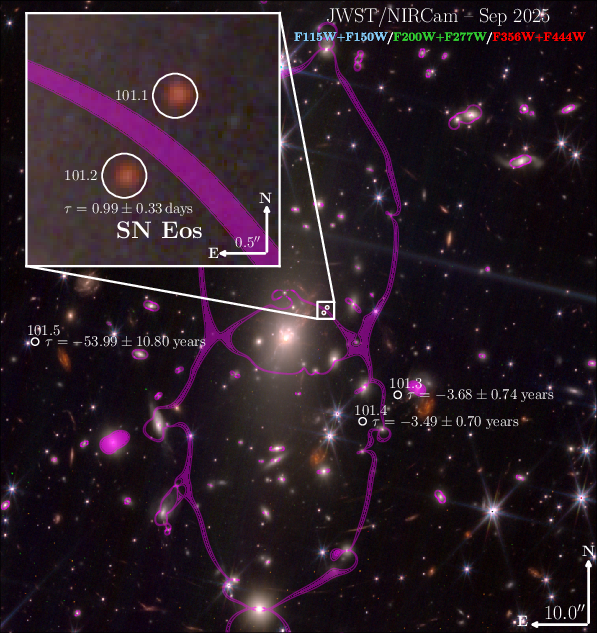
- Gravitational lensing: A massive galaxy cluster between us and SN Eos bent and magnified the supernova’s light. Think of it like a glass marble making a tiny object look bigger and sometimes creating multiple copies. This lensing made SN Eos appear brighter and in more than one place in the sky, with each “copy” arriving at slightly different times.
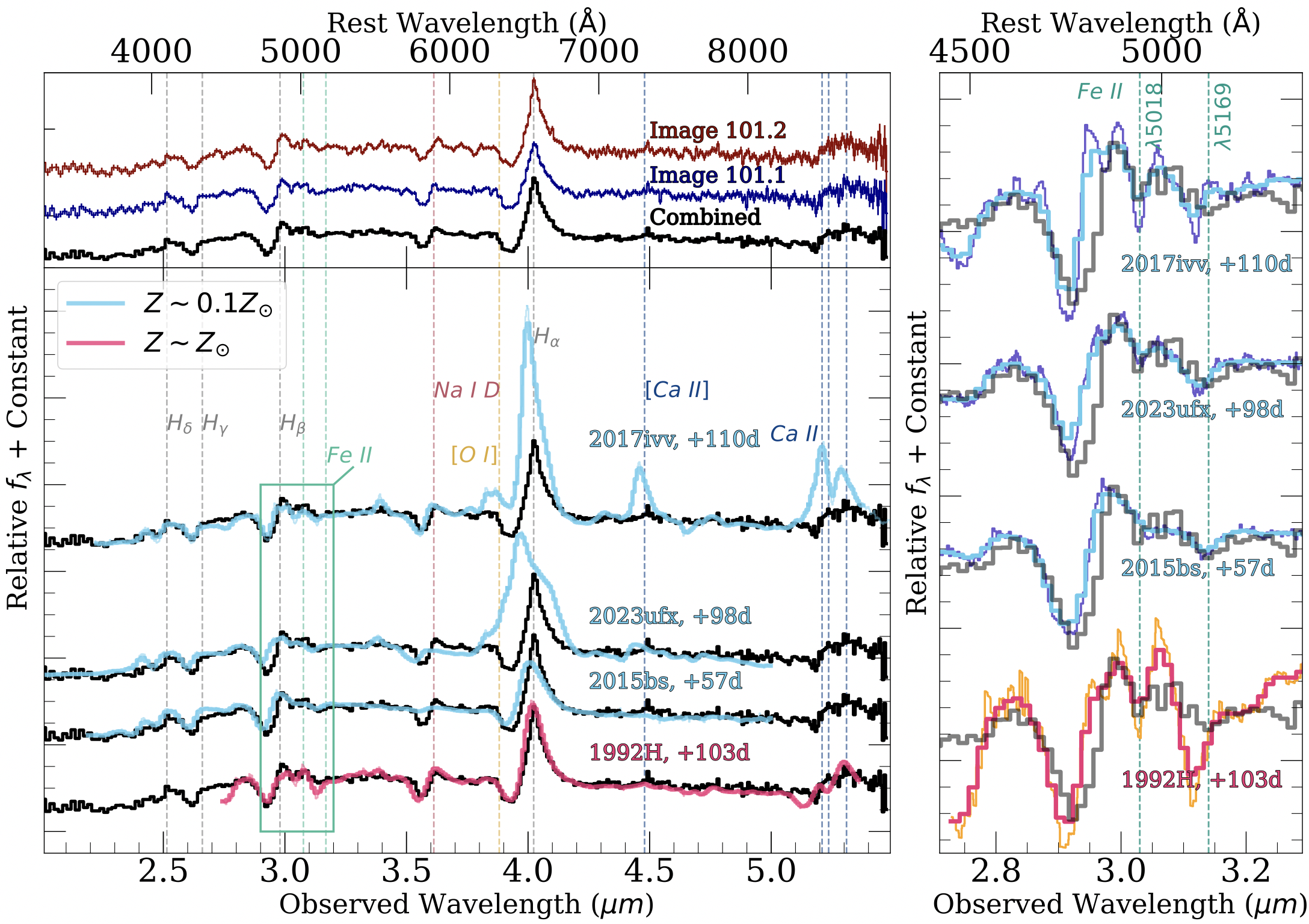
- Spectroscopy (the light fingerprint): They split the supernova’s light into its colors, like a rainbow, to see specific patterns from elements. Seeing strong hydrogen features told them it was a Type II supernova. Specific line shapes (called P-Cygni profiles) are a classic signature of an exploding star.
- Redshift and distance: They measured how much the light was stretched (redshift, written as z = 5.13). The more the light is stretched, the farther back in time we’re seeing. At z ≈ 5.13, the Universe was very young.
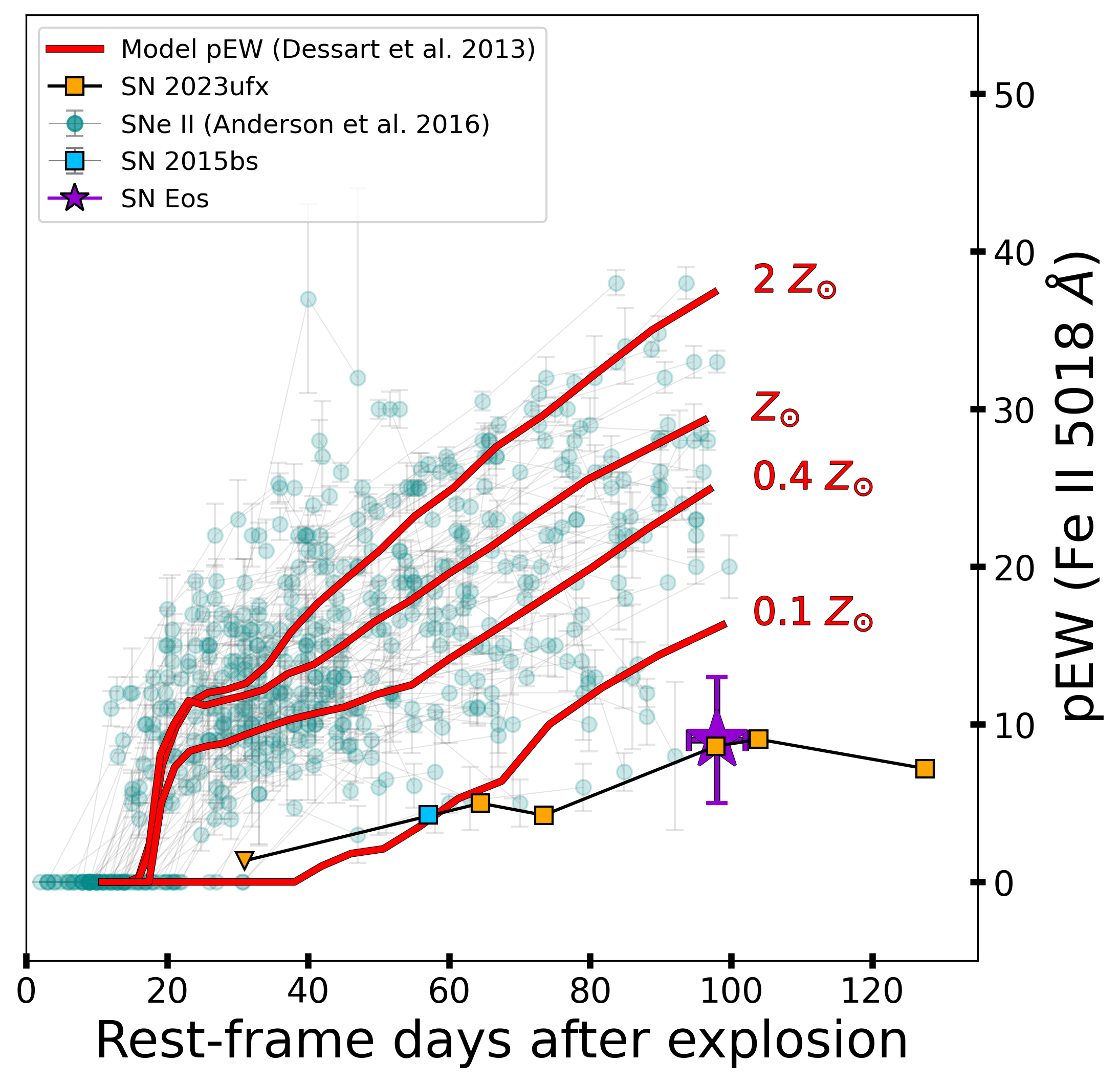
- Clues about “metallicity” (how many heavy elements there are): Heavy elements like iron build up over time as stars live and die. The team measured the strength of certain iron features (Fe II lines) in the spectrum. Weak iron lines mean the star formed in a metal-poor environment—less than about 10% of the Sun’s metal content.
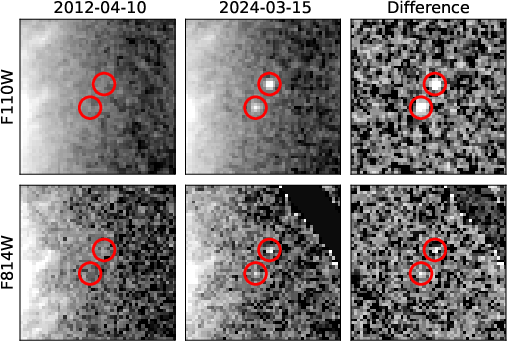
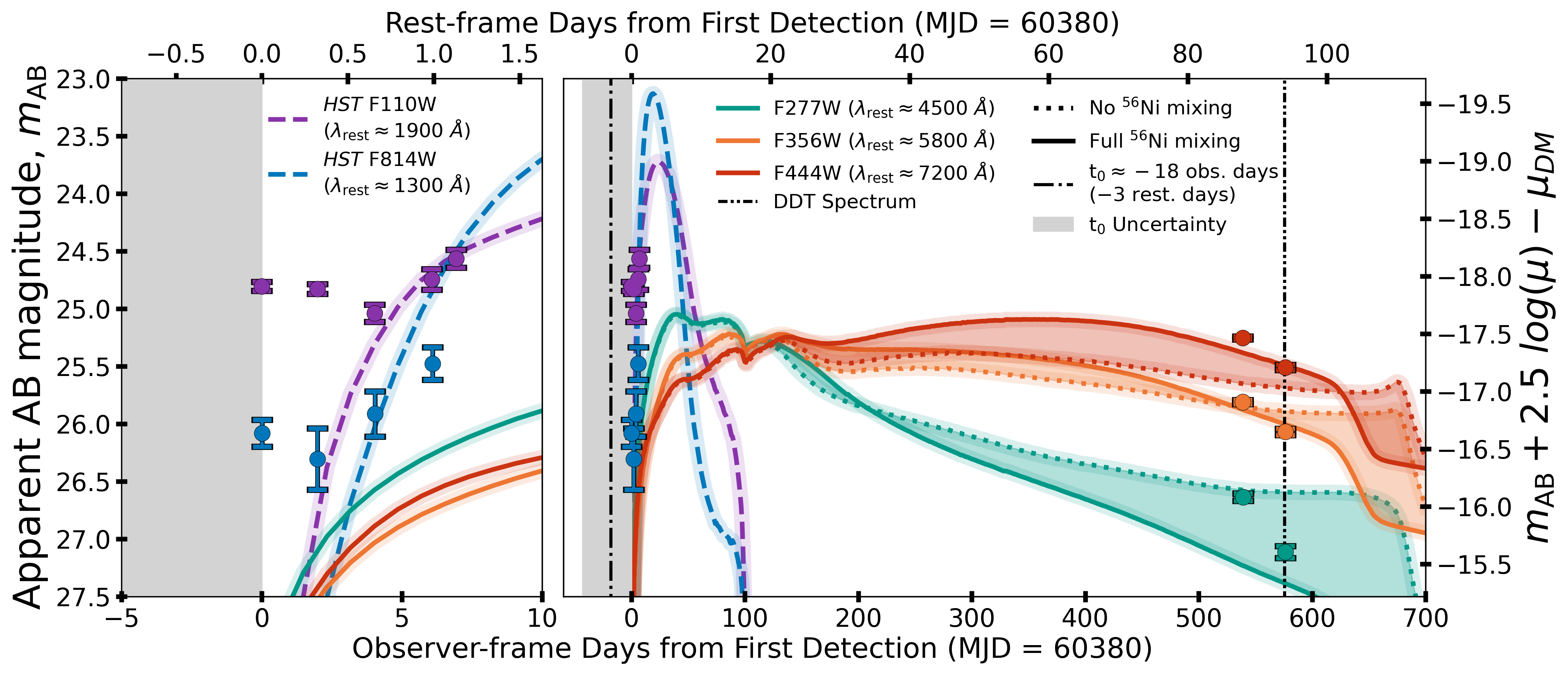
- Early UV flashes: Old Hubble images from 2024 (arriving earlier due to lensing time delays) caught the supernova’s bright ultraviolet light just days after the explosion in its own timeline. That early UV glow can come from the first “shock breakout” or from the explosion briefly lighting up gas close around the star (circumstellar material).
What did they find, and why is it important?
Here are the main results in plain language:
- Farthest confirmed supernova: SN Eos is the most distant supernova ever confirmed by its spectrum. That’s a big deal because spectra give reliable, detailed information.
- It’s a Type II supernova: The light fingerprint showed strong hydrogen features, proving it was a massive star that kept its hydrogen until it exploded.
- Very low metals: The supernova’s spectrum indicates the star formed in a metal-poor environment (less than about 10% of the Sun’s heavy-element content). This matches what we expect for the early Universe and is direct evidence that massive stars were forming in such primitive conditions.
- Caught very early light: Hubble accidentally saw the supernova’s ultraviolet light very early (just days after it exploded in its own frame of time), likely showing the first flash or the explosion hitting nearby gas.
- Gravitational lensing made it possible: Without the huge magnification from the galaxy cluster, SN Eos would have been too faint to detect. Lensing both brightened it and created multiple images with tiny time delays between them.
Why this matters:
- It gives us a close look at how massive stars lived and died when the Universe was young and still getting filled with heavier elements.
- It shows that we can use supernovae to reveal extremely faint, early galaxies that are otherwise invisible.
- It proves that Type II supernovae can act as tools to measure how “metal-rich” or “metal-poor” the Universe was at different times.
What’s the bigger impact?
- Understanding the first generations of stars: Results like this help scientists figure out how the earliest stars formed, how they spread the ingredients for planets and life, and how quickly the Universe became enriched with heavy elements.
- Finding hidden galaxies: Supernovae can light up tiny, faint galaxies in the early Universe, helping us count and study them more fairly than before.
- New era of discovery: Using JWST together with gravitational lensing opens a powerful new window to study explosions and galaxies from the dawn of time. With more discoveries like SN Eos, scientists can map how star formation and chemical enrichment changed over cosmic history and better test theories about how galaxies grew.
In short, SN Eos is a landmark discovery: a magnified, metal-poor, early-Universe supernova that lets us directly test ideas about the first massive stars and the young galaxies they lived in.
Knowledge Gaps
Knowledge gaps, limitations, and open questions
Below is a concise, actionable list of what remains missing, uncertain, or unexplored in the study of SN Eos and its environment:
- Direct host metallicity is unmeasured: only Lyα is detected at low S/N and no rest-frame optical/UV nebular lines (e.g., Hβ, [O III], [O II], [C III]) are available to independently calibrate gas-phase metallicity.
- Metallicity inference from SN Fe II pEW is phase-dependent and based on a single epoch near the end of the plateau; its use at lacks validation across phases and may bias metallicity high due to cooler photospheric temperatures at late times.
- Explosion time () is weakly constrained (≤5 rest-frame days) owing to the absence of a tight pre-detection non-detection; this uncertainty propagates into phase, pEW interpretation, and model fitting.
- Lensing magnification and time-delay estimates near the critical curve have substantial uncertainties; derived absolute luminosities, Ni mass, and energy are sensitive to these values and need refined lens models with more constraints.
- Potential microlensing by stars in the lens plane and differential magnification across the extended SN photosphere are not assessed; both could affect fluxes, line profiles, and color evolution.
- Only two lensed SN images are observed; the three additional predicted images (with earlier arrival times) are not detected, limiting empirical time-delay measurements and lens-model validation.
- The predicted short time delay (~1 day) between images 101.1 and 101.2 was not measured with high-cadence monitoring; this precludes using the system for time-delay cosmography or stringent lens-model tests.
- Early UV emission is modeled with a simplified spherical CSM shell; excess flux in the first two HST epochs indicates more complex CSM geometries (e.g., asymmetry, clumping, binary interaction) that are not explored.
- No multi-wavelength constraints (radio/X-ray) are available to quantify CSM densities and mass-loss rates; these are crucial to discriminate shock breakout vs. CSM interaction scenarios.
- SN subtype (IIP) classification relies on inferred plateau phase without a long, well-sampled rest-frame optical/NIR light curve; alternative interaction-dominated subtypes (e.g., IIn) are not rigorously excluded.
- Progenitor properties (mass, radius, explosion energy, Ni mass, mixing) remain degenerate due to limited photometric coverage, single-epoch spectroscopy, and lensing uncertainties.
- Nebular-phase spectroscopy is absent; without late-time spectra, inner ejecta composition, Ni mass, and explosion asymmetry cannot be constrained.
- The Fe II pEW–metallicity calibration is extrapolated from local SNe II; its applicability at very low and high redshift (with potentially non-solar abundance patterns, e.g., /Fe enhanced) is unverified.
- Spectral resolution (NIRSpec PRISM) may blend features and bias pEW measurements; higher-resolution spectroscopy is needed to robustly isolate Fe II λ5018/5169 and measure velocities.
- Host dust attenuation is unknown; the analysis assumes Milky Way foreground only, leaving possible host attenuation effects on photometry and continuum shape unquantified.
- Host galaxy physical properties (stellar mass, SFR, dust, size, morphology) are not derived; a lens-corrected SED fit across multiple bands is needed to contextualize the environment.
- IGM/ISM absorption effects near the end of reionization on the SN continuum and line profiles are not modeled; their impact on spectral interpretation and UV photometry remains uncertain.
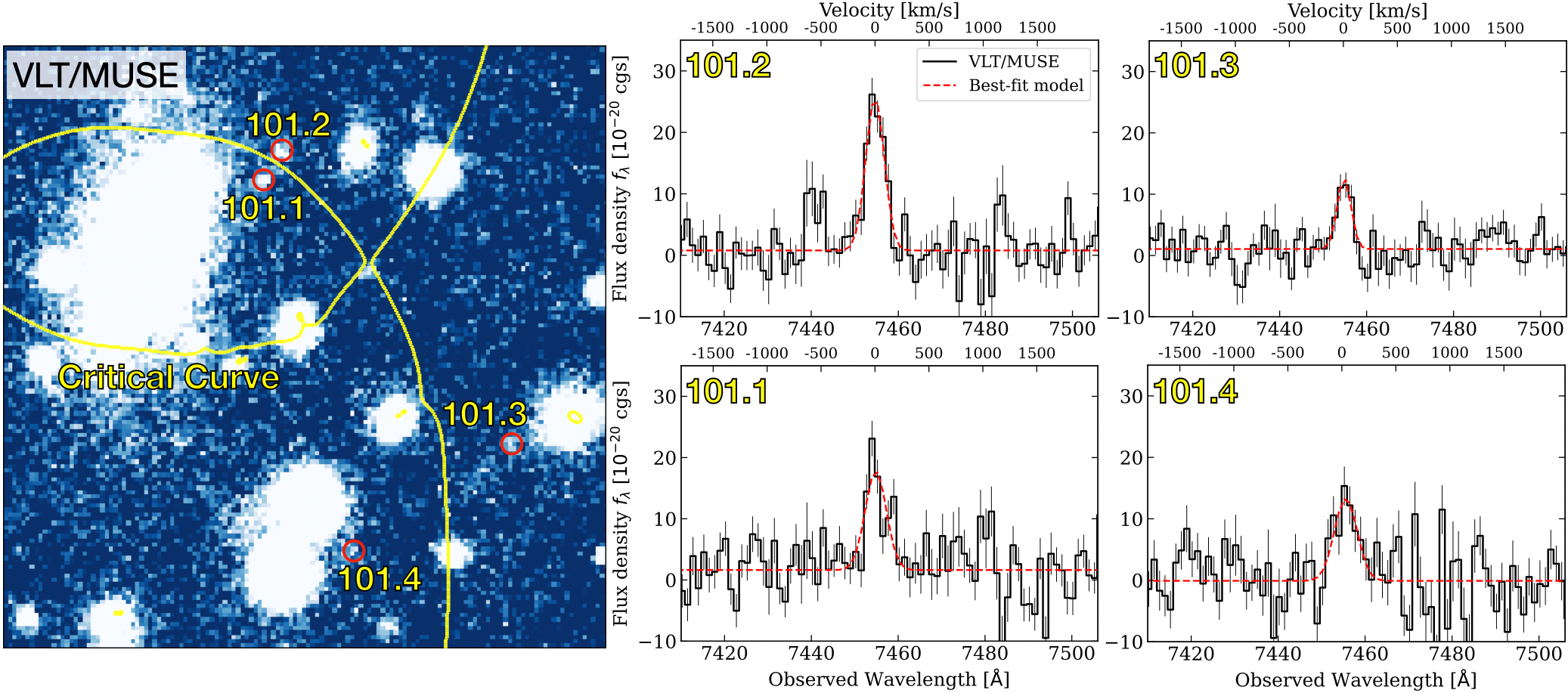
- Association of the Lyα emitter with the SN’s host is based on positional coincidence and lensing model predictions; confirmation via additional emission lines or deeper integral-field spectroscopy is needed to rule out chance alignment.
- The impact of assumed cosmology (fixed , , ) on lens modeling and time-delay predictions is not explored; joint cosmology–lens model uncertainties are unquantified.
- Differential host light contamination in SN photometry near the critical curve is not assessed; even a faint host can bias SN fluxes and colors under high magnification.
- Photometric modeling uses only the brighter image (101.2) to mitigate lensing uncertainty, but potential differences in magnifications between images remain untested; joint modeling of both images could tighten constraints.
- The survey’s selection function, detection efficiency, and lensing volume are not quantified; the single-event discovery cannot yet constrain the faint-end SFR density or SN II rates at .
- Statistical generalization is impossible from one object; a systematic program to build a sample of high- SNe II with similar-quality spectra and light curves is needed to test metallicity–spectrophotometric correlations and population diversity.
- Calibration of SNe II as metallicity probes at high redshift requires cross-validation against independent host metallicity measurements and multi-epoch Fe II pEW evolution; such calibration is not yet established.
- The possibility of measuring future or past-arriving lensed images (beyond 101.1/101.2) with targeted archival searches or new observations is not exploited; such detections could refine lens models and SN timeline.
- Constraints on reionization-era chemical enrichment (e.g., vs. host mass) from a single event are qualitative; a framework to connect SN-derived metallicities to the evolving mass–metallicity relation is not implemented.
- The role of SN Eos and similar events in tracing the faint end of the galaxy UV luminosity function is proposed but not quantified; a methodology linking SN rates, magnifications, and completeness to LF constraints is missing.
- Potential signatures of extremely metal-poor or Pop III-like progenitors (e.g., distinctive abundance ratios, line strengths, or continuum behavior) are not investigated beyond the low- inference.
Practical Applications
Immediate Applications
Below are practical use cases that can be deployed now, derived from the paper’s findings, methods, and data-processing innovations.
- Lensed-transient discovery and follow-up workflows (Academia; Observatory operations; Software)
- What: Targeted searches for supernovae behind massive galaxy clusters acting as “gravitational telescopes” to boost detectability of high-z events, with lens-model–informed follow-up scheduling.
- Tools/products/workflows: Cluster-field observing programs (VENUS-like), lens-model overlays in survey planning tools, transient alert brokers that ingest lens-model time-delay predictions for automatic follow-up requests, quick-look spectroscopic classification with JWST/NIRSpec PRISM templates.
- Assumptions/dependencies: Accurate mass models for lensing clusters; access to JWST/HST/ground-based spectrographs; timely alert dissemination; reliable time-delay estimates.
- Supernova II spectroscopy as a metallicity probe at high redshift (Academia)
- What: Immediate adoption of Fe II pseudo-equivalent width measurements (e.g., λ5018, λ5169) in SN II spectra to infer local environmental metallicity beyond the local Universe.
- Tools/products/workflows: Public spectral templates for low-Z SNe II; pEW measurement scripts; phase-calibration aids; integration into transient classification pipelines.
- Assumptions/dependencies: High S/N spectra and phase constraints; applicability of local calibrations to high-z; minimized contamination from host and CSM interaction.
- SN-triggered discovery of ultra-faint Lyman-α emitters (Academia)
- What: Use high-z core-collapse SNe as signposts to reveal otherwise undetectable, faint LAE hosts; extend the faint end of the UV luminosity and mass–metallicity relations.
- Tools/products/workflows: Automated host-galaxy searches tied to SN detections; cross-matching with archival IFU data (e.g., MUSE); catalog updates of faint LAEs.
- Assumptions/dependencies: Lens magnification sufficient for host detection; availability of archival IFU coverage or follow-up IFU time.
- Cross-archive, rapid data fusion for time-domain constraints (Academia; Software/Data engineering)
- What: Operationalize workflows that combine archival HST detections with new JWST imaging/spectroscopy to constrain explosion epochs and early UV behavior.
- Tools/products/workflows: Cross-mission reprocessing pipelines; automated footprint/time-window matchers across JWST/HST/MUSE; provenance-aware data products.
- Assumptions/dependencies: Open, timely access to archives; consistent calibration references; accurate astrometric registration.
- Enhanced imaging pipelines for space-based instruments (Software; Remote sensing)
- What: Immediate reuse of background modeling, 1/f noise mitigation, diffraction spike subtraction, and drizzling practices (as in grizli) to improve data quality in other astronomical and Earth-observation imaging.
- Tools/products/workflows: Open-source modules or API endpoints for artifact removal and mosaic building; CI/CD for pipeline updates; reproducible calibration contexts (CRDS).
- Assumptions/dependencies: Domain adaptation to non-astronomical radiometry and PSFs; documentation and benchmarking across sensors.
- Lens-aware telescope scheduling to capture multiple images with predicted time delays (Observatory operations; Software)
- What: Use model-predicted image arrival times to optimize cadence and maximize signal in multiply imaged SNe.
- Tools/products/workflows: Scheduling plugins that ingest lens-model posteriors; dashboards exposing expected image positions, magnifications, and arrival phases.
- Assumptions/dependencies: Lens-model uncertainties; weather/queue constraints on ground-based facilities.
- Training datasets and classifiers for low-metallicity SNe II (Academia; Software/ML)
- What: Curated spectral and photometric libraries (including NIRSpec PRISM-convolved templates) to improve automated classification and metallicity inference.
- Tools/products/workflows: Labeled datasets; feature extractors for pEWs; semi-supervised learned representations for low-S/N regimes.
- Assumptions/dependencies: Sufficient diversity of well-modeled low-Z SNe; robust labels; standardized preprocessing.
- Education and public engagement content on the first stars and gravitational lensing (Education; Daily life)
- What: Create curricula and media assets showcasing SN Eos to explain reionization, chemical enrichment, and lensing.
- Tools/products/workflows: Lesson plans; planetarium scripts; interactive visualizations of critical curves and time delays.
- Assumptions/dependencies: Partnerships with schools/museums; age-appropriate framing; rights to imagery.
- Scalable research computing patterns validated for large space datasets (Cloud/HPC)
- What: Leverage CANFAR/DRAC-like science platforms for collaborative storage, compute, and analysis of JWST-scale imaging and spectroscopy.
- Tools/products/workflows: Containerized pipelines; federated data access; Jupyter-based science platforms with GPU/CPU backends.
- Assumptions/dependencies: Sustained funding; data egress policies; user support and allocation management.
Long-Term Applications
These opportunities require further research, scaling, or technology development before broad deployment.
- Time-delay cosmography with lensed supernovae for precision H0 and dark-energy constraints (Academia; Policy relevance)
- What: Build statistically significant samples of multiply imaged SNe with measured time delays to constrain cosmological parameters independently of the distance ladder.
- Tools/products/workflows: End-to-end inference platforms combining light curves, spectroscopy, lens mass modeling, and line-of-sight structure; Roman/LSST/ELT synergy for cadence and resolution.
- Assumptions/dependencies: Many well-characterized events; reduced lens-model systematics; coordinated multi-facility scheduling; long-baseline monitoring.
- Population-scale chemical cartography of the early Universe via SNe II (Academia)
- What: Calibrate and apply SN II metallicity diagnostics across cosmic time to map chemical enrichment, the evolving IMF, and faint-end star-formation rate density.
- Tools/products/workflows: Uniform modeling frameworks (hydrodynamics + radiative transfer) coupled to spectral diagnostics; hierarchical Bayesian population analyses.
- Assumptions/dependencies: Consistency of metallicity proxies across environments and redshifts; sample sizes in the hundreds; improved phase and CSM characterization.
- Autonomous, lens-aware mission planning and robotic follow-up (Robotics/Autonomy; Observatory operations)
- What: Real-time agents that anticipate future image arrivals and autonomously trigger coordinated spectro-photometric campaigns.
- Tools/products/workflows: Decision-theoretic schedulers integrating lens-model posteriors; broker-to-telescope APIs; reinforcement learning for cadence optimization.
- Assumptions/dependencies: Reliable predictions and uncertainty quantification; facility buy-in for automated ToO triggers; latency guarantees.
- Transfer of astronomical noise/artifact mitigation to other imaging domains (Healthcare imaging; Materials microscopy; Earth observation)
- What: Adapt 1/f noise correction, diffraction- and artifact-suppression, and super-resolution mosaicking to improve diagnostic imaging and remote sensing.
- Tools/products/workflows: Cross-domain signal-processing libraries; benchmarking datasets; regulatory-grade validation in clinical/industrial settings.
- Assumptions/dependencies: PSF/physics differences demand re-training/retuning; safety and compliance (e.g., FDA/CE for medical); quantifiable gains over incumbents.
- Discovery-at-scale platforms for lensed transients (Education; Citizen science; Academia)
- What: Public platforms enlisting volunteers to scan cluster fields for transient features near critical curves; triage candidates for professional follow-up.
- Tools/products/workflows: Web/mobile apps with AI-assisted pre-filtering; gamified training; expert review queues integrated with alert brokers.
- Assumptions/dependencies: Sustained data streams; moderation; feedback loops to maintain data quality and volunteer engagement.
- Space-instrument design and survey strategy informed by early-UV SN physics (Space instrumentation; Policy)
- What: Incorporate filter sets, cadences, and IFU capabilities optimized for capturing early UV shock breakout and CSM interaction in next-gen missions (e.g., Roman extensions, LUVOIR/Habitable Worlds Observatory concepts).
- Tools/products/workflows: Design studies using forward models of early SN spectra; simulation-to-requirements pipelines; trade studies for cadence/filter selection.
- Assumptions/dependencies: Mission timelines; budget and prioritization; downstream science cases co-benefits.
- Computational “lensing” analogs for super-resolution beyond astronomy (Software/Imaging; Defense/Surveillance; Manufacturing inspection)
- What: Explore priors-driven super-resolution frameworks inspired by gravitational lens modeling to resolve sub-resolution features in complex scenes.
- Tools/products/workflows: Probabilistic inverse-problem solvers with strong structural priors; uncertainty-aware reconstructions.
- Assumptions/dependencies: Existence of robust analog priors in target domains; ethical and legal considerations; rigorous validation vs. hallucination risks.
- Open, rapid cross-mission data-sharing standards for time-domain astronomy (Policy; Research infrastructure)
- What: Codify protocols and SLAs for data latency, standardized formats, and coordinated ToOs across agencies and facilities to maximize science return from fleeting events.
- Tools/products/workflows: Community-endorsed schemas (VOEvent-like extensions), interoperability guidelines, governance compacts.
- Assumptions/dependencies: Multi-agency alignment; resources for compliance and tooling; incentives for participation.
- End-to-end pipelines for faint-galaxy discovery via transient signposts (Academia; Software)
- What: Systematically leverage transients (SNe, lensed stars) to uncover otherwise invisible galaxies and build catalogs that inform the faint end of galaxy evolution.
- Tools/products/workflows: Joint transient–host inference; IFU follow-up protocols; catalog fusion with deep-field surveys.
- Assumptions/dependencies: Continued access to IFUs and deep imaging; robust selection functions; careful lensing bias correction.
- Education technology built on authentic high-z transient datasets (Education; EdTech)
- What: Interactive curricula and AR/VR experiences for classrooms that simulate lensing, time delays, and spectral classification with real JWST/HST data.
- Tools/products/workflows: Dataset APIs for educators; modular lesson kits; standards-aligned assessments.
- Assumptions/dependencies: Teacher professional development; sustained content maintenance; accessibility considerations.
Glossary
- 1/f noise: Low-frequency electronic noise whose power spectral density is inversely proportional to frequency, often affecting astronomical detectors. "We further perform additional background, 1/f noise and diffraction spike subtraction at both the amplifier and mosaic levels"
- AB mag: A photometric magnitude system calibrated so that a flat spectrum in frequency has constant magnitude; widely used for comparing brightness across wavelengths. "a limiting magnitude of 27.3 AB mag"
- Balmer lines: Spectral lines of hydrogen resulting from electron transitions to the n=2 energy level; key diagnostics in stellar and supernova spectra. "hydrogen Balmer lines"
- Charge transfer efficiency (CTE): A measure of how efficiently charge is transferred across a detector’s pixels during readout; imperfections can cause signal loss and must be corrected. "products that include the pixel-based corrections for charge transfer efficiency (CTE)"
- Circumstellar material (CSM): Gas and dust surrounding a star, often produced by stellar winds, that can interact with supernova ejecta and affect early light curves. "indicative of shock breakout or interaction with circumstellar material"
- Core-collapse supernovae (CC SNe): Explosions of massive stars whose cores collapse under gravity, producing bright transients and enriching the interstellar medium. "core-collapse supernovae (CC~SNe)"
- Critical curve: The locus in the lens plane where gravitational lensing magnification formally diverges, yielding highly magnified and often multiple images. "the critical curve, which represents the thin region of infinite magnification in the lens system for the source redshift"
- Distance modulus: The difference between apparent and absolute magnitude, encoding the luminosity distance to an object. "calculate a distance modulus ~AB mag"
- Drizzled (drizzling): An image combination technique that resamples and co-adds dithered exposures to improve resolution and mitigate artifacts. "Final NIRCam mosaics are then drizzled to native pixel scales for each detector"
- Epoch of Reionization (EoR): The era when the first luminous sources ionized the intergalactic medium, ending the cosmic “dark ages.” "This transition... is referred to as the Epoch of Reionization \citep[EoR,]{}"
- Far ultraviolet (FUV): The ultraviolet regime at shorter wavelengths (roughly 912–2000 Å), sensitive to hot, young stars and early SN emission. "rest-frame far ultraviolet (FUV: \AA)"
- Fe II complex: A set of iron (Fe II) spectral lines that serve as diagnostics of composition and physical conditions in supernova ejecta. "A detailed view of the Fe~II complex for the same SNe, with SN Eos in gray"
- Fe-group elements: Heavy elements around iron on the periodic table (e.g., Fe, Co, Ni) produced in stellar interiors and supernovae, often traced via spectral lines. "the presence of Fe-group elements in the hydrogen-rich envelope at late times"
- Flat cosmology: A cosmological model with zero spatial curvature (Ωk=0), commonly parameterized by H0, ΩΛ, and Ωm. "a standard flat \ cosmology with , , and "
- Gas-phase metallicity: The abundance of elements heavier than helium in a galaxy’s gas, often inferred from emission lines. "lower (gas-phase) metallicity"
- Gravitational lensing (strong lensing): The deflection and magnification of light by massive foreground objects; strong lensing produces multiple highly magnified images. "This ``strong'' lensing effect leads to the appearance of multiple magnified images of the background object"
- H II regions: Clouds of ionized hydrogen around young, massive stars, used to infer local metallicity via emission line diagnostics. "the metallicity inferred from local measurements of the host HII regions"
- Hubble constant: The current expansion rate of the Universe, often constrained via lensing time delays and other cosmological probes. "thus directly probing cosmological evolution \citep[e.g, the Hubble constant]{}"
- Initial mass function (IMF): The statistical distribution of stellar masses at birth, which shapes galaxy evolution and supernova rates. "the potentially evolving initial mass function"
- JWST/NIRCam: JWST’s near-infrared camera used for imaging across multiple filters to detect distant galaxies and transients. "JWST/NIRCam imaging"
- JWST/NIRSpec PRISM: JWST’s near-infrared spectrograph in PRISM mode, providing low-resolution, wide-wavelength coverage for spectral classification. "NIRSpec PRISM spectroscopy"
- K-correction: A correction applied to observed magnitudes accounting for redshifted spectra and filter bandpasses to derive rest-frame quantities. "applying the redshift-dependent K-correction"
- Lyman-α (Lyα): A hydrogen emission line at 1215 Å, a key tracer of star formation and the intergalactic medium at high redshift. "a Lyman- emitting galaxy"
- Lyman-α emitter (LAE): A galaxy with strong Lyα emission, typically young, metal-poor, and actively forming stars at high redshift. "a Lyman-$ emitter (LAE) galaxy"</li> <li><strong>Magnification (μ)</strong>: The factor by which lensing boosts an object’s apparent brightness and size. "the model-predicted magnification is $\mu > 100z=5.133\pm0.001$"</li> <li><strong>Mass-metallicity relationship</strong>: The empirical correlation where lower-mass galaxies tend to have lower metallicities. "According to the mass-metallicity relationship, fainter, lower-mass galaxies should have lower (gas-phase) metallicity."</li> <li><strong>Metallicity</strong>: The fraction of a star or galaxy’s mass in elements heavier than helium; often expressed relative to solar (Z⊙). "lower metallicity environments than in the local Universe"</li> <li><strong>Multi Unit Spectroscopic Explorer (MUSE)</strong>: A VLT integral-field spectrograph that produces datacubes for spatially resolved spectroscopy. "Very Large Telescope (VLT) Multi Unit Spectroscopic Explorer (MUSE)"</li> <li><strong>Nucleosynthesis</strong>: The creation of new atomic nuclei in stars and supernovae, enriching the interstellar medium with heavy elements. "SN nucleosynthesis"</li> <li><strong>Photosphere</strong>: The visible “surface” layer of an exploding star or supernova from which most photons escape. "SN Eos's photosphere would be cooler than most of those measured"</li> <li><strong>Plateau (Type IIP plateau)</strong>: A phase in Type IIP supernova light curves with nearly constant luminosity driven by hydrogen recombination. "hydrogen recombination powers a relatively constant luminosity and results in a $\sim50 - 100$~rest-frame day ``plateau''"</li> <li><strong>Progenitor</strong>: The original star that explodes as a supernova, whose properties influence the explosion and observables. "SN Eos's progenitor star likely formed in a metal-poor environment"</li> <li><strong>P-Cygni profile</strong>: A spectral feature showing emission with a blueshifted absorption component, characteristic of expanding outflows in supernovae. "P-Cygni profile shapes that are characteristic of SNe"</li> <li><strong>Radioactive decay of 56Co</strong>: The decay chain powering late-time supernova luminosity, especially after the plateau phase. "radioactive decay of $^{56}$Co"</li> <li><strong>Red supergiant (RSG)</strong>: A massive, cool, evolved star type often serving as the progenitor of Type IIP supernovae. "low-metallicity red supergiant (RSG) SN progenitor models"</li> <li><strong>Redshift (spectroscopic redshift)</strong>: The shift of spectral features to longer wavelengths due to cosmic expansion; measured via spectroscopy to determine distance. "a spectroscopic redshift of $\mathbf{z=5.133\pm0.001}$"</li> <li><strong>Rest-frame</strong>: The reference frame in which the source is at rest, used to compare intrinsic timescales and wavelengths across redshift. "($\sim4$~rest-frame hours)"
- Shock breakout: The brief, luminous flash when a supernova shock emerges from the stellar surface, often bright in UV. "indicative of shock breakout"
- Specific star formation rate (sSFR): Star formation rate normalized by stellar mass, indicating how rapidly a galaxy is building its mass. "high specific star formation rates"
- Star-formation rate density: The amount of star formation per unit volume in the Universe, often studied as a function of redshift. "cosmic star-formation rate density"
- Time delay: The difference in arrival times between multiple lensed images of the same source, set by lens geometry and cosmology. "The difference between these arrival times is known as the ``time delay''"
- UV luminosity function: The distribution of galaxy number density as a function of ultraviolet luminosity, used to study faint galaxy populations. "the LAE UV luminosity function"
- Very Large Telescope (VLT): A ground-based observatory in Chile hosting advanced instruments like MUSE for deep spectroscopic observations. "Very Large Telescope (VLT) Multi Unit Spectroscopic Explorer (MUSE)"
Collections
Sign up for free to add this paper to one or more collections.