- The paper presents a novel GNN approach that improves QKD network key rates from 27.1 Kbits/s to 470 Kbits/s while reducing QBER from 6.6% to 6.0%.
- The methodology employs advanced layers like TransformerConv and GATv2Conv to model dynamic network topologies and quantum channel properties with high accuracy.
- Experimental results reveal a trade-off between network scale and predictive accuracy, highlighting the need for balanced configurations in quantum key distribution.
Introduction
Quantum Key Distribution (QKD) networks represent a critical frontier in secure communications, providing information-theoretic security that is invulnerable to quantum computing attacks. This paper outlines an innovative approach leveraging Graph Neural Networks (GNNs) to optimize QKD networks, addressing challenges such as adaptive dynamic conditions, parameter optimization, and resource utilization deficiencies common in classical cryptographic networks. The approach models QKD networks as dynamic graphs, extracting exploitable structural characteristics vital for efficient communication while ensuring robust security measures.
The fundamental QKD security principles are based on quantum mechanics' no-cloning theorem and Heisenberg's uncertainty principle. These principles facilitate secure key exchanges that are theoretically immune to computational brute-force attacks. The BB84 protocol, one of the most studied QKD protocols, transmits quantum states encoded in polarized photons. This protocol incorporates mechanisms to detect eavesdropping by identifying disturbances in quantum states, allowing legitimate parties to maintain only uncompromised key bits.
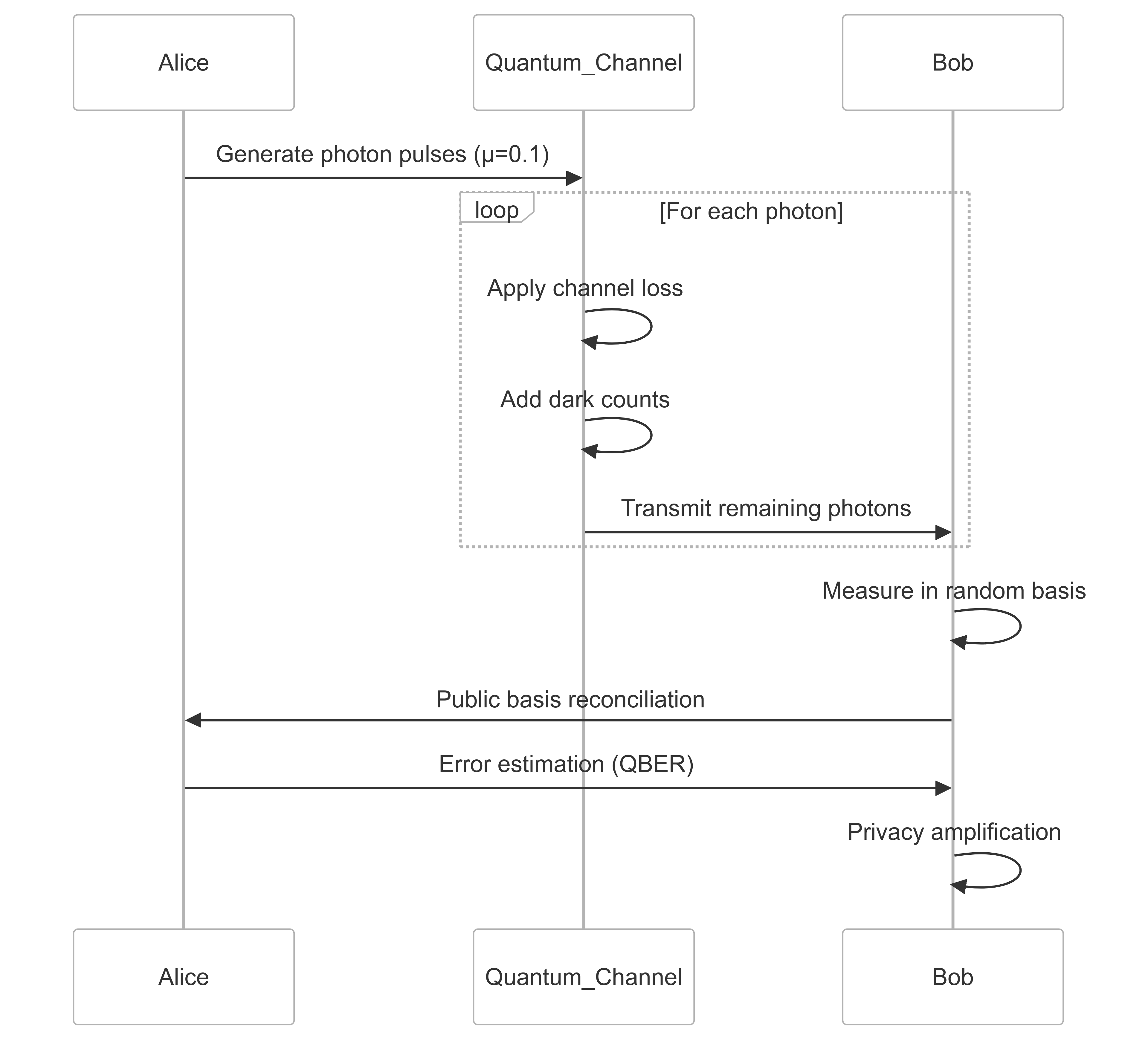
Figure 1: Simplified Demonstration of BB84 Communication Protocol.
Given the susceptibility of quantum transmissions to noise, loss, and decoherence—issues exacerbated by distance—innovations to extend QKD reach, such as quantum repeaters, are explored. However, the specific constraints necessitate solutions like GNNs capable of handling graph-structured data, essential for dynamic network optimization in QKD deployments.
Proposed Methodology
The proposed GNN-based framework centers around simulation environments that replicate QKD network behavior for optimization. Network topologies are modeled probabilistically, simulating realistic deployments characterized by clustered distributions. Critical QKD parameters, including detector efficiency and fiber loss, are integrated into simulations, mirroring physical systems.
For the link prediction task, a sophisticated GNN architecture processes node and edge features through layers like TransformerConv and GATv2Conv, with further processing of quantum channel properties via a dedicated MLP. This multi-layer architecture models complex relationships, enabling accurate key establishment predictions vital for optimizing routing and resource allocation.
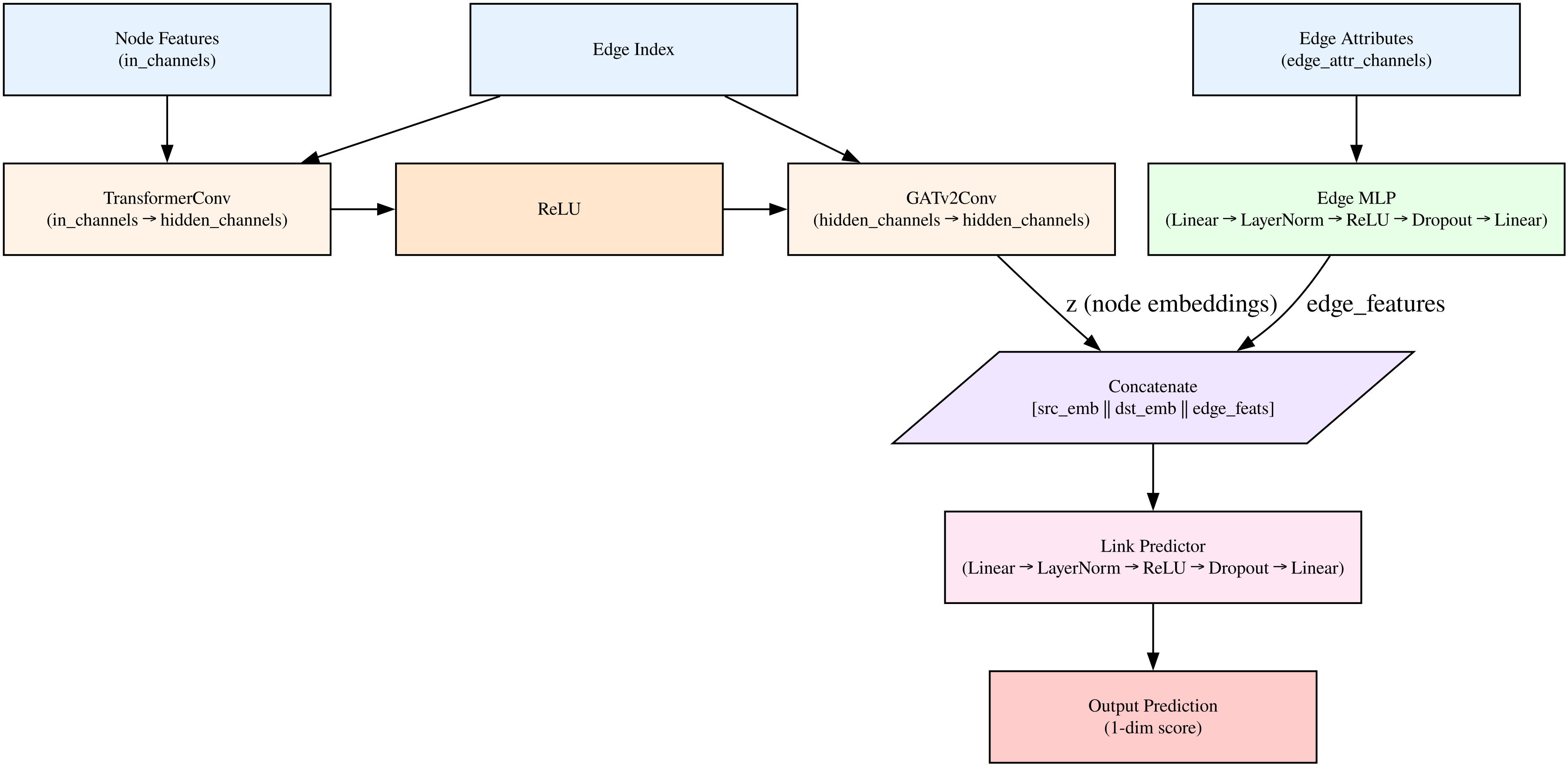
Figure 2: Model architecture with (1) Transformer-based graph convolution, (2) GATv2 attention layer, (3) Edge feature processing MLP, and (4) Link prediction decoder.
The simulation integrates channel parameters while processing network topologies into PyTorch Geometric Data objects. Edge features, demonstrating link properties, undergo special handling in the quantum domain, optimizing key generation rates and network performance metrics.
Experimental Setup
The experimental setup evaluates the proposed GNN framework rigorously, employing comprehensive training regimens to assess predictive capabilities and analyze network characteristics. Utilizing K-fold cross-validation and AdamW optimization, the training data incorporates both node and edge features for balanced, efficient link prediction, reducing computational inefficiencies inherent to network size.
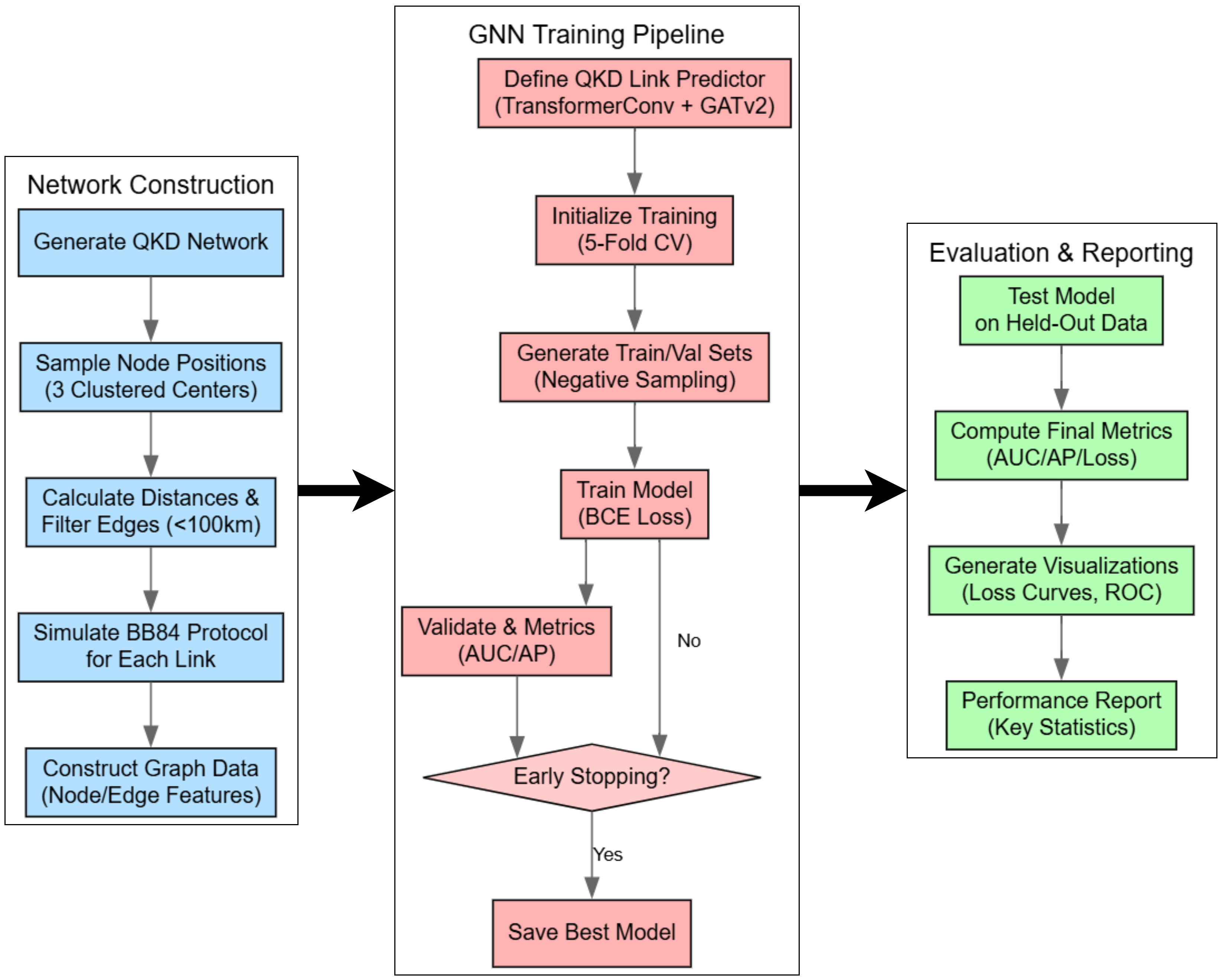
Figure 3: Three-stage quantum key distribution (QKD) network pipeline: (1) Network construction with BB84 protocol simulation, (2) Graph neural network (GNN) training with transformer and graph attention layers, and (3) Performance evaluation with quantum channel metrics.
The experiment is grounded in robust evaluation criteria, emphasizing Area Under Curve (AUC) and Average Precision (AP) metrics to measure model accuracy across network scales. Further, simulations of node and link removal test network resilience, complemented by comparative analyses across varied network sizes.
Results
Experimental findings reveal notable scaling characteristics and QKD performance metrics. The GNN-optimized networks display significant key rate increases (from 27.1 Kbits/s to 470 Kbits/s) with marginal QBER reduction (from 6.6% to 6.0%), validating the optimization strategy.
Network scaling shows super-linear growth, with edge numbers rising significantly as nodes increase, improving connectivity and resilience. Though larger networks provide better key rates and connectivity, link prediction accuracy declines with size, suggesting a mid-sized network configuration may balance performance and predictive efficacy effectively.
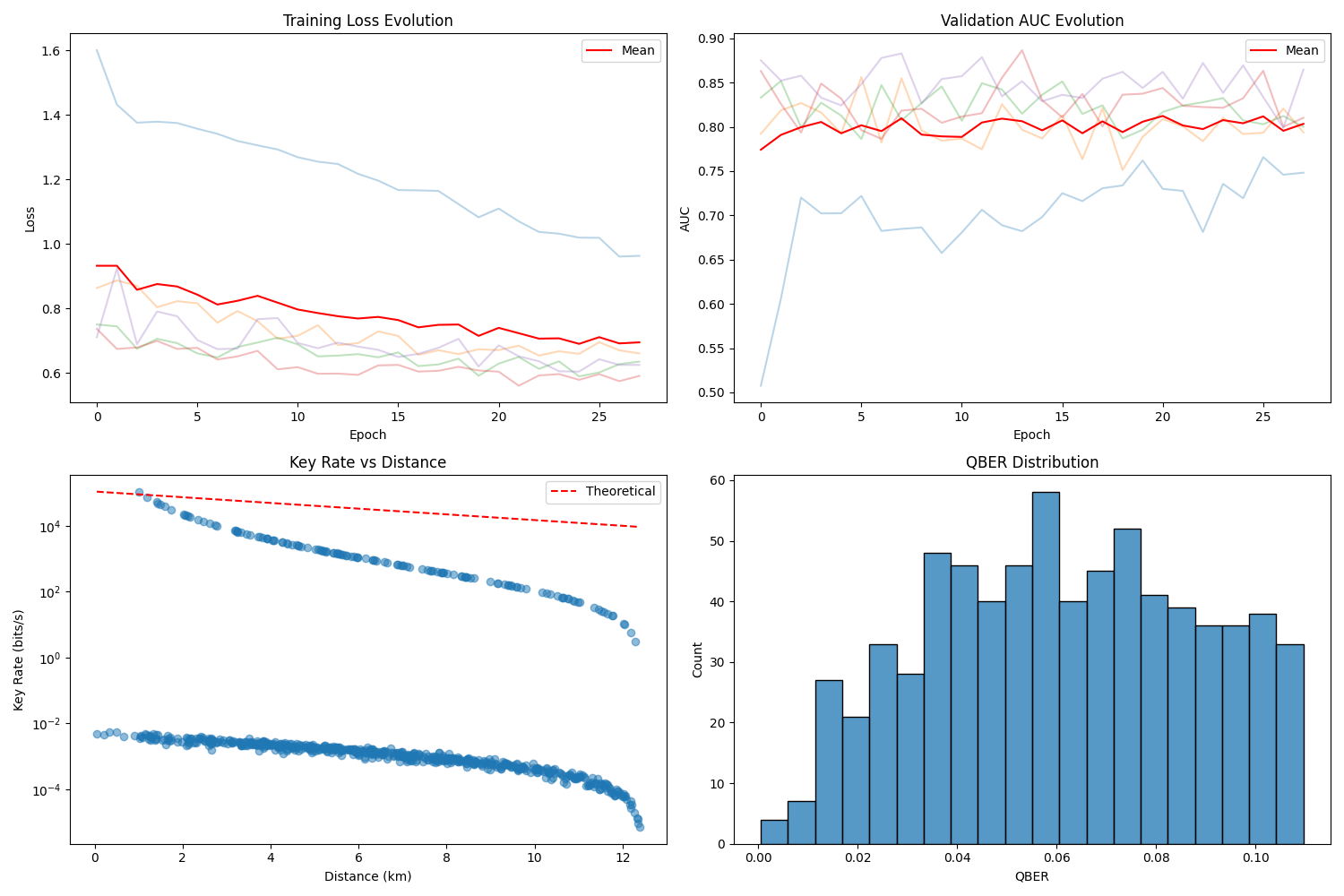
Figure 4: Quantum Network Performance Visualization 1: Training Loss Evolution, 2: Validation AUC Evolution, 3: Key Rate vs Distance, 4: QBER Distribution.
Discussion
The results underscore a crucial trade-off in network scaling—larger networks enhance key rates yet challenge predictive accuracy. The observed high key rate improvement illustrates the GNN's optimization capacity, enhancing network robustness via increased average degree, connectivity, and reduced QBER.
In practical terms, the GNN model identifies less obvious routes that offer optimal network performance, potentially reshaping traffic management by learning dynamically adjusted routes that enhance total key rates. The refined noise management, as evidenced by reduction in dark count probabilities, suggests an intelligent trade-off between signal quality and reach, suggesting a GNN's potential in discovering optimal configurations within large-scale quantum networks.
Conclusion
The research presents a substantial advancement in QKD network performance optimization using GNNs, demonstrating improved network efficiency and security. By characterizing QKD networks through advanced GNN models and simulations, the study opens pathways for robust, scalable quantum communication systems. Despite challenges in large-scale deployments, the framework provides a solid foundation for enhancing QKD networks, paving the way for broader adaptations in rapidly advancing quantum internet infrastructure. The GNN-based framework proves pivotal in balancing key distribution efficacy against the demands of dynamic network conditions, offering a powerful tool for future quantum communication system designs.
(Figure 5)
Figure 5: Quantum Network Performance Visualization 1: Training Loss Evolution, 2: Validation AUC Evolution, 3: Key Rate vs Distance, 4: QBER Distribution.