- The paper introduces ECF, a plug-and-play module employing truncated Fourier analysis to guarantee conservation law enforcement in neural operator predictions.
- ECF features dual integration modes—integrated during training and staged at inference—achieving up to 37.7% RMSE improvement on benchmark PDEs.
- Empirical results show that ECF reduces conservation errors to near machine precision with less than 2% computational overhead across diverse physical systems.
Exterior-Embedded Neural Operator Framework for Preservation of Conservation Laws
Motivation and Background
Neural operators have become a prominent approach for mapping between spaces of functions, notably accelerating the solution of time-dependent PDEs via direct data-driven modeling of physical laws. Despite their efficacy in many spatiotemporal prediction tasks, conventional neural operator architectures are fundamentally limited when dealing with PDEs governed by strict conservation laws (e.g., mass, energy). Unlike classical numerical schemes such as FVM, which explicitly preserve conservation at both local and global scales through their discretization strategies, neural operators often induce persistent and accumulating errors in conserved quantities, leading to degraded physical fidelity and limited generalizability.
Empirical evidence highlights the pronounced non-conservation exhibited by state-of-the-art models like CNO on representative problems such as the Allen-Cahn equation (AC-DW), where standard predictions exhibit substantial temporal decay of the conserved quantity and spatial deviations from ground truth, particularly in high-sensitivity central regions.
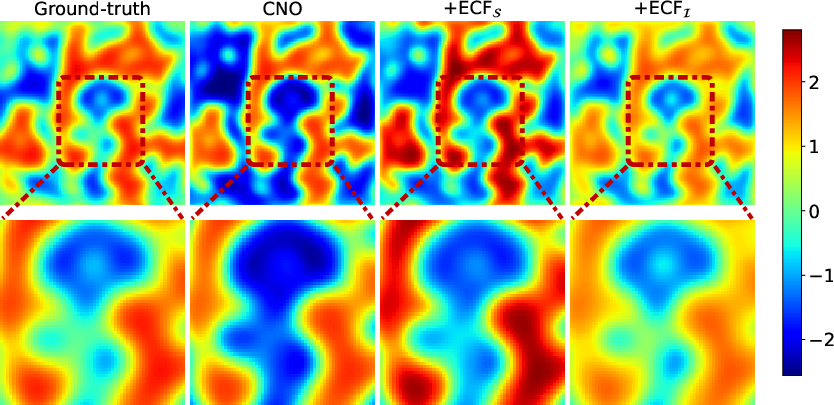
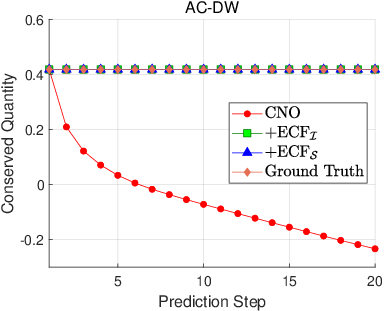
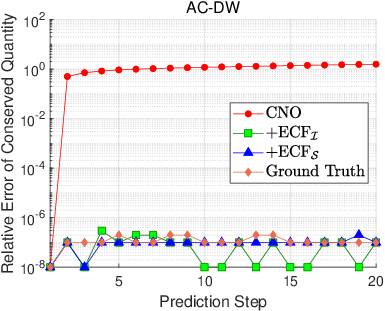
Figure 1: Visualization of CNO prediction error on AC-DW and temporal decay of conserved quantities compared to conservation-preserving frameworks.
Existing conservation-promoting neural operator schemes tend to be tightly coupled to specific tasks and architectures, lacking robustness and adaptability across physical domains. Benchmarking across varied PDEs (e.g., adiabatic, shallow water, Allen-Cahn) demonstrates that optimal neural operator architectures are dataset-dependent, preventing any single physically-constrained design from being universally effective.
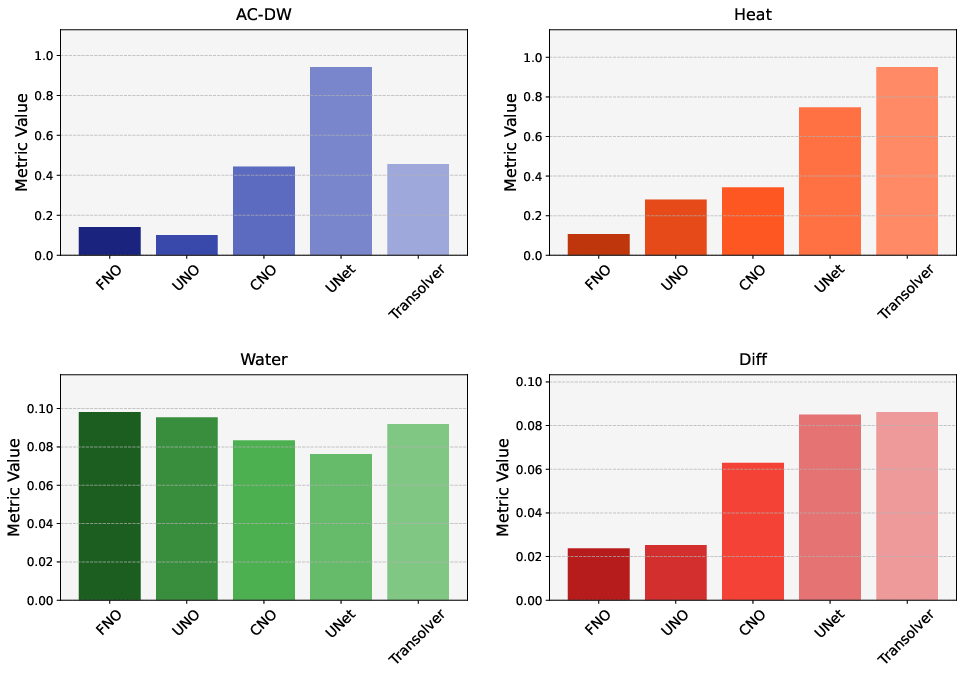
Figure 2: Relative RMSE comparison for five models across four conservation-critical datasets, highlighting architecture-dependent performance variability.
Exterior-Embedded Conservation Framework (ECF): Architecture and Theory
The proposed Exterior-Embedded Conservation Framework (ECF) is designed as a universal, plug-and-play module for strict enforcement of conservation laws in neural operator predictions. ECF decomposes into two principal modules:
- Conservation Quantity Encoder: Utilizes truncated Fourier analysis to extract zero-frequency coefficients—the spectral proxies for globally conserved quantities—from input data.
- Conservation Quantity Decoder: Applies frequency-domain correction by substituting predicted zero-frequency components with the ground-truth values ensured by the encoder, before reconstructing refined outputs via inverse Fourier transform.
This correction strictly enforces conservation, as the zero-frequency mode uniquely determines the domain integral of the solution, corresponding directly to the conservation law. The correction is mathematically guaranteed to strictly reduce prediction error in the L2 norm, as shown in supporting theorems: error is decomposable across modes and correction of the zero-frequency term minimizes the total error unless the model already satisfies conservation.
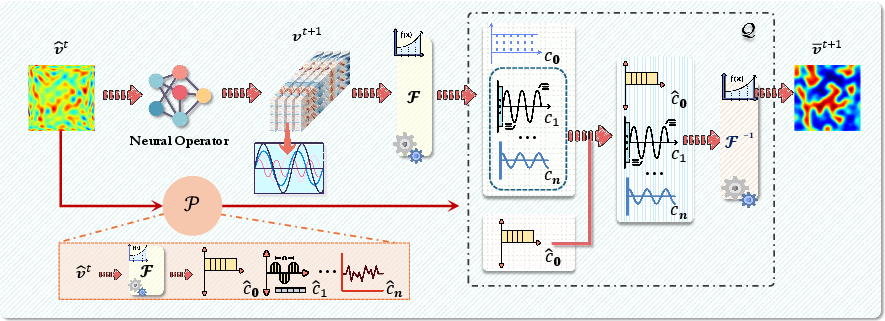
Figure 3: Schematic overview of the ECF architecture, integrating encoder, operator, and decoder modules for frequency-domain conservation enforcement.
To accommodate distinct optimization dynamics, ECF offers two training paradigms:
- Integrated Mode (+ECFI): The correction module is actively embedded during end-to-end model training, directly influencing weight updates for enhanced error reduction in conservation-compromised regimes.
- Staged Mode (+ECFS): The base neural operator is first trained independently; the correction module is activated only during inference, offering a robust guarantee of strict conservation with potentially limited expressiveness increase.
Theoretical analysis demonstrates that ECF’s spectral editing leaves higher-frequency (non-conserved) features academically untouched, while strictly matching conserved quantities to ground truth.
Experimental Evaluation
Six benchmark PDE datasets—ranging from Allen-Cahn (double-well and Flory-Huggins forms) and shallow water equations to adiabatic, diffusion, and convection-diffusion problems—were employed for comprehensive empirical validation of ECF.
Across all baselines (FNO, UNO, CNO, UNet, Transolver), both +ECFI and +ECFS variants produced consistent error reductions, with +ECFI achieving up to 37.7% improvement for UNO on AC-DW—representing pronounced generality and model-agnostic gains. Staged integration (+ECFS) reliably reduced conservation errors, sometimes with smaller magnitude performance gains, while never increasing global error, except in cases of pre-existing negligible conservation violation.
Both training and inference computational overheads were shown to be marginal (<2%), supporting the practicality of ECF for large-scale deployment.
Quantitative Conservation Law Enforcement
Empirical results reveal that baseline neural operators exhibit substantial and temporally accumulating conservation errors, sometimes exceeding 100% (e.g., UNet on AC-FH shows 236% relative error in the conserved quantity). In contrast, both flavors of ECF consistently reduce conservation error to near machine precision (∼1e-6), with the residual error dominated by floating-point representation limits.
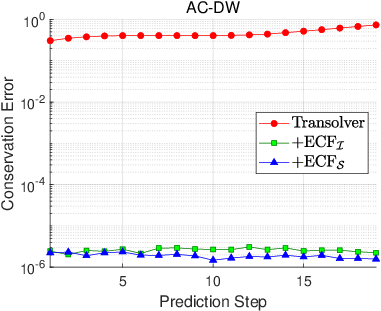
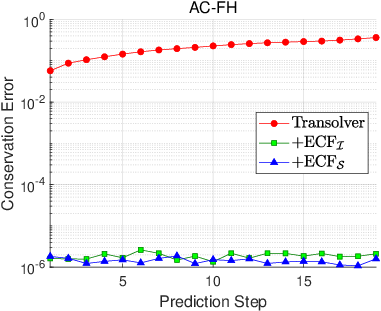
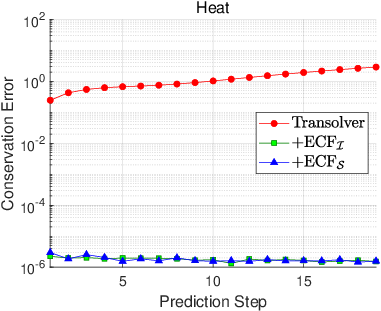
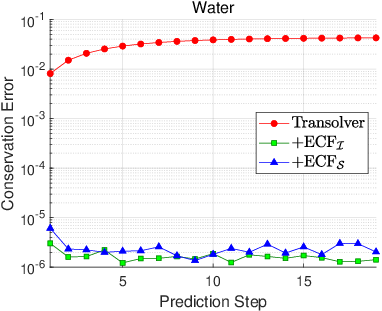
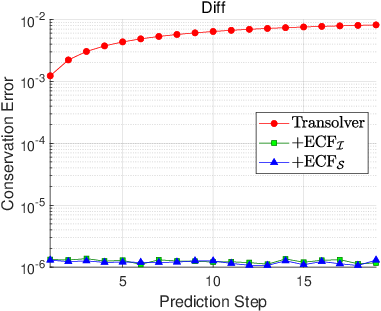
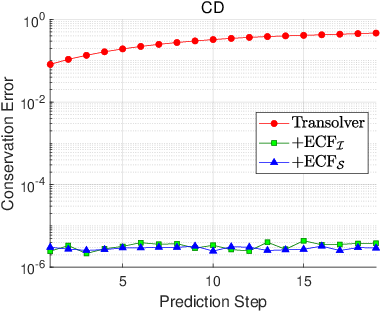
Figure 4: Time evolution of conservation errors for Transolver and its +ECF-enhanced variants across all datasets.
Notably, when conservation errors in the original prediction are already small, ECF’s effect on RMSE becomes limited, directly confirming the theoretical bounds outlined in the supplement.
Implications and Future Directions
The ECF formalism offers a generalizable, mathematically rigorous solution for integrating strict conservation constraints into arbitrary neural operator architectures. By operating in the frequency domain and preserving only the zero-frequency mode associated with conservation, ECF avoids model-specific architectural constraints and preserves the full expressiveness of neural mappings.
This approach is directly relevant to any data-driven scientific inference framework for PDEs, especially in long-term, multi-step prediction settings where error accumulation can fundamentally corrupt physical interpretability. The strong empirical validation across multiple operator classes and physical domains affirms its protocol-level versatility.
Looking ahead, ECF could serve as a template for the enforcement of additional physics-based invariants encoded in other spectral or functional properties (e.g., momentum, angular momentum, charge), potentially extending the paradigm to multi-quantity conservation and partial preservation regimes. Its compatibility with emerging developments in high-dimensional operator learning (e.g., transformer-based PDE solvers) further expands applicability in hybrid and multi-physics simulation settings.
Conclusion
The Exterior-Embedded Conservation Framework (ECF) establishes a unified frequency-domain protocol for exact conservation law enforcement in neural operators. By decoupling conservation correction from architectural constraints and rigorously bounding prediction errors, ECF advances physics-informed machine learning methodologies for PDEs. Theoretical analysis and empirical results demonstrate robust improvements in both model accuracy and physical fidelity, with negligible computational overhead. This framework is expected to significantly influence future work in physically-constrained AI and scientific computing models.