- The paper introduces a synergy framework combining mobile low-altitude networks with global computing to optimize real-time services.
- Experimental evaluations reveal improved task success rates and efficient resource allocation in hotspot regions using the integrated model.
- The framework leverages collaborative control and adaptive task offloading to deliver scalable and resilient air-ground communications.
Toward Integrated Air-Ground Computing and Communications
The paper "Toward Integrated Air-Ground Computing and Communications: A Synergy of Computing Power Networks and Low-Altitude Economy Network" (2511.18720) articulates a sophisticated integration framework between the Low-Altitude Economy (LAE) network and the Computing Power Network (CPN), aiming to address inherent limitations and optimize operational efficiencies in dynamic environments. The research outlines a paradigm which leverages the inherent complementary attributes of LAE and CPN to form a robust, resilient, and intelligent air-ground cooperative system.
Introduction to LAE and CPN
Low-Altitude Economy
The rapid growth of LAE, driven by Uncrewed Aerial Vehicles (UAVs), marks a transition in utilizing low-altitude airspace for diversified intelligent services. Incorporating edge computing, AI, and advanced communications (5G/6G), LAE presents a networked service-oriented ecosystem capable of urban logistics, aerial sensing, and emergency communications, although constrained by limited node computing capacity and dynamic network variability [ref2].
Computing Power Network
CPN, as a computing-centric network paradigm, aggregates global resources to enable Computing-as-a-Service (CaaS), integrating cloud, edge, and end devices. This network addresses latency-sensitive applications through computing power abstraction and in-network computing, although its static infrastructure hinders dynamic adaptability, particularly in mobile contexts [ref3, ref4].
Complementarity of LAE and CPN
Both LAE and CPN face challenges. LAE struggles with computational constraints and network heterogeneity, while CPN contends with fixed node deployments and dynamic service demands. However, their integration provides synergistic enhancements: LAE's mobility and real-time sensing complement CPN's global computing power and optimization capabilities, resulting in scalable and efficient computing and communication services.
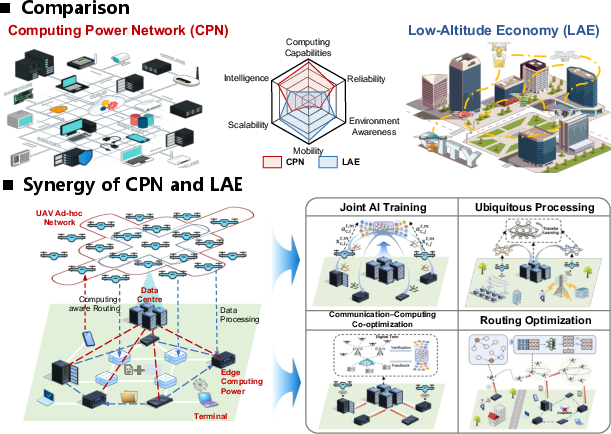
Figure 1: LAE features wide-area mobility and real-time sensing capabilities, while CPN provides powerful global computing scheduling and intelligent optimization.
Synergy Mechanisms
Air-Ground Collaboration
The synergy between CPN and LAE encompasses collaborative control, joint AI training, and communication-computing co-optimization. CPN supports LAE with distributed computational resources for sophisticated tasks, while LAE extends CPN's service reach through mobility and real-time sensing, ensuring robust responsiveness in dynamic conditions [ref7, ref13].
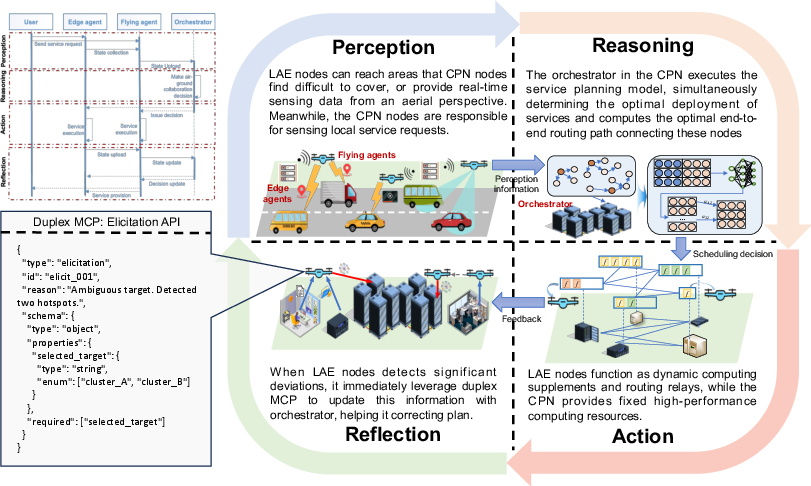
Figure 2: The agentification approach integrates perception, planning, action, and reflection capabilities for operational synergy between LAE and CPN.
Mutual Assistance in Networks
CPN alleviates LAE's computational limitations by offloading tasks to powerful nodes, enabling efficient resource allocation and routing optimization. Conversely, LAE fortifies CPN's flexibility, providing aerial communication relays and extending network services to remote areas, thus addressing real-time environmental changes and enhancing dynamic task adaptation [ref1, ref7].
Case Study Insights
Framework and Implementation
The agentification paradigm transforms LAE-CPN interaction into a real-time collaborative ecosystem, facilitating resource allocation adjustments in service hotspot regions. This framework assigns intelligent agent roles to LAE and CPN nodes, optimizing air-ground interactions through real-time state sharing and adaptable task execution [ref17].
Experimental Evaluation
The case study reveals substantial improvements in task success rates within the integrated environment compared to standalone LAE or CPN systems. Numerical simulations demonstrate the framework's effectiveness in handling service hotspots by smartly deploying LAE nodes to support computational workloads in congested regions.
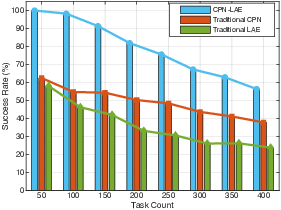
Figure 3: Task success rate versus task count shows improved performance with integrated CPN-LAE framework.
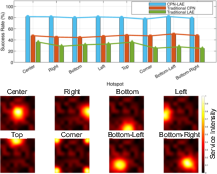
Figure 4: Task success rate versus movement of hotspot area highlights adaptive response capabilities.
Future Directions
Enhancing Integration with Digital Twins
Future research should explore digital twins to simulate, predict, and optimize the integrated LAE-CPN system, facilitating proactive resource management and maintenance.
Addressing Security and Privacy
Security protocols must evolve to address vulnerabilities exposed by integration, focusing on multilayered defenses and privacy-preserving techniques for distributed networks.
Improving Energy Efficiency
Energy-aware protocols will be crucial, necessitating intelligent task scheduling and optimized routing to balance latency and consumption in UAV operations.
Conclusion
The paper provides a detailed examination of how integrating LAE and CPN can construct a flexible, intelligent air-ground network system capable of addressing dynamic service demands. The synergy of LAE's mobility and CPN's computational power offers a pathway to enhanced efficiency, scalability, and adaptability in real-time computing and communication applications.