Polarization by Design: How Elites Could Shape Mass Preferences as AI Reduces Persuasion Costs
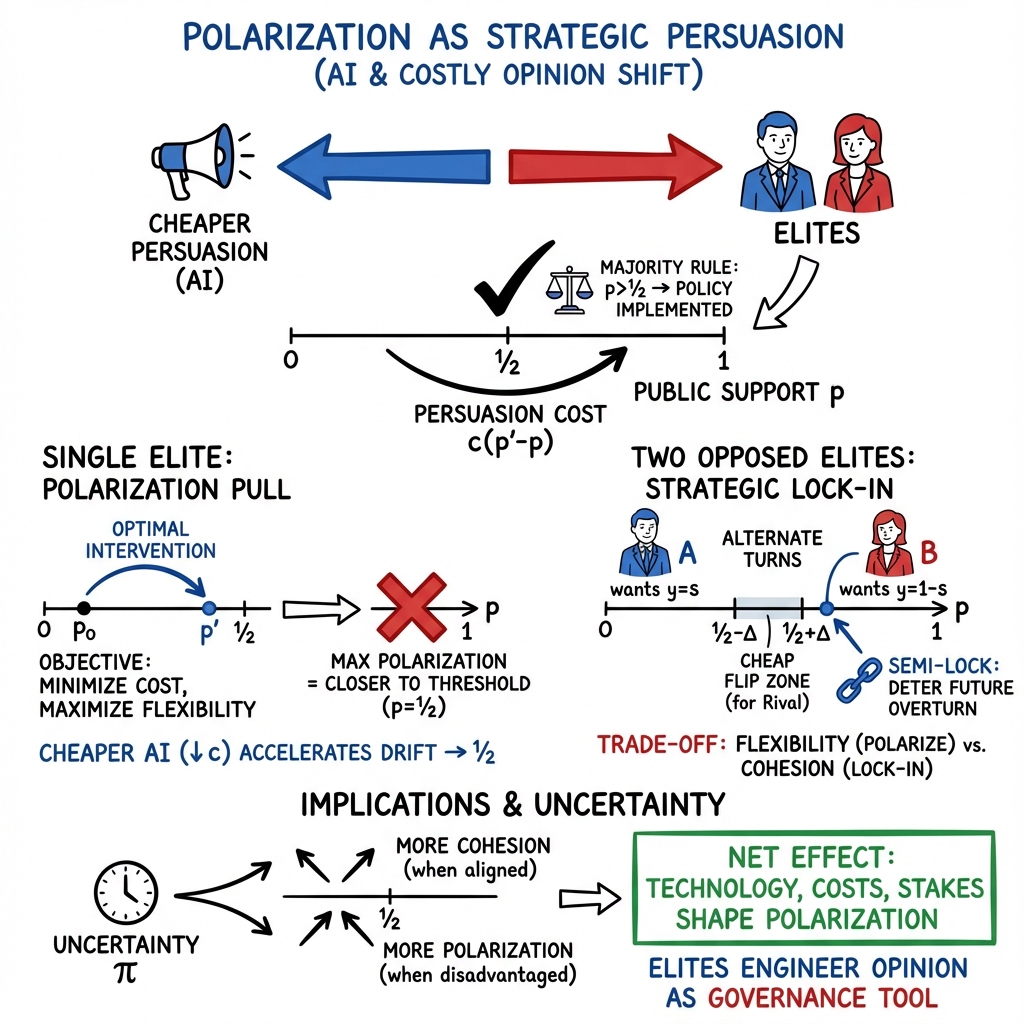
Abstract: In democracies, major policy decisions typically require some form of majority or consensus, so elites must secure mass support to govern. Historically, elites could shape support only through limited instruments like schooling and mass media; advances in AI-driven persuasion sharply reduce the cost and increase the precision of shaping public opinion, making the distribution of preferences itself an object of deliberate design. We develop a dynamic model in which elites choose how much to reshape the distribution of policy preferences, subject to persuasion costs and a majority rule constraint. With a single elite, any optimal intervention tends to push society toward more polarized opinion profiles - a polarization pull'' - and improvements in persuasion technology accelerate this drift. When two opposed elites alternate in power, the same technology also creates incentives to park society insemi-lock'' regions where opinions are more cohesive and harder for a rival to overturn, so advances in persuasion can either heighten or dampen polarization depending on the environment. Taken together, cheaper persuasion technologies recast polarization as a strategic instrument of governance rather than a purely emergent social byproduct, with important implications for democratic stability as AI capabilities advance.
Paper Prompts
Sign up for free to create and run prompts on this paper using GPT-5.
Top Community Prompts
Explain it Like I'm 14
What this paper is about (in simple terms)
The paper asks: if powerful leaders (called “elites”) can use new AI tools to cheaply and precisely persuade people, how will they try to shape public opinion over time? Because most democracies need a majority to pass policies, leaders care a lot about where public opinion sits. The authors build a simple math-based story (a model) to see whether leaders would prefer a society that mostly agrees, or one that is evenly split (polarized), when they can push opinions around at some cost.
The main questions the paper asks
- If one leader controls persuasion, will they try to make public opinion more united or more split?
- How does cheaper, smarter AI persuasion change that decision?
- What happens when two rival leaders take turns in power and both can reshape opinions?
- Overall, does better persuasion technology increase polarization, reduce it, or do both depending on the situation?
How the authors study it (in everyday language)
Think of public opinion as a point on a number line from 0 to 1:
- 0 means everyone supports policy A.
- 1 means everyone supports policy B.
- 0.5 (50%) is the middle—half support A and half support B—maximum polarization.
Each time period, the leader:
- Sees which policy would be best for them right now.
- Can “push” the public’s opinion left or right, but pushing costs effort/money (this is the persuasion cost).
- Needs the public on their side (above 50% for their policy) to pass it.
Key ideas explained simply:
- Majority rule: You need more than 50% to win.
- Persuasion cost: The further you try to move opinion, the more it costs, and the cost rises faster the more you push (that’s what “strictly convex” means—nudging a few people is cheap; flipping a whole country is expensive).
- Looking ahead: Leaders know the world can change, so they plan moves now that make future wins cheaper.
- Two settings:
- One leader (single-elite): Only one side shapes opinions.
- Two leaders (two-elite): Opponents alternate power and both can move opinions.
- How they solve it:
- For short time spans (two periods), they solve the model step-by-step from the end back to the start (called “backward induction”).
- For long time spans, they use a standard “dynamic planning” approach (think of it like a careful recipe for making the best move at each step).
- With two rivals over many periods, exact math is messy, so they use computer simulations to find sensible patterns (a “Markov-perfect equilibrium,” which means each leader’s move depends only on the current public opinion, not the full history).
What they find
With a single leader
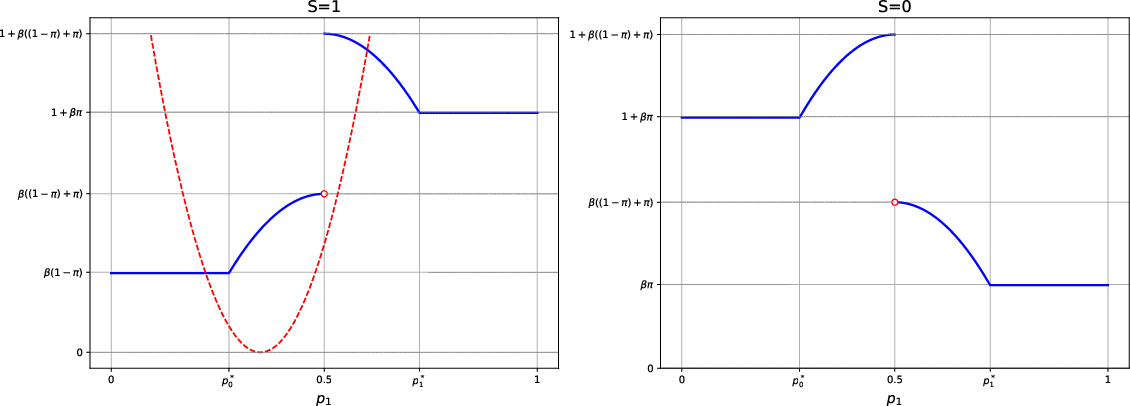
- Polarization pull: If a leader can move opinions at some cost, the best place to “park” public opinion is closer to 50–50. Why? Because from the middle, it’s cheap to nudge the majority to your side next time the world changes. A split society is easier (and cheaper) to steer quickly.
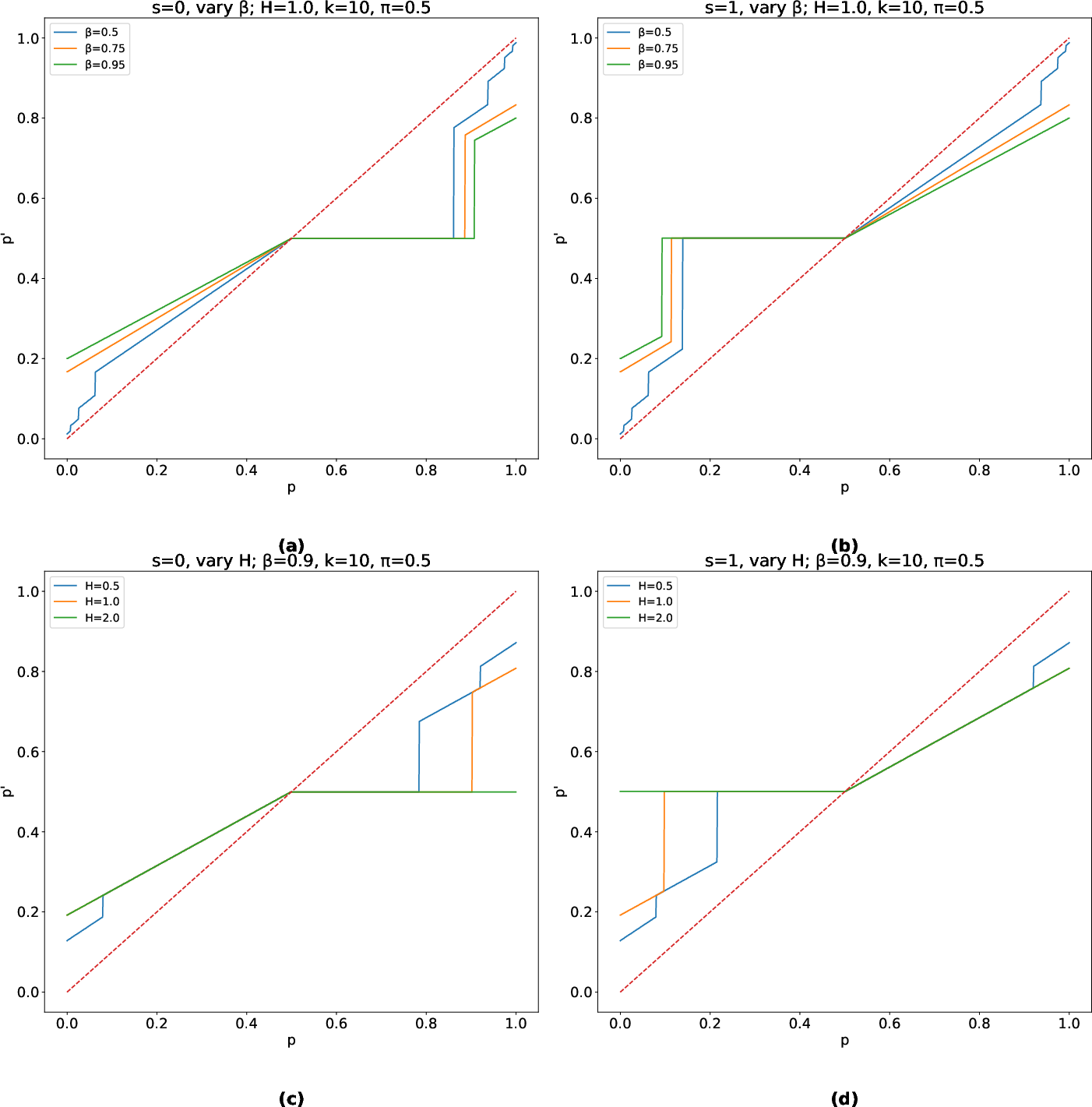
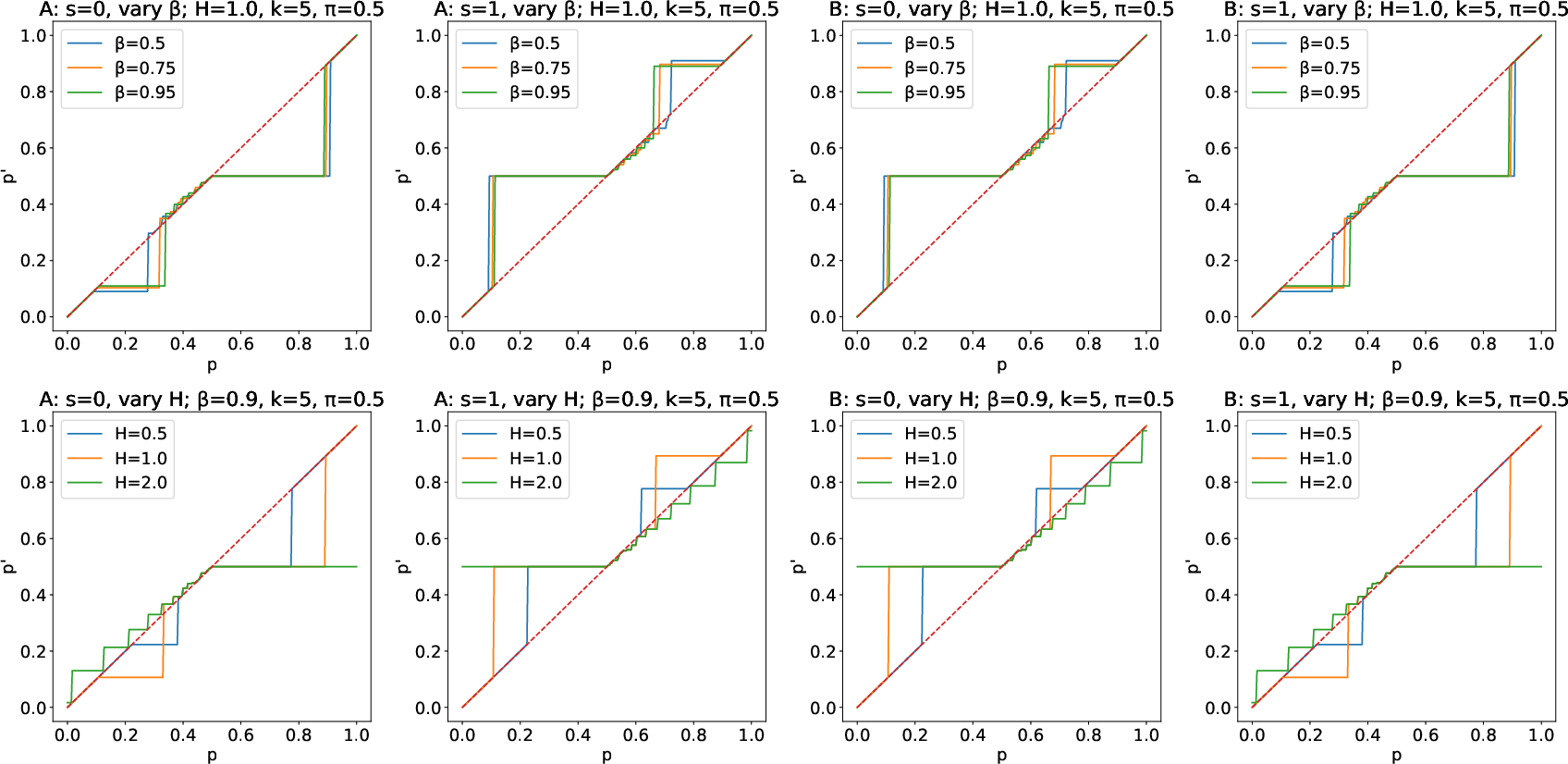
- Cheaper persuasion → faster drift to the middle: As AI makes persuasion cheaper and more precise, leaders move public opinion toward 50–50 faster. Even if people currently agree with the leader, the leader still often nudges opinion toward the middle to keep future options open.
- Bigger stakes or more patience → more movement: If the payoff from winning is big, or the leader cares a lot about the future, they invest more in pushing opinions toward the middle.
Why this matters: In a world where one side dominates persuasion, polarization isn’t just an accident—it can be an intentional choice to keep the crowd easy to swing.
With two rival leaders who alternate power
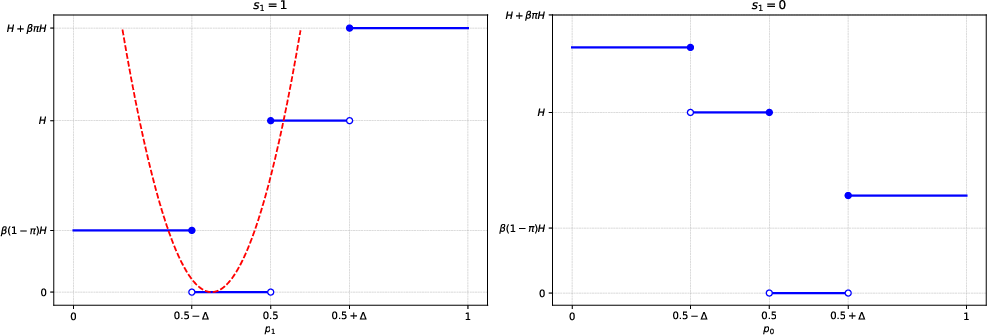
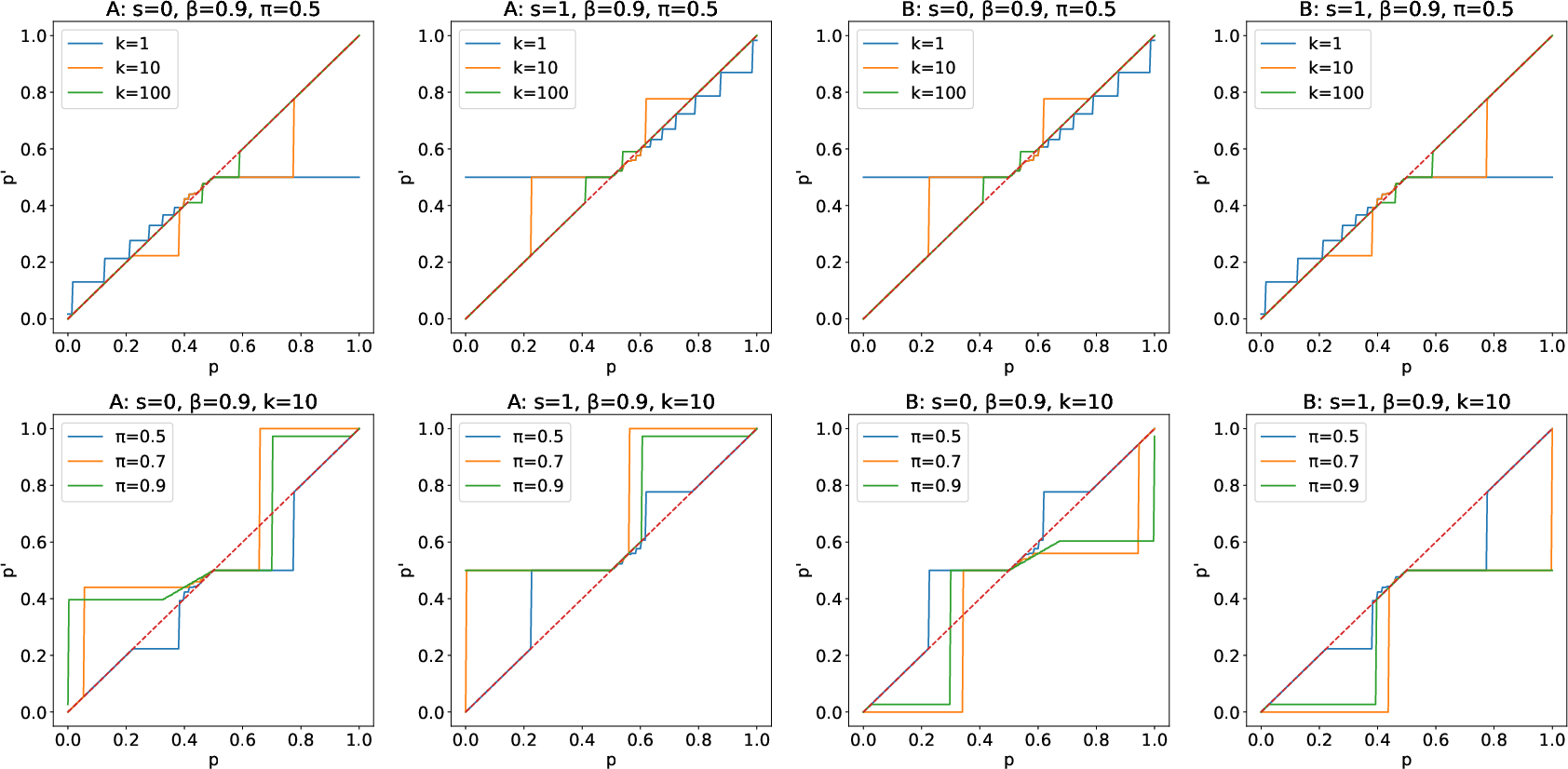
- A new force appears: “semi-lock” points. These are positions just beyond the rival’s easy reach—close to 50%, but not so close that the other side can cheaply flip the majority. Think of parking your car on a hill with the wheels turned to the curb: you’re near the tipping point, but not easy to push over.
- Two competing incentives:
- Polarization pull (like before): Being near 50% keeps future moves cheap.
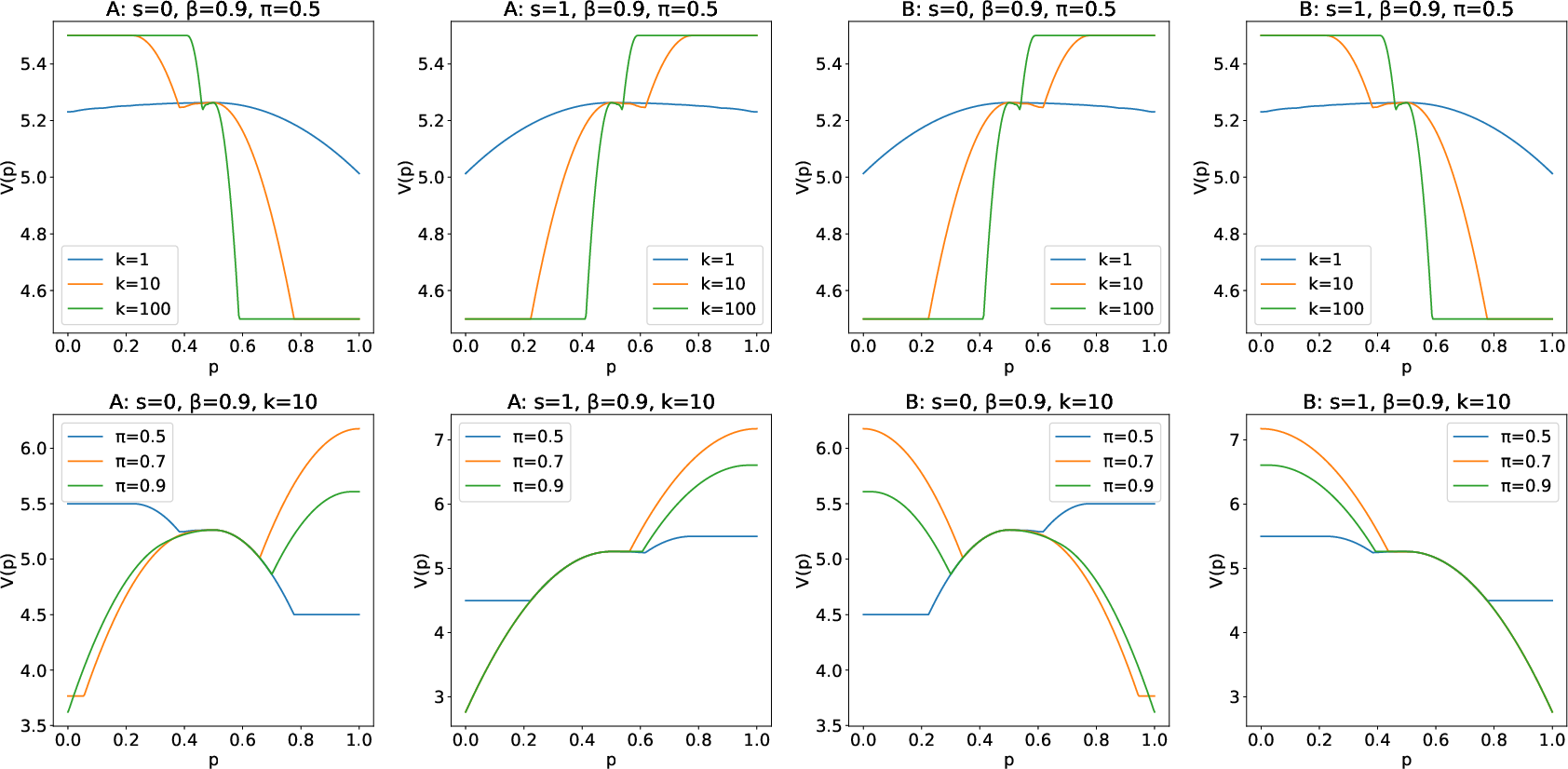
- Lock-in pull: Moving slightly away from the center can make it harder for your rival to undo what you did next time they’re in charge.
- So does AI increase or decrease polarization with rivals?
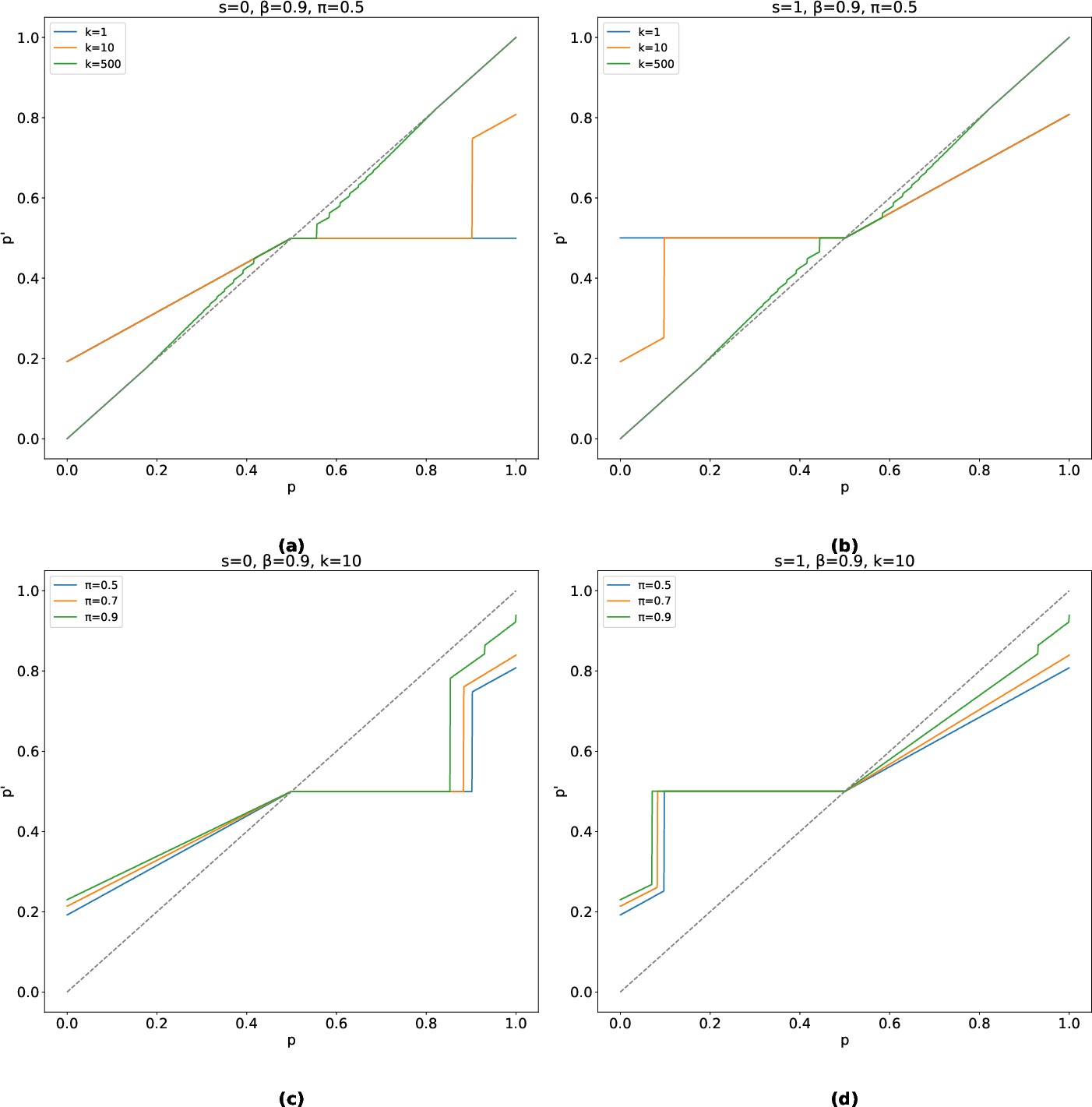
- If persuasion is cheap for both sides, it becomes hard to lock in. The polarization pull wins, and society tends to drift toward 50–50.
- If persuasion is still costly, each leader sometimes prefers to keep opinions more cohesive (less polarized) on their side to make it expensive for the opponent to flip things later. This can dampen polarization.
- Role of uncertainty:
- If the future is predictable, leaders may keep opinions cohesive when they already have the majority, and push toward the center when they’re on the losing side so they can flip it soon.
- If the future is uncertain, the “insurance” value of being near 50% grows.
Why this matters: With competing elites, AI doesn’t automatically mean more polarization. Sometimes it can push the public toward more unity—if unity helps block the rival. Other times it increases polarization—if lock-in isn’t possible and flexibility matters more.
Why these results are important
- Polarization can be a strategy, not just a side effect: The paper argues that leaders may deliberately engineer how split or united public opinion is, depending on the tools they have and the opponents they face.
- AI changes the rules: As persuasion becomes cheaper and more targeted, polarization becomes easier to create and maintain when it is useful—especially in the single-leader case or when lock-in is hard.
- Democratic stability: If leaders can shape public preferences at low cost, they can tilt the playing field, making societies swing faster—or get stuck in hard-to-change positions.
What this could mean for the real world
- Governance by design: Leaders might treat public opinion like a controllable dial—pulling it toward a 50–50 split when they want flexibility, or toward cohesion when they want to block opponents.
- Mixed effects on polarization: Cheaper AI persuasion may increase polarization when one side dominates or when both sides can’t easily lock in. But it can also reduce polarization if leaders find it profitable to build “semi-lock” support that’s hard to overturn.
- Policy implications to consider:
- Transparency about political targeting and AI-generated content.
- Limits on hyper-personalized political ads that make mass opinion “cheap to move.”
- Rules that slow rapid swings (for example, deliberation periods or cross-party checks) so opinion engineering doesn’t immediately rewrite policy.
In short: As AI lowers the cost of persuasion, polarization becomes something leaders can design on purpose. Whether societies become more split or more united will depend on who holds the tools, how costly it is to move opinions, how predictable the future is, and whether rivals can “lock in” support against each other.
Knowledge Gaps
Knowledge gaps, limitations, and open questions
The paper introduces a stylized dynamic model of elite-driven opinion shaping under majority rule and explores polarization dynamics. The following items identify what remains missing, uncertain, or unexplored, framed to guide future research:
- Endogeneity of institutional constraints: Analyze how results change under supermajority thresholds, veto players, bicameralism, or alternative tie-breaking rules (randomization, status quo bias), and derive conditions under which the “polarization pull” persists or reverses.
- Stochastic process for states: Replace i.i.d. states with persistent, autocorrelated, or regime-switching processes; characterize how state persistence alters optimal positioning near the threshold and the existence/size of “semi-lock” regions.
- Deterministic control of public opinion: Introduce stochastic persuasion outcomes (noise, failure risk), bounded rates of change per period, saturation effects, or backlash dynamics; quantify how these frictions reshape optimal opinion trajectories.
- Heterogeneous populations and targeted persuasion: Move beyond a single aggregate to multi-group or networked populations with group-specific persuasion costs and responsiveness; study how targeted AI campaigns alter the feasibility and shape of lock-in and polarization.
- Alternative polarization metrics: Test whether main results hold under Esteban–Ray/DER indices, affective polarization, partisan distance measures, or multidimensional dispersion, not just variance-like metrics in a binary setting.
- Multidimensional policy space: Extend from binary policy choice to multiple issues or continuous policy instruments; analyze cross-issue spillovers and whether elites optimally polarize some dimensions while seeking consensus on others.
- Asymmetric and state-dependent persuasion costs: Allow , non-symmetric cost functions, fixed costs, S-shaped/marginally decreasing costs (learning-by-doing), or state-dependent costs; establish robustness of polarization/lock-in results to these variations.
- Endogenous power transitions: Replace deterministic alternation with election-based or stochastic leadership transitions that depend on ; study feedback between opinion distributions, electoral success, and future persuasion incentives.
- Strategic information design vs. preference shaping: Allow elites to manipulate perceived states (framing, misinformation) in addition to preferences; compare the relative welfare and polarization effects of belief manipulation vs. opinion shifting.
- Commitment and durability of persuasion: Model decay, inertia, or durability of opinion changes (e.g., partial reversion, habit formation) and the cumulative costs of repeated persuasion; quantify how durability affects lock-in and arms-race incentives.
- Empirical calibration and measurement: Develop methods to estimate , , , and the distribution of using field data or experiments with AI persuasion; identify natural experiments or platform changes that shift persuasion costs and validate model predictions.
- Existence, uniqueness, and characterization of MPE: Provide formal conditions for existence/uniqueness of Markov-perfect equilibria in the two-elite game, characterize comparative statics analytically, and map parameter regions for polarization vs. cohesion.
- Analytical characterization of “semi-lock” in long horizon: Derive closed-form or qualitative conditions (in terms of , , , and ) that guarantee the emergence, boundaries, and stability of semi-lock regions without relying solely on numerics.
- Policy discontinuity at the threshold: Replace the hard majority rule with a smooth policy-probability function of (e.g., logistic) to assess whether kinks in payoffs drive the main results; compare to environments with procedural friction or agenda power.
- Dynamic technology co-evolution: Endogenize persuasion technology investments by elites and platform interventions (moderation, authentication, friction); study arms-race dynamics, equilibrium regulation, and how endogenous tech trajectories alter costs and outcomes.
- Public agency and social learning: Microfound via individual-level belief updating, social influence, and resistance/adaptation; incorporate feedback from past persuasion (fatigue, reactance) and measure whether repeated interventions amplify or dampen polarization.
- Heterogeneous elite objectives: Move beyond “match” vs. “mismatch” payoffs to richer ideological, partisan, or rent-seeking utility with state-dependent stakes ; analyze how asymmetries in goals change the strategic use of polarization.
- Turnout and mobilization channels: Differentiate between changing opinions and mobilizing turnout; assess how AI-enabled mobilization (without opinion change) interacts with majority constraints and alters polarization incentives.
- Welfare and democratic stability: Quantify citizen welfare, governance quality, and stability (gridlock, policy volatility) under elite-driven polarization/cohesion; identify trade-offs and policy implications for safeguarding democratic resilience as persuasion costs fall.
- Cross-country and platform heterogeneity: Explore how institutional environments, media ecosystems, and platform architectures mediate persuasion costs and targeting precision; test whether the model’s predictions vary across regimes and technology contexts.
Practical Applications
Immediate Applications
These applications can be deployed with today’s data, platforms, and organizational practices, drawing directly on the paper’s findings that (i) cheaper persuasion creates a “polarization pull” toward the 50% threshold under single control, and (ii) competition between opposed actors creates incentives to “semi-lock” opinion beyond a reversible band around 50%.
- Industry (Adtech/MarTech, Software): “Threshold Watch” analytics for comms teams
- What: A SaaS dashboard that tracks the distribution of public/supporter opinions on key issues and highlights (a) proximity to the 50% majority threshold and (b) “semi-lock” margins at 1/2 ± Δ, where Δ ≈ c⁻¹(H) estimated from campaign spend vs. observed opinion shifts.
- Workflow: Ingest polling, social listening, and engagement data; fit an opinion elasticity/persuasion cost curve; flag segments drifting toward 50% (polarization pull risk) or slipping inside the semi-lock band (vulnerability to rival reversal).
- Dependencies/Assumptions: Access to survey/panel or platform analytics; ability to proxy c(·) and H from historical data; binary or dichotomized outcomes for monitoring.
- Industry (Political/Issue Campaigns, NGOs): Polarization risk and semi-lock playbooks
- What: Campaign playbooks that choose between two strategies: (i) move supporters to ~50% for agility when future shocks are likely (single-elite logic), or (ii) push support beyond the semi-lock band to deter reversal when facing an active rival (two-elite logic).
- Workflow: Budget allocation to audiences by estimated swing cost; target creatives to shift mass either toward 50% or beyond 1/2 ± Δ; real-time A/B monitoring.
- Dependencies/Assumptions: Accurate estimation of Δ; consistent measurement of opinion shifts; compliance with platform and jurisdictional ad rules.
- Policy/Regulation (Elections, Platform Governance): Near-threshold microtargeting limits
- What: Interim regulatory guidance discouraging or limiting microtargeted political messaging to segments identified as being near 50% on specific issues, where the model predicts maximal manipulability.
- Tools: Platform APIs to label and gate political A/B tests targeted at narrow swing segments during defined periods.
- Dependencies/Assumptions: Legal authority; shared definitions of “political” content; platform cooperation.
- Policy/Regulation (AI Governance): Political persuasion testing in AI evaluations
- What: Require “political persuasion red teaming” in model evaluations, with metrics for the model’s ability to move users toward 50% or out of semi-lock regions.
- Tools: Standardized benchmarks measuring shift magnitudes and costs; logs and watermarking for political content.
- Dependencies/Assumptions: Standards agreement; testing sandboxes; collaboration with model providers.
- Platforms (Trust & Safety, Integrity): Polarization pull and semi-lock early warning
- What: Integrity pipelines flag coordinated activity that systematically moves distributions toward 50% (polarization by design) or seeks to entrench semi-lock regions that make reversal costly.
- Workflow: Detect sustained narrowing of consensus on a topic; throttle or label high-velocity, highly personalized political A/B tests.
- Dependencies/Assumptions: Topic-level stance estimation; causal inference is hard—focus on pattern-based monitoring.
- Academia (Political Economy, Communication): Field experiments to estimate Δ and c(·)
- What: Run randomized field or platform experiments quantifying persuasion costs for shifting shares by δp and test whether actors steer populations toward 50% (single) or beyond 1/2 ± Δ (two-elite).
- Workflow: Pre-registered A/B/C tests; repeated surveys; structural estimation of c(·) and H.
- Dependencies/Assumptions: IRB approvals; platform partnerships; funding for repeated measurement.
- Public Health (Health Comms): Semi-lock consensus strategy for critical behaviors
- What: For vaccine uptake or emergency response, proactively push public support beyond 1/2 + Δ to deter reversal by later opposition campaigns.
- Workflow: Audience prioritization by elasticity; mobilize credible messengers to broaden consensus beyond the reversible zone.
- Dependencies/Assumptions: Ethical and legal compliance; reliable measurement of Δ; potential trade-offs with pluralism.
- Corporate Governance/Finance (IR, Proxy Contests): Vote-share optimization using semi-locks
- What: Apply the model to majority thresholds in shareholder votes. Keep support beyond 50% + Δ to deter activist reversals, or near 50% if future strategy pivots are expected.
- Tools: Shareholder sentiment tracking, persuasion budget optimizers.
- Dependencies/Assumptions: Accurate sentiment data; valid mapping of c(·) in corporate contexts.
- Journalism/Civil Society: Polarization-by-design reporting and indices
- What: Create beat coverage and public indices tracking how often public opinion is being steered toward 50% on salient issues, and where semi-lock patterns emerge.
- Tools: Open dashboards; investigative workflows combining ad library data and stance estimation.
- Dependencies/Assumptions: Ad transparency; methodological transparency to avoid false positives.
- Education/Media Literacy: Citizen guidance to reduce manipulability
- What: Public-facing guidance on how personalized persuasion exploits near-threshold dynamics and how to opt out or reduce data trails that enable low-cost targeting.
- Tools: Simple self-audits showing “how close am I to being a swing target?” based on stated attitudes.
- Dependencies/Assumptions: Access to tools and settings; literacy and adoption.
- Campaign and Government Comms (Operations): Dynamic persuasion budget optimization
- What: Deploy budget optimizers that solve a simplified dynamic program: invest today to place opinion either near 50% (if anticipating shocks) or beyond semi-lock thresholds (if deterring rivals).
- Tools: Off-the-shelf reinforcement learning or dynamic programming modules; weekly re-estimation of costs.
- Dependencies/Assumptions: Stable feedback loops; sufficient data for reliable updates.
- Risk Management (ESG, Platform Risk): Polarization impact assessments
- What: Add a “Polarization Impact” section in comms and product risk reviews that quantifies whether initiatives will pull public distributions toward 50% or away from semi-locks on sensitive topics.
- Tools: Checklists; scenario modeling.
- Dependencies/Assumptions: Issue-scoping; agreement on sensitive-topic taxonomy.
Long-Term Applications
These require further research, new regulation, platform-level changes, or scaled infrastructure. They translate the model’s dynamics into governance, product, and institutional redesigns.
- Policy/Regulation: Comprehensive political personalization rules
- What: Legislate guardrails on AI-assisted, highly personalized political persuasion, especially near decision thresholds; mandate transparency logs and independent audits.
- Dependencies/Assumptions: Political consensus; enforceability; definitions that avoid overbreadth.
- Platforms/Software: Counter-polarization ranking and feedback throttling
- What: Ranking systems that reduce the effectiveness of rapid, personalized political A/B loops that shrink consensus toward 50% (raise effective c(·)); limit real-time micro-optimization for politics.
- Dependencies/Assumptions: Willingness to trade engagement for integrity; reliable political-content classification.
- Public Infrastructure: Opinion Distribution Observatory
- What: A neutral, open-data institute that tracks opinion distributions and publishes “polarization pull” and “semi-lock” metrics across issues, geographies, and time.
- Dependencies/Assumptions: Sustained funding; data-sharing agreements; strong privacy protections.
- Institutional Design (Elections/Democracy): Threshold-robust decision rules
- What: Tailor majority rules for high-stakes or easily manipulable domains (e.g., requiring supermajorities or multi-stage deliberation) to reduce exploitation of 50% thresholds predicted by the model.
- Dependencies/Assumptions: Constitutional/legislative changes; careful balance with democratic responsiveness.
- AI Safety/Governance: Political persuasion safety standards
- What: Incorporate “ability to move users toward 50% or out of semi-locks” as a risk category with mitigation protocols (e.g., capability gating, geofencing, supervised access for political use).
- Dependencies/Assumptions: International standards bodies; vendor participation.
- Cross-Platform Protocols: Coordinated “lock-in mitigation”
- What: Inter-platform coordination to prevent incumbents from entrenching semi-locks via synchronized narratives and cross-platform retargeting; shared signals on coordinated inauthentic behavior.
- Dependencies/Assumptions: Legal frameworks for collaboration; antitrust considerations.
- Academia/Methods: Multidimensional opinion dynamics and heterogeneity
- What: Extend the model beyond binary issues to multidimensional, identity-linked, and networked settings; map how asymmetries in c(·) and backfire effects alter polarization pull.
- Dependencies/Assumptions: Rich panel data; methods for causal identification in networks.
- Measurement Science: Robust estimation of persuasion cost functions
- What: Develop standardized methods to estimate c(·) and Δ across topics, populations, and channels, with confidence intervals and transferability assessments.
- Dependencies/Assumptions: Access to advertising logs and outcomes; privacy-preserving analytics.
- Privacy Tech: Design frictions that increase effective persuasion costs
- What: Use differential privacy, coarse-grained targeting, and limits on real-time feedback to artificially increase c(·) for political persuasion, damping polarization pull.
- Dependencies/Assumptions: Platform adoption; user acceptability; precise tuning to avoid harming beneficial information.
- Deliberative Systems (Civic Tech): Anti-polarization workflows
- What: Institutionalize deliberative polling, citizens’ assemblies, and structured dialogue platforms to widen consensus beyond reversible bands before policy adoption.
- Dependencies/Assumptions: Public trust; scalable facilitation; integration with formal decision-making.
- Sectoral Governance (Healthcare, Education): Ethical persuasion charters
- What: Sector-specific codes governing use of personalized persuasion to avoid deliberately steering populations to 50% for strategic flexibility; prioritize semi-lock consensus for critical behaviors.
- Dependencies/Assumptions: Professional bodies’ endorsement; monitoring and accountability mechanisms.
- Corporate Policy (Internal Change Management): Culture and consensus design
- What: Build internal policies that avoid weaponizing near-threshold opinion dynamics in organizational change; promote broad-based consensus to reduce volatility and manipulation.
- Dependencies/Assumptions: Leadership buy-in; credible internal measurement of sentiment.
- Crisis Management (Government/Platforms): Surge protocols for persuasion spikes
- What: Pre-committed protocols that trigger when rapid opinion shifts toward 50% are detected during crises (e.g., pandemics), temporarily restricting high-precision persuasive operations.
- Dependencies/Assumptions: Clear triggers; governance to avoid abuse; transparency to the public.
Notes on Key Assumptions and Dependencies Across Applications
- Binary issues and majority thresholds: The model is framed for a binary policy and majority rule; real-world issues are multidimensional and involve institutions beyond simple majorities.
- Persuasion cost function c(·): Assumed symmetric, convex, and estimable; in practice, costs vary by audience, channel, and message; backfire and fatigue effects can create asymmetries.
- Observability and measurability: Most applications rely on timely, reliable estimates of opinion distributions and elasticities; access to data (surveys, platform signals) is critical.
- Legal and ethical constraints: Political persuasion is highly regulated and sensitive; many proposed tools require careful governance, transparency, and opt-in consent.
- Strategic interaction: The two-elite “semi-lock” logic assumes active, capable rivals; in fragmented or multiparty environments, dynamics may differ and require adaptation.
- AI capabilities: The predicted acceleration of polarization pull depends on continued declines in persuasion costs via AI (generation, targeting, feedback). Guardrails can re-inflate effective costs.
Glossary
- absorbing (state): A state that, once reached, cannot be left under the optimal policy. "In particular, is absorbing: ."
- affective polarization: The intensification of negative feelings toward opposing groups, independent of policy disagreement. "and the literature on affective polarization surveyed by \citet{iyengar2019origins}."
- agentic systems: AI systems that can autonomously plan and act to achieve goals. "Generative models, agentic systems, and platform-level tools make it possible to generate, test, and personalize persuasive content at scale, in real time, and at very low marginal cost."
- argmin: The argument (input value) that minimizes a given function. "p_{B,\max}(p) \in \arg\min_{q\in [p_0*,\,\tfrac12]}\Big{\, c(q-p)+\beta\,\pi\,c(\tfrac12-q)\,\Big},"
- backward induction: A method for solving finite-horizon dynamic problems by working from the last period backward. "We solve for the optimal policy using backward induction."
- Bellman equation: A recursive functional equation that defines the value of a decision problem in dynamic programming. "The elite’s optimization problem can be expressed as a pair of Bellman equations, written as functions of the initial public opinion and the current state:"
- Bellman system: The coupled set of Bellman equations describing the dynamic optimization of one or more agents. "With the median rule, the Bellman system is"
- comparative statics: Analysis of how optimal choices change in response to parameter variations. "Accordingly, since our results are ordinal (comparative statics), nothing depends on the particular formula, and we use whichever representation is algebraically most convenient."
- consensus constraint: A requirement that policies can be implemented only with sufficient agreement or majority support. "by modeling polarization as the optimal choice of a forward-looking decision-maker facing a consensus constraint, rather than as a reduced-form outcome of other processes."
- continuation value: The expected future payoff from a given state after the current decision is made. "we can calculate the expected continuation value in period 2 as a function of the chosen public opinion share, :"
- cost dominance: An ordering of cost functions where one has uniformly larger marginal increments away from the status quo. "We say that cost-dominates if for all ,"
- discount factor: A parameter (β) that down-weights future payoffs relative to current ones. "Finally, both elites share the same discount factor, ."
- dynamic Industrial Organization: A field studying dynamic strategic interactions and decisions of firms and regulators. "following standard practice in dynamic games and dynamic Industrial Organization."
- dynamic oligopoly: A dynamic game among a small number of firms, often requiring specialized computational methods. "See, for example, \citet{PakesMcGuire1994} and \citet{EricsonPakes1995} for classic algorithms in dynamic oligopoly,"
- independently and identically distributed: A sequence of random variables that are independent and share the same distribution. "At each date , a state is drawn independently and identically distributed with probability ,"
- indicator function: A function that equals 1 if a condition holds and 0 otherwise. "where $\mathbbm{1}{\cdot}$ is the indicator function and is a scalar representing the benefit to the elite from implementing its preferred policy."
- increasing differences: A property where the difference in function values increases with the argument, often linked to stronger convexity. "it is ``more convex'' in the sense of increasing differences."
- infinite horizon: A model where decision-making extends indefinitely into the future. "We maintain the same assumptions as before, letting ."
- lock-in region: A set of states where the leader positions the system to make reversal by a rival too costly or unlikely. "Instead, the lockâin region, where social cohesion is high, delivers the highest value."
- majority rule: A decision rule requiring more than half of supporters to implement a policy. "subject to persuasion costs and a majority rule constraint."
- majority threshold: The critical support level (here, 1/2) required to pass a policy. "a distribution of opinions clustered near the majority threshold provides insurance against future uncertainty,"
- Markov-Perfect Equilibrium (MPE): An equilibrium in dynamic games where strategies depend only on the current state, not on past history. "we focus on Markov-Perfect Equilibria (MPE) in which strategies depend only on the current distribution of public opinion and the realization of signals."
- median rule: A specific majority-rule implementation where the threshold is at the median (1/2) of support. "With the median rule, the Bellman system is"
- monotone policy: A policy function that preserves order—e.g., moves are in a consistent direction as the state changes. "Polarization pull and monotone policy."
- non-Markovian: Depending on the full history of play rather than only the current state. "This rules out equilibria supported by non-Markovian, history-dependent threats"
- polarization pull: A strategic force that draws opinion distributions toward a 50–50 split to minimize future adjustment costs. "(ii) (Polarization pull) Every optimal satisfies"
- policy function: The mapping from states to chosen actions in a dynamic optimization problem. "Let be the policy function for the elite given state and ."
- quadratic adjustment cost: A cost of changing a variable that grows with the square of the change. "under a quadratic adjustment cost ."
- semi-lock: Opinion configurations just outside the rival’s cheap-reversal range, used to deter future policy flips. "park society in ``semi-lock'' regions where opinions are more cohesive and harder for a rival to overturn,"
- Stackelberg equilibrium: A leader–follower equilibrium concept for sequential-move games. "The Stackelberg equilibrium of this game is characterized by a pair of policy functions:"
- Stackelberg game: A sequential-move game with a leader committing to a move before a follower responds. "extends the model to two competing elites, analyzes a two-period Stackelberg game, and studies Markov-perfect equilibria numerically,"
- value function: The maximal expected (discounted) payoff achievable from a given state. "Let denote the value function when the inherited support is p and the current state is s."
- variance-based measure: A metric of dispersion using variance, here applied to polarization as . "In our binary setting this notion of polarization is closely related to variance-based measures of polarization commonly used."
Collections
Sign up for free to add this paper to one or more collections.