- The paper finds that DM-induced antiproton fluxes for both bbar and W+W- channels sharply exceed AMS-02 observations, with discrepancies of 15σ and 18σ respectively.
- It employs detailed GALPROP modeling and MCMC marginalization to robustly compare gamma-ray excess parameters with cosmic ray propagation uncertainties.
- The findings imply that the 20 GeV gamma-ray excess likely arises from non-DM astrophysical processes, highlighting the need for multi-messenger constraints.
Constraints on the Dark Matter Interpretation of the 20 GeV Milky Way Halo Gamma-Ray Excess via AMS-02 Antiproton Data
Background and Motivation
The persistent search for indirect dark matter (DM) signals in cosmic rays and gamma-rays has yielded several candidate excesses over the past decades. While phenomenological explanations of the GeV gamma-ray Galactic Center Excess (GCE) remain actively debated—complicated by unresolved astrophysical backgrounds—recent analyses have reported a statistically significant halo-like 20 GeV excess in diffuse gamma-ray emission within the Milky Way [2025JCAP...11..080T]. The morphology and spectrum of this signal are compatible with DM annihilation under an NFW-like profile, with best-fit parameters mχ∼0.5−0.8 TeV and ⟨σv⟩∼(5−8)×10−25 cm3/s for the bbˉ and W+W− final states.
However, this inferred annihilation rate significantly exceeds both standard thermal relic assumptions and stringent constraints from dwarf spheroidal galaxies by an order of magnitude. Resonant annihilation scenarios have been invoked to reconcile these tensions (Murayama, 1 Dec 2025), but multi-messenger consistency requires joint analysis with charged cosmic ray observables—specifically, the AMS-02 antiproton dataset, which offers high-precision flux measurements up to hundreds of GeV [2025PhRvL.134e1002A, 2021PhR...894....1A].
Methodology: Modeling CR Propagation and Antiproton Production
The study utilizes a Galactic cosmic ray propagation framework incorporating spatial diffusion and re-acceleration, omitting convection effects in accordance with best-fit results for secondary CR nucleus spectra [2020JCAP...11..027Y]. The GALPROP code solves CR transport equations across multiple nuclear species, integrating source spectra and ISM interactions. Solar modulation is parameterized by the force-field approximation, with charge sign-dependent modulation potential ϕ determined via fitting to AMS-02 antiproton LIS data.
Antiproton fluxes are derived from two distinct sources: secondary production from CR-ISM collisions, and primary production from DM annihilation. The DM halo density follows an NFW profile [1997ApJ...490..493N], and yields for different annihilation channels adopt state-of-the-art particle physics calculations [2011JCAP...03..051C, Ciafaloni2011Mar]. Propagation uncertainties are marginalized using an MCMC approach, calibrated to CR nuclei data from AMS-02, DAMPE, and ACE-CRIS for robust parameter estimation.
Results: Incompatibility of DM Interpretation with AMS-02 Antiproton Data
The predicted antiproton spectra for DM-induced contributions sharply conflict with AMS-02 observations. For the bbˉ channel with mχ=510 GeV and ⟨σv⟩=6.3×10⁻²⁵ cm3/s, and the W+W− channel with mχ=420 GeV and ⟨σv⟩=7.2×10⁻²⁵ cm3/s, the high-energy (∼100 GeV) antiproton flux predicted by DM annihilation alone saturates and overshoots the measured values, irrespective of background inclusion.
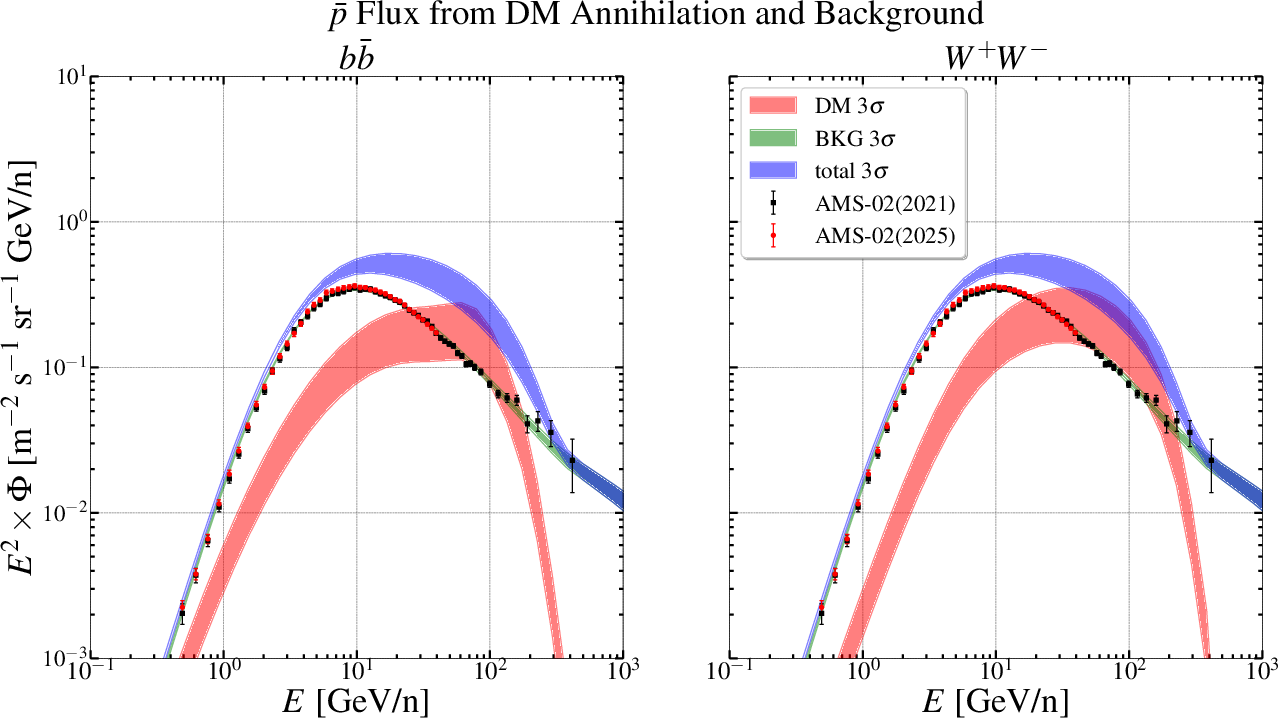
Figure 1: Antiproton spectra produced by dark matter annihilation through different channels, showcasing tension between predicted DM-induced flux (red/blue bands) and AMS-02 data.
Specifically, the total (background plus DM) flux at 100 GeV exceeds AMS-02 flux by 15σ for the bbˉ channel and 18σ for the W+W− channel, where σ denotes experimental uncertainty. This level of discrepancy persists after propagation uncertainty marginalization and fitting the solar modulation only to background, confirming that excessive cross-sections inferred from gamma-ray excess produce antiproton levels incompatible with observational constraints.
The cross-validation of the DM parameter spaces derived from gamma-ray excess analyses and those allowed by antiproton data further illustrates the contradiction.
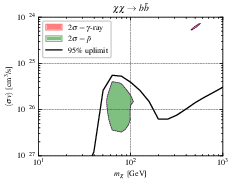
Figure 2: Comparison of dark matter annihilation signals derived from gamma-ray and antiproton data, with signal regions and upper limits, highlighting a two-order-of-magnitude discrepancy.
The 2σ region supporting the gamma-ray excess (red area) is nearly two orders of magnitude above the 2σ region and 95% upper limit derived from AMS-02 antiproton analysis (green area and black curve). Potential systematic errors in propagation and modulation are shown to be subdominant. Solar modulation uncertainties do not affect this conclusion, as the relevant signal energies (∼100 GeV) are well above the regime impacted by solar physics.
Implications and Theoretical Interpretation
This work establishes that the Milky Way halo-like 20 GeV gamma-ray excess cannot be attributed to DM annihilation under current local cosmic ray antiproton measurements. The annihilation cross section required for a DM interpretation exceeds secondary production limits and multi-messenger consistency by a factor of ∼40. The outcome is robust against uncertainties in propagation modeling and solar modulation.
These findings suggest that the 20 GeV gamma-ray excess arises from non-DM astrophysical processes or sources inadequately modeled in diffuse emission templates. This is consistent with the ambiguous origin of other claimed gamma-ray excesses, such as the GCE, which remain subject to unresolved pulsar and stellar bulge hypotheses [2020ARNPS..70..455M]. For indirect DM searches, coupling gamma-ray analyses with charged CR constraints remains mandatory, and future model-building should encompass multi-messenger compatibility.
Conclusion
Through rigorous multi-channel and multi-messenger analysis, the gamma-ray excess at 20 GeV in the Milky Way halo is excluded as a plausible DM annihilation signal by direct comparison with antiproton flux limits from AMS-02. The annihilation cross sections required for consistency with the gamma-ray data are inconsistent with measured antiproton fluxes at high significance, and propagation plus modulation uncertainties do not affect this conclusion. The paper underscores the necessity for simultaneous constraints from independent astrophysical messengers in the indirect detection program, and motivates further study of unknown astrophysical backgrounds in gamma-ray observations.