- The paper introduces a self-consistent axio-dilaton model that modifies electron mass through dilaton dynamics, effectively shrinking the recombination sound horizon.
- It employs a Bayesian MCMC approach with CMB, BAO, and SNe data to achieve a statistically superior fit over ΛCDM and elevate H₀ estimates.
- The model predicts correlated shifts in microphysical constants and cosmic expansion that challenge local gravity tests, highlighting the need for effective screening mechanisms.
Axiodilaton Cosmology and the Hubble Tension: A Self-Consistent Microphysical Solution
Overview and Motivation
This work introduces and thoroughly investigates a minimal axio-dilaton cosmology constructed to address persistent tensions in the values of the Hubble constant (H0) inferred from early- and late-Universe measurements, notably the discrepancy between the Planck-inferred H0 and that derived from local distance-ladder methods. The framework embeds two new scalar degrees of freedom: the dilaton, acting as a light scalar field with universal couplings to matter and responsible for dark energy, and a heavy axion, representing dark matter but with field-dependent mass driven by the dilaton. The distinctive feature of the construction is its origin in plausible UV completions (extra-dimensional settings with accidental approximate symmetries), ensuring calculable, predictively correlated modifications of cosmological microphysics, notably around recombination.
Contrary to prior phenomenological approaches—which often insert arbitrary steps or transitions in the electron mass me at recombination to shrink the sound horizon—the axio-dilaton dynamics provide a concrete mechanism: time-evolving particle masses universally rescaled by the dilaton, with explicit predictions for both microphysical and gravitational signatures.
Theoretical Framework
The Einstein-frame action supplements the Standard Model + General Relativity with an axio-dilaton sector. The dilaton field χ couples universally to visible and dark sectors through a conformal factor A(χ)=egχ and an additional two-derivative kinetic mixing with the axion. The Lagrangian allows both for a simple exponential (tracker) potential and for a shallow polynomial with a minimum—the latter motivated by technical naturalness arguments, and both realized in constructions with accidental scale invariance.
Particle masses, specifically the electron mass me(z), become explicit functions of the dilaton, leading to cosmological time-variation with quantitative impact on the ionization and recombination rates, atomic binding energies, and the Thomson cross section. The axion acts as cold dark matter, but with a time-dependent mass induced by kinetic mixings.
Data Analysis Methodology
The axio-dilaton models are implemented into CLASS, including a custom dynamical treatment of the electron mass within the HyRec recombination module. Their predictions are confronted with a suite of cosmological observations:
- CMB temperature, polarization, and lensing (Planck, ACT DR6, SPT-3G)
- DESI and SDSS/eBOSS baryon acoustic oscillation data
- Pantheon+ and SH0ES supernovae, with and without local H0 calibration
A Bayesian MCMC approach is used for parameter estimation, sampling both standard six ΛCDM parameters and the additional axio-dilaton couplings. Particular care is taken to properly capture bimodal and correlated posterior structures, a characteristic feature deriving from the compensation between baryonic and axion-induced source terms in the dilaton's evolution.
Model Dynamics: Microphysical Effects and Background Evolution
A unique aspect of this framework is the correlated evolution of me(z), baryonic and CDM densities, and the expansion rate, traced to a common rolling scalar. A transient dilaton excursion around the epoch of recombination naturally generates a step in me(z), shrinking the sound horizon rs while also altering baryon loading and shifting matter-radiation equality. This is seen directly in modifications to the angular CMB power spectra as a function of the initial dilaton displacement:
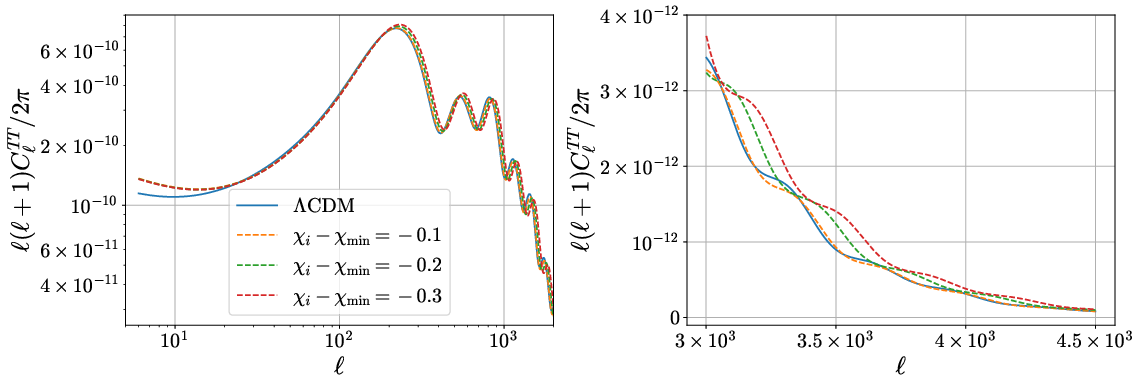
Figure 1: χi−χmin modulates the CMB peaks and damping tail through the time-dependent mass rescaling induced by the dilaton in the Yoga model.
Comparative fits to high-resolution CMB data (Planck/ACT/SPT-3G) demonstrate that for O(0.1) dilaton couplings, the model can simultaneously address the acoustic scale and the high-ℓ damping tail, thereby accommodating strong constraints from both low and high multipoles.
The dynamical evolution of the background and derived microphysical parameters, including me(z) and the effective dark energy EoS, are displayed for the best-fit trajectories:
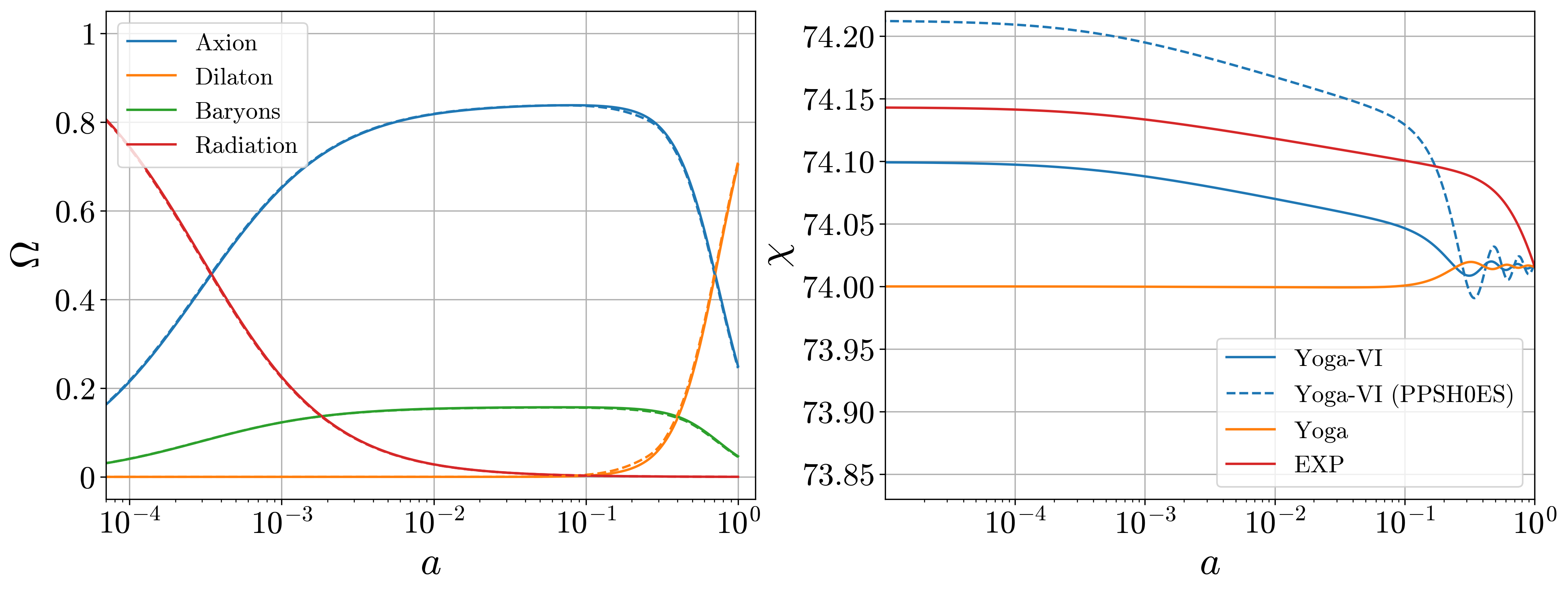
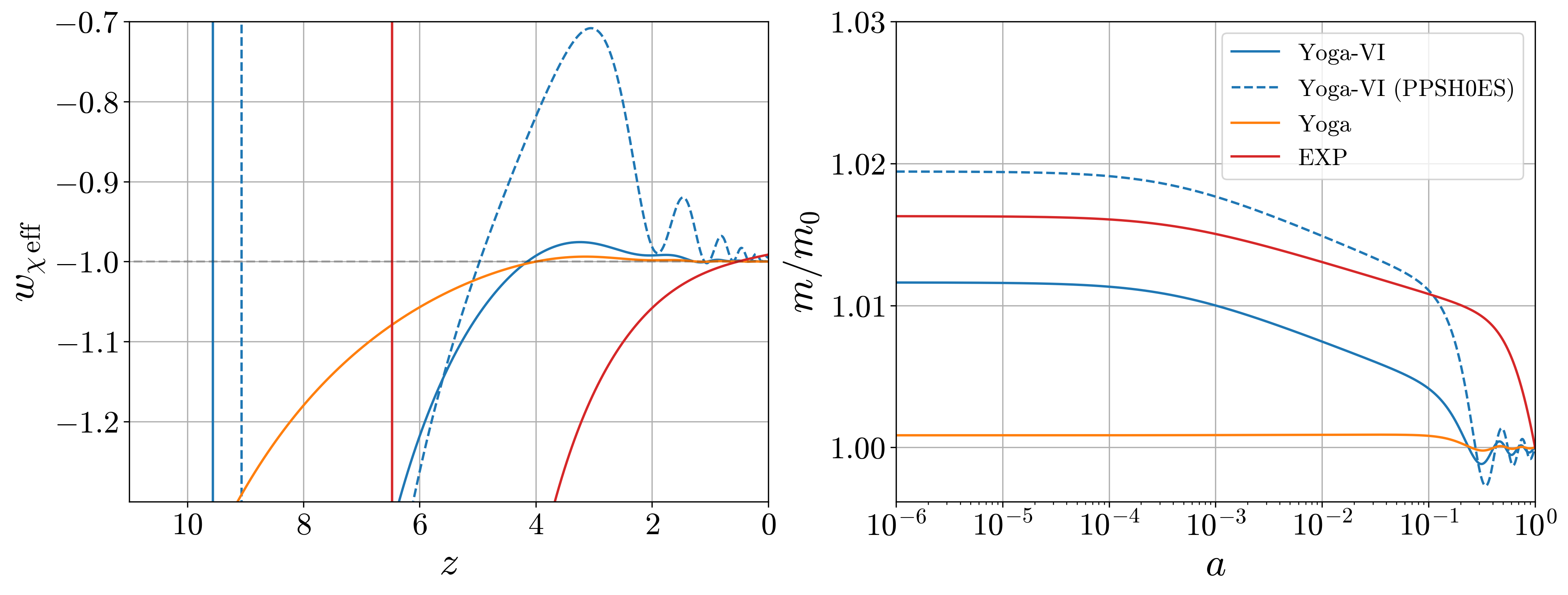
Figure 2: Background evolution in the best-fit Yoga-VI model, showing dilaton and axion densities, field evolution, the effective dark-energy EoS wχ, and the induced variation in electron mass me(z).
The model robustly predicts "apparent" phantom crossing in cosmological fits, i.e., an effective w<−1 favored by DESI DR2 BAO when analyzed in a conventional w0−wa framework, but arising here from correlated dilaton-matter interactions that never violate fundamental energy conditions.
The analysis finds that the minimal axio-dilaton models provide a statistically superior fit to the combined CMB+BAO+SNe datasets relative to ΛCDM, with Δχ2≃−7 when SPT-3G high-ℓ spectra are included, for only two or three additional parameters depending on the potential. Importantly, these models systematically shift the inferred H0 upwards:
- Without external H0 prior: H0≃69.2 kms−1Mpc−1, reducing the Hubble tension to ≲3σ
- With SH0ES prior: joint fit remains excellent, H0≃71 kms−1Mpc−1, with Δχ2 competitive with explicit w0–wa or ΛCDM+me fits.
The triangle plots (Figure 3) capture the distinctive parameter space structure: bimodal posteriors in the dilaton coupling g and kinetic mixing ζ, reflecting a degeneracy under compensation between baryon and axion source terms.
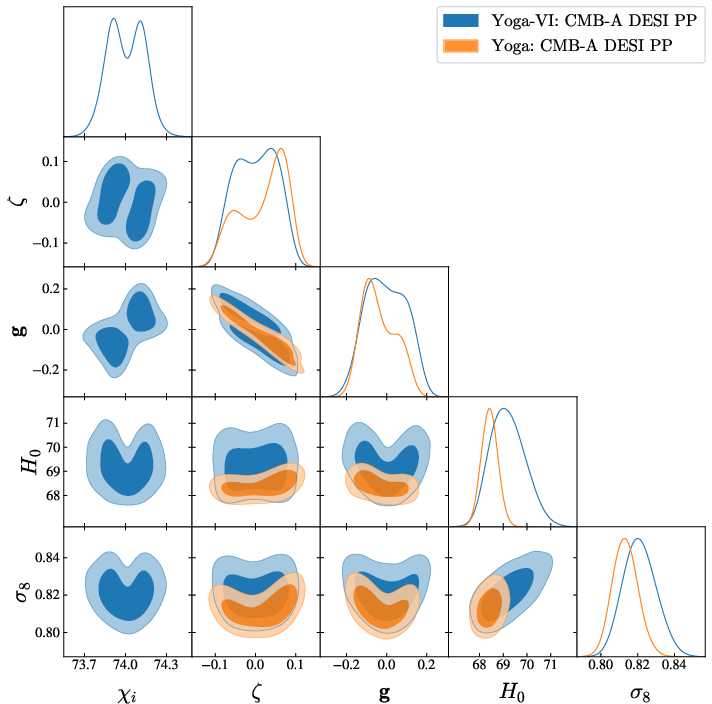
Figure 3: Posterior degeneracy structure in the Yoga model parameter space, highlighting the g–ζ compensation and the effect of initial field displacement on H0.
Comparisons with exponential tracker variants confirm the essential robustness of the phenomenon, as shown in Figure 4.
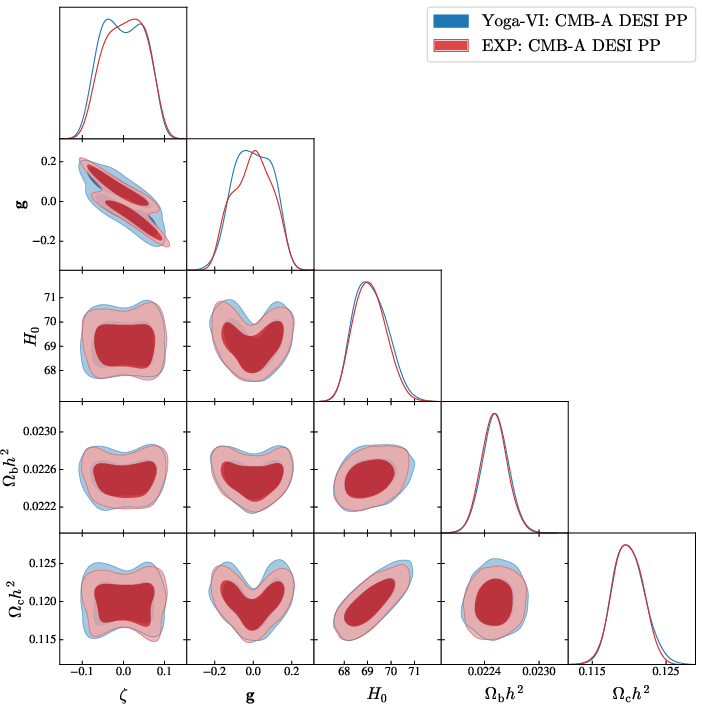
Figure 4: Parameter constraints overlap tightly between tracker (EXP) and Yoga axio-dilaton models, illustrating the broad viability and insensitivity to the scalar potential details within the preferred region.
Qualitative Distinctions from Phenomenological Models
While phenomenological models with explicit me(z) steps or w0–wa late-time freedom can achieve larger apparent reductions in χ2, these models do so by artificially decoupling recombination physics, baryon loading, and dark sector evolution. The axio-dilaton framework's predictions are considerably more constrained, with definite ratios enforced between shifts in me, baryonic and CDM densities, and zeq. Triangle plots contrasting standard ΛCDM, ΛCDM+me, and Yoga models (Figure 5) highlight these constraints:
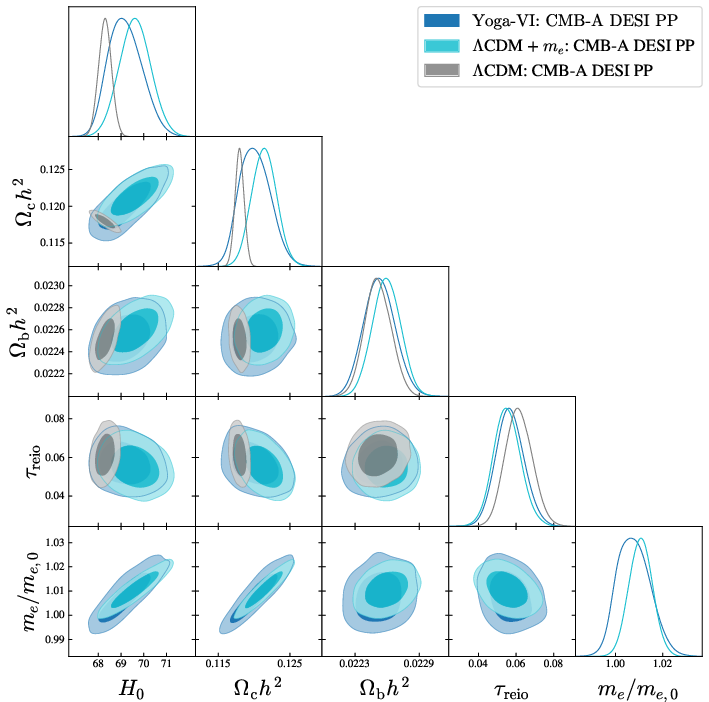
Figure 5: Comparison of ΛCDM, ΛCDM+me, and Yoga models, emphasizing the broader me posterior in the phenomenological fit and the more predictive structure in the dynamical model.
Inclusion of a local H0 prior (SH0ES calibration) selects the high-H0 branches in the parameter posteriors, visibly amplifying the correlations inherent in the model (Figure 6):
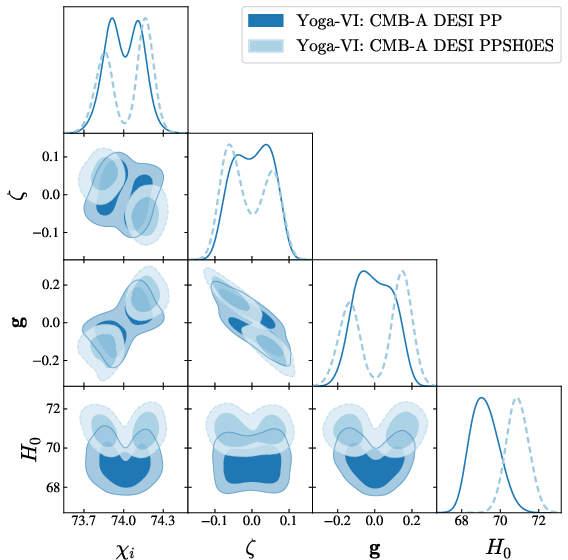
Figure 6: Constraints on Yoga-VI with and without SH0ES calibration: the local H0 prior amplifies the matter coupling, highlighting the need for a screening mechanism for Solar System compatibility.
Implications and Open Issues
Theoretical and Observational Ramifications
The work demonstrates directly that physics underlying the coupled evolution of dark energy, dark matter, and particle masses can explain the H0 and related tensions with a modest theoretical extension, deriving all modifications from a single rolling scalar sector whose microphysics are calculable and internally consistent. This paradigm introduces tight, falsifiable correlations across sectors—especially between early-time microphysical modifications and late-time cosmological observables.
A nontrivial and bold outcome is the emergence of cosmologically favored dilaton–matter couplings ∣g∣∼0.1, which are in apparent contradiction with Solar System tests of gravity (requiring ∣g∣≲10−3), thus moving the tension from internal cosmological datasets to the interface between cosmology and fifth-force/local gravity constraints. The challenge of achieving screening or environmentally-dependent suppression of couplings is highlighted as the crucial next direction for model-building. The proposal here motivates a sharply defined target for both theoretical mechanisms and future precision tests of gravity.
Future Prospects
The model makes concrete predictions for time-variation in fundamental constants around recombination, correlated shifts in CMB/BAO observables, and small but calculable implications for late-time structure growth. The universality of the mass rescaling provides potential synergies with forthcoming high-precision measurements of the cosmic recombination epoch, BAO rulers, large-scale structure, 21cm cosmology, and laboratory searches for varying fundamental constants and fifth forces.
Conclusion
This work establishes that the axio-dilaton framework constitutes a UV-motivated, dynamically self-consistent, and tightly predictive model that can simultaneously accommodate and explain the persistent Hubble tension, as well as other concordance-breaking anomalies, through calculable modification of recombination-era microphysics. The requisite scalar–matter couplings are large at cosmological scales and, unless an efficient screening mechanism is operational today, disfavored by local experiments—posing a well-posed open problem in the interplay between cosmology, field theory, and gravity.
The broader implication is clear: the apparent cosmological tensions are quantitatively compatible with, and perhaps indications of, specific microphysical phenomena linked to underlying fundamental structures, and their ultimate resolution will require tight synthesis of cosmological, astrophysical, and local laboratory data.