- The paper establishes that chiral topological superconductivity emerges in twisted bilayer and double bilayer graphene through spin-triplet chiral p+ip pairing and tunable system parameters.
- The paper employs low-energy continuum models and non-Abelian Berry curvature techniques to precisely map Chern number phase diagrams across varied twist angles, chemical potentials, and superconducting gaps.
- The paper reveals that stacking order and effects such as trigonal warping critically influence gap openings and drive the emergence of high-magnitude nontrivial Chern phases.
Chiral Topological Superconductivity in Twisted Bilayer and Double Bilayer Graphene
Overview and Motivation
The paper provides a comprehensive theoretical study of chiral topological superconductivity in small-angle twisted bilayer graphene (tBLG) and twisted double bilayer graphene (tDBLG), using low-energy continuum modeling augmented with spin-triplet chiral px+ipy pairing in each monolayer. Motivated by the unique tunability of moiré systems—particularly the ability to engineer flat bands and strong correlations near the so-called “magic angle”—the investigation focuses on the emergence and nature of topological superconducting phases. Key topological features are characterized throughout a broad multidimensional parameter space (including twist angle, chemical potential, and superconducting order parameter) using Chern number evaluation, band structure analysis, and Bloch state profiles.
Model Hamiltonian and Methodology
The construction begins with continuum models grounded in the Bistritzer–MacDonald (BMD) approach for tBLG and its appropriate extension for tDBLG (both AB-AB and AB-BA stacking). Chiral px+ipy pairing is incorporated via layer-specific symmetry-allowed pairing terms, yielding fully spin-degenerate Bogoliubov–de Gennes (BdG) Hamiltonians in the Nambu basis. In both tBLG and tDBLG, spin-flip and interlayer pairing are intentionally omitted. Topological properties are quantified using non-Abelian Berry curvature techniques to calculate Chern numbers across the moiré Brillouin zone (mBZ), with attention paid to direct band gap closings marking potential phase boundaries.
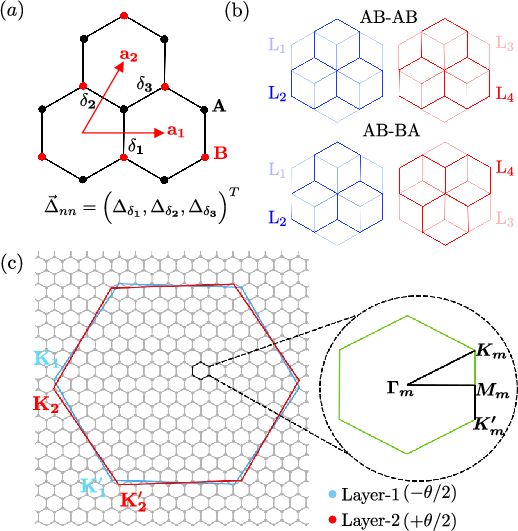
Figure 1: Schematic of monolayer and double bilayer graphene stackings, fundamental for constructing the moiré continuum model.
Electronic Band Structures
Calculation of band dispersions under varying chemical potential (μ), superconducting gap (Δsc), and twist angle (θ) reveals robust tunability and clear signatures of chiral superconducting pairing. For tBLG near the magic angle (θ≈1.05∘), the flat bands are highly sensitive to doping and pairing amplitude:
- Finite μ induces direct band gaps near Km and Km′ in the mBZ, separating particle and hole sectors by 2∣μ∣.
- The presence of Δsc lifts degeneracies but does not guarantee a full gap unless μ is also finite.
- Combined tuning of μ and Δsc yields global gap opening and topological band structure modifications.
In tDBLG, both AB-AB and AB-BA stackings exhibit heightened complexity: multiple pairs of flat bands emerge, and gap formation depends intricately on the stacking sequence and the interplay between μ and Δsc.
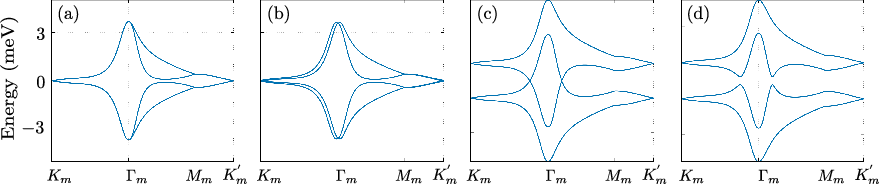
Figure 2: Band dispersion in tBLG for various (μ,Δsc) combinations and twist angles, highlighting tunable gap opening and flattening.
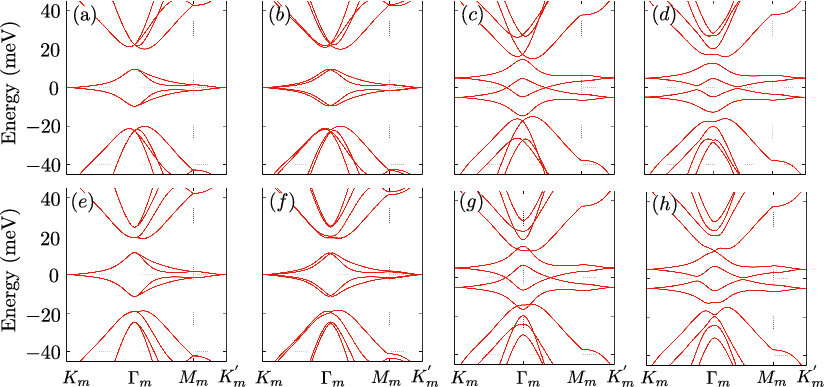
Figure 3: Electronic band dispersion in tDBLG for both AB-AB and AB-BA stackings; gap profiles evolve with chemical potential and pairing amplitude.
Topological Phase Diagrams
The central results consist of detailed phase diagrams mapping Chern numbers C↑K as a function of (θ,μ) and (μ,Δsc).
- tBLG: Near the magic angle, multiple phase transitions are observed, with nontrivial Chern phases {−1,+1,+2} appearing in distinct regions. For larger θ, only C↑K=+2 survives. Topologically trivial regions are substantial for certain parameters.
- tDBLG: Compared to tBLG, the nontrivial phases are more prevalent and the trivial region is considerably reduced, especially in AB-BA stacking. New Chern phases such as C↑K=+3 arise.
These transitions are universally associated with direct band gap closings, often at high-symmetry points (e.g., Γm), and the number of gap-closing points correlates with the magnitude of Chern number changes.
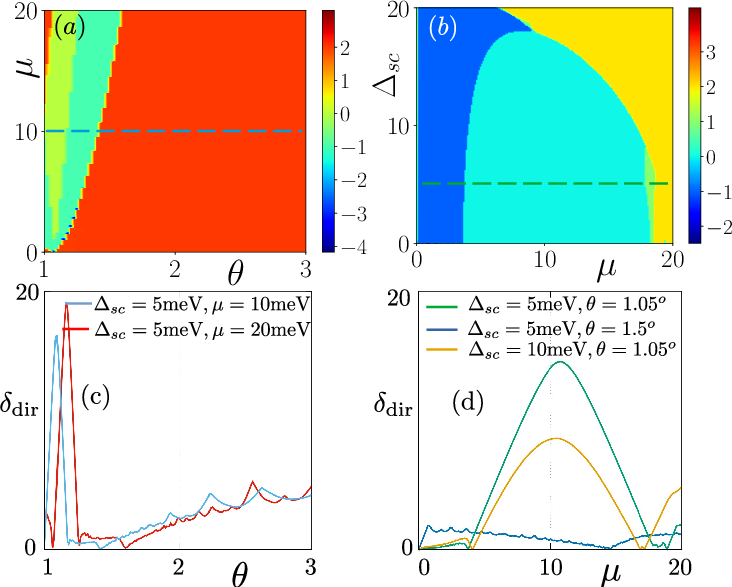
Figure 4: Topological phase diagram in tBLG; Chern number as a function of (θ,μ) and (μ,Δsc), with phase boundaries marked by gap closings.
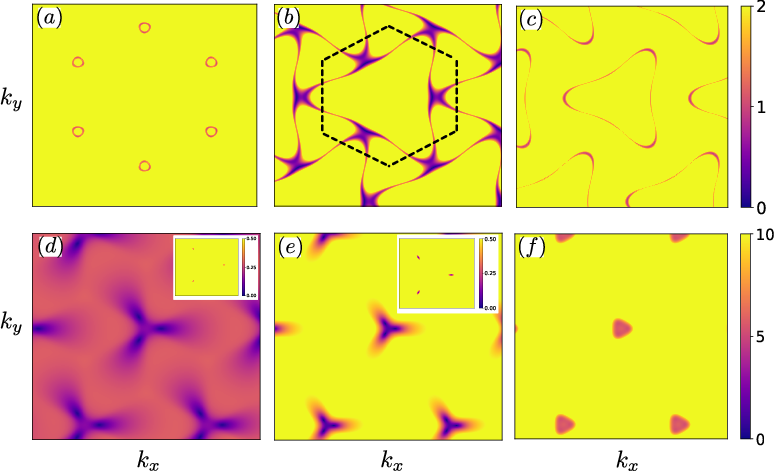
Figure 5: Gap closing contours in the mBZ for tBLG, supporting identification of the locus of topological phase transitions.
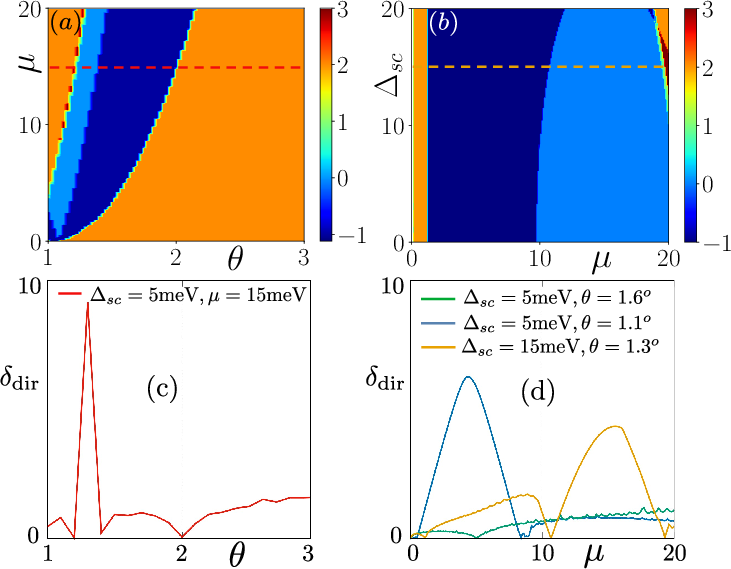
Figure 6: Topological phase diagram for AB-AB stacked tDBLG, exhibiting richer phase structure versus tBLG.
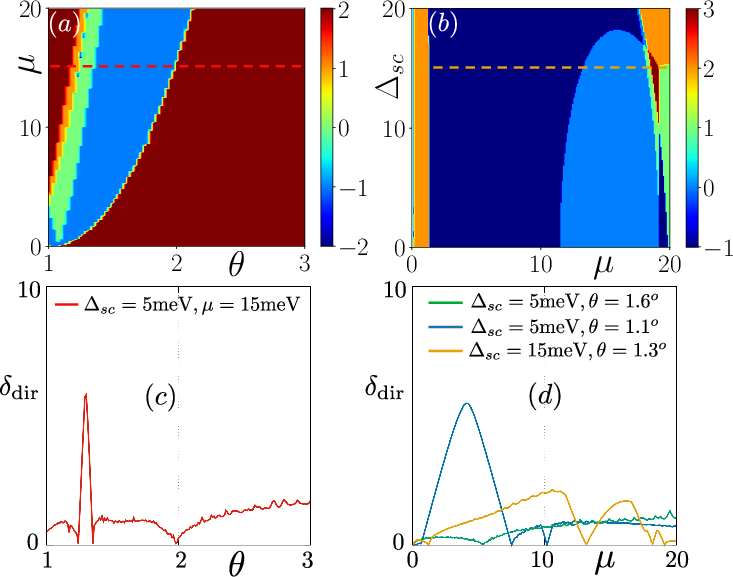
Figure 7: Phase diagram for AB-BA stacked tDBLG, showing emergence of extended nontrivial regions and new Chern phases.
Bloch State Localization Profiles
Spatial maps of Bloch-state squared amplitudes for conduction bands at the Γm point reveal distinct localization characteristics for topological versus trivial phases. Topological phases show enhanced real-space localization and sublattice selectivity. These features differ between tBLG and tDBLG, and between AB-AB and AB-BA configurations.
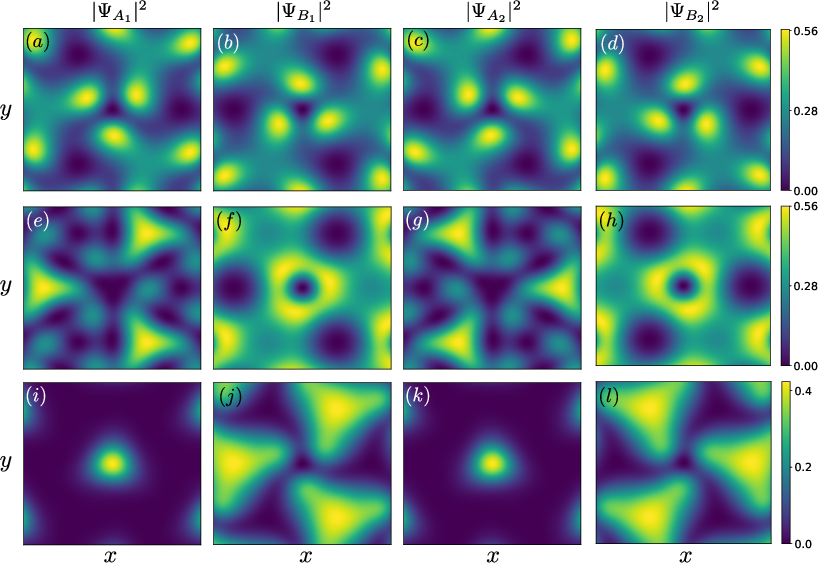
Figure 8: Real-space density plots of Bloch state amplitudes in tBLG for varying μ; strong localization correlates with nontrivial topology.
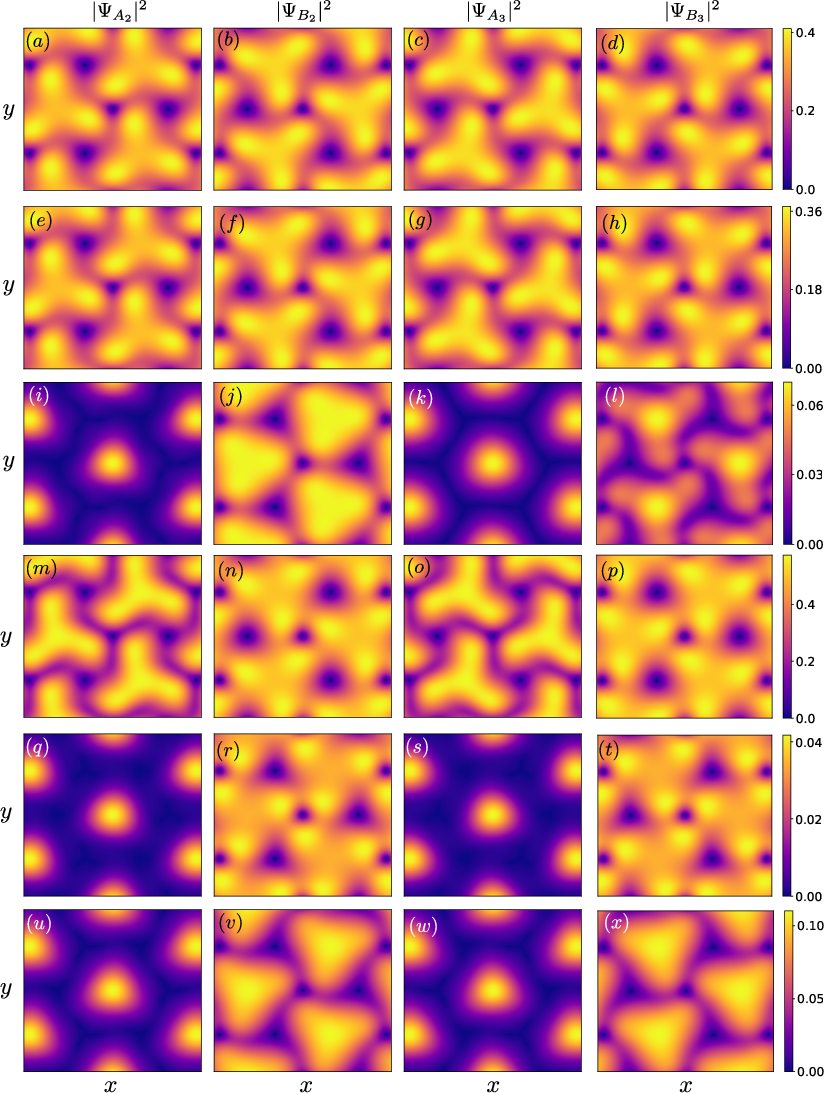
Figure 9: Bloch state profiles for AB-AB and AB-BA tDBLG; evolution with chemical potential demonstrates stacking-dependent localization.
Effects of Trigonal Warping
Inclusion of trigonal warping (interlayer γ3) in tDBLG dramatically alters phase topology. Chern number phase diagrams exhibit new high magnitude nontrivial phases (e.g., C↑K=−4), and the topologically trivial region is nearly eliminated, especially for AB-BA stacking.
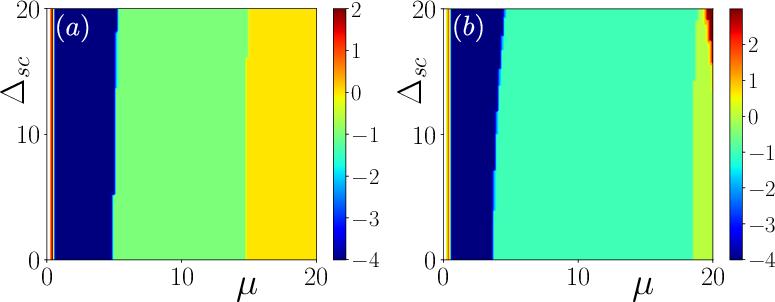
Figure 10: Topological phase diagrams for tDBLG in presence of trigonal warping; nontrivial phases dominate the parameter space.
Effective p+ip Pairing from Conventional s-Wave Superconductivity
Theoretical construction employing a unitary transformation demonstrates that effective chiral p+ip pairing can arise from conventional s-wave superconductivity under the combined effects of Rashba spin–orbit coupling and perpendicular magnetic field. The duality explicitly shows the emergence of momentum-dependent pairing terms and an effective Zeeman field, suggesting a plausible experimental route for realizing topological superconductivity in multilayer graphene structures.
Implications and Outlook
The study rigorously establishes that chiral topological superconductivity—marked by robust Chern phases and tunable band gaps—emerges generically in stacked graphene moiré systems under px+ipy pairing. Differences between tBLG and tDBLG, and between stacking variants, reveal rich physics in accessible parameter regimes. The presence of strong nontrivial topological phases over extended regions (particularly in tDBLG with trigonal warping) points toward practical realization of platforms supporting exotic low-energy quasiparticles, such as Majorana modes.
Experimentally, recent observations of chiral superconductivity in rhombohedral and twisted graphene systems corroborate the possibility of observing these phenomena. The outlined theoretical path from s-wave to p+ip pairing may inform engineering strategies for topological superconductivity via controlled proximity effects and external fields.
Conclusion
This work offers a systematic and detailed exploration of chiral topological superconductivity in twisted graphene-based moiré systems. Its numerical and analytic frameworks, coupled with strong correlation between band topology and physical control parameters, provide vital guidance for future research and experimental realization. The study opens avenues for the engineering of exotic superconducting states and devices leveraging tunable moiré superlattices, with far-reaching consequences for quantum information science and topological matter studies.