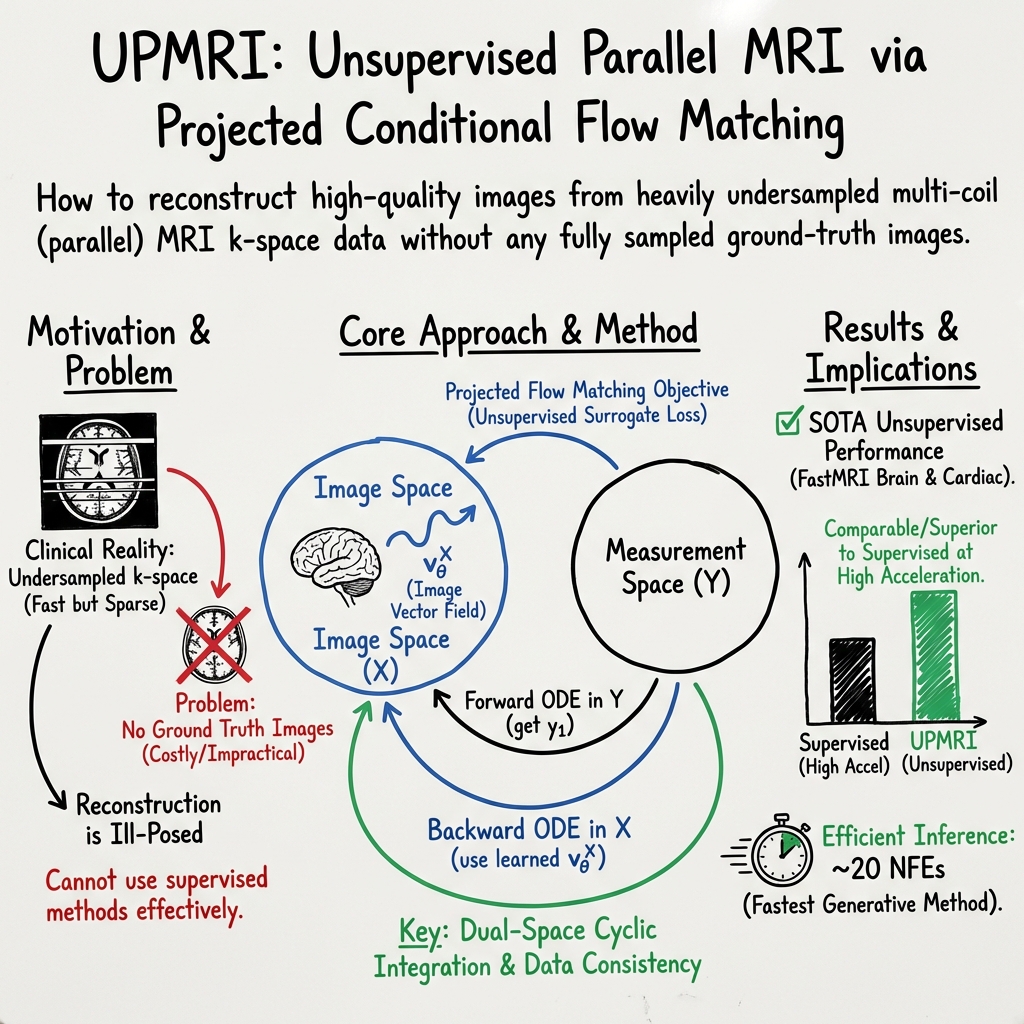
- The paper introduces UPMRI, using PCFM to learn image priors directly from undersampled k-space data, eliminating the need for fully sampled datasets.
- It employs a dual-space cyclic integration method to ensure measurement consistency during reconstruction, achieving performance comparable to supervised methods on fastMRI and CMRxRecon.
- The approach demonstrates robust generalization across various acceleration rates and unseen sampling masks, paving the way for practical clinical application.
UPMRI: Unsupervised Parallel MRI Reconstruction via Projected Conditional Flow Matching
Introduction
The reconstruction of high-quality images from undersampled k-space data in accelerated MRI poses a significant challenge due to the ill-posed nature of the inverse problem. This is exacerbated by the limited availability of fully sampled ground-truth MRI datasets, which are often impractical to obtain in clinical settings. UPMRI introduces a novel framework leveraging Projected Conditional Flow Matching (PCFM) for unsupervised parallel MRI reconstruction, circumventing the need for fully sampled data by learning the prior distribution directly from undersampled measurements.
Methodology
Projected Conditional Flow Matching Framework
The proposed framework, UPMRI, uses PCFM to learn the prior distribution of fully sampled parallel MRI data by utilizing only undersampled k-space measurements. Unlike standard generative models, PCFM exploits the continuity equation to establish a connection between marginal vector fields in the measurement space and the optimal solution to the PCFM objective. This leads to a dual-space cyclic sampling algorithm capable of reconstructing high-quality images without fully sampled training data.
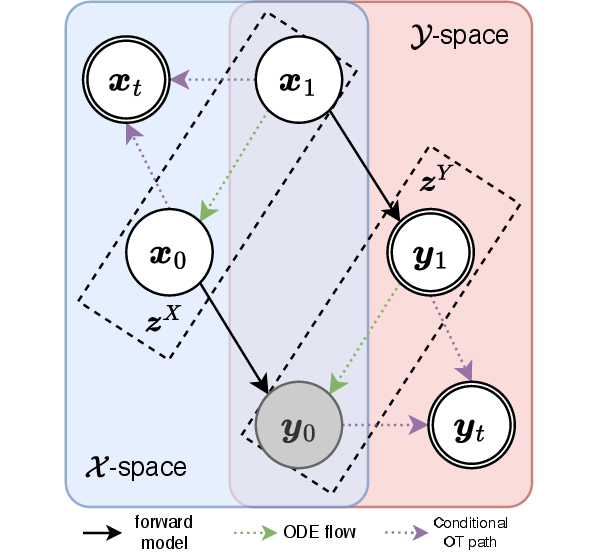
Figure 1: Generation chart of the dual-space conditional probability paths, where observed variables are shaded, and deterministic variables are in double circles. Dotted green arrows indicate deterministic ODE flows, whereas purple ones denote conditional probability paths.
Dual-Space Cyclic Integration
The inference process in UPMRI employs a dual-space cyclic integration approach. The algorithm begins by sampling latent noise via forward integration in the measurement space, followed by backward integration in the image space, ensuring measurement consistency through interpolated paths. This dual-space approach integrates measurement-space consistency with image-space prior sampling, effectively addressing the inverse problem of MRI reconstruction.
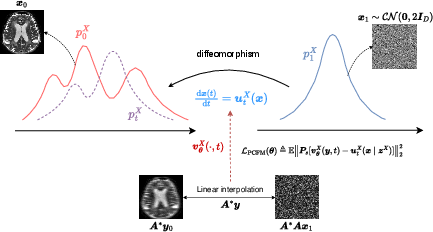
Figure 2: Schematic illustration of the proposed projected conditional flow matching framework.
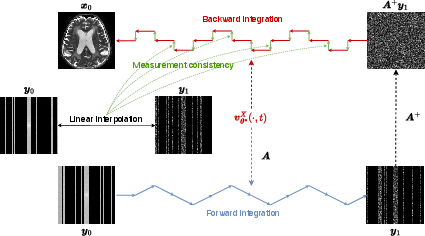
Figure 3: Inference via Dual-Space Cyclic Integration. The algorithm first samples latent noise y via forward integration, then reconstructs the target image x0 via backward integration, enforcing data consistency at each step.
Experimental Evaluation
Quantitative Results
The UPMRI framework is evaluated on large-scale public datasets including fastMRI and CMRxRecon, demonstrating significant superiority over state-of-the-art unsupervised and self-supervised baselines. Notably, UPMRI achieves reconstruction fidelity comparable to leading supervised methods at high acceleration factors, without requiring fully sampled training data.
Generalization and Robustness
UPMRI exhibits impressive generalization capabilities across different acceleration rates, showcasing robustness in scenarios involving unseen sampling masks. The model trained on higher acceleration rates displays superior reconstruction fidelity and robustness when generalizing to extreme undersampling scenarios.
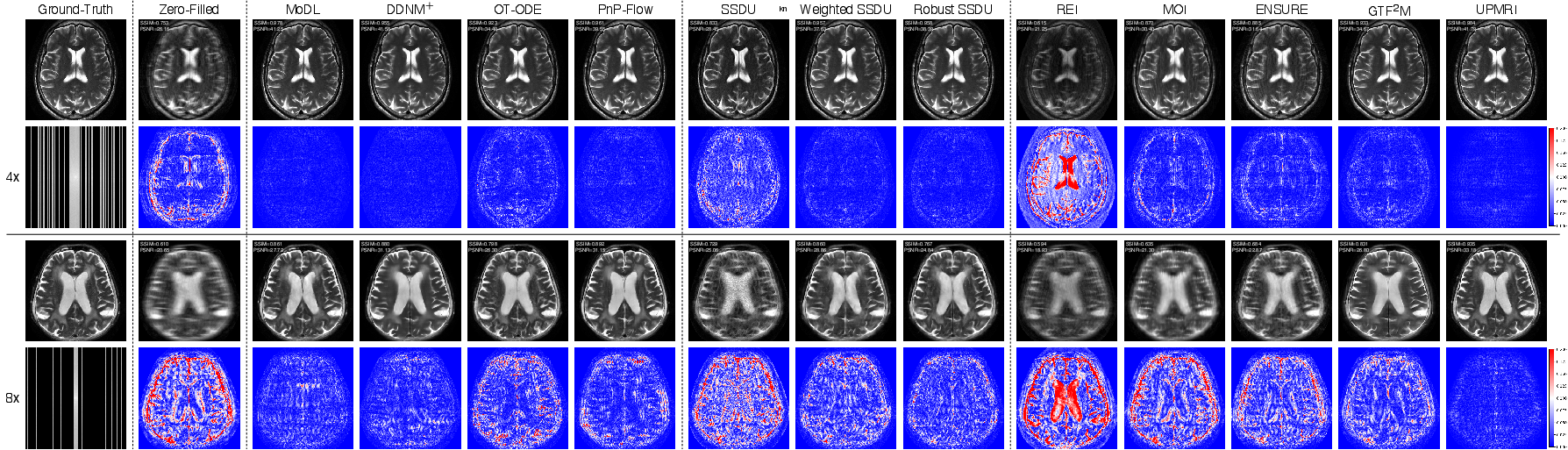
Figure 4: Visualization of reconstruction on two test samples of 4× and 8× accelerated multi-coil brain MRI from the compared methods.
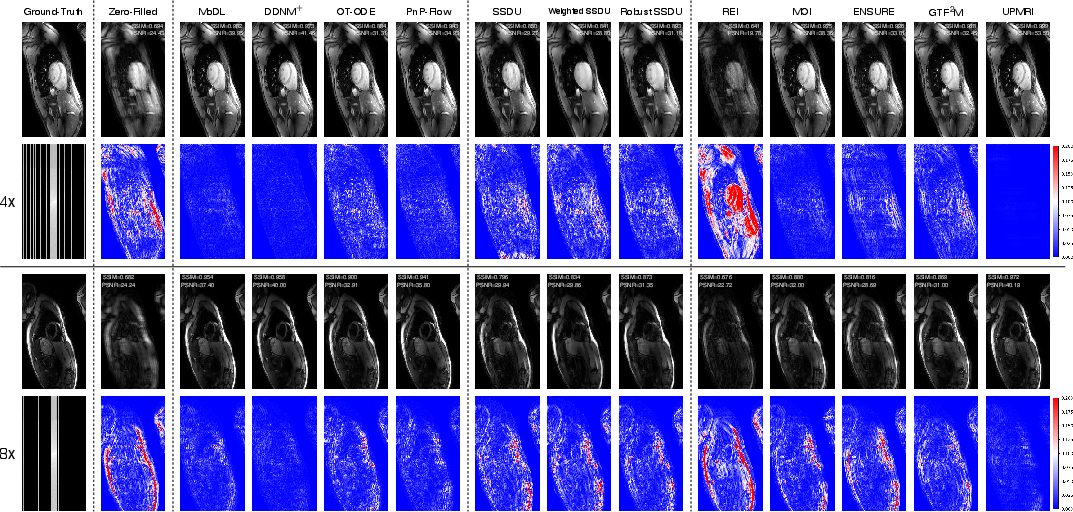
Figure 5: Visualization of reconstruction on two test samples of 4× and 8× accelerated multi-coil cardiac T1/T2-mapping MRI from the compared methods.
Conclusion
UPMRI presents a significant advancement in the field of MRI reconstruction by eliminating the reliance on fully sampled data and achieving state-of-the-art performance in unsupervised learning scenarios. The proposed PCFM framework and dual-space cyclic integration algorithm not only enhance reconstruction fidelity but also facilitate efficient training and inference, highlighting the potential for practical deployment in clinical settings. Future developments may explore broader applications of PCFM in other inverse imaging problems and the integration of spatial-temporal dynamics in MRI reconstruction.