The size of 3I/ATLAS from non-gravitational acceleration
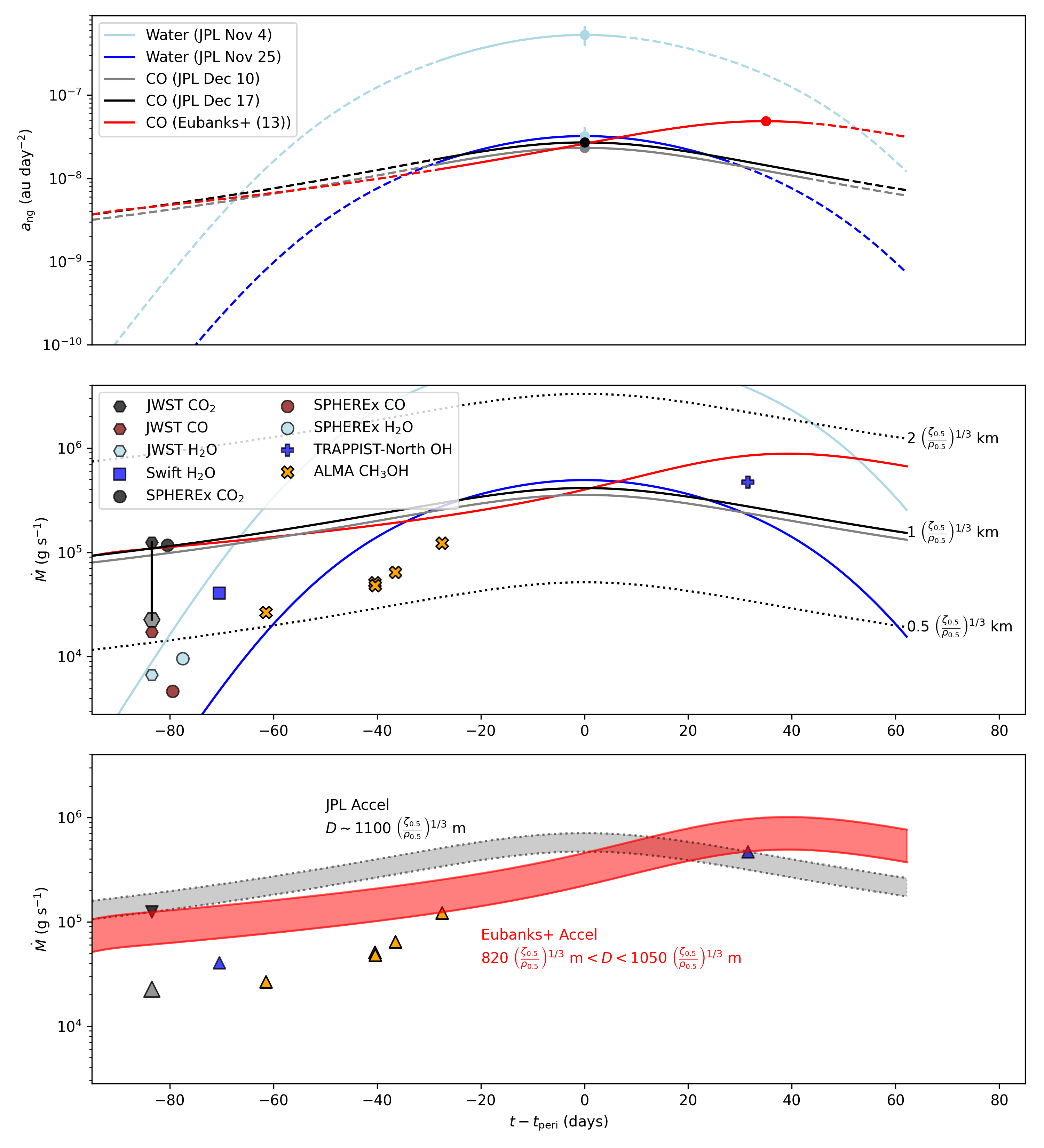
Abstract: The third macroscopic interstellar object detected in the solar system recently passed through perihelion, with the best-fitting models of its trajectory now featuring non-gravitational accelerations. We assess how much mass loss is required to produce plausible non-gravitational acceleration solutions and compare with estimates of the mass loss. We find that they are consistent when the nucleus of 3I/ATLAS is around 1 km in diameter. For a recent solution with a time lag in the acceleration from Eubanks et al, we find diameters between 820 meters and 1050 meters, assuming an outgassing asymmetry factor $ζ=0.5$ and a density of the comet nucleus $ρ=0.5$ g cm${-3}$. The limits on the diameter scale as $(ζ/ρ){1/3}$. Substantial extrapolation is required in general to compare non-gravitational accelerations to mass loss rates, so reliable estimates of the mass loss rate at other stages of the comet's trajectory will substantially reduce the systematic uncertainty in this estimate.
Paper Prompts
Sign up for free to create and run prompts on this paper using GPT-5.
Top Community Prompts
Explain it Like I'm 14
Overview
This paper tries to figure out how big the solid core (called the “nucleus”) of the interstellar comet 3I/ATLAS is. The authors use a clever idea: as the comet gets close to the Sun, it heats up and blows off gas like tiny thrusters. That gas push gives the comet a small “extra” acceleration that isn’t from gravity. By measuring that extra push and comparing it to how much gas the comet is releasing, they estimate the comet’s size. Their main result suggests the nucleus is about 1 kilometer wide.
What questions does the paper ask?
The paper focuses on two simple questions:
- How strong is the comet’s non‑gravitational acceleration (the small shove caused by gas jets), and what amount of gas loss would create that shove?
- If we match those shoves to actual measurements of gas coming off the comet, what does that tell us about the comet’s mass and diameter?
How did they do it?
The authors use a “rocket effect” idea:
- When 3I/ATLAS warms up near the Sun, ices (especially carbon dioxide, or CO2) turn into gas and stream off the surface. If the gas escapes more strongly on one side than the other, it pushes the comet a tiny bit, like a gentle thruster.
- That push shows up as a non‑gravitational acceleration, written as . It’s measured by tracking the comet’s position very carefully over time and seeing that its path doesn’t match gravity alone.
They connect the push to the amount of gas released using momentum (the same physics that makes rockets go):
- The basic relation is: .
- is the comet’s mass.
- is the size of the non‑gravitational acceleration.
- is how fast the comet loses mass (gas per second).
- is the speed of the escaping gas (they use an estimate that gets slower farther from the Sun).
- is an “asymmetry factor” between 0 and 1 that says how one‑sided the gas blowing is. If gas jets equally in all directions, is small; if it blasts from one side like a focused jet, is larger.
In everyday terms:
- Think of the comet as a big snowball.
- Sun‑heated gas shoots off like hair‑dryers mounted around it.
- If the hair‑dryers blow more on one side, the snowball drifts that way a tiny bit.
- By measuring both the drift and the amount of blowing, you can estimate how heavy and how big the snowball is.
Data and models they used:
- Non‑gravitational acceleration models from two sources:
- The JPL Small‑Body Database (which assumes acceleration changes with distance from the Sun in a simple way).
- A model by Eubanks et al. (2025) that includes a time delay, meaning the strongest push happens slightly after the comet passes a certain point.
- Gas production measurements from several telescopes:
- Space telescopes like JWST and SPHEREx can directly see CO2.
- Other observatories (ALMA, TRAPPIST‑North, Swift) measure different gases or give lower limits when CO2 is hard to see from the ground.
They compare the measured to the observed gas release rates and ask: “What comet mass and diameter make these consistent?”
What did they find and why does it matter?
Main findings:
- With reasonable assumptions (asymmetry factor and comet density ), the Eubanks et al. model points to a nucleus diameter between about 820 and 1050 meters.
- Their result lines up with what Hubble saw (HST set upper limits that this size fits under).
- The JPL acceleration model had trouble matching both the upper limit from JWST’s CO2 measurements and lower limits from other telescopes at the same time, suggesting the time‑delay model may better represent what actually happened.
Why this matters:
- Size tells us a lot about the comet’s structure and survival. A ~1 km wide nucleus is big enough to hold together and explains the observed gas release.
- 3I/ATLAS comes from outside our solar system, so learning its size and behavior helps scientists compare interstellar comets to those born here.
- Understanding these tiny “rocket pushes” improves how we predict comet paths, which is important for future observations and possibly spacecraft missions.
A helpful detail about uncertainty:
- The diameter depends on the ratio of the outgassing asymmetry to density: the limits scale like . That means:
- If the gas is more one‑sided (larger ), the comet could be a bit larger.
- If the comet is denser (larger ), it could be a bit smaller.
- Better measurements of gas release at different times would reduce these uncertainties a lot.
What are the broader implications?
- Method-wise: The paper shows a practical way to estimate a comet’s size by combining precision tracking (to get ) with gas measurements. This “rocket effect” method will be useful for other comets, especially interstellar ones we can’t study up close.
- Science-wise: It supports the idea that CO2 drove much of 3I/ATLAS’s activity near the Sun and that gas jets can cause noticeable changes in a comet’s path.
- Future work: Getting more frequent and wide‑ranging measurements of different gases, and refining models that include time delays and changing jet patterns, will make size estimates even more reliable. This helps us understand how interstellar comets form, what they’re made of, and how they evolve when they visit our solar system.
Knowledge Gaps
Knowledge gaps, limitations, and open questions
Below is a concise list of what remains uncertain or unexplored in the paper and what would enable more definitive constraints on 3I/ATLAS’s nucleus size:
- Appropriate NGA law and physical model: It remains unresolved whether a Marsden-style water law, a CO2-like r-2 law, or a time-lagged model (ΔT) best describes 3I/ATLAS’s NGAs; a systematic comparison using physically based sublimation/thermophysical models and all available astrometry (including spacecraft) is needed.
- Degeneracy in key parameters: The inferred diameter scales as D ∝ (ζ/ρ)1/3 and depends on the assumed gas speed; there are no independent constraints on ζ (outgassing asymmetry), ρ (bulk density), or v_th (outflow speed), leaving a strong degeneracy that future observations must break.
- Outgassing asymmetry factor ζ: ζ is assumed constant and set to 0.5, but its true value and time variability are unconstrained; resolved coma/jet modeling and rotational/seasonal analyses are needed to derive ζ(t) rather than adopt a constant.
- Nucleus density ρ: The assumed ρ = 0.5 g cm-3 is untested for this interstellar object; independent bounds from rotational stability, shape modeling, or future direct size/albedo constraints are required.
- Gas outflow speed v_th: The adopted v_th = 0.8 km s-1 (r/1 au)-0.5 is species-agnostic; species-specific and epoch-dependent speeds (especially for CO2) should be measured from high-resolution spectroscopy (line widths) or ALMA kinematics to reduce the momentum-flux uncertainty.
- Species mixture and temporal evolution: The analysis assumes CO2 dominates the NGA at least near the JWST epoch, but the relative contributions of CO2, CO, H2O, and others likely vary with heliocentric distance; contemporaneous, multi-species production rates along the full arc are needed.
- Sparse and non-contemporaneous mass-loss constraints: CO2 is poorly sampled in time (ground-inaccessible), forcing extrapolations; dense, multi-epoch space-based coverage (e.g., JWST/SPHEREx) pre- and post-perihelion is necessary to match the time span over which NGAs are inferred.
- Distributed coma sources vs nucleus source: A fraction of the observed CO2 may arise from sublimating grains in the coma; that component does not impart momentum to the nucleus, biasing size estimates if uncorrected; spatially resolved maps and radiative transfer are needed to quantify the nucleus-origin fraction.
- Dust momentum contribution: Dust is excluded due to lower speeds, yet dust mass flux may be large enough to affect the momentum budget; joint constraints on dust-to-gas ratio and particle velocities are needed to determine whether dust contributes non-negligibly to NGA.
- Time variability in mass and activity: The model assumes constant nucleus mass and a stationary ζ; significant mass loss and activity changes (e.g., seasonal effects, jet activation) could alter the acceleration; time-dependent mass/activity modeling should be incorporated.
- Spin state and pole orientation: The nucleus spin period, pole, and their evolution are not constrained, yet they control jet directionality, seasonal forcing, and potential time lags; lightcurve analysis and coma morphology inversions are needed to recover the spin state.
- Directional NGA information: Only the magnitude of a_ng is used; vector components (in RTN or equivalent frames) compared to observed jet orientations could localize active areas and reduce ζ-related uncertainties.
- Tension with JPL NGA law: The JPL solution cannot simultaneously satisfy the JWST upper and TRAPPIST/ALMA lower limits; it is unclear which model ingredients (ΔT, multi-species activity, variable ζ, v_th) resolve this tension; explicit model testing against all constraints is required.
- Error-budget quantification: A full uncertainty propagation (NGA fit uncertainties, ζ, ρ, v_th, species mix, coma optical depth/systematics) to produce confidence intervals on D is not provided; a formal Bayesian or Monte Carlo framework would clarify robustness.
- Direct size/density constraints: HST provides only upper limits; targeted high-resolution imaging, stellar occultations, or thermal-IR observations could independently bound diameter and, combined with rotation, constrain density.
- Heliocentric-distance mismatch: NGA is inferred cumulatively over arcs, whereas production rates are instantaneous; a forward model that integrates time-resolved activity into predicted NGAs (and vice versa) is needed for like-for-like comparison.
- Thermophysical basis of time lag ΔT: The physical origin and magnitude of the suggested time lag (thermal inertia, self-shadowing, seasonal geometry) are not constrained; thermophysical modeling anchored by multi-epoch gas maps is needed to link ΔT to material properties.
- Shape and topography: The analysis assumes a spherical, homogeneous nucleus; non-spherical shapes and localized topography can focus jets and affect ζ and ΔT; shape modeling (from lightcurves/occultations) should be incorporated.
- Outbursts or fragmentation: Potential transient events that could alter NGAs are not assessed; continuous monitoring is needed to identify and model such episodes in the dynamical fits.
- Composition-to-total mass-loss conversion: Using minor-species (e.g., HCN, CH3OH) production to infer total mass loss introduces composition-driven uncertainties; contemporaneous volatile inventory and dust-to-gas ratio are necessary to convert line fluxes to total momentum flux.
- Peak NGA vs peak mass loss: The temporal alignment between peak NGA and peak production rates is not tested; cross-correlation using time-resolved datasets could validate or refute specific activity laws and ΔT values.
- Observational access to CO2: Ground-based CO2 inaccessibility is a major limiting factor; dedicated space-based campaigns at key epochs (both pre- and post-perihelion) are essential to constrain the dominant volatile and its evolution.
Practical Applications
Summary of practical implications
This paper infers the diameter of interstellar comet 3I/ATLAS by reconciling its non-gravitational acceleration (NGA) with gas production rates using conservation of momentum, an outgassing asymmetry factor ζ, and species-dependent gas speeds. It finds a nucleus diameter of roughly 0.82–1.05 km (for ζ=0.5, ρ=0.5 g cm-3) when using a time-lagged NGA model, and highlights tensions with simpler NGA laws unless key assumptions are relaxed. The approach generalizes to other small bodies by combining astrometric NGA fits with multi-instrument volatile production rates, with size constraints scaling approximately as D ∝ (ζ/ρ)1/3.
Below are actionable applications derived from the paper’s findings, methods, and assumptions.
Immediate Applications
These can be implemented now with currently available data, models, and tooling.
- Orbit determination enhancements for small bodies with outgassing
- Sector: software, space operations, planetary defense (academia, agencies, industry)
- Application: Integrate CO2-appropriate NGA laws (∝ r-2), time-lag terms, and species-dependent gas speeds into operational orbit determination (OD) pipelines (e.g., JPL/HORIZONS, MPC, ESA NEOCC, OrbFit/OpenOrb).
- Tool/product/workflow: Add a “time-lagged Marsden-like” NGA force model option; enable species selection (H2O, CO2) with v_th(r) profiles; expose ζ and ρ as priors; export propagated ephemerides and uncertainties that account for NGA.
- Assumptions/dependencies: Availability of robust astrometry; adequate data arc to constrain time lag; correct species assignment; stable outgassing geometry over the OD window.
- Rapid nucleus size and mass bracketing from NGA and gas production rates
- Sector: academia, observatories, mission design
- Application: Use the paper’s momentum-based relation M a_ng ≈ ζ dotM v_th and D ∝ (ζ/ρ)1/3 to deliver quick, transparent size/mass ranges constrained by multi-instrument Q(species) measurements.
- Tool/product/workflow: A Python/R notebook or web calculator that ingests (i) an NGA solution vs. r, (ii) production rates and limits (JWST, SPHEREx, ALMA, ground-based), (iii) ζ, ρ priors; outputs bracketed D and sensitivity plots.
- Assumptions/dependencies: Correct v_th(r) model, species dominance at observation epochs, reliable upper/lower limits and optical depth corrections.
- Cross-instrument data fusion for outgassing constraints
- Sector: academia, observatory operations
- Application: Treat gas production rates lacking CO2 access as lower limits, and space-based IR (CO2-sensitive) as upper/lower bounds to bracket dotM and test NGA-law consistency.
- Tool/product/workflow: A data fusion service that ingests production rates (with access limitations and calibration notes) and maps them to dotM envelopes used in OD model validation.
- Assumptions/dependencies: Harmonized calibration across instruments; documented line-access constraints; timely data sharing.
- Validation and alerting for inconsistent NGA laws
- Sector: software, planetary defense, policy/standards
- Application: Automatically test currently adopted operational NGA solutions against contemporaneous production-rate constraints and flag inconsistencies (as the paper found for one JPL solution).
- Tool/product/workflow: A “consistency checker” module that compares NGA-implied dotM(r) envelopes with observational bounds and issues alerts or recommends alternative NGA parameterizations (e.g., with time lag).
- Assumptions/dependencies: Up-to-date production-rate databases; uncertainty models for both astrometry and spectroscopy.
- Observation planning to maximize information gain
- Sector: observatories (space and ground), academia
- Application: Prioritize observing windows near peak NGA leverage and when CO2 lines are accessible to break degeneracies in ζ, species dominance, and time-lag parameters.
- Tool/product/workflow: An information-driven scheduler that simulates expected reduction in D uncertainties for proposed observations; targets both pre- and post-perihelion epochs.
- Assumptions/dependencies: Coordinated access to JWST/SPHEREx or equivalent IR capability; weather/instrument duty cycles; availability of tracking ephemerides.
- Mission environment bounding for comet encounters
- Sector: space agencies, aerospace industry
- Application: Use NGA–dotM inferences to estimate gas flux, jet asymmetry, and likely dust-coupled environments for spacecraft risk and pointing constraints.
- Tool/product/workflow: A pre-phase-A risk-and-environment assessment template ingesting NGA-derived dotM and ζ to bound plume density/speed and jet variability for contingencies.
- Assumptions/dependencies: Gas–dust coupling models; jet morphology persistence; adoption of species-specific v_th.
- Education and citizen science support
- Sector: education, outreach, daily life
- Application: Engage citizen scientists to identify jets/asymmetries in images to inform ζ estimates and temporal variability.
- Tool/product/workflow: A lightweight web app guiding participants to annotate jet directions/variability; exports summaries usable as ζ priors in OD refinements.
- Assumptions/dependencies: Adequate image quality; training to avoid systematic bias; moderation and validation.
- Standards and metadata improvements for NGA reporting
- Sector: policy/standards bodies (IAU, MPC), data archives
- Application: Encourage reporting of NGA model choice (species law, time lag), ζ and ρ priors, and the v_th(r) function used, to aid reproducibility and downstream data fusion.
- Tool/product/workflow: Minimal metadata schema extension for NGA solutions in public databases; templates for manuscripts/telegrams.
- Assumptions/dependencies: Community buy-in; backward compatibility with existing OD archives.
Long-Term Applications
These require further research, validation, instrument access, or scaling efforts.
- Standardized, species-aware, time-lag NGA modeling in operational ephemerides
- Sector: planetary defense, space operations, standards
- Application: Make time-lagged, species-specific NGA models default in ephemeris services for comets/interstellar objects, with uncertainty quantification that propagates compositional and ζ/ρ priors.
- Tool/product/workflow: Next-generation OD frameworks with hierarchical Bayesian inference linking astrometry, production rates, and thermophysical priors; formal adoption in IAU/agency standards.
- Assumptions/dependencies: Robust evidence that time-lag models generalize; scalable inference pipelines; sustained multi-instrument data streams.
- Population-scale size distribution of interstellar comets via NGA–dotM synthesis
- Sector: academia
- Application: Derive statistical size/mass distributions for interstellar objects discovered by Rubin/LSST and others, informing planetesimal formation and ejection models.
- Tool/product/workflow: A survey pipeline coupling Rubin astrometry with targeted IR follow-up to estimate D across many objects; hierarchical models pooling ζ, ρ priors.
- Assumptions/dependencies: Sufficient sample size; systematic follow-up; well-characterized selection effects.
- Autonomous onboard navigation accounting for outgassing forces
- Sector: space robotics, software
- Application: Spacecraft near comets estimate and predict NGA in situ (from optical nav, accelerometers, and gas sensors), adjusting guidance/pointing autonomously.
- Tool/product/workflow: Flight software modules combining real-time NGA estimation with plume sensing to update force models and control laws.
- Assumptions/dependencies: Onboard sensing fidelity; computational margins; validated real-time NGA estimation algorithms.
- Interstellar object intercept mission design under large NGA uncertainty
- Sector: space agencies, mission design
- Application: Use time-lagged NGA scenarios and ζ/ρ uncertainty envelopes in trajectory design, Δv margins, and timeline planning for fast-response interceptors.
- Tool/product/workflow: Design toolkits that Monte Carlo over NGA models tied to speculative composition (CO2/H2O/CO dominance) and likely v_th(r) laws.
- Assumptions/dependencies: Early discovery and rapid characterization capability; launch-on-alert infrastructure.
- Resource assessment and volatile inventory inference for cometary prospecting
- Sector: space resources (research-stage)
- Application: Infer bulk volatile content and compositional dominance from NGA–dotM constraints to guide future in situ exploration and sampling strategies.
- Tool/product/workflow: Inversion frameworks linking NGA, production rates, and thermophysical models to volatile inventory maps.
- Assumptions/dependencies: Calibrated relationships between production rates and subsurface inventories; improved models for dust–gas coupling and optical depth.
- Improved hazard models for dust/gas environments around active comets
- Sector: space operations, insurance/finance (mission risk)
- Application: Forecast gas/dust encounter risks for spacecraft based on NGA-inferred outgassing asymmetries and production rates; inform insurance underwriting and operational guidelines.
- Tool/product/workflow: Environment simulators driven by NGA-derived dotM and ζ, coupled with plume CFD and dust dynamics.
- Assumptions/dependencies: Validated gas–dust momentum transfer models; empirical jet variability statistics.
- Data assimilation frameworks linking thermophysics, spectroscopy, and astrometry
- Sector: academia, software
- Application: Build end-to-end models that jointly fit rotation, seasonal illumination, thermal inertia, and species sublimation to explain NGAs and production rates coherently.
- Tool/product/workflow: Open-source multi-physics solvers with modular components (illumination, sublimation, flow, momentum transfer) and probabilistic inference.
- Assumptions/dependencies: Availability of rotation state and shape models; laboratory-calibrated sublimation/optical-depth parameters.
- Observational policy for rapid CO2-accessible follow-up
- Sector: policy/observatory networks
- Application: Establish protocols to trigger space-based IR observations (CO2 lines) for newly discovered active objects to reduce NGA-model ambiguity early.
- Tool/product/workflow: MOUs and queue-scheduling policies prioritizing time-critical CO2 spectroscopy; cross-facility alerting.
- Assumptions/dependencies: Competing time demands on space assets; funding and operations support.
Key cross-cutting assumptions and dependencies
- Outgassing asymmetry factor ζ and bulk density ρ are weakly constrained; size estimates scale as D ∝ (ζ/ρ)1/3.
- Dominance of a single volatile (e.g., CO2) may change with heliocentric distance and time; v_th(r) must match the dominant species.
- NGA is inferred cumulatively from astrometry, while dotM is instantaneous; reconciliation needs careful time alignment and, in some cases, time-lag modeling.
- Optical depth and coma contributions can bias production-rate estimates if not corrected.
- Jet morphology and seasonal/rotational variability can violate assumptions of constant ζ or single-species dominance; multi-epoch observations mitigate this.
- Reliable adoption in operations depends on sustained, rapid data sharing between astrometry and spectroscopy communities and on standardized NGA metadata.
Glossary
- Astrometry: The precision measurement of the positions and motions of celestial objects used to infer orbital parameters and accelerations. "the acceleration is never measured at a single moment, but inferred from its cumulative effect on the astrometry"
- Astronomical unit (au): A standard astronomical distance equal to the average distance between Earth and the Sun. "NGAs proportional to appropriate for CO in the inner solar system."
- Collimated jet: A narrow, directed stream of gas or dust ejected from a comet’s surface. "while means a single collimated jet."
- Coma: The gaseous and dusty envelope surrounding a comet’s nucleus formed by sublimation. "some CO gas may come from sublimation of grains in the coma"
- Comet nucleus: The solid central body of a comet composed of ices and dust. "density of the comet nucleus "
- Conservation of momentum: A physical principle stating that total momentum remains constant, used to relate outgassing to acceleration. "we use conservation of momentum,"
- Ejection velocity: The speed at which material is expelled from the comet’s surface or coma. "likely due to differences in assumed ejection velocities"
- Heliocentric distance: The distance of an object from the Sun. "NGAs are parameterized as a smooth interpolation between two powerlaws in heliocentric distance"
- Interstellar object: A body originating outside the Solar System passing through it. "The third macroscopic interstellar object detected in the solar system recently passed through perihelion"
- Mass loss rate (Ṁ): The rate at which a comet loses mass due to outgassing. "mass loss rates are estimated at well-defined points in time."
- Non-gravitational acceleration (NGA): Acceleration of a comet arising from outgassing forces rather than gravity. "Asymmetries in the outgassing impart nonâgravitational accelerations (NGAs) on the nucleus via conservation of momentum"
- Optical depth: A measure of opacity that affects how radiation is absorbed or transmitted through material. "\citet{Cordiner2025} argue that the difference between these two points comes from optical depth effects."
- Outgassing: The release of gas from a comet’s surface or interior as it warms. "Asymmetries in the outgassing impart nonâgravitational accelerations (NGAs)"
- Outgassing asymmetry factor (ζ): A parameter quantifying how directional the outgassing is, affecting the net acceleration. "The asymmetry is encapsulated in , which is typically taken to be "
- Perihelion: The point in an object’s orbit where it is closest to the Sun. "recently passed through perihelion"
- Power law: A functional relationship where one quantity varies as a power of another. "parameterized as a smooth interpolation between two powerlaws in heliocentric distance"
- Production rate: The rate at which a specific molecular species is emitted from a comet. "CO production rates measured by JWST are treated as upper and lower limits"
- Sublimation: The phase transition where a solid turns directly into a gas. "higher temperatures cause sublimation of volatile ices"
- Thermal velocity: The characteristic speed of gas molecules determined by temperature. "We assume that these velocities are of order the thermal velocity, which we take to be "
- Time-delayed acceleration: An acceleration model where the outgassing-induced force is applied after a delay relative to activity changes. "Another possibility apparently supported by the astrometry is the time-delayed acceleration suggested by \citet{eubanks2025}."
- Time lag (ΔT): A temporal offset used when evaluating models, such as the heliocentric distance at a shifted time. "sometimes with the heliocentric distance evaluated at an offset time, "
Collections
Sign up for free to add this paper to one or more collections.