- The paper presents prediscovery ZTF observations of 3I/ATLAS, uncovering a steep heliocentric brightening rate (∝r⁻³.⁸) consistent with dynamically-old comets.
- The analysis employs stacked imaging and lightcurve modeling to isolate dust coma contributions, estimating dust production rates rising from ∼5 to 30 kg s⁻¹.
- The study finds no evidence for strong outbursts and suggests that 3I/ATLAS shares evolutionary pathways with long-period Solar System comets.
Prediscovery Activity of Interstellar Comet 3I/ATLAS: Evidence for Dynamically-Old Behavior
Introduction
The identification and characterization of interstellar objects (ISOs) traversing the Solar System provide unique opportunities to probe the physical and chemical properties of small bodies formed in extrasolar environments. The discovery of 3I/2025 N1 (ATLAS), the third ISO and the second confirmed interstellar comet, enables comparative studies with 2I/Borisov and Solar System comets. This paper presents a comprehensive analysis of prediscovery observations of 3I/ATLAS using the Zwicky Transient Facility (ZTF), focusing on its activity, dust production, and photometric evolution during its inbound leg, extending to heliocentric distances of rh=17~au.
Observational Campaign and Data Processing
ZTF's wide-field optical survey capabilities, with regular coverage of the northern sky and a mosaic camera optimized for transient detection, facilitated the identification of 3I/ATLAS in archival data. The analysis utilized 187 ZTF images spanning from UT 2024 June 15 to UT 2025 July 20, processed through the ZTF Science Data System for astrometric and photometric calibration. Nightly and multi-nightly stacks were generated, with rigorous quality control to exclude images affected by poor background subtraction or cloud contamination.
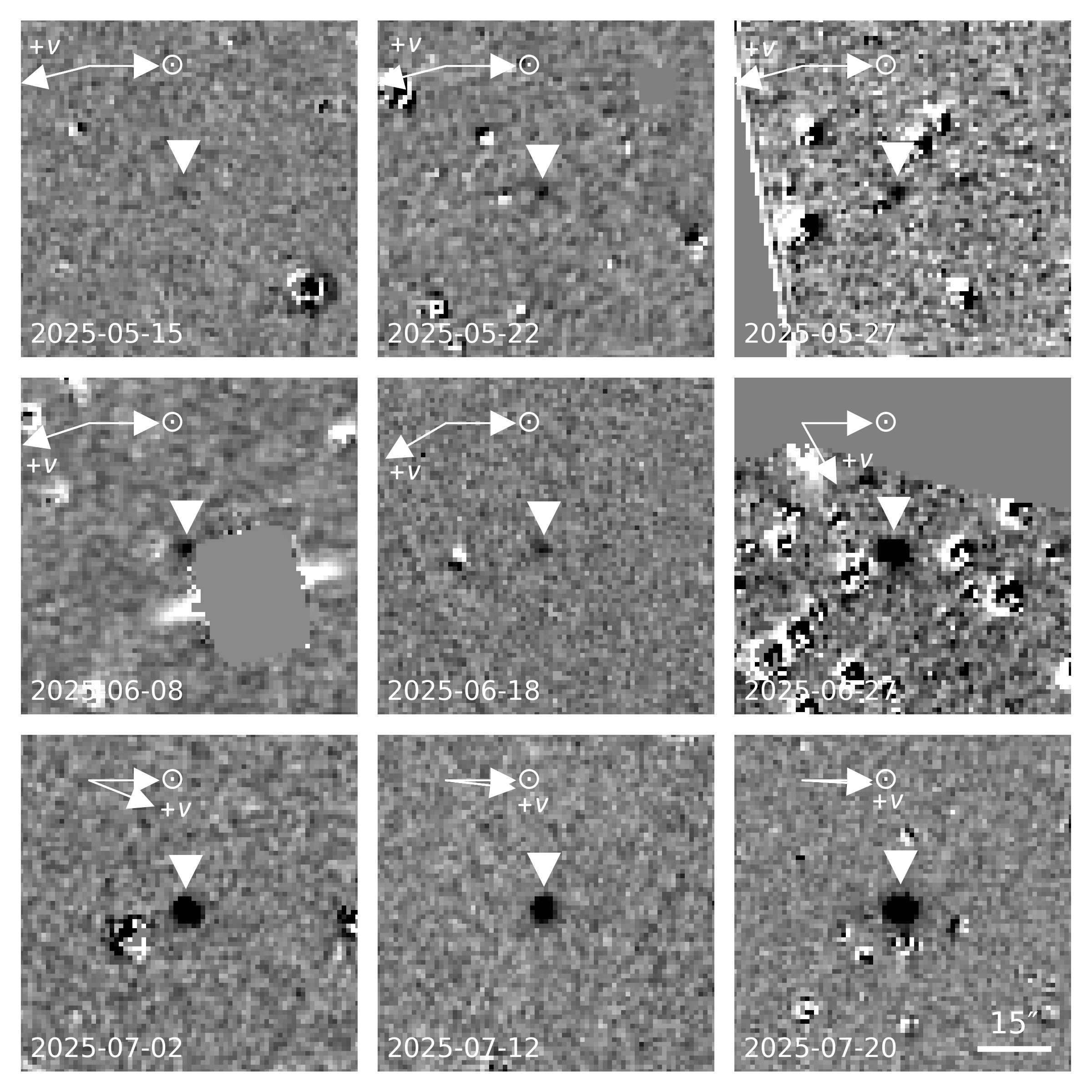
Figure 1: A selection of nightly ZTF stacks of 3I from its first detection on UT 2025 May 15 to UT 2025 July 20, with 3I marked and directional vectors indicated.
The earliest unambiguous detection of 3I/ATLAS in ZTF data occurred on UT 2025 May 15. Multi-night stacks were constructed for periods of non-detection, enabling stringent upper limits on the comet's brightness at larger heliocentric distances.
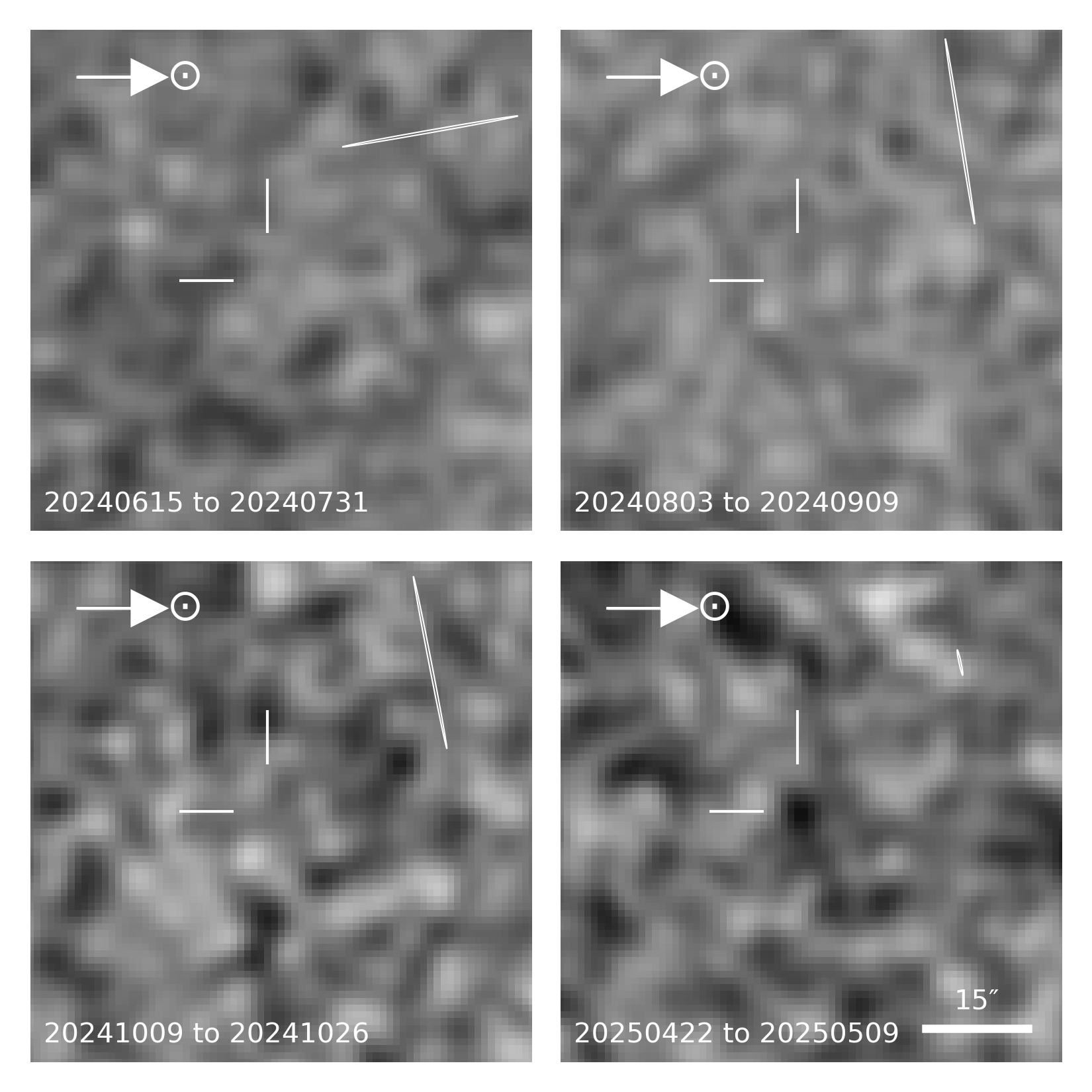
Figure 2: Multi-night ZTF stacks centered at the nominal ephemeris position of 3I from UT 2024 June 15 to UT 2025 May 9, with 3σ uncertainty ellipses.
Photometric Analysis and Lightcurve Modeling
Aperture photometry was performed using a $3''$ radius, with corrections for PSF blurring and color transformations based on a spectral slope of 18\%/100~nm. The surface brightness profile was modeled as 1/ρ, appropriate for a coma dominated by long-lived dust in constant radial outflow.
The lightcurve was fit using both a classic comet model and a bare-nucleus model. The comet exhibited a brightening rate of ∝rh−3.8, significantly steeper than 2I/Borisov (∝rh−2.1) and consistent with dynamically-old long-period and short-period Solar System comets (n∼2.5--$5.5$). The best-fit parameters were M1=9.2±0.2~mag, K1=9.5±0.3, and Hr,n=12.1±0.1~mag.
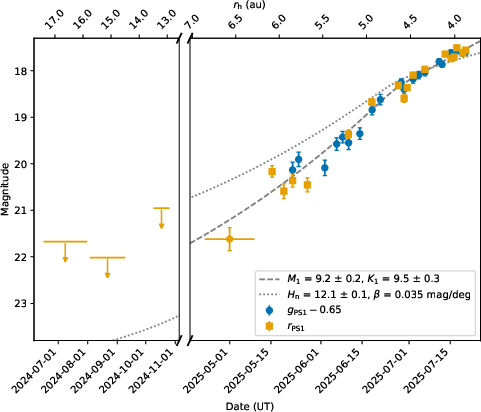
Figure 3: Best-fit lightcurve of 3I using ZTF photometry from nightly and multi-nightly stacks, with model fits for coma and nucleus.
The deviation of the bare-nucleus model from the observed data, especially early in the observing window, suggests that the measured "nucleus" magnitude is dominated by material released during early activity, not the true nucleus.
Dust Coma Evolution and Production Rates
The analysis isolated the dust coma signal by subtracting the nucleus contribution, adopting the HST-derived lower limit of HV,n>15.4~mag. The dust-to-nucleus flux ratio (Fd/Fn) increased from ∼5 to ∼15 over 50 days, with an initial plateau phase. The ZTF-derived flux ratios are consistent with Rubin Observatory measurements when accounting for differences in assumed nuclear magnitude.
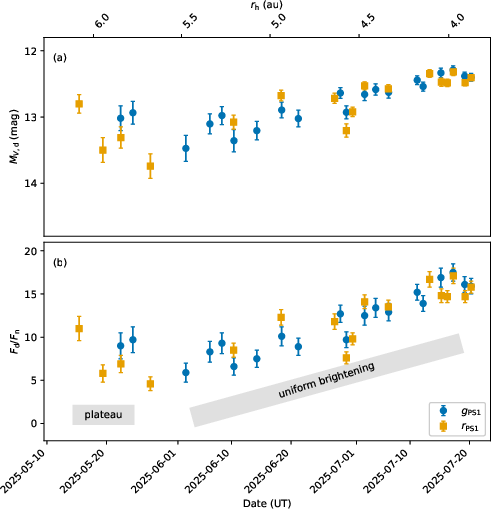
Figure 4: (a) Nucleus-subtracted V-band absolute magnitudes of 3I's excess dust; (b) dust-to-nucleus flux ratios as functions of time and heliocentric distance.
Assuming optically thin coma and 100~μm dust grains, the dust production rate increased from M˙d∼5 kg s−1 at rh=6~au to M˙d∼30 kg s−1 at rh=4~au, in agreement with HST and Rubin measurements within an order of magnitude. The onset of constant dust outflow is estimated to have occurred at rh∼9~au, coinciding with the activation distance of CO2 ice.
Constraints from Non-Detections and Comparative Photometry
Multi-night stacks from 2024 yielded 3σ upper limits of m3σlim∼21--$22$~mag, indicating no strong outbursts (Δmag≳2--$5$) at rh∼13--$17$~au. This behavior is consistent with 2I/Borisov and most long-period Solar System comets. Prediscovery photometry from ATLAS and TESS corroborates the ZTF-derived brightening rate and supports the conclusion that 3I/ATLAS did not exhibit significant activity prior to rh∼9~au.
Implications for Interstellar Comet Populations
The steep brightening rate and early onset of activity in 3I/ATLAS suggest a dynamically-old nature, possibly indicative of repeated heating episodes in its parent system or during prior stellar encounters. The lack of strong outbursts and the similarity in intrinsic brightness to 2I/Borisov reinforce the hypothesis that interstellar comets may share evolutionary pathways with dynamically-old Solar System comets. The activation of CO2 ice at large heliocentric distances is consistent with models of volatile-driven activity in both interstellar and Solar System comets.
Conclusion
The prediscovery ZTF observations of 3I/ATLAS provide robust constraints on its activity and dust production during its inbound leg. The comet was active inward of rh=6.5~au, with a brightening rate of ∝rh−3.8, consistent with dynamically-old comets. The dust production rate increased from ∼5 to ∼30 kg s−1 for 100~μm grains, matching independent measurements. No evidence for strong outbursts was found at large heliocentric distances. These results support the interpretation of 3I/ATLAS as a dynamically-old interstellar comet and provide a foundation for future comparative studies of ISO populations and their evolutionary histories.