Papers
Topics
Authors
Recent
Search
2000 character limit reached

Information Critical Phases under Decoherence

Published 26 Dec 2025 in quant-ph, cond-mat.dis-nn, and cond-mat.stat-mech | (2512.22121v1)

Abstract: Quantum critical phases are extended regions of phase space characterized by a diverging correlation length. By analogy, we define an information critical phase as an extended region of a mixed state phase diagram where the Markov length, the characteristic length scale governing the decay of the conditional mutual information (CMI), diverges. We demonstrate that such a phase arises in decohered $\mathbb{Z}{N}$ Toric codes by assessing both the CMI and the coherent information, the latter quantifying the robustness of the encoded logical qudits. For $N>4$, we find that the system hosts an information critical phase intervening between the decodable and non-decodable phases where the coherent information saturates to a fractional value in the thermodynamic limit, indicating that a finite fraction of logical information is still preserved. We show that the density matrix in this phase can be decomposed into a convex sum of Coulombic pure states, where gapped anyons reorganize into gapless photons. We further consider the ungauged $\mathbb{Z}{N}$ Toric code and interpret its mixed state phase diagram in the language of strong-to-weak spontaneous symmetry breaking. We argue that in the dual model, the information critical phase arises because the spontaneously broken off-diagonal $\mathbb{Z}{N}$ symmetry gets enhanced to a U(1) symmetry, resulting in a novel superfluid phase whose gapless modes involve coherent excitations of both the system and the environment. Finally, we propose an optimal decoding protocol for the corrupted $\mathbb{Z}{N}$ Toric code and evaluate its effectiveness in recovering the fractional logical information preserved in the information critical phase. Our findings identify a gapless analog for mixed-state phases that still acts as a fractional topological quantum memory, thereby extending the conventional paradigm of quantum memory phases.
Summary

  • The paper introduces information critical phases by revealing divergent conditional mutual information while the correlation length remains finite.
  • It employs analytical techniques and numerical phase diagrams via Kramers-Wannier duality to map transitions in Zₙ toric codes for N > 4.
  • The results imply that novel decoding protocols and fractional quantum memories can preserve logical information under decoherence.

Information Critical Phases under Decoherence

Abstract

The study explores the emergence of information critical phases within the context of decohered ZN\mathbb{Z}_{N} Toric codes, characterized by the divergence of the Markov length, even as the correlation length remains finite. This work reveals the presence of such phases in systems for N>4N>4, bridging the gap between fully decodable and non-decodable states. The paper explores the implications for quantum memory and the robust preservation of logical information in these critical phases.

Concepts and Methods

The concept of an information critical phase is introduced, defined by divergent conditional mutual information (CMI) scaling while the traditional correlation length ξ\xi remains finite. This phase distinction is leveraged in the study of ZN\mathbb{Z}_{N} Toric codes under decoherence, differing fundamentally from the singular decodability transition found in the simpler Z2\mathbb{Z}_{2} case.

Analytical techniques employed include the study of the CMI and coherent information as proxies for phase transition behavior. The analysis hinges on characterizing these phases using partition functions mapped onto disordered classical spin models along the Nishimori line.

Numerical Analysis and Phase Diagram

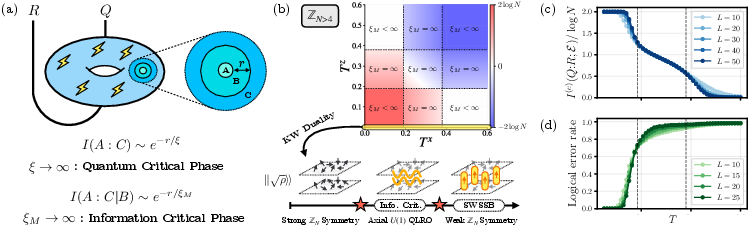
For ZN\mathbb{Z}_{N} codes with N>4N>4, the paper outlines three distinct phases: the conventional decodable and non-decodable phases, with an intervening information critical phase. The behavior within this regime is dictated by the structure of the quasi-long-range-ordered (QLRO) phase, typically associated with an emergent U(1)U(1) symmetry. Figure 1

Figure 1: Information critical phase depiction showing the divergence of Markov lengths and associated phase transitions in the ZN>4\mathbb{Z}_{N>4} toric code.

Strong-to-Weak Spontaneous Symmetry Breaking

The ungauged model's phase diagram was explored using Kramers-Wannier duality, interpreting the information critical phase as a transition to a superfluid phase. This involved the enhancement of broken ZN\mathbb{Z}_{N} symmetries to U(1)U(1) symmetries, indicating the presence of novel superfluid phases with associated gapless modes.

This section further highlights how these findings extend to novel decoding protocols which integrate minimum cost flow solutions, efficiently navigating the complex topology of the decohered state while leveraging stochastic worm algorithms to explore homological sectors.

Quantum Memory Implications

The research extends the framework of quantum memory by illustrating that mixed-state phases can function as fractional quantum memories. This phase confers robustness previously not attributed to topological quantum codes under certain decoherence regimes, suggesting that Toric codes subject to such conditions can preserve a finite fraction of logical information.

The implications of these findings are vast. They suggest new avenues for the development of quantum degenerate states deeply connected to the principles of spin-wave theories and provide a critical understanding of achievable structural encoding within a decohered environment.

Conclusion

This comprehensive exploration uncovers the complex phenomenology of information critical phases in decohered ZN\mathbb{Z}_{N} Toric codes, offering a framework for understanding these phases beyond the conventional quantum memory paradigm. The results highlight the need for revised decoding strategies tailored to these fractional-memory scenarios, ultimately advancing the theoretical underpinnings of quantum decoherence and memory in complex systems.

Paper to Video (Beta)

No one has generated a video about this paper yet.

Whiteboard

No one has generated a whiteboard explanation for this paper yet.

Open Problems

We haven't generated a list of open problems mentioned in this paper yet.

Authors (2)

Collections

Sign up for free to add this paper to one or more collections.

Tweets

Sign up for free to view the 1 tweet with 0 likes about this paper.