- The paper demonstrates that leveraging PoS subnets anchored to Bitcoin improves throughput and reduces fees by up to 23× compared to traditional L1 and L2 approaches.
- The paper details an architecture that integrates commit-reveal schemes, SegWit, and efficient data batching to securely enable cross-subnet transactions.
- The paper validates its design with benchmarks showing a potential scalability improvement to 160+ tps and significant vbyte cost reductions through optimized batching.
Scaling Bitcoin via Proof-of-Stake Subnetworks: The Bitcoin-IPC Protocol
Introduction and Motivation
The inherent scalability bottleneck of Bitcoin L1, capped at approximately 7 transactions per second (tps), precludes its practical use as a global medium of exchange. While existing L2 solutions, primarily the Lightning Network (LN) and numerous independent L2 chains, offer increased throughput, these approaches suffer from either liquidity reservation constraints, lack of rich programmability, or problematic interoperability and non-uniform security postures. The "Bitcoin-IPC: Scaling Bitcoin with a Network of Proof-of-Stake Subnets" (2512.23439) introduces Bitcoin-IPC, a protocol and software stack that enables permissionless instantiation of fully programmable, interoperable L2 subnets backed by PoS, with stake denominated in L1 BTC, all without enacting modifications to the Bitcoin protocol. Critical operations such as cross-subnet value transfer, security checkpointing, and validator dynamic participation are explicitly anchored to Bitcoin L1, ensuring composable security and robust auditability.
Architecture Overview
An IPC-aware node encapsulates several key subsystems: the Bitcoin Core full node, a chain monitor, a command provider interfacing with Bitcoin on-chain operations, the filecoin-derived Fendermint PoS validator implementation, a relayer for state bridging, and user/developer tooling (ipc-cli).
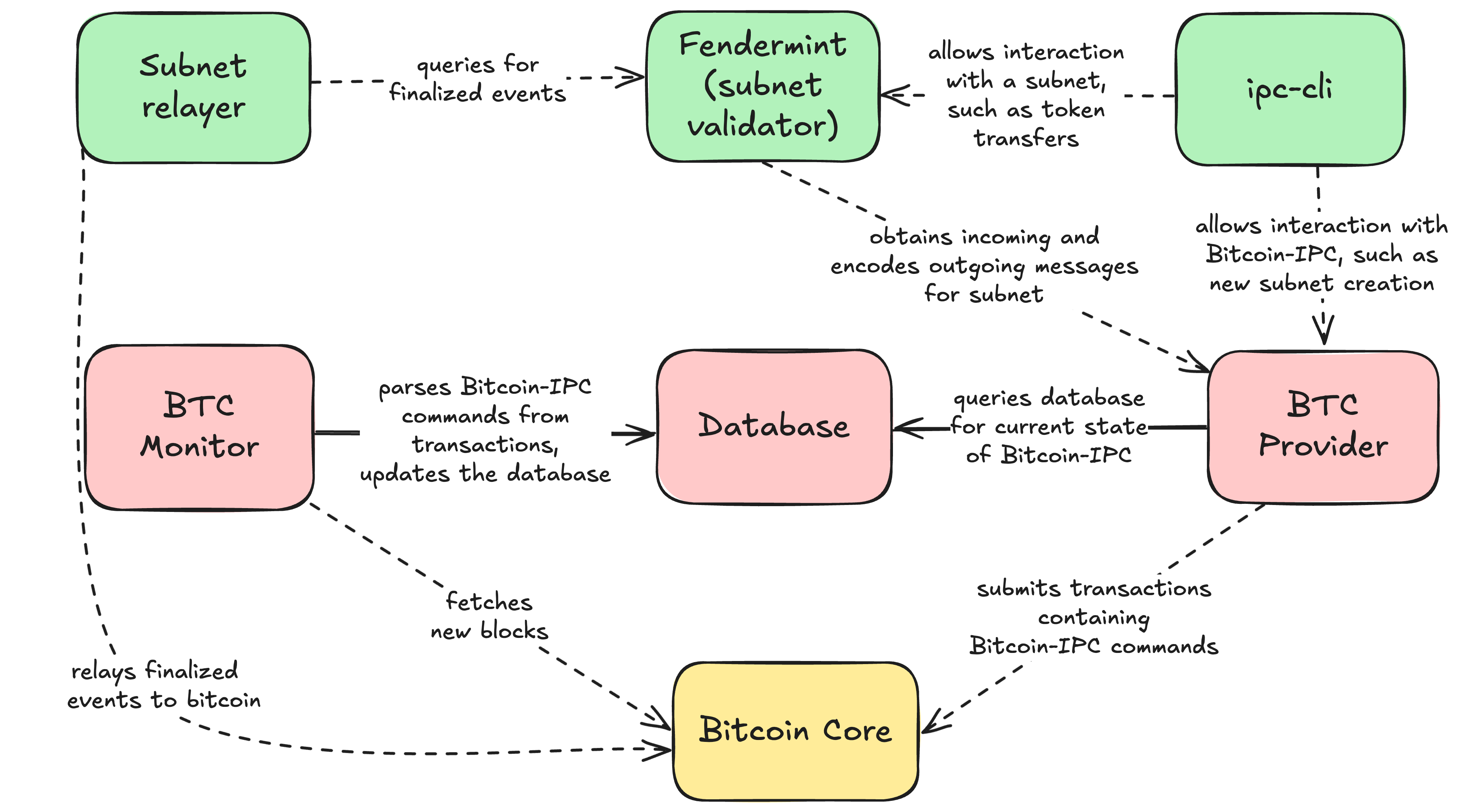
Figure 1: Component architecture of an IPC-aware node, detailing local and RPC-based communication pathways between Bitcoin Core, IPC subnet validators, and relayers.
Subnet Structure and Lifecycle
Subnets are instantiated via consensus over a whitelist and collateralized threshold, support dynamic validator set membership, and support arbitrary EVM-compatible smart contracts. The subnet lifecycle includes initialization, validator participation (join/leave/stake/unstake), checkpointing, and (optionally) orderly shutdown with collateral release.
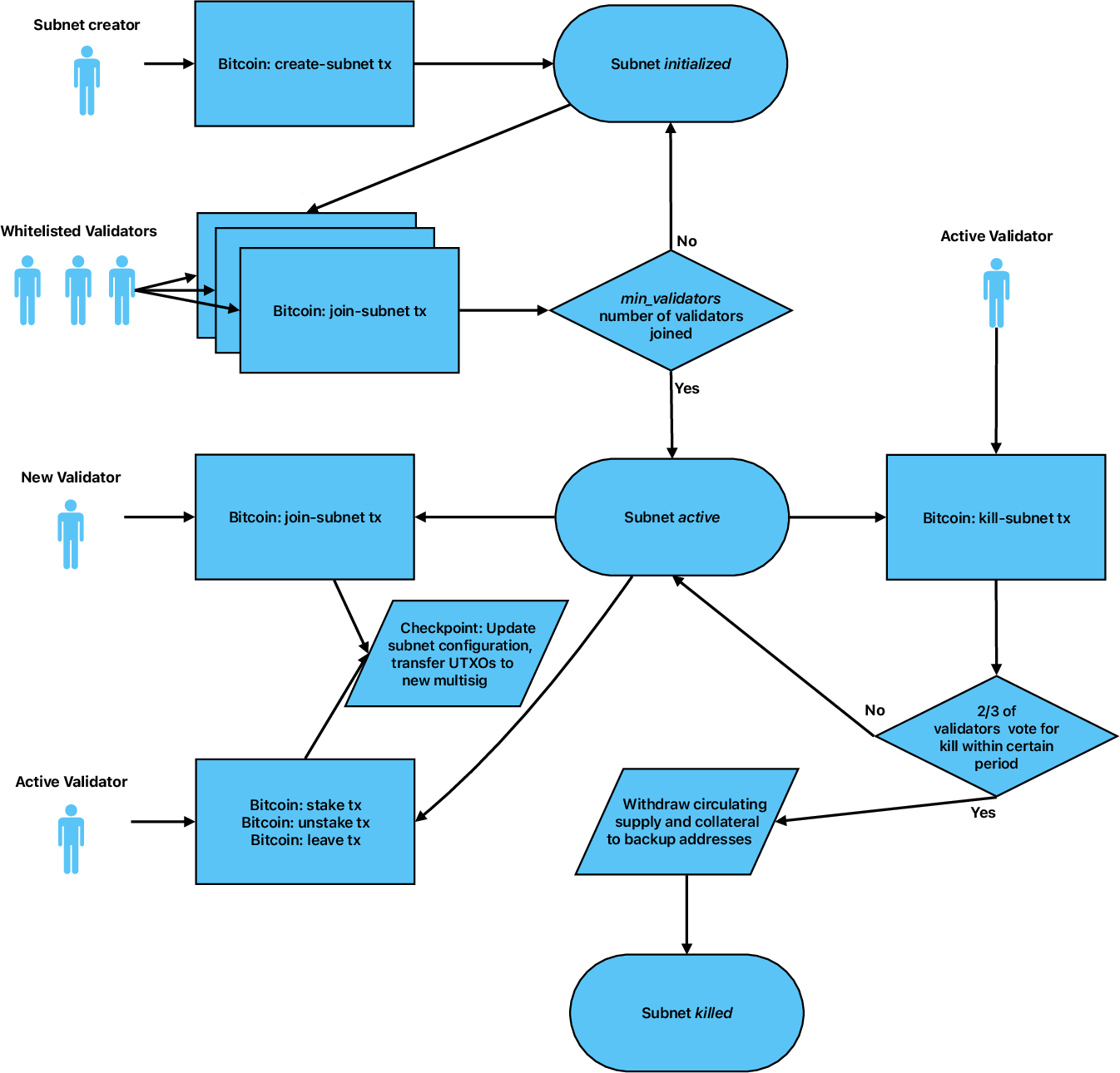
Figure 2: The lifecycle state flow showing subnet creation, activation, validator changes, and termination transitions.
Subnet parameters include validator thresholds, minimum collateral, checkpoint intervals, and optional subnet-specific parameters. A subnet is addressable via a unique identifier derived from the creating Bitcoin transaction, maintaining hierarchical composability for L3+ deployments.
Secure PoS Interoperable Subnets over Bitcoin
The protocol leverages Bitcoin scripting primitives (SegWit and OP_RETURN) and an efficient commit-reveal scheme to encode arbitrary subnet operations directly in Bitcoin transactions. Specifically, the commit phase locks collateral via a P2TR script, and the reveal phase triggers subnet activation by providing full parameter disclosure in the witness field, enabling operation auditability and censorship resistance.
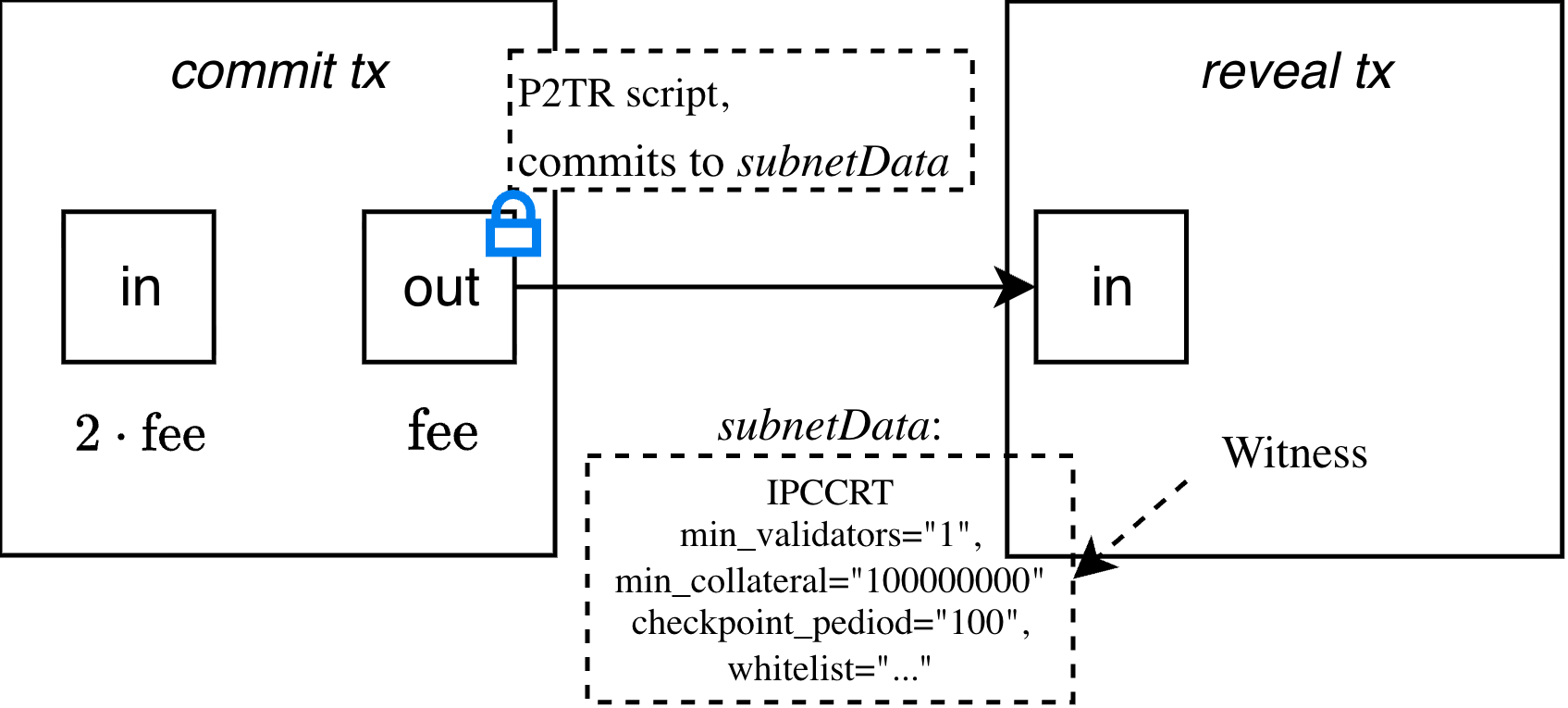
Figure 3: Transactional commit-reveal sequence for creating a subnet, including the encoding of subnet metadata and resource commitment via P2TR script and reveal.
Batching and Communication Patterns
Transfers across subnets are aggregated and represented as minimal data commitments utilizing the discounted witness structure (via SegWit), enabling up to 16,500 distinct value transfers per Bitcoin transaction batch. Withdrawal operations are similarly batched, and all inter-subnet coordination is ultimately mediated by periodic L1 checkpointing.
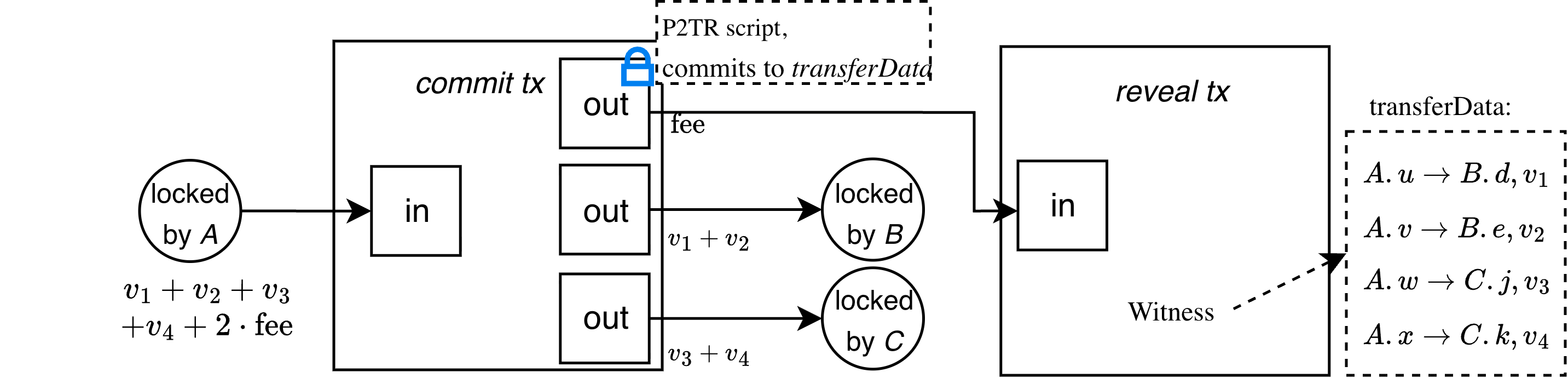
Figure 4: Amortized transfer mechanism via checkpointed and batch transfer transactions, illustrating the grouping of cross-subnet messages.
Amortization and Transfer Efficiency
Experiments demonstrate that as the number of transfers per batch increases, the amortized vbyte cost per transfer drops sharply, converging to approximately 6.1 vB in large batches, compared to 141 vB for native L1 operations—a 23× improvement. The break-even for cost/efficiency occurs with as few as 3–4 transfers per batch. Multiple subnets incrementally increase overhead, but the gains persist at scale.
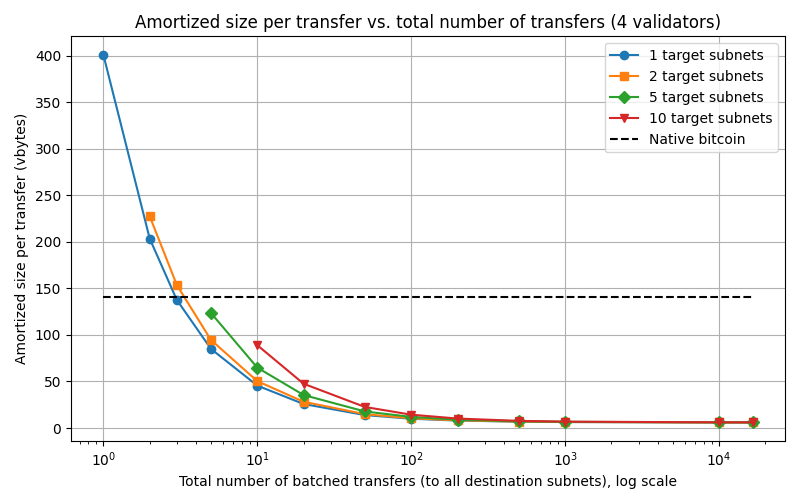
Figure 5: Amortized transaction size per transfer as a function of batch size and number of target subnets.
Validator set size affects the cost of checkpointing due to multi-sig signature payloads, though future work targets threshold signatures to minimize this dependence and further compress cost per transfer at larger validator counts.
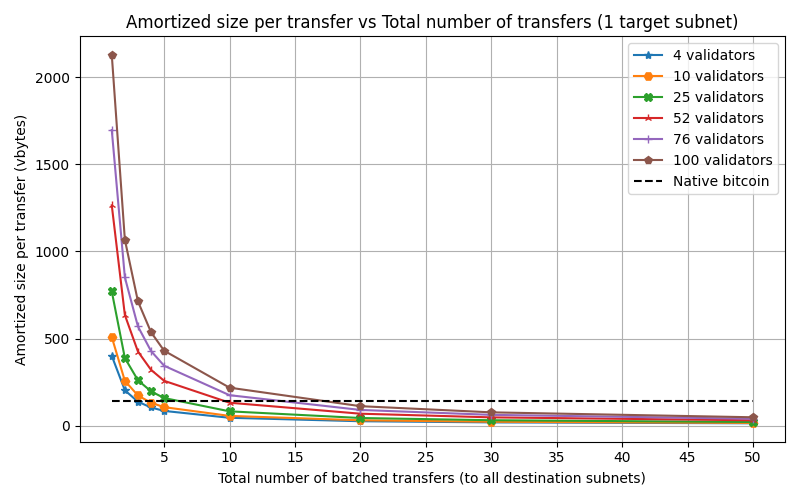
Figure 6: Amortized transfer size dependency on validator set cardinality.
Maximum Throughput
Given the maximum permissible transaction size and Bitcoin's network throughput, the protocol supports over 160 tps of settleable transfers when batching is maximized, a radical improvement compared to L1 limitations.
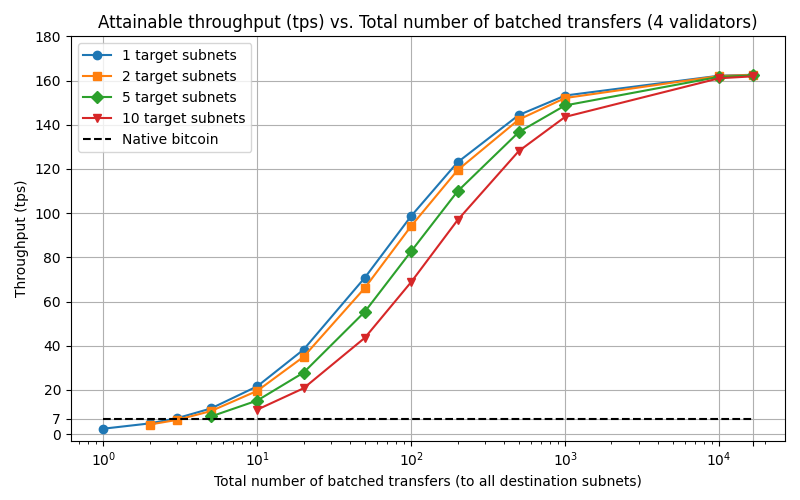
Figure 7: Maximum achievable system throughput as a function of batch size and subnet topology.
Economic Implications
Given typical fee rates, the fee per transfer decreases from $28,200$ satoshis for a direct L1 transfer to $1,214$ satoshis (or less than 5% of standard L1 costs) for highly batched transfers via Bitcoin-IPC. These reductions have substantial implications for adoption in high-volume transactional environments.
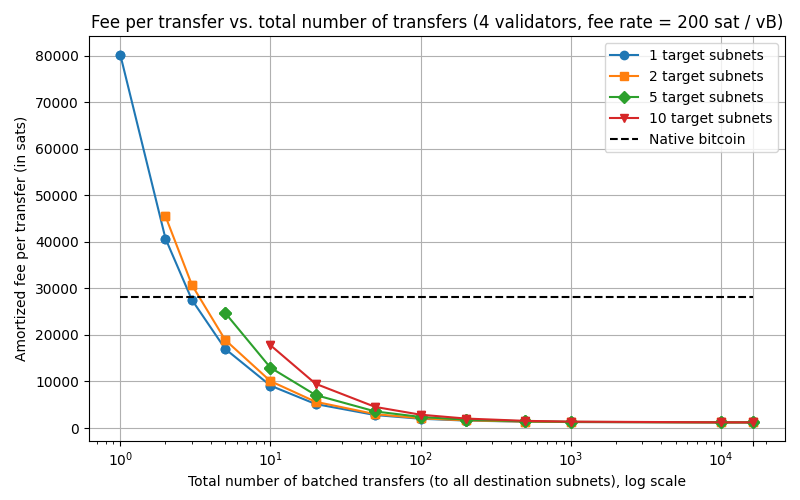
Figure 8: Fee per transfer as a function of batch size and target subnet count.
Withdrawals and Checkpointing
Withdrawals, natively non-batchable in L1, benefit from protocol-enabled batching, achieving amortized withdrawal costs under 44 vB. Checkpointing overhead is also quantified, showing minimal daily size/fee impact for reasonable checkpoint periods.
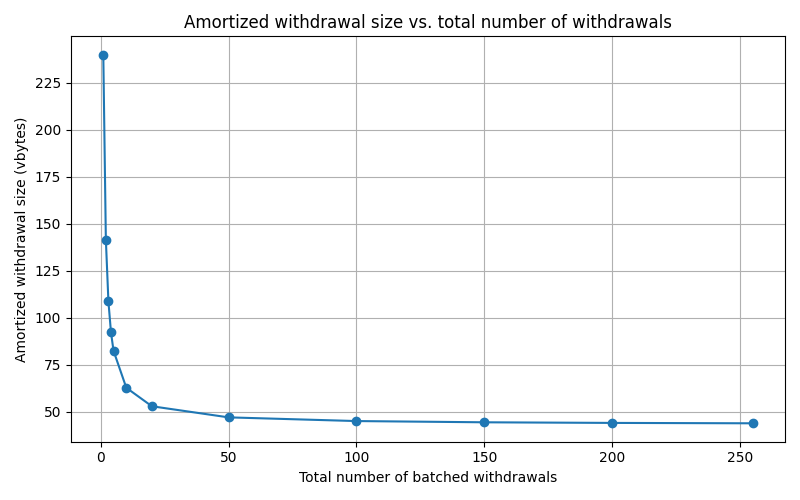
Figure 9: Amortized withdrawal size per operation vs. batch size.
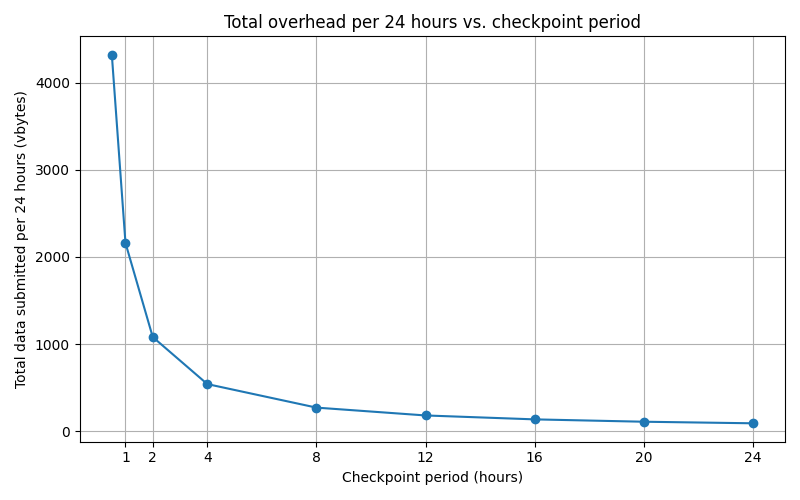
Figure 10: Checkpoint overhead tradeoff as a function of checkpoint frequency.
Composability, Interoperability, and Programmability
Subnets utilize EVM-compatible execution (via Fendermint and Filecoin VM), enabling complex programmable assets (RWAs, stablecoins, etc.). The protocol enables dynamic, permissionless subnet creation and robust cross-subnet transfers with no changes to Bitcoin consensus code. The explicit design for interoperability eliminates fragmentation issues endemic to current L2 ecosystems and obviates the need for trust-minimized bridges.
Security and Trust Model
Each subnet is secured by PoS (collateralized in BTC), with dynamic validator changes confirmed on L1; consensus security is combinatorially reduced to that of underlying L1 Bitcoin, assuming at least $2/3$ stake honesty per configuration. Long-range and related attacks are mitigated by L1-anchored checkpointing, following the paradigm of securely anchoring PoS chain state to PoW roots.
Future Developments and Broader Impact
Upcoming protocol enhancements include the integration of threshold signature schemes to supplant N-of-M multisig overhead, streamlining both transaction size and operational robustness [(2512.23439), AzouviV22]. Incentivization via native protocol tokenomics for participation, configurable privacy enhancements, and adaptive coin selection logic also form part of the forward roadmap. The architecture supports extensibility to L3+ hierarchical subnetworks, and can be leveraged for various institutional use cases (e.g., national banks, ETFs).
The system’s generalizability establishes a framework for scalable, permissionless, non-custodial extension of base-layer PoW chains with programmable, high-throughput L2s, potentially redefining how programmable overlays are built atop major cryptocurrencies.
Conclusion
Bitcoin-IPC (2512.23439) constructs the first protocol, implementation, and benchmarked stack for scalable, programmable, and interoperable Bitcoin L2 subnets using a PoS architecture with BTC as stake. By coupling multidimensional batching, commit-reveal data encoding, and composition with security via Bitcoin-anchored checkpointing, Bitcoin-IPC demonstrates more than an order-of-magnitude step-function improvement over existing L1 and L2 mechanisms—without requiring consensus changes or trust-minimized bridges. The protocol’s rigorous treatment of operational, economic, and security concerns positions it as a feasible architectural direction for scaling decentralized financial primitives on Bitcoin and likely serves as a reference point for further L1-anchored multi-chain system designs.