- The paper demonstrates that capacitive design can yield ZZ interaction strengths exceeding 350 MHz, enabling dynamical blockade between transmon qubits.
- It employs detailed spectroscopic and time-domain measurements alongside circuit quantization to validate blockade dynamics and quantify interaction effects.
- This approach offers scalable implications for global control techniques and robust suppression of crosstalk in superconducting quantum architectures.
Experimental Observation of Dynamical Blockade Between Transmon Qubits via ZZ Interaction Engineering
Introduction
This paper presents a systematic experimental study on the engineering of strong longitudinal (ZZ) coupling between transmon qubits, achieved exclusively by capacitive design. The primary result is the demonstration that capacitive coupling can yield ZZ interaction strengths (ζ) exceeding 350 MHz, more than an order of magnitude larger than previous reports for similar architectures. When operating in this regime, excitation of one qubit dynamically inhibits excitation of its neighbor—a manifestation of the "dynamical blockade" analogous to the well-known Rydberg blockade in atomic systems. The authors provide thorough characterization via spectroscopy and time-domain measurements, theoretical modeling including perturbative and circuit quantization approaches, and discuss implications for scalable quantum information architectures that exploit globally controlled cooperative dynamics.
Device Design and Experimental Methodology
The study utilizes two devices, each composed of two capacitively coupled, flux-tunable transmon qubits. Architecture highlights include independent flux biasing, dedicated microwave control lines, and individual readout resonators for each qubit, analyzed via heterodyne detection. Engineering focus is placed on maximizing the direct mutual capacitance (C12), with optimized design values yielding exchange couplings (J/(2π)) around 240 MHz. The first device employs circular-pad transmons; the second uses X-mon geometry and serves to corroborate blockade phenomena. Device parameters such as transition frequencies ($6.3$–$9.2$ GHz), anharmonicities (−312 to −351 MHz), and coherence times (T1, T2echo up to 9μs) are in the standard range for high-coherence superconducting circuits.
The experimental setups are extensively filtered, attenuated, and electromagnetically shielded to suppress noise and achieve high-fidelity measurement (Figure 1).
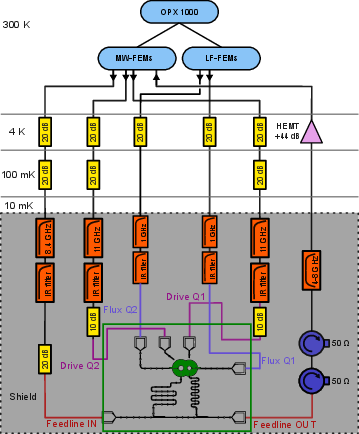
Figure 1: Schematic of the cryogenic measurement setup, showing extensive filtering and shielding for both drive, flux, and readout lines.
Spectroscopic Characterization of ZZ Interaction
The capacitively engineered coupling produces an effective two-qubit Hamiltonian with a cross-Kerr interaction:
Hint=4ζ(Δ)σz(1)σz(2),
where ζ is a function of the bare qubit detuning Δ=ω1−ω2. Spectroscopy measurements determine the conditional transition frequencies of each qubit, extracting ζ as the frequency offset when the partner qubit is excited:
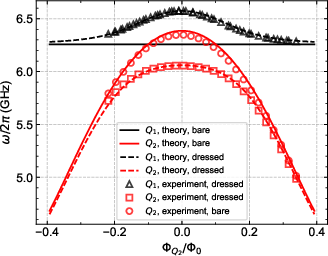
Figure 2: Excitation spectra for Q1, Q2 vs. flux, showing deviation of dressed qubit transition frequencies due to strong exchange interaction J and longitudinal shift ζ.
The dependence of ζ on qubit detuning is strictly monotonic, increasing from $10$ MHz at Δ/(2π)≈2 GHz to $350$ MHz near resonance, with Ramsey and echo protocols confirming the extracted values. Time-domain measurements further validate these findings for ζ up to $125$ MHz, constrained by experimental electronics.
Demonstration of Dynamical Blockade
The strong longitudinal coupling enables exploration of blockade physics. By applying controlled π-pulses with variable delay, the excitation probability of one qubit is shown to be suppressed when its partner is already excited—a direct signature of energy penalty for doubly excited states (Figure 3). Suppression efficiency depends sharply on pulse spectral width relative to ζ; only spectrally narrow pulses (long duration) robustly suppress excitation via blockade.
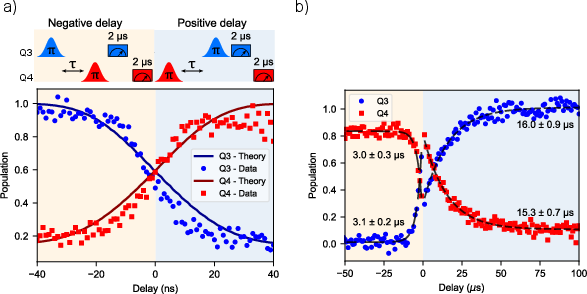
Figure 3: Q3 (blue) and Q4 (red) excited state populations versus relative delay; excitation of one qubit blocks population of the other for positive delays due to strong ZZ coupling ζ/(2π)=20 MHz.
Measurements of populations at longer time delays (microseconds) demonstrate relaxation dynamics consistent with the measured T1 of the blockading qubit, confirming the robustness of the blockade against decoherence.
Theoretical Modeling and Circuit Quantization
Theoretical analysis combines perturbative techniques and black-box quantization. In the dispersive regime, virtual excitations to non-computational states (∣20⟩, ∣02⟩) mediate the ZZ interaction. Schrieffer-Wolff analysis yields the effective coupling:
ζ≃2g2(Δ+∣α2∣1−Δ−∣α1∣1).
Circuit quantization, employing Foster network synthesis and mode truncation, yields parameters in excellent agreement with measurement, demonstrating that simple capacitance engineering suffices to enter the regime where ZZ dominates over both Rabi drive and intrinsic anharmonicity.
Simulation of Blockade Dynamics
Numerical solution of the driven effective Hamiltonian,
H^block=ζ∣11⟩⟨11∣+i=1∑22Ωi(t)σx(i),
consistently reproduces the blockade dynamics observed in experiments (Figure 4 and Figure 5). Simulations quantify the sensitivity of blockade efficiency to pulse shape, spectral leakage, and residual exchange errors.
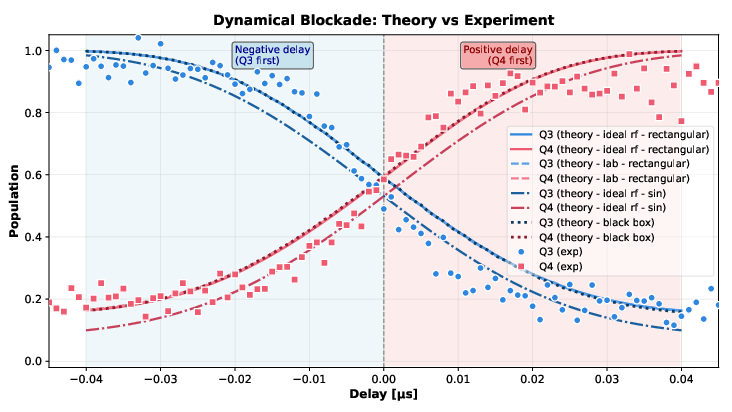
Figure 4: Experimental and modeled qubit population dynamics in the blockade regime, showing protocol dependence on pulse shaping and inclusion/exclusion of residual XX+YY terms.
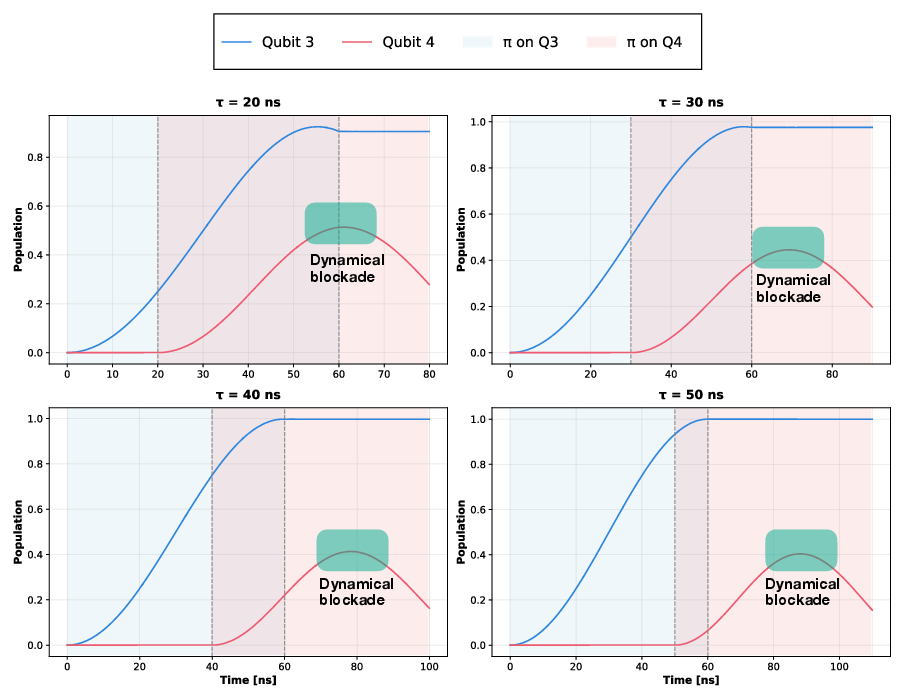
Figure 5: Time-resolved simulation of blockade population inversion for various positive delay times, indicating the inability of the second qubit to get excited due to ZZ-induced detuning.
Implications and Prospects for Quantum Architectures
The observed dynamical blockade demonstrates that superconducting circuits can access interaction-dominated regimes previously associated primarily with atomic, especially Rydberg, platforms. This enables solid-state realizations of constrained dynamics, collective blockade effects, and global control protocols that eschew per-qubit microwave wiring. Notably, the engineered ζ routinely exceeds typical drive amplitudes and anharmonicities, providing a robust method for suppressing simultaneous multi-qubit excitations and crosstalk.
These results impact architecture design by suggesting that:
- Global control schemes are feasible, reducing hardware complexity and wiring bottlenecks.
- Many-body simulation of constrained models and long-range interactions in superconducting circuits is achievable.
- Gate-design strategies may leverage strong longitudinal coupling for novel protocols rather than treating it as a parasitic error source.
Future directions include extending blockade phenomena to larger arrays or lattices, which can realize collective suppression, facilitate entangled state preparation, and broaden the suite of Hamiltonians accessible for NISQ-era simulation. Additionally, the methods introduced for capacitive engineering and circuit quantization present practical tools for scalable integration while maintaining strong, controllable interactions.
Conclusion
This work establishes capacitive ZZ engineering as a viable and scalable route to entering the strong-interaction, blockade regime in superconducting qubit architectures. The dynamical suppression of excitation, direct agreement between experiment and theory, and clear scalability implications mark a significant advance for solid-state quantum simulation and cooperative computing models. Capacitive longitudinal coupling, long viewed as a nuisance in superconducting hardware, becomes in this context an enabling resource for future architectures leveraging global control and interaction-induced constraints.