- The paper develops a unified semiclassical theory showing extrinsic mechanisms, such as side-jump and skew-scattering, dominate nonlinear Nernst and Seebeck responses.
- It provides closed-form band-geometric expressions and a detailed symmetry analysis to distinguish intrinsic from extrinsic contributions in thermoelectric transport.
- Numerical results in ABA trilayer graphene reveal that skew-scattering peaks about 20 times higher than side-jump, aligning well with experimental detection thresholds.
Asymmetric Scattering and Nonlinear Thermoelectricity: Dominant Extrinsic Mechanisms in ABA Trilayer Graphene
Overview
The paper "Asymmetric Scattering Drives Large Nonlinear Nernst and Seebeck Effects" (2601.17775) develops a unified semiclassical theory for nonlinear Nernst (NNE) and Seebeck (NSE) effects by systematically incorporating both intrinsic and extrinsic mechanisms, emphasizing the critical role of asymmetric impurity scattering. The framework highlights that in non-magnetic systems, extrinsic contributions—specifically, side-jump and skew-scattering processes—dominate the nonlinear thermoelectric response, a finding quantitatively validated for ABA-stacked trilayer graphene (TLG). The formalism provides closed-form, band-geometric expressions for all contributions and rigorously analyzes symmetry constraints, offering both physical insight and practical avenues for material optimization.
Unified Semiclassical Theory and Breakdown of Thermoelectric Response
The manuscript constructs a detailed semiclassical Boltzmann-like kinetic theory for nonlinear thermoelectric transport in the presence of disorder. It generalizes previous treatments by including all extrinsic (disorder-induced) asymmetric scattering channels beyond the symmetric-scattering approximation. The central result is the identification and explicit derivation of six distinct second-order (quadratic in ∇T) response channels:
- Intrinsic Channels: Nonlinear Drude (ND) and Berry curvature–driven Berry-curvature-dipole (NA) contributions.
- Extrinsic Channels: Side-jump (NSJ), skew-scattering (NSK), and hybrid Berry-curvature–side-jump (NASJ) and Berry-curvature–skew-scattering (NASK) channels.
The full response tensor is summarized as follows:
| Contribution |
Intrinsic/Extrinsic |
Mechanism |
NNE/NSE Presence |
Berry Curvature Dependence |
Symmetry Restrictions |
| ND |
Intrinsic |
Drude |
NSE |
No |
Parity required |
| NA |
Intrinsic |
Berry-dipole |
NNE |
Yes |
|
| NSJ |
Extrinsic |
Side-jump |
NNE, NSE |
Yes |
|
| NSK (3rd,4th order) |
Extrinsic |
Skew-scattering |
NNE, NSE |
Yes |
|
| NASJ |
Extrinsic |
Berry + SJ hybrid |
NNE |
Yes |
|
| NASK |
Extrinsic |
Berry + SK hybrid |
NNE |
Yes |
|
Four of these channels—two side-jump and two skew-scattering—are genuinely extrinsic and had not been fully unified in previous treatments of nonlinear thermoelectric transport.
The extrinsic mechanisms are rigorously shown, via explicit derivations, to be universally governed by the Berry curvature of the host band structure, establishing a precise geometric origin even for disorder-driven effects.
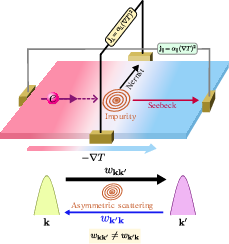
Figure 1: Schematic illustration of extrinsic nonlinear Nernst and Seebeck effects. The quadratic dependence on thermal gradient and the role of asymmetric impurity scattering are illustrated.
Symmetry Analysis and Constraints
A comprehensive symmetry analysis is carried out, examining the transformation properties of each constituent (velocity, Berry curvature, side-jump, scattering rate) under inversion (P) and time-reversal (T) operations. The theories identify which response channels are symmetry-allowed in a given material class:
- Inversion symmetry forbids all nonlinear conductivities; noncentrosymmetric materials are necessary.
- In time-reversal-symmetric, inversion-broken (e.g., ABA-TLG, TRS nonmagnetic) systems: ND, NSJ, NSK, and NA survive; NASJ and NASK require simultaneous P, T breaking.
- Enhanced responses are expected in nearly C3-symmetric systems, in line with the low-symmetry constraints of ABA-TLG.
Band-Geometry Dependence and Microscopic Origin
The paper presents explicit, gauge-invariant analytic connections between side-jump velocity/skew-scattering rates and the Berry curvature, for realistic disorder models (short-range impurities). The skew-scattering contribution is decomposed into third- and fourth-order Born approximations, and the resulting extrinsic response functions are shown to scale with Berry curvature and local density of states:
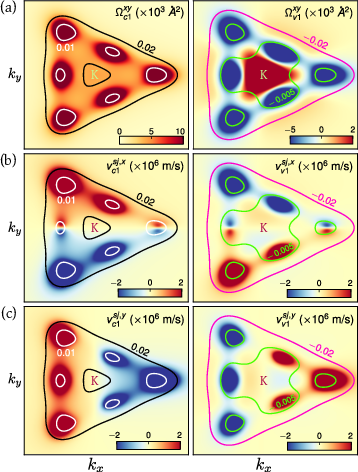
Figure 2: Momentum-space distribution of Berry curvature and side-jump velocity in ABA-TLG, showing the close spatial correlation of Berry curvature hotspots and extrinsic velocities near the Dirac points.
These compact expressions are computationally efficient and directly link extrinsic transport to underlying band topology.
ABA Trilayer Graphene: Model System and Numerical Results
The formalism is applied explicitly to ABA-stacked trilayer graphene, which preserves time-reversal symmetry but lacks inversion. The full tight-binding band structure, Berry curvature hotspots, and density of states are computed using realistic parameters. The Dirac points (K, K′) are shown as intense Berry curvature sources, critical for transport.
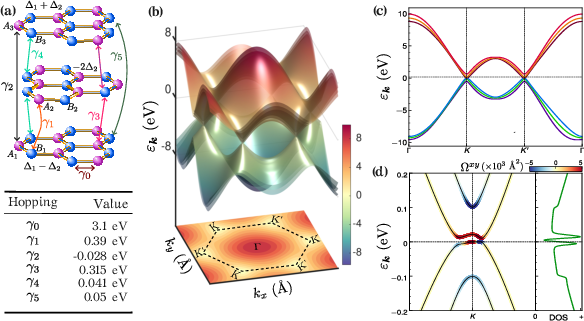
Figure 3: Lattice, bands, and Berry curvature of ABA-TLG, with strong hotspots at charge neutrality and van Hove singularities in the DOS.
The nonlinear Nernst and Seebeck conductivities, resolved by physical origin, are computed as a function of chemical potential and temperature.
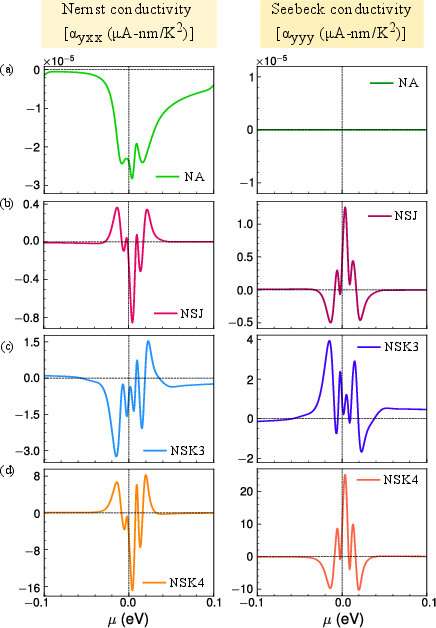
Figure 4: Calculated chemical-potential dependence of nonlinear Nernst and Seebeck conductivities—extrinsic (NSJ, NSK) components dominate near the charge-neutrality point.
Key quantitative results:
Physical Mechanism and Design Principles
Dimensional analysis reveals the scaling of conductivity ratios with scattering time and impurity parameters. For realistic disorder strengths, the enhancement of NSK over NSJ is traced to the prefactor structure and intrinsic C3 band geometry. The theory thus enables explicit design guidance—optimizing disorder type and symmetry can maximize extrinsic nonlinear response.
Crystalline symmetry analysis (especially nearly C3-symmetric systems like ABA-TLG) restricts possible tensor elements, but the slight breaking in realistic TLG leads to finite, symmetry-allowed responses closely matching experiment.
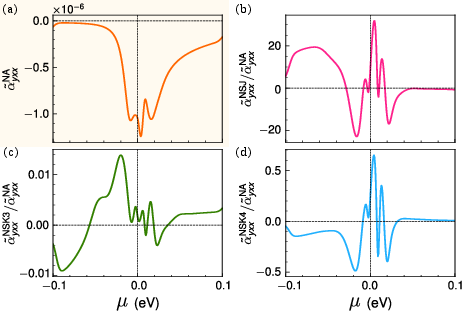
Figure 6: Scaled, dimensionless nonlinear anomalous, side-jump, and skew-scattering conductivities, highlighting intrinsic mechanisms of enhancement set by band geometry and disorder.
Implications and Future Directions
The theoretical framework unifies intrinsic and extrinsic nonlinear thermoelectricity, clarifies the dominant mechanisms in realistic materials, and demonstrates the central role of band geometry even for disorder-driven effects. Practically, the findings establish ABA-TLG as a high-performance, magnetic-field-free platform for nonlinear thermoelectric devices, and suggest general criteria for material selection:
- Noncentrosymmetric, TRS-preserving systems with large Berry curvature hotspots accessible near the Fermi level.
- Nearly C3-symmetric van der Waals multilayers and engineered moiré heterostructures.
- Control of disorder (type and density) provides a tunable handle on device response.
The comprehensive symmetry and scaling analysis lays the groundwork for further discoveries in nonlinear caloritronics, transverse thermoelectric generation, and the exploration of hybrid topological-magnetic systems where new symmetry-allowed channels (NASJ, NASK) can be targeted.
Conclusion
This work delivers a rigorous, unified theory linking band geometry and impurity scattering to all nonlinear second-order thermoelectric effects, resolving the microscopic mechanisms underlying giant Nernst and Seebeck signals in non-magnetic systems like ABA-TLG (2601.17775). The quantitative agreement with experiment confirms the physical picture and provides compelling design principles for next-generation thermoelectric and spin-caloritronic devices.
Figure 1: Schematic illustration of extrinsic nonlinear Nernst and Seebeck effects—nonlinear response (proportional to (∇T)2) emerges from asymmetric impurity scattering in the absence of magnetic order.
Figure 3: Lattice structure, electronic bands, and Berry curvature hotspots of ABA-TLG—essential band-geometric ingredients for giant nonlinear thermoelectricity.
Figure 2: Momentum-space pattern of Berry curvature and associated side-jump velocity—extrinsic mechanisms inherit Berry curvature structure.
Figure 4: Numerical calculations: nonlinear Nernst and Seebeck conductivities (dominated by extrinsic mechanisms) show strong enhancement near charge neutrality.
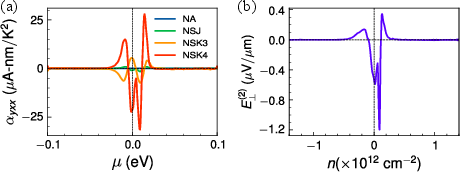
Figure 5: Electric field from nonlinear Nernst current as a function of carrier density, demonstrating direct correspondence with experimental observables.
Figure 6: Scaling analysis: dimensionless nonlinear conductivities vs. chemical potential, quantifying the dominance of extrinsic skew-scattering channels set by disorder and band structure.